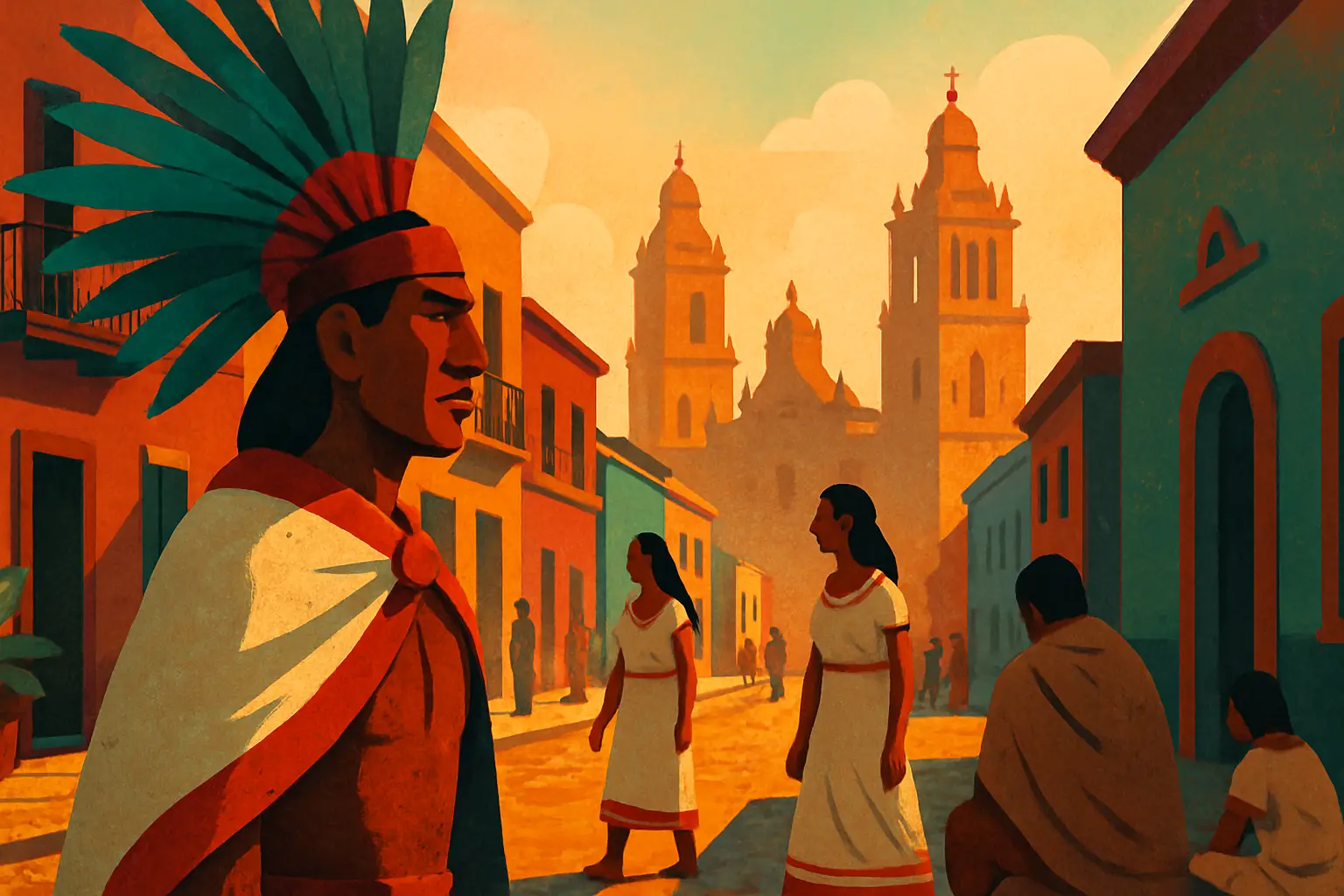
The fall of the Aztec empire is often described as a Spanish military victory. The more accurate description is a coalition victory — and a biological catastrophe. Hernán Cortés arrived in 1519 with approximately 500 soldiers. By the time Tenochtitlán fell in August 1521, his effective fighting force numbered in the tens of thousands — primarily indigenous allies, most importantly the Tlaxcalans, who had resisted Aztec domination for generations and saw the Spanish as an opportunity to destroy their oppressors. Simultaneously, a smallpox epidemic introduced by Spanish contact swept through central Mexico in 1520–1521, killing an estimated 30–50% of the population. Tenochtitlán's last ruler, Cuauhtémoc, was captured attempting to flee the destroyed city by canoe on the night of August 13. The city itself was in ruins — the 75-day siege had destroyed most of it, and the Spanish systematically demolished what remained to build the colonial capital on the same site. What ended was the Aztec state and its political structures. The people who had built it were still there.
The 'Spanish' army that took Tenochtitlán was majority indigenous — Tlaxcalans, Texcocans, and dozens of other anti-Aztec allies
Smallpox killed 30–50% of central Mexico's population in 1520–1521 — the conquest was partly a biological catastrophe
Cuauhtémoc captured August 13, 1521 — the last tlatoani (ruler) of Tenochtitlán, tortured for the location of the Aztec treasury, executed in 1525
The century following the conquest was a demographic catastrophe for the indigenous population of central Mexico. A series of epidemic waves — smallpox (1520), measles (1531), typhus (1545–48), measles again (1576) — killed an estimated 80–90% of the pre-conquest population within 100 years. Central Mexico's population may have fallen from 20–25 million in 1519 to 1–2 million by 1620. This was not primarily the result of direct Spanish violence — it was the consequence of the indigenous population's complete lack of immunity to Old World diseases. The surviving Mexica population was subjected to the encomienda system — a forced labor regime in which Spanish colonists were granted rights over indigenous communities' labor. The tribute system that had operated under the Aztecs was largely preserved, with the beneficiaries changed from the Aztec state to Spanish encomenderos. The physical infrastructure of Tenochtitlán was dismantled — the stones of the Templo Mayor used to build the Catedral Metropolitana — but the indigenous population rebuilt and inhabited the colonial city. Mexico City's historic center was a predominantly indigenous city for most of the colonial period.
80–90% demographic collapse within 100 years of contact — primarily from epidemic disease, not direct violence
Central Mexico: estimated 20–25 million people in 1519, 1–2 million by 1620 — one of history's greatest demographic catastrophes
The encomienda system: forced labor with changed beneficiaries — the tribute structure the Aztecs had used, redirected to Spanish colonists
Get short, interactive stories that make each place easier to remember while you travel.
One of the most important and least-known facts about what happened to the Aztecs is that their language survived the conquest and remained dominant in central Mexico for over a century. Spanish missionaries — recognizing that conversion required communication — learned Nahuatl rather than expecting indigenous populations to learn Spanish. The Franciscan friar Bernardino de Sahagún compiled the Florentine Codex in Nahuatl, producing the most important single document about Aztec civilization. Courts operated in Nahuatl. Indigenous communities governed themselves in Nahuatl. Nahuatl words entered Spanish wholesale: the words for hundreds of plants (chile, aguacate, jitomate, cacao), animals (coyote, ocelote), places (Mexico, Oaxaca, Acapulco, Jalisco), and cultural concepts (tequila, mezcal, guacamole) are all Nahuatl in origin — and many of those passed from Spanish into English and global use. Today, approximately 1.5 million people in Mexico speak Nahuatl as a first language. The language has never stopped being spoken. The Aztec civilization, in that most fundamental sense, never ended.
Nahuatl remained more widely spoken than Spanish in central Mexico for 100+ years after the conquest
Spanish missionaries learned Nahuatl to convert indigenous people — not the other way around
1.5 million Nahuatl speakers today: the language has been continuously spoken for 3,000+ years without interruption
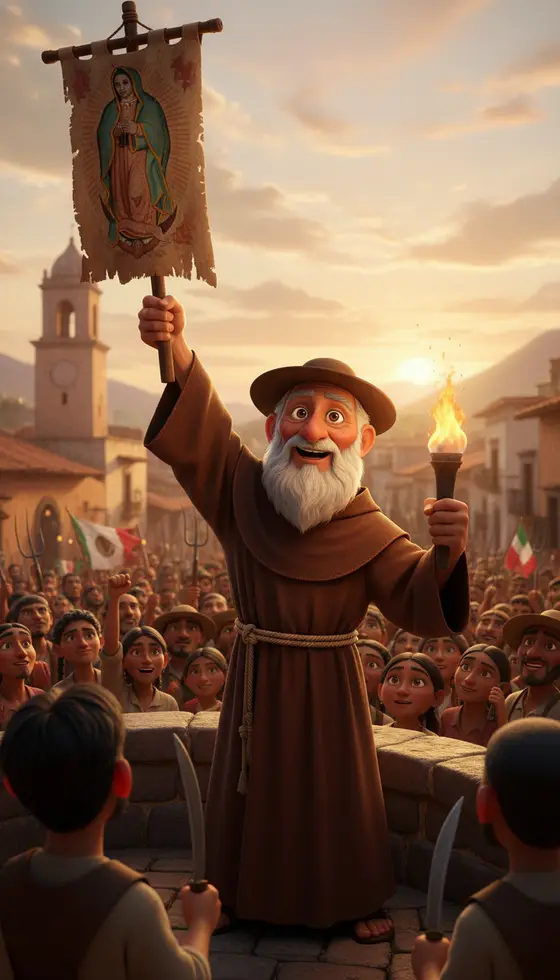
Spanish missionaries made a strategic and consequential decision: rather than eliminating indigenous religious practice, they mapped Catholic figures onto existing indigenous deities and repurposed pre-Hispanic sacred sites as church locations. The Catedral Metropolitana stands on the Aztec sacred precinct. The Basílica de Guadalupe was built where the goddess Tonantzin had been worshipped — and the Virgin of Guadalupe, whose apparition was reported to the indigenous convert Juan Diego in 1531, appeared in indigenous dress, spoke Nahuatl, and bore iconographic similarities to Aztec earth goddess imagery. Whether deliberately engineered or organically emergent, the result was a syncretic religion that preserved enormous amounts of pre-Hispanic cosmology inside Catholic forms. The Day of the Dead tradition is the most internationally recognized example — pre-Hispanic beliefs about the dead's ability to return, mapped onto Catholic All Souls' Day, surviving into the present. Mercado de Sonora shows the living result: Tlaloc imagery and Santa Muerte altars on the same shelves, the boundaries between pre-Hispanic and Catholic practice dissolved by centuries of coexistence.
The Virgin of Guadalupe appeared at Tepeyac Hill precisely where the Aztec goddess Tonantzin had been worshipped — the location was not coincidental
Syncretic religion: Catholic saints mapped onto Aztec deities — the overlap preserved pre-Hispanic cosmology inside Catholic forms
Día de Muertos: pre-Hispanic belief that the dead can return, mapped onto Catholic All Souls' Day — a direct Aztec survival
The Spanish conquest did not eliminate the Aztec nobility — it co-opted it. The Spanish colonial system recognized indigenous aristocracy (principales) as an intermediate administrative class, granting them privileges and land rights in exchange for organizing indigenous labor and tribute collection. Aztec noble families documented their genealogies and land claims in detailed pictorial manuscripts (codices) specifically to establish legal standing in the colonial court system — dozens of these documents survive. The children and grandchildren of Aztec rulers attended colonial schools alongside Spanish children, learned Latin and Spanish, and in some cases entered the Catholic clergy. Several mestizo descendants of the Aztec royal line — most notably the historian Fernando de Alva Ixtlilxóchitl, a descendant of the kings of Texcoco — wrote major historical accounts of pre-conquest civilization in the 17th century. Without their work, most of what we know about the Aztec world would be lost. The indigenous intellectual tradition of preserving pre-Hispanic knowledge, conducted quietly within the colonial system, is one of the most significant acts of cultural survival in history.
The Spanish recognized Aztec nobles (principales) as an administrative class — collaboration preserved some elite families' land and status
Aztec nobles produced genealogical codices specifically to establish legal standing in Spanish colonial courts — dozens survive
Fernando de Alva Ixtlilxóchitl: 17th-century mestizo historian descended from Texcoco kings — his writings are a primary source for Aztec history
The Mexican Revolution of 1910 produced a deliberate political project: the construction of a national Mexican identity based on mestizaje — the blending of indigenous and Spanish heritage into a new, unified 'Mexican' identity. The post-revolutionary government, under education minister José Vasconcelos, commissioned Diego Rivera and the muralists to paint Mexican history on public walls, with the Aztec civilization positioned as the nation's proud origin. The Museo Nacional de Antropología — built in 1964 by the same architect as the Azteca stadium — was explicitly designed to enshrine pre-Hispanic civilization as the foundation of Mexican national identity. The Aztec Sun Stone became the symbol on the national shield. Tenochtitlán's founding myth became the central image of the national flag. In official Mexican political culture, 'the Aztecs' are not a conquered people — they are ancestors. This is a political construction with real consequences: it has been used both to celebrate indigenous heritage and (critics argue) to subsume living indigenous communities into a homogenized national identity that erases their specific present.
Post-revolutionary indigenismo: the government deliberately positioned Aztec civilization as Mexico's founding heritage
The Museo Nacional de Antropología (1964): explicitly designed as a political statement — pre-Hispanic Mexico as national origin
The Aztec Sun Stone on the national seal: the Aztec past transformed into national symbol — a political act, not just historical recognition
The descendants of the Aztecs — broadly categorized as the Nahua people — are Mexico's largest indigenous ethnic group, with approximately 1.5–2 million people identifying as Nahua today. They live primarily in the states of Puebla, Veracruz, Hidalgo, San Luis Potosí, Guerrero, and Oaxaca, as well as in urban communities throughout Mexico City. They speak varieties of Nahuatl, practice syncretic religious traditions, maintain distinctive agricultural, craft, and culinary traditions, and — in increasing numbers since the late 20th century — assert indigenous rights and political identity within the Mexican state. The Nahua are not 'living Aztecs' in a frozen historical sense: their culture has evolved continuously for 500 years, incorporating Spanish, African, and global influences while maintaining linguistic and cultural distinctiveness. They are contemporary people with a specific heritage, not museum exhibits. Xochimilco — where the ancient chinampa agricultural system still produces food — is partly managed by Nahua-descended communities who have maintained the water-based farming tradition for 700 years.
Nahua people: 1.5–2 million today, Mexico's largest indigenous ethnic group, concentrated in Puebla, Veracruz, Hidalgo, and Guerrero
They are contemporary people with a 700-year continuous culture — not 'living Aztecs' frozen in the past
Xochimilco's chinampa system: maintained partly by Nahua-descended communities for 700 years — the same agricultural technology as Tenochtitlán
Walking through Mexico City's Centro Histórico is walking through the most direct evidence of what happened to the Aztecs: a civilization that was physically demolished and built over, but whose spatial logic, symbolic language, and cultural memory persisted through everything the colonial period and the modern era could do. The Zócalo is on the ceremonial precinct of Tenochtitlán. The streets follow the Aztec grid. The Templo Mayor ruins sit one block east, excavated only in 1978. The sinking of Mexico City is a direct consequence of the decision to drain the lake that kept Tenochtitlán stable. The eagle and serpent on the flag are Huitzilopochtli's founding vision. The Aztec gods appear in the murals, in the museums, and in the folk spiritual market. The tamale, the tortilla, and the chile are pre-Aztec Mesoamerican inventions in daily use globally. What happened to the Aztecs is: they became Mexico.
The Templo Mayor was buried for 450 years under Mexico City streets — discovered in 1978 when an electrical worker broke through a buried stone
The Aztec street grid underlies Centro Histórico — the city's spatial organization is 700 years old
What happened to the Aztecs: they became Mexico — their language, food, symbols, and cosmology are embedded in the country that replaced their empire