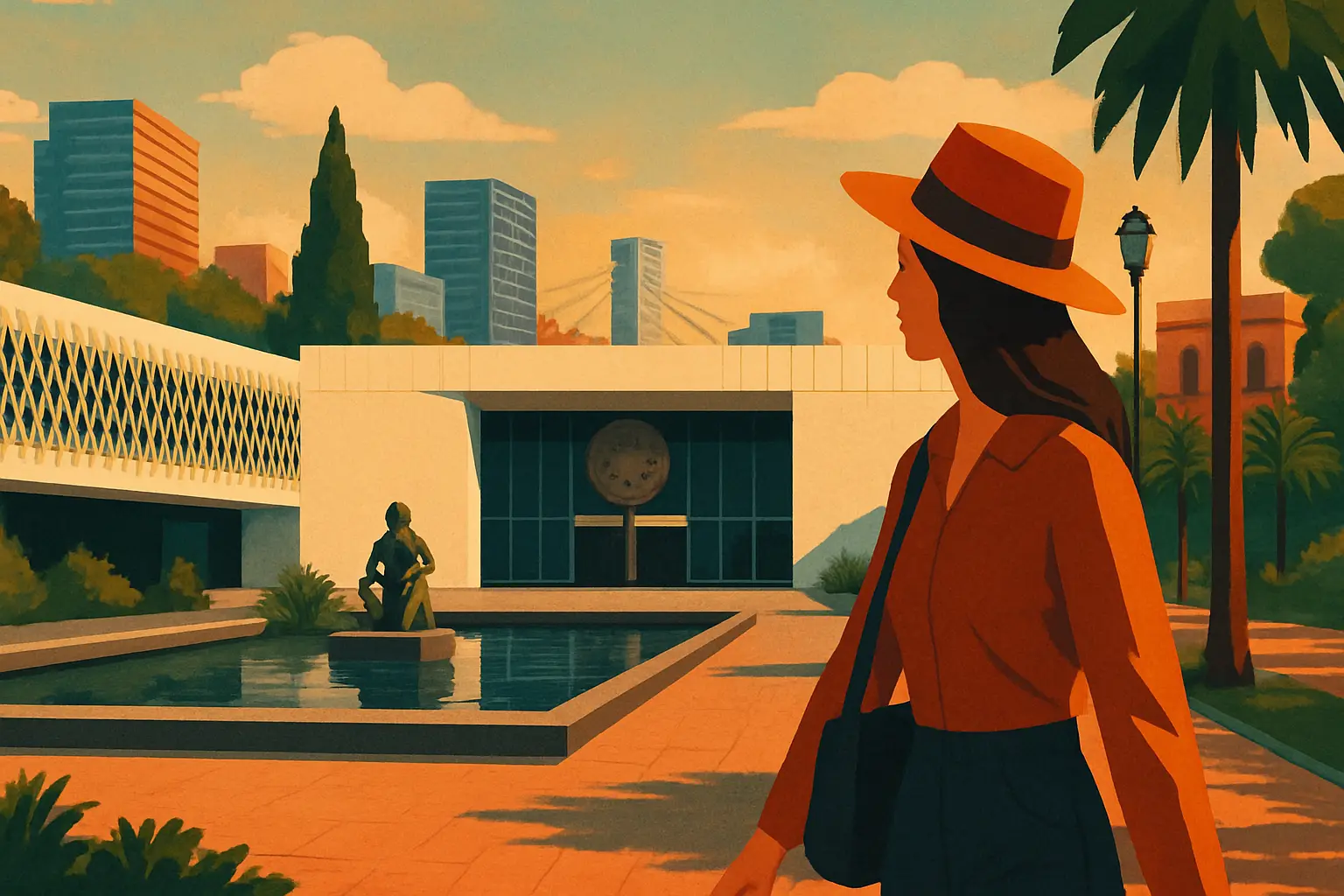
Locals call it the MNA, and many will tell you it's the single most important building in Mexico. Opened in 1964 inside Chapultepec Park, the museum was designed by architect Pedro Ramírez Vázquez to do something unusual: tell the story of Mexico's pre-Hispanic civilizations on the ground floor, and the story of the country's living indigenous cultures upstairs. It's not a museum about old things. It's a museum about who Mexico is.
23 permanent rooms across two floors
Designed in 1964 — the building itself is a landmark
Lower floor is archaeology, upper floor is living cultures
Almost every traveler walks past the central courtyard in 30 seconds. Don't. The giant concrete column you see — locals call it El Paraguas, 'The Umbrella' — is a 28-meter cantilevered roof with water pouring down its sides like a permanent rainstorm. The reliefs around it depict Mexican history, and standing under it for a minute resets your brain before the museum overwhelms you. This is the single best photo spot in the entire complex.
El Paraguas is a 28-meter concrete column shaped like a tree
The water curtain is part of the design — not a decoration
The courtyard is free to enter even without a ticket to the halls
Get short, interactive stories that make each place easier to remember while you travel.
The natural instinct is to start at Room 1 and walk in order. Resist it. Rooms 1–3 cover the introduction to anthropology and prehistoric Mexico, and they're the rooms most likely to drain your energy before you reach the highlights. Instead: walk straight across the courtyard to Sala Mexica (Room 7) at the far end. That's where the Sun Stone, Coatlicue, and the great Aztec sculptures live. Anchor yourself there first, then loop back through the surrounding rooms — Teotihuacán (Room 5), Toltec (Room 6), Oaxaca (Room 8), and Maya (Room 9). Save the intro rooms for last, or skip them entirely if you're short on time.
Sala Mexica (Room 7) is the heart of the museum — start there
Loop outward to Teotihuacán, Maya, and Oaxaca
Skip Rooms 1–3 if you're tight on time
If you only have 90 minutes, here's the shortlist. **Sala Mexica** holds the Piedra del Sol and the towering Coatlicue. **Sala Teotihuacán** has a full-scale replica of the Temple of Quetzalcóatl's facade and feels like stepping into the city itself — pair this with our Teotihuacán day-trip guide. **Sala Maya** has a full reconstruction of the tomb of Pakal from Palenque, including his jade death mask. **Sala Oaxaca** holds the Zapotec and Mixtec treasures, including some of the finest gold work in the Americas. **Sala Culturas del Golfo** has the colossal Olmec stone heads — the ones with the helmets that look weirdly like American football gear.
Mexica: Sun Stone, Coatlicue, Eagle Warrior
Teotihuacán: Quetzalcóatl temple replica
Maya: tomb of Pakal and his jade mask
Oaxaca: Zapotec and Mixtec gold
Gulf: Olmec colossal heads
Almost everyone knows the Sun Stone (Piedra del Sol) as the 'Aztec calendar.' That's only half right. The 24-ton basalt disk was carved around 1500, and while it does encode the Mexica understanding of cosmic time — the five 'suns' or world ages — it's also a political monument, a sacrificial altar, and a piece of imperial propaganda. The face in the center is most likely Tonatiuh, the sun god, with his tongue protruding as a sacrificial knife. The four squares around him represent the four previous worlds, each destroyed by jaguars, wind, fire, and water. We're currently living in the fifth sun. For more context on Mexica cosmology, our beginner's guide to Aztec history walks through the basics.
Carved around 1500 from a single basalt block
Encodes five world ages, not just a calendar
Center face is the sun god Tonatiuh
Most travelers never make it to the second floor, which is genuinely a shame. The upper floor mirrors the layout below, but instead of pre-Hispanic archaeology, each room covers a contemporary indigenous group — Maya, Nahua, Otomí, Purépecha, Huichol, and many more. You'll see textiles, ceremonial objects, masks, instruments, and full-scale recreations of homes from across the country. It's quieter, less crowded, and gives you a sense of how the cultures from the ground floor evolved into the Mexico of today. Even 30 minutes upstairs changes how you understand the rest of the country.
Upper floor mirrors the lower floor's geography
Far less crowded than the archaeology halls
Best time to visit: after lunch when the ground floor peaks
Tickets are about 95 MXN (around US$5) for foreigners and free for Mexican residents. Sundays are free for Mexican nationals and residents — which means Sundays are also packed, so go on a weekday if you can. Photos without flash are allowed almost everywhere. Bring water, but skip a backpack if possible — large bags must be checked. The cafeteria is fine but underwhelming; for a real meal, walk 10 minutes south to the restaurants in Polanco or grab tacos at the stands along Paseo de la Reforma. The closest Metro station is Auditorio (Line 7), but the easiest arrival is by Uber — about 80–120 MXN from Roma Norte or Condesa.
Open Tuesday–Sunday, 9am–6pm. Closed Mondays.
Foreign admission ~95 MXN; Sundays free for residents
Best Metro stop: Auditorio (Line 7); Uber from Roma ~100 MXN
How long do you need? A focused visit is 2.5–3 hours; a full deep-dive is 5–6. Wear comfortable shoes — the polished stone floors are unforgiving, and you'll walk more than you expect. Is it worth it on a short trip? Yes. If you only have three days in Mexico City, the MNA is the one museum that actually changes how you see the rest of the country. It contextualizes the ruins at Teotihuacán, the murals of Diego Rivera, the markets, the food, and the language people use every day. Pair it with a morning at Chapultepec Castle and you've done one of the best half-days the city offers.
Minimum: 2.5 hours. Ideal: 4 hours with a coffee break.
Wear soft-soled shoes — the floors are stone
Pair with Chapultepec Castle for a great half-day