1. What Teotihuacan actually is (and isn’t)
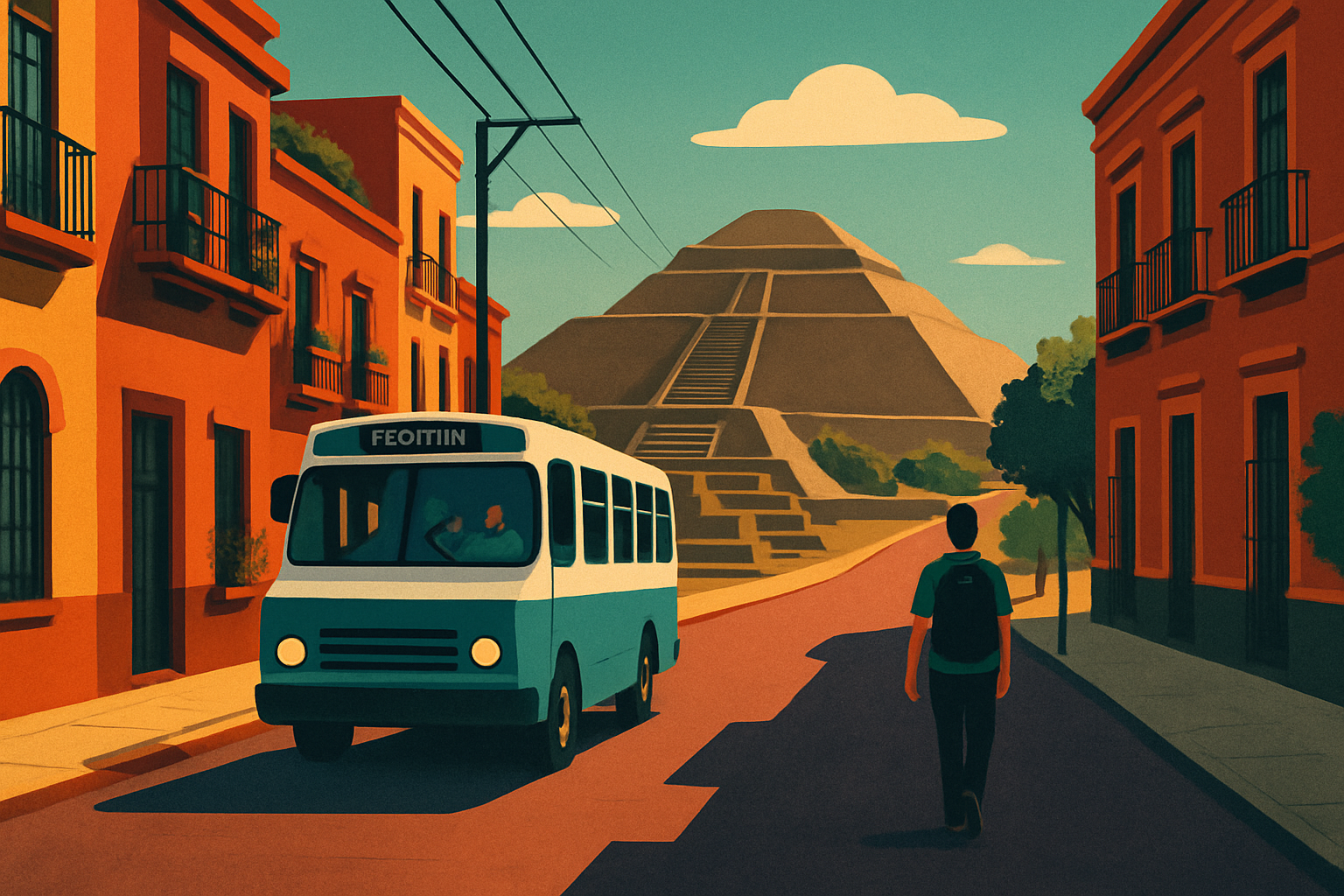
Teotihuacan is the massive ruined city about 50 km northeast of Mexico City — and it is not Aztec. It was built between roughly 100 BC and 250 AD by a civilization that vanished long before the Aztecs ever arrived. When the Mexica showed up around 1300 AD, the place was already a thousand-year-old ghost city, so they named it Teotihuacan: 'the place where the gods were born.' At its peak it housed somewhere between 100,000 and 200,000 people, putting it on the short list of the largest cities in the world at the time. Knowing this changes the visit — you're not standing in an Aztec ruin, you're standing in a mystery older than Rome.
•Built ~100 BC – 250 AD by an unknown civilization, abandoned around 550 AD
•Predates the Aztecs by about 1,000 years
•Pyramid of the Sun is the third-largest pyramid in the world by volume
2. The three ways to get there: bus, Uber, or tour
You have three real options and the right one depends on your morning energy. Public bus from Autobuses del Norte is the cheapest — about 60 MXN one-way (~$3.50 USD) — and the most local. Uber or Didi runs roughly 700–900 MXN each way and takes 50–75 minutes door-to-door, which works well if you're a group of three or four splitting the fare. Organized tours from Roma Norte or Centro Histórico run 800–1,500 MXN per person and usually bundle a stop at the Basílica de Guadalupe, an obsidian workshop, and lunch — convenient if you don't want to think, expensive if you do. Whatever you pick, leave by 8 a.m. — afternoon sun on the Avenida de los Muertos is brutal.
•Bus: ~60 MXN one-way, 1 hour, departs every 15–20 minutes
•Uber/Didi: ~700–900 MXN each way; book the return with the same driver if possible
•Group tour: 800–1,500 MXN; check if entrance fee and lunch are included before booking
3. The bus from Autobuses del Norte, step by step
If you’re going on your own, this is the route locals use. Take Metro Line 5 (yellow) to Autobuses del Norte station — it drops you directly inside the terminal. Walk to Gate 8 at the far end and look for the Autobuses Teotihuacanos counter (the buses are red, white, and blue). Ask for ‘Pirámides’ — not Teotihuacan, since locals call the destination ‘the pyramids.’ Buses leave every 15–20 minutes from around 6 a.m. to 6 p.m. The ride takes about an hour and drops you at Puerta 1, 2, or 3 of the archaeological site. For the return, the same buses leave from outside Puerta 1 until about 6 p.m. — don’t miss the last one or you’re paying Uber prices.
•Metro Line 5 to Autobuses del Norte → Gate 8 → Autobuses Teotihuacanos counter
•Ask for ‘Pirámides,’ round-trip ticket is ~110 MXN
•Last return bus from the site: around 6 p.m. — confirm with the driver on arrival
4. What to see at the site: the four things that matter
The site is huge — 8 square kilometers — and you can wander for six hours if you let yourself. The essentials are the Avenida de los Muertos (the 4 km central boulevard, named by the Aztecs who thought the platforms lining it were tombs — they weren’t), the Pyramid of the Sun at the midpoint, the Pyramid of the Moon at the north end, and the Templo de Quetzalcóatl (also called the Ciudadela) at the south end with its terrifying carved feathered-serpent and rain-god heads. Enter at Puerta 1 if you want to walk south-to-north and end at the Moon; enter at Puerta 2 if you want to start with the Sun and skip the long walk in. Either way, plan four hours minimum on the ground.
•Avenida de los Muertos: 4 km, ceremonial spine of the city
•Pyramid of the Sun: 65 m tall, aligned to mark the spring and fall equinox sunsets
•Templo de Quetzalcóatl: the most detailed stonework on site — don’t skip the back face
5. You can’t climb the pyramids anymore — here’s the deal
This is the question every first-timer gets wrong. Since 2020, INAH (Mexico’s federal heritage institute) has prohibited climbing the Pyramid of the Sun and the Pyramid of the Moon — first for COVID, now permanently for preservation. The stones are wearing down from millions of footsteps, and the rule is enforced by guards. You can walk all the way around both pyramids, climb the smaller platforms along the Avenida de los Muertos, and get within a few meters of the bases — the views are still incredible, just from ground level. If you specifically wanted the summit photo, this changes the trip; plan for sweeping wide shots instead.
•No climbing on the Sun or Moon pyramids — enforced by site guards
•Smaller platforms and the Quetzalcóatl temple steps are still open
•Best photo angles are from the Plaza de la Luna at the north end
6. Lunch: La Gruta in a cave, or the food stalls outside the gates
La Gruta is the famous one — a restaurant set inside a natural lava cave a five-minute walk from Puerta 5, serving since 1906. Order the sopa de hongos, the mixiotes de pollo, and a copita of pulque if you’re feeling adventurous. It’s touristy and pricey (~600–900 MXN per person) but the cave alone is worth it. For half the price, the food stalls just outside Puerta 1 do solid quesadillas with squash blossom and barbacoa tacos — eat there and you’ll have lunch money left for a balloon ride. Skip the restaurants right inside the gate; they’re the most expensive and the worst.
•La Gruta: walk to Puerta 5, reservations smart on weekends
•Stalls outside Puerta 1: 80–150 MXN for a real meal, cash only
•Inside the site you can only buy water and ice cream — bring snacks
7. The hot air balloon add-on (and is it worth it?)
Sunrise hot air balloon flights over the pyramids are the Instagram shot you've seen — drifting at 300 m above the Avenida de los Muertos as the sun comes up over the Sierra de Patlachique. They run about $170–220 USD per person, include hotel pickup at 4:30 a.m. and a champagne breakfast, and last about 45 minutes in the air. Operators like Volar en Globo and Sky Balloons have solid safety records. The catch: flights only happen in good weather (so dry season is your best window) and they cancel for wind. If it's a bucket-list item, book it for the start of your trip so you have a backup day. For more CDMX day trip options, explore our guide to Xochimilco.
•~$170–220 USD per person; pickup around 4:30 a.m. from your hotel
•Best months: November through April (dry, calm mornings)
•Always book your first morning so cancellations have a backup day
8. When is the best time to visit Teotihuacan?
April is genuinely one of the best months — dry, warm, and still before the rainy season starts in early June. November through May is the broad sweet spot: clear skies, mild temperatures, and predictable conditions for balloon flights. Avoid weekends, especially Sundays — entry is free for Mexican residents on Sundays, which means the site is mobbed and the parking lots overflow by 10 a.m. The single worst day is the spring equinox (around March 20–21) when tens of thousands of people show up wearing white to ‘absorb energy’ from the Sun pyramid. Tuesday through Friday mornings, gates opening at 9 a.m., is the quietest window you’ll find.
•Best months: November–May (dry season); April is peak before the June rains
•Avoid Sundays (free entry for residents = packed) and the spring equinox
•Arrive at 9 a.m. opening — the site is empty for the first 90 minutes
9. Is Teotihuacan safe? And what should I bring?
Yes — Teotihuacan is a heavily monitored federal heritage site with police presence and high foot traffic. The bus route from Autobuses del Norte is also well-traveled and safe during daytime hours. The bigger threats are sunburn, dehydration, and twisted ankles on the uneven stone. Bring a wide-brim hat, more water than you think you need (1.5L minimum), real walking shoes (not sandals), sunscreen, and a small backpack. Cash for entry fees and street food is essential — site entry is 95 MXN per person and most vendors don’t take cards. Skip the obsidian-knife hawkers unless you actually want one; the same items are cheaper in Mexico City markets.
•Site entry: 95 MXN (~$5.50 USD), cash preferred
•Bring: hat, sunscreen, 1.5L+ water, walking shoes, 500 MXN cash
•Skip the obsidian sellers — same products are cheaper at Mercado de Sonora