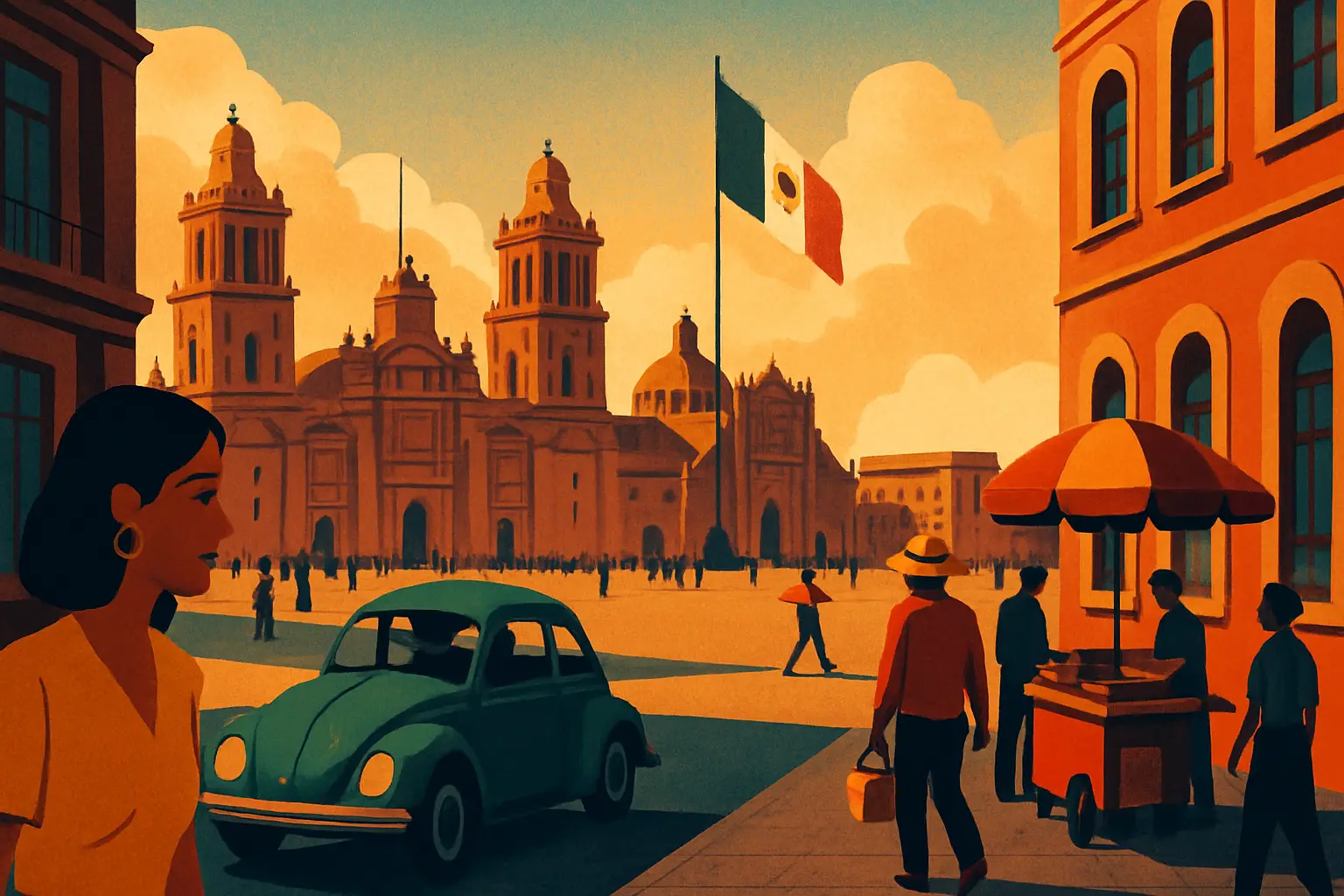
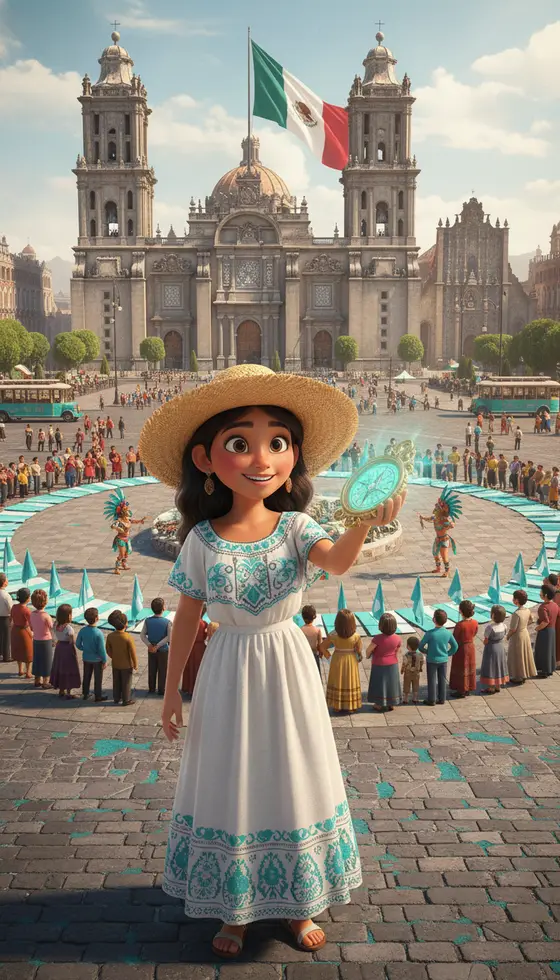
The Plaza de la Constitución — the Zócalo to everyone who lives here — is the largest city square in the Americas: 57,000 square meters of flagstone bordered by the Catedral Metropolitana on the north, the Palacio Nacional on the east, and five centuries of overlapping empires in between. Show up at 8 a.m. for the flag-raising ceremony, when a full battalion of soldiers marches the enormous Mexican flag out of the Palacio gates and hoists it on a 50-meter pole while bugles echo off the cathedral facade. By 9 a.m. the square fills with organ grinders, Aztec dancers in feather headdresses, and the first round of coffee carts. Walk into the Catedral Metropolitana while the morning light slants through the cupola — it's free, and the Altar de los Reyes inside is one of the most extravagant Baroque altarpieces anywhere in the Americas.
Flag ceremony: 8:00 a.m. raise and 6:00 p.m. lower, every single day
Catedral Metropolitana: free entry; mass runs on the hour and temporarily closes tourist access
Palacio Nacional: book the free Diego Rivera mural visit 2–3 weeks ahead at gob.mx
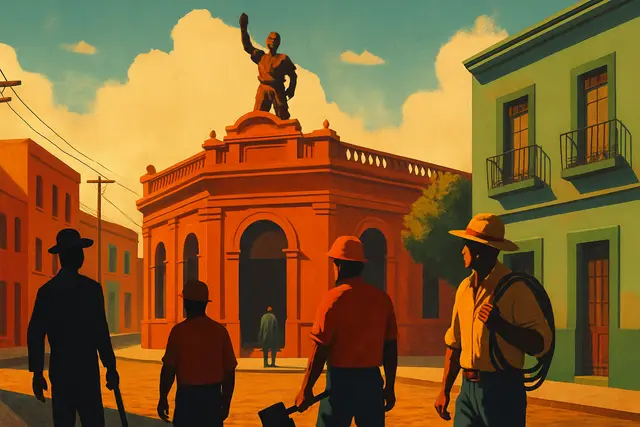
Walk east along the north side of the cathedral and turn onto Calle Seminario — within half a block you're standing above a sunken pit of Aztec stone. This is Templo Mayor, the great pyramid at the center of Tenochtitlán, the Mexica capital that Hernán Cortés leveled in 1521. The Spanish built their cathedral directly on top of it and the ruins stayed buried until 1978, when electrical workers struck a three-ton carved disc of the moon goddess Coyolxauhqui eight feet below street level. The excavation that followed uncovered over 7,000 ceremonial offerings: jaguar skulls, turquoise mosaic masks, a wall of 675 human skulls, and greenstone figures stacked in ritual sequences. The on-site museum (110 MXN, closed Mondays) displays the Coyolxauhqui disc and puts the whole layers-under-layers story into sharp focus. Even if you skip the museum, the elevated walkway above the outdoor ruins is free and worth ten minutes of any itinerary.
Address: Seminario 8, directly behind the Catedral Metropolitana — easy to miss, look for the low sunken stone
Museum: 110 MXN, closed Mondays, allow 90 minutes if you're reading the exhibits
Read up on the Aztec story before you go — the context turns a pile of rocks into something remarkable
Get short, interactive stories that make each place easier to remember while you travel.
At the western edge of Centro, where Avenida Juárez meets Eje Central, the Palacio de Bellas Artes rises in white Carrara marble and Art Deco tile — Mexico City's grandest building, commissioned in 1904 and finished in 1934 after two revolutions and one world war interrupted construction. The entrance fee (90 MXN, closed Mondays) gets you to the 2nd and 3rd-floor galleries where Diego Rivera's 'Man, Controller of the Universe' hangs — the same mural Rockefeller Center had dynamited off its wall in New York because Lenin appeared in it. Orozco and Siqueiros fill the other walls. The Tiffany glass stage curtain showing the two volcanoes above Mexico City is visible during ballet folklórico performances. Then do this: walk across Eje Central, enter the Sears on Madero, take the elevator to the 8th floor, and order any coffee at the terrace café. The balcony looks straight across at the Bellas Artes dome. It costs 80 MXN including the coffee and it's the best vantage point in Centro Histórico.
Bellas Artes: 90 MXN, closed Mondays; murals on 2nd and 3rd floors
Sears 8th-floor café: take the elevator, order a coffee, claim a balcony table — wide-open view of the dome
Ballet folklórico matinees: Sunday afternoons, book tickets at the BBA box office or website
Calle Madero is pedestrianized from Eje Central all the way to the Zócalo and it's where a lazy explorer accidentally covers most of the Centro's landmarks. Start at the corner of Madero and Eje Central: the Torre Latinoamericana is right there, a 44-story 1956 skyscraper that famously survived the catastrophic 1985 earthquake without structural damage, and whose observation deck (220 MXN) gives you a vertigo-inducing view of the entire city grid. Walk east and you hit Casa de los Azulejos — the 18th-century blue-and-white Talavera tile palace now housing a Sanborns, worth walking into just to see the Jose Clemente Orozco mural on the staircase and the tiled courtyard. Keep going and you'll pass the Templo de San Francisco on Madero 7, founded by Franciscan friars in 1525 on the site of Moctezuma II's royal aviary. The walk from Bellas Artes to the Zócalo is 15 minutes at a tourist pace; three hours if you stop at everything.
Torre Latino observation deck: 220 MXN, best visited at sunset for the city lights
Casa de los Azulejos: free to walk in; Sanborns inside is decent for breakfast in a pinch
Madero is pedestrianized — no cars — but it's prime pickpocket territory; front pockets, phone in your bag
Centro Histórico has more historically significant restaurants per block than anywhere else in the city. Café de Tacuba, at Calle Tacuba 28, has been operating since 1912 inside what was originally a 17th-century convent — order the enchiladas tacuba (red, green, and cream sauce, three to a plate) and a tamarindo agua fresca, and look up at the painted vaulted ceilings. El Cardenal at Palma 23, one block off the Zócalo's southeast corner, is the Centro breakfast institution: chilaquiles verdes, hot chocolate whipped tableside with a wooden molinillo into a foam, and a basket of warm sweet rolls — open 8 a.m. on weekdays and reliably packed by 10. For late-night tacos, Los Cocuyos on Bolívar 56 is a tiny counter where the suadero (slow-braised brisket) is ladled from copper pots into tortillas fresh off the comal — open until 4 a.m., cash only, standing room for six.
Café de Tacuba: Tacuba 28, open daily from 8 a.m., enchiladas + agua fresca under 200 MXN
El Cardenal: Palma 23, best on weekdays before 10 a.m. — Saturday waits run 40+ minutes
Los Cocuyos: Bolívar 56, cash only, open late; the suadero and tripa are the orders
Cantinas are the social heartbeat of old Mexico City, and Centro has the best examples still intact. Cantina La Ópera, at 5 de Mayo 10, opened in 1876 — its mahogany booths, pressed-tin ceilings, and Belle Époque bar mirror have barely changed. The detail that stops everyone: a bullet hole in the ceiling directly above booth four, which the staff will tell you (with complete sincerity) was fired there by Pancho Villa himself when he rode his horse through the front door during the Revolution. Verifiable? Unclear. Worth seeing? Absolutely. Order a tequila with sangrita and a complimentary plate of botanas. Salón Corona, a ten-minute walk north on Filomeno Mata 18, is the working-class counterpart: standing-only draft beer hall since 1928, with enormous tortas de pierna under 100 MXN. For a Friday night, walk south to Calle Regina between Bolívar and 5 de Febrero — a pedestrianized strip of ten cantinas and bars packed shoulder to shoulder from 8 p.m. onward.
La Ópera: 5 de Mayo 10, open daily noon–midnight; ask the waiter about the bullet hole
Salón Corona: Filomeno Mata 18, cash only, best for draft caguamas and a cheap torta
Calle Regina: ten-bar pedestrianized strip, goes late on Fridays and Saturdays
Centro Histórico is safe by day and along its main corridors at night, with consistent police presence along Madero, the Zócalo perimeter, and 5 de Mayo. The realistic concern is petty theft — pickpocketing on crowded Madero and on the metro — not violent crime. Keep your phone in your bag instead of your back pocket, wear your backpack on your front on the metro, and use ATMs inside Sanborns, Sears, or bank lobbies rather than freestanding street machines. Two areas to avoid at night without a local: the neighborhood north of the cathedral toward Tepito, and the blocks east of Mercado de la Merced after dark. Everything covered in this guide is well within the safe zone. Daytime Centro is genuinely relaxed.
Stick to Madero, 5 de Mayo, Tacuba, and the Zócalo perimeter — these are well-patrolled day and night
Pickpockets work Madero and Line 2 metro; front pockets and bag across your chest is the move
Tepito is half a mile north — stay away at night; it's not on any tourist itinerary anyway
From Benito Juárez airport, an Uber or Didi to Centro runs 35–60 minutes and 250–400 MXN depending on traffic — faster than the metro if you have luggage. By metro: take Line 1 (pink) to Pino Suárez or Zócalo station — both drop you a three-minute walk from the square. From Roma Norte or Condesa, the Metrobús Line 4 orange route connects directly to Bellas Artes for 7 MXN in about 20 minutes. The best time to visit is March through May, when the weather is dry, clear, and around 75°F — April in particular overlaps with the tail end of jacaranda season on the Alameda Central. September 15 is a once-in-a-lifetime night: the President delivers the Grito de Independencia from the Palacio balcony at 11 p.m. while 400,000 people pack the Zócalo. Avoid Mondays, when Templo Mayor, Bellas Artes, and most national museums are closed.
Airport → Centro: 35–60 min Uber, 250–400 MXN; metro Line 1 to Zócalo is faster in off-peak hours
Metrobús Line 4 from Roma/Condesa: 7 MXN, drops you at Bellas Artes in ~20 minutes
Avoid Mondays — Templo Mayor, Bellas Artes, and most museums are all closed