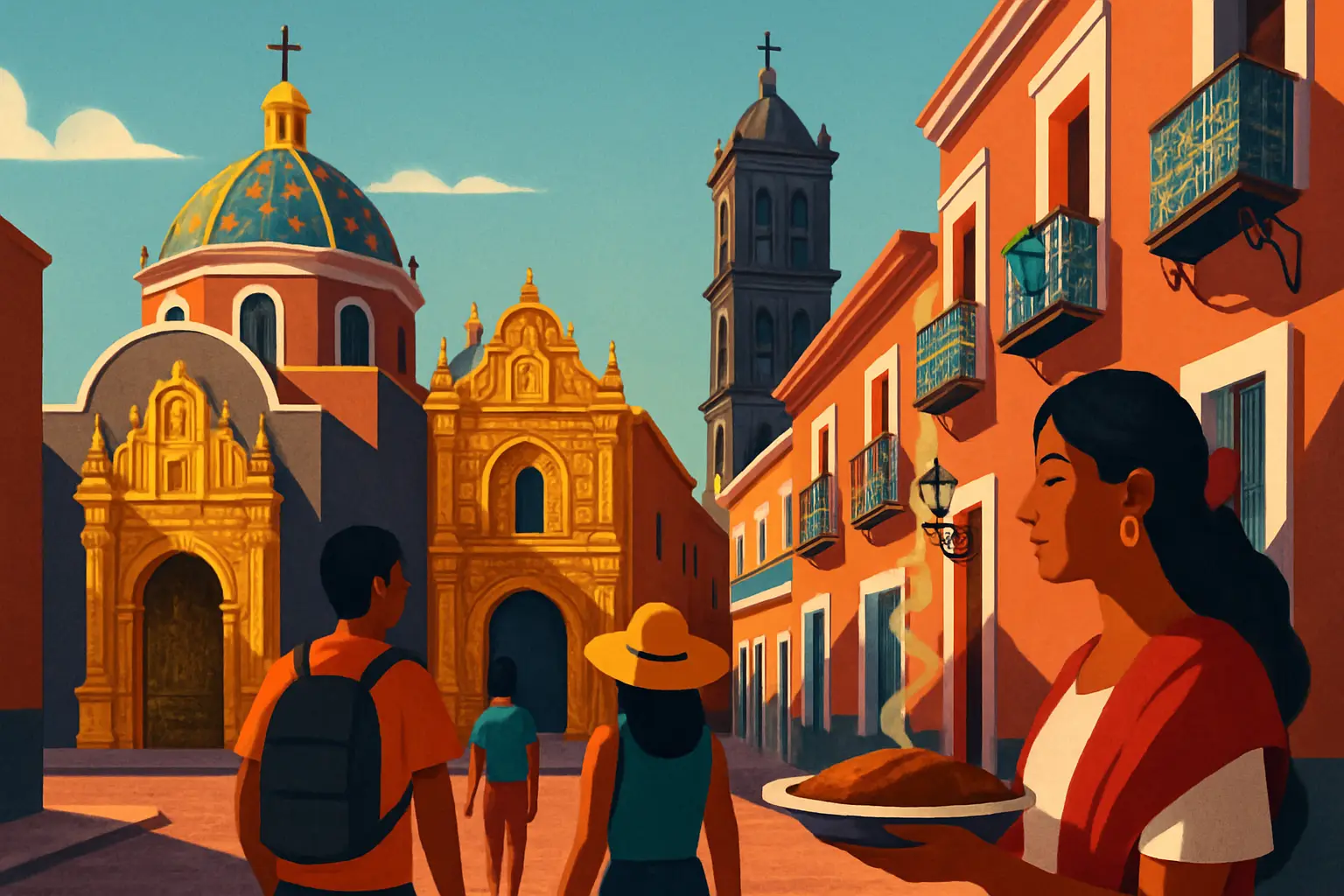
Puebla sits 130 kilometers southeast of Mexico City, in the shadow of the Popocatépetl volcano. Founded in 1531 as a Spanish colonial city built from scratch — no Aztec settlement underneath — its Centro Histórico has been a UNESCO World Heritage Site since 1987 for a reason. You get baroque cathedrals, hand-painted Talavera tile facades on every other building, the mole that put Mexican food on the world map, and a chapel covered in roughly 23 carat gold leaf. It's also the city where, on May 5, 1862, an outnumbered Mexican army beat back a French invasion — the actual reason Cinco de Mayo exists. Two hours by bus. One unforgettable day.
130 km southeast of CDMX, about 2 hours by direct ADO bus
UNESCO World Heritage Site since 1987 — the entire Centro Histórico
The real birthplace of Cinco de Mayo (the 1862 battle was fought here)
The cleanest way is the bus. ADO runs direct service from TAPO — the Terminal de Autobuses de Pasajeros de Oriente, accessible from Metro San Lázaro on Lines 1 and B — to Puebla's CAPU station roughly every 20 minutes from 5am to midnight. The ride is 2 hours via the México 150D toll highway. In 2026, expect to pay around 280 pesos one way for a regular ADO seat, 380 pesos for ADO GL (slightly nicer, drinks included), and 450+ pesos for ADO Platino (recliner seats, useful only if you're going further). Estrella Roja is a solid second option that drops you closer to the historic center at the 4 Poniente terminal, which saves you a 60–80 peso Uber from CAPU. If you want to skip the CAPU-to-Centro shuffle entirely, take Estrella Roja. If you're combining with our other day trips, ADO is the more frequent option.
ADO from TAPO (Metro San Lázaro): every ~20 min, ~2 hours, 280 pesos
Estrella Roja drops at 4 Poniente — closer to the Zócalo than CAPU
Buy your return on arrival; Sunday evening buses fill up fast
Get short, interactive stories that make each place easier to remember while you travel.
Start at the Zócalo — Plaza de la Constitución — under the laurel trees. The Catedral de Puebla anchors the south side. Construction started in 1575 and didn't finish until 1690; the towers, at 70 meters, were the tallest in colonial Mexico. Entry is free. Walk four blocks north to the real reason architecture lovers come: the Capilla del Rosario, tucked inside the Templo de Santo Domingo on Calle 5 de Mayo. Finished in 1690, the chapel is a single room of churrigueresque baroque excess — every surface gilded, every angel sculpted, the dome painted with the Virgin surrounded by saints. Diego Rivera called it the eighth wonder of the world. Photos undersell it. From there, walk three blocks to the Biblioteca Palafoxiana, the first public library in the Americas (founded 1646), with 45,000 leather-bound volumes still on their original cedar shelves. UNESCO listed the library itself in its Memory of the World register. Entry is 50 pesos.
Catedral de Puebla — 115 years to build, free entry, climb the bell tower
Capilla del Rosario inside Templo de Santo Domingo — gold-leaf masterpiece
Biblioteca Palafoxiana — first public library in the Americas, 50 pesos
Puebla is the only city in Mexico where Talavera pottery can legally be called Talavera — there's a Denominación de Origen, like champagne or tequila. Real Talavera is hand-painted, kiln-fired twice, and stamped on the bottom with the workshop's certification. Casa Talavera Uriarte on Avenida 4 Poniente has been making it since 1824 and offers free 30-minute workshop tours every hour on weekdays — you watch the painters work and then walk through the showroom. Skip the cheap stalls near the Zócalo unless you just want a souvenir. Two blocks north, Calle 6 Oriente — known as the Calle de los Dulces — is a single street lined with traditional sweet shops that have been making camotes (sweet potato candies), tortitas de Santa Clara, and jamoncillo since the 1700s. Dulcería de Celia and La Gran Fama are the originals. For antiques and folk art, the Callejón de los Sapos comes alive on Sundays with an open-air market on the cobblestones.
Casa Uriarte (since 1824) for certified Talavera and free workshop tours
Calle 6 Oriente — the candy street, working since the 1700s
Callejón de los Sapos — Sunday antique market on cobblestones
Puebla is one of the most influential food cities in Mexico. Mole poblano — the iconic dark, chocolate-tinged sauce — was invented here, traditionally credited to the nuns of the Convento de Santa Rosa in the 17th century (you can visit the convent kitchen, now the Museo de Arte Religioso Ex-Convento de Santa Rosa, for 50 pesos). Eat the real version at El Mural de los Poblanos on Calle 16 de Septiembre, or Fonda de Santa Clara on Avenida 3 Poniente if you want the classic tourist-friendly spot — both are genuinely good. For street food, head to the Mercado El Carmen for chalupas poblanas (small fried tortillas with salsa, shredded pork, and onion) and molotes (stuffed and fried masa pockets). The wildcard is tacos árabes, invented in Puebla in the 1930s by Lebanese immigrants — pork shawarma on pita with chipotle sauce, the direct ancestor of tacos al pastor. Tacos Tony and Las Ranas serve them all night. End at La Pasita, a tiny 1916 cantina that pours one thing — pasita, a sweet raisin liqueur — served in a shot glass with a cube of cheese on a toothpick. Total weirdness; total tradition. For more on Mexican food origins, see our CDMX food history guide.
Mole poblano: try it at El Mural de los Poblanos or Fonda de Santa Clara
Tacos árabes: the Lebanese-Mexican fusion that became al pastor
La Pasita: 1916 cantina pouring exactly one drink, with a cheese cube
Cholula sits 10 kilometers west of Puebla — 20 minutes by Uber (around 100–150 pesos) or 35 minutes by colectivo from the corner of 6 Poniente and 13 Norte. The reason to go is the Great Pyramid of Cholula, the largest pyramid by volume in the world (4.45 million cubic meters — bigger than Giza). The Spanish, not realizing what was under the grass, built the Iglesia de Nuestra Señora de los Remedios on top in 1594. Today you can walk the 800 meters of excavated tunnels underneath (90 pesos, closes 4:30pm), then climb to the church on top for postcard views of Popocatépetl. Can you do Cholula plus Puebla in one day from CDMX? Yes — but you'll feel rushed. Realistic plan: leave CDMX at 7am, do Cholula 10am–12:30pm, back to Puebla for late lunch and the Capilla del Rosario, return bus at 7pm. If you have two days, sleep in Puebla and do Cholula slowly the next morning. If you only have one day and you have to choose, choose Puebla.
Cholula is 20 min by Uber from Puebla (100–150 pesos)
Largest pyramid by volume in the world; tunnels close at 4:30pm
Doable in one day, but tight — 7am departure or pick one
Puebla works year-round, but timing matters. May 5 — Cinco de Mayo — is the biggest day on the local calendar, commemorating the 1862 Battle of Puebla. Expect a military parade, free concerts in the Zócalo, the historical reenactment at the Forts of Loreto y Guadalupe (where the battle was actually fought), and a packed city. Hotels triple in price; book weeks ahead. Late July through August is mild and green but wet — afternoon thunderstorms are routine. Late August through September is chiles en nogada season — the only time of year to eat Puebla's other signature dish, a stuffed poblano pepper covered in walnut cream and pomegranate seeds, served in the colors of the Mexican flag. November through April is the dry sweet spot: cool mornings, warm afternoons, no rain. Day of the Dead (October 31 to November 2) is intimate and beautiful here, especially in the cemeteries of Huejotzingo nearby.
Cinco de Mayo: parades, reenactments, and packed streets — book ahead
Late August–September: chiles en nogada season, only here
November–April is the dry, comfortable sweet spot for sightseeing
The Centro Histórico of Puebla is very safe by day and reasonably safe at night — busy with families, students from BUAP and UDLAP, and weekenders from CDMX. Standard rules apply: keep your phone in your pocket on quiet side streets, use Uber instead of street taxis after dark, and stay in the well-lit core (roughly between Avenidas 18 Poniente, 18 Oriente, and the Boulevard 5 de Mayo). The CAPU bus station area is fine during the day but isn't somewhere to wander at night — just take an Uber straight to the Centro. Bring a sweater (Puebla sits at 2,135 meters and gets chilly after sunset, even in summer), comfortable shoes (the Centro is cobblestoned), 1,000–1,500 pesos in cash for food, market shopping, and small entries, and a backup card. Most restaurants and museums take cards, but the candy street, the Sunday market, and street food vendors are cash-only. Phone signal is excellent throughout the Centro.
Centro Histórico is safe day and night; take Uber after dark elsewhere
Bring a sweater — Puebla is at 2,135 m and cools fast in the evening
Mostly card-friendly, but bring 1,000+ pesos cash for markets and street food