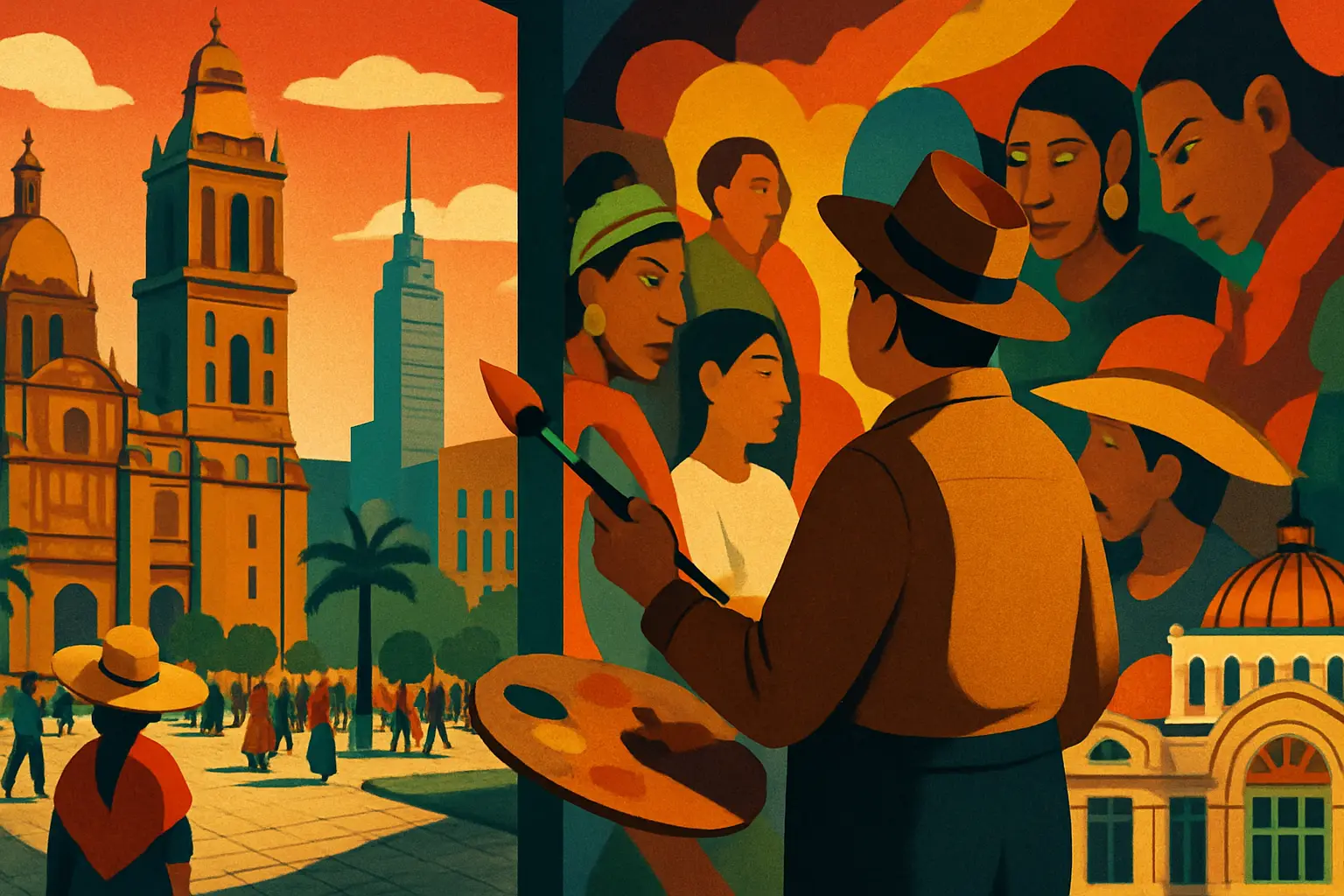
After the Mexican Revolution ended in 1920, the new minister of education, José Vasconcelos, handed the walls of public buildings to artists and told them to teach a barely literate country its own history. Diego Rivera was the loudest voice in that experiment. Between 1922 and 1957 he covered miles of CDMX walls with farmers, conquistadors, Aztec markets, factory workers, and his own complicated politics. Most of those walls are still standing, most are free or nearly free to enter, and most are within walking distance of each other in Centro. Mexico City isn't a museum that holds Rivera — it is the museum.
Muralism began as a literal public-education project in 1921
Rivera painted on walls in CDMX for 35 years
Most of his major sites in the city are free or under 90 pesos
If you only see one Rivera mural in your life, see this one. On the grand staircase of the Palacio Nacional, facing the Zócalo, Rivera painted The History of Mexico from 1929 to 1935 — Tenochtitlán, the conquest, independence, the Reforma, the Revolution, and a Marxist future, all stacked into one wall like a graphic novel you read by walking up. Keep going through the second-floor corridor and you'll find his quieter panels of pre-Hispanic life: the Tlatelolco market, the Totonac people harvesting vanilla, Tarascan fishermen on Lake Pátzcuaro. Entry is free with a passport or government ID. The palace closes Mondays and security is real — leave big bags at your hotel.
Bring your passport for security
Closed Mondays; mornings are calmer
Don't skip the second-floor corridor — the calmest, prettiest panels
Get short, interactive stories that make each place easier to remember while you travel.
Six minutes' walk north of the Zócalo, on Calle República de Argentina 28, sits the Secretaría de Educación Pública. Between 1923 and 1928 Rivera painted 235 fresco panels across its two enormous courtyards — the largest mural project of his career and, by his own account, his favorite. You'll find dyers in Oaxaca, a Day of the Dead skeleton parade, mining scenes, and Frida Kahlo (then a teenager) handing out rifles in 'The Arsenal'. It's an active government building, free to enter on weekdays, and you can usually have whole walls to yourself. Bring ID and sign in at the front desk.
República de Argentina 28, Centro
Open weekdays; bring ID and sign in
Look for 17-year-old Frida Kahlo in 'In the Arsenal'
Across the Alameda Central, in a small purpose-built museum on Calle Balderas, hangs Rivera's 'Sueño de una tarde dominical en la Alameda Central' — Sunday Afternoon Dream in Alameda Park. Rivera painted it in 1947 for the lobby of the Hotel del Prado and packed it with his own life: a young Diego holds the hand of a calavera (skeleton) in fancy dress, with Frida behind him, José Martí to one side, and Benito Juárez nearby. When the 1985 earthquake destroyed the hotel, the mural survived. The city moved the wall — wall, not painting — across the street and built the Museo Mural Diego Rivera around it. Entry is around 45 pesos, and Sunday is free for residents.
Inside Museo Mural Diego Rivera, Calle Balderas s/n
The wall itself was relocated after the 1985 quake
Pair it with a walk through Alameda Central
In the second section of Bosque de Chapultepec, behind the zoo and past the Audiorama, you'll find a small octagonal building most visitors walk straight past. Inside is one of Rivera's strangest works: 'El agua, origen de la vida' (Water: Origin of Life), painted in 1951 directly onto the floor and walls of a working pump house that channeled drinking water from the Lerma River into the city. For decades the mural was literally underwater — Rivera used a chemical resin he hoped would survive submersion. It mostly didn't. Today the water has been turned off, the mural restored, and a sound installation by Ariel Guzik plays inside the chamber. Outside, his giant Tláloc fountain (the Aztec rain god, reimagined as a reclining mosaic) stretches across the plaza. Entry is around 32 pesos.
Bosque de Chapultepec, segunda sección
The mural was originally painted to be submerged
Combine with the Museo Tamayo or the Papalote children's museum
Two of Rivera's biggest works in Mexico City aren't murals at all — they're stone mosaics on the outsides of buildings, and you can see them for free without going inside. On Avenida Insurgentes Sur, the Teatro de los Insurgentes (1953) carries a 46-meter mosaic mural across its entire facade: Mexican theater history, Cantinflas as a Robin Hood figure handing money from rich to poor, and the faces of Sor Juana Inés de la Cruz and Benito Juárez. South of there, at the Estadio Olímpico Universitario in Ciudad Universitaria (UNAM), Rivera designed a high-relief mosaic of an eagle, a condor, and a family lighting the Olympic torch — finished in 1952 and meant to circle the entire stadium (he only completed the main entrance before he ran out of time and money).
Teatro de los Insurgentes, Avenida Insurgentes Sur 1587
Estadio Olímpico Universitario at UNAM
Both are visible from the street — no ticket needed
If you're trying to do this in a single day, treat it as a Centro day with a Chapultepec coda. Start at Palacio Nacional at 10:00 when it opens — give it 75 minutes. Walk five minutes north to the SEP courtyards (45 minutes). Cut west past Bellas Artes, eat lunch on Calle Dolores or in Alameda, then visit the Museo Mural Diego Rivera (30 minutes). That's the foot-tour. To add Cárcamo de Dolores, take a 15-minute Uber to Chapultepec's segunda sección in the late afternoon — it closes at 17:00. Save the Insurgentes mosaics for the way home, or for a separate day combined with Coyoacán and the Anahuacalli museum, the black-volcanic-stone pyramid Rivera designed himself to house his pre-Hispanic art collection.
Palacio Nacional → SEP → Museo Mural = the walking core
Cárcamo de Dolores closes around 17:00 — do it last
Anahuacalli + Coyoacán is a great second day
Yes, and probably more than if you were. Rivera didn't paint for galleries or collectors — he painted for people walking through buildings on their way to do something else. The murals reward the same thing the city rewards: slowing down and looking. You don't need to know fresco technique or the politics of the 1920s to be hit by a 30-foot wall of Tenochtitlán's market or by 17-year-old Frida holding a rifle. If you want one piece of pre-reading, look up the mural 'Man at the Crossroads' that Rivera painted at New York's Rockefeller Center in 1933 — and that the Rockefellers destroyed when he refused to paint Lenin out of it. He repainted a defiant version in Bellas Artes the next year. It's still hanging there. You can walk over and see it after Palacio Nacional.