Most travelers walk into Bosque de Chapultepec from Paseo de la Reforma, see the Anthropology Museum, climb to the castle, and call it a day. They've covered roughly a quarter of the park. Chapultepec is divided into four sections — Primera, Segunda, Tercera, and the new Cuarta — that together stretch west from the Auditorio Nacional almost five kilometers into the foothills. It's the largest urban park in Latin America, larger than New York's Central Park, and most of it is genuinely wooded: ahuehuete cypress trees that pre-date the Spanish, eucalyptus groves, and a handful of small lakes. The name comes from the Náhuatl 'chapoltepēc' — grasshopper hill — and the place was sacred to the Mexica long before any park existed. Moctezuma I built an aqueduct from here to Tenochtitlan, and the spring at the base of the hill was reserved for the tlatoani's personal use.
Four sections — most visitors only ever see Section 1
Largest urban park in Latin America (over 1,600 acres)
Sacred to the Mexica long before colonization
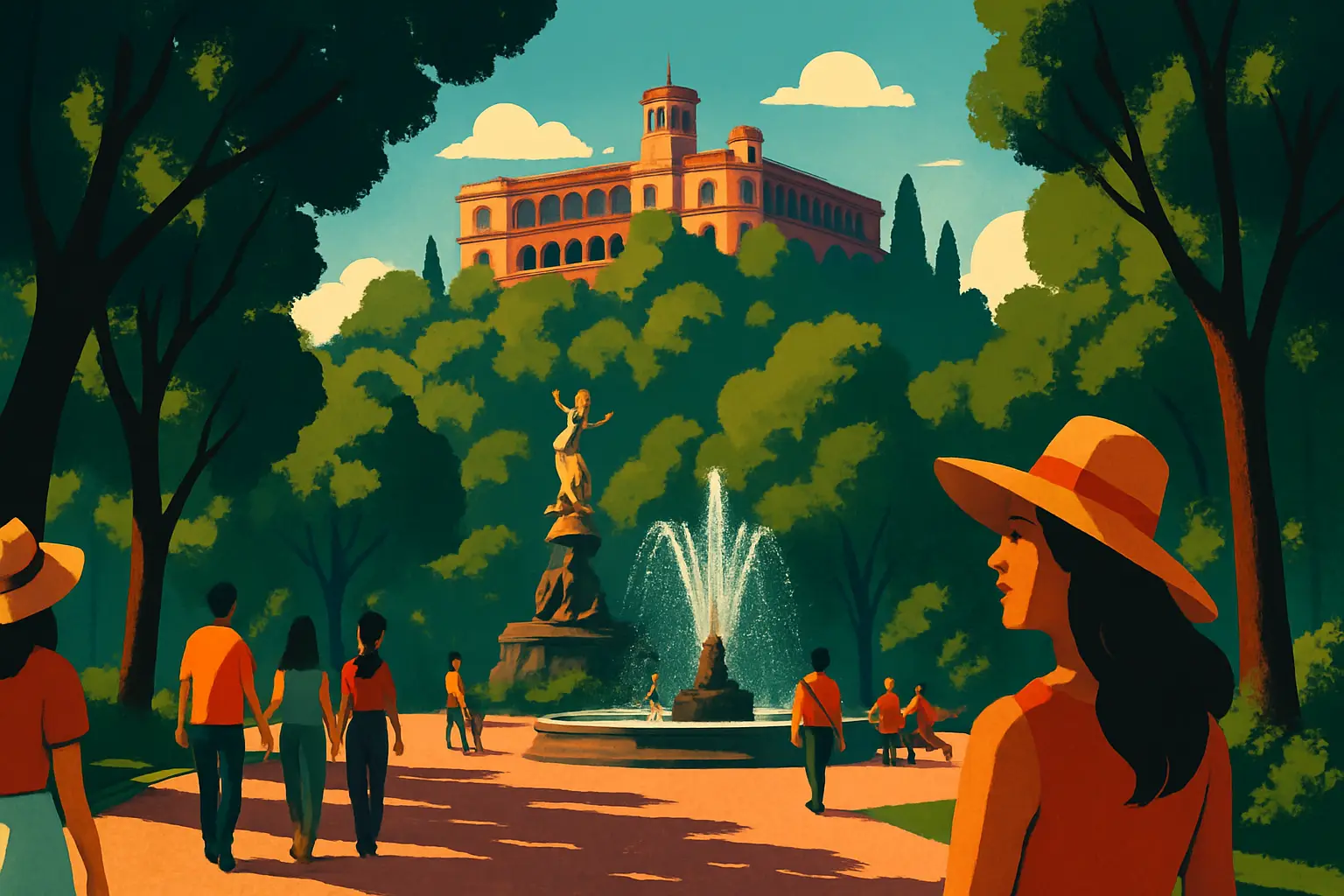
On top of the hill, reached by a 15-minute uphill walk from the Reforma entrance, sits the Castillo de Chapultepec. Construction began in 1785 as a summer house for the Spanish viceroy, but its strangest chapter started in 1864, when Maximilian I of Habsburg and his wife Carlota moved in as Mexico's short-lived emperor and empress. They redesigned the gardens in European style, added a private boudoir, and lasted three years before Maximilian was executed by Benito Juárez's forces in 1867. The castle later became the official residence of Mexican presidents until Lázaro Cárdenas moved out in 1939. Today it houses the Museo Nacional de Historia, and the rooftop garden — the Alcázar — is the best free-ish view in the city: the entire eastern half of CDMX laid out below, all the way to Popocatépetl on a clear day. Look for the David Alfaro Siqueiros mural 'Del Porfirismo a la Revolución' on the way down — three hundred square meters of pure visual chaos. At the foot of the hill, by the Reforma entrance, six tall white columns mark the Monumento a los Niños Héroes — six teenage cadets who in 1847 refused to retreat as U.S. troops stormed the hill during the Mexican-American War. The youngest was thirteen. The story shaped Mexican national identity for the next century and a half, and most tourists walk straight past the monument without realizing what it is.
Built 1785; home of Emperor Maximilian I and Empress Carlota 1864–67
Mexican presidential residence until 1939
Niños Héroes monument: six teen cadets who died in the 1847 U.S. invasion
Rooftop Alcázar has the best free city view in CDMX
Get short, interactive stories that make each place easier to remember while you travel.
If you only do one indoor activity in Mexico City, do this. The Museo Nacional de Antropología, on the north edge of Section 1, opened in 1964 in a building designed by Pedro Ramírez Vázquez. The courtyard is dominated by an enormous concrete umbrella — el Paraguas — that drops a curtain of water from its single supporting column. Inside, the ground floor is laid out by region: Olmec colossal heads in the first hall, the Mexica room with the Aztec Sun Stone (Piedra del Sol) on a black wall as the centerpiece, the Maya room with Pakal's jade death mask brought up from Palenque, the Oaxaca room with Monte Albán treasures, and seven more. Allow a minimum of three hours. Skip the upper floor of ethnography on a first visit unless you have a full day. Entry is around 100 pesos; closed Mondays; free for Mexican residents on Sundays. Our Aztec history guide provides the perfect context before you visit.
Aztec Sun Stone, Olmec heads, Pakal's jade mask — all under one roof
Architect: Pedro Ramírez Vázquez, 1964 — the umbrella courtyard is iconic
Allow 3+ hours; closed Mondays; ~100 pesos entry
Section 1 alone holds five major museums, and tourists usually only do Antropología and the castle. The Museo de Arte Moderno, a five-minute walk from Antropología, is small (two floors) but holds Frida Kahlo's 'Las Dos Fridas' from 1939 — arguably her single most famous canvas — plus key works by Siqueiros, Orozco, and Rufino Tamayo. Across the street, Museo Tamayo is a low-slung modernist building designed by Teodoro González de León housing Tamayo's personal collection of Picasso, Bacon, Magritte, and more. The Papalote Museo del Niño in Section 2 is a hands-on children's museum housed in another González de León building (the blue-and-red one that looks like a giant toy). And the small but charming Museo Jardín del Agua in Section 2 sits over a 1950s water reservoir and houses Diego Rivera's underwater mural 'El agua, origen de la vida.' All four are walkable from the Auditorio Metro stop.
Museo de Arte Moderno — home of Frida's 'Las Dos Fridas' (1939)
Museo Tamayo — modernist building, world-class private collection
Museo Jardín del Agua — Diego Rivera's underwater mural in Section 2
The best parts of Chapultepec are the ones nobody mentions. Tucked into the rocks behind the castle is the Audiorama — a small open-air garden where curated music plays softly from speakers hidden in the trees, and locals come to read or nap on stone benches. It's been running since 1972 and entry is free. In Section 2, the Fuente de Tláloc is a 1950s mosaic fountain Diego Rivera designed in the form of the Aztec rain god, sprawled across an entire pool — most visible from above. The Lago Mayor in Section 1 rents pedal boats by the half hour for around 80 pesos; the smaller Lago Menor in Section 2 is quieter and prettier on weekends. And in the wooded heart of Section 1, the Jardín Botánico holds a small but well-curated collection of cactus and endemic Mexican flora — totally free, almost always empty.
Audiorama: open-air music garden behind the castle, free
Fuente de Tláloc: Diego Rivera's reclining rain god in Section 2
Pedal boats on Lago Mayor (~80 pesos / 30 min)
Past the Periférico ring road, Section 2 gives way to Sections 3 and 4, which together more than double the park's size. Section 3 is mostly forested — eucalyptus, oak, walking trails, picnic clearings — and on weekends it fills with families having long carne-asada lunches. Section 4 is the newest piece: the Bosque de Chapultepec Cuatro project led by Gabriel Orozco opened to the public in stages from 2022 onward, adding a long pedestrian and cycling axis (Calzada Flotante) that runs west on stilts above old industrial land. The cycling path connects all the way back to Section 1, so the more athletic option is to rent a bike near the Auditorio and ride west. There's a new cultural complex too — Bosque Cuatro hosts open-air concerts and small art installations on weekends. It's the part of Chapultepec where you'll see almost zero tourists and a lot of skateboarders.
Section 3 is wild, wooded, and full of weekend family BBQs
Section 4 (Cuatro): Gabriel Orozco's redesign, opened 2022+
Calzada Flotante: elevated bike + walking axis west of the Periférico
Chapultepec is generally one of the safer big public spaces in CDMX during daylight, and Sections 1 and 2 are well-policed because of the museums. After dark, leave — the park officially closes around 5 p.m. and the wooded areas aren't pleasant or particularly safe at night. Tuesday through Thursday mornings are the calmest time to visit; Sundays are the most chaotic but also the most fun, with families, mariachis, and ice-cream carts. Almost everything inside the park — castle, museums, the zoo — closes on Mondays, so don't come on a Monday unless you only want to walk around. The dry season (November through April) gives you the bluest skies and the best castle views; rainy season (May through October) brings dramatic afternoon storms, so plan castle visits before noon. The Zoológico de Chapultepec is free year-round and is one of the only zoos outside China to have successfully bred giant pandas, which has been the case here since 1980.
Safe in daylight; leave by sunset — park closes ~5 p.m.
Closed Mondays for almost everything inside the park
Best weather: November–April; arrive at the castle before noon in rainy season
Chapultepec sits at the western end of Paseo de la Reforma, and three Metro stations serve the park: Chapultepec (Line 1, pink) drops you at the Niños Héroes monument, Auditorio (Line 7, orange) puts you between the Anthropology Museum and Polanco, and Constituyentes (Line 7) is the back entrance to Section 2. From Roma Norte or Condesa, walk or taxi up Reforma — it's 15–25 minutes. A solid half-day plan: enter at Chapultepec Metro, climb to the castle (90 minutes), descend, walk along Reforma toward the Anthropology Museum (3 hours), then exit at Auditorio for lunch in Polanco. A full day adds Museo Tamayo, the Audiorama, and the Tláloc fountain in Section 2. Bring water — the altitude (2,240 m / 7,350 ft) and the climb to the castle are no joke, especially in the dry season.
Metro stops: Chapultepec (L1), Auditorio (L7), Constituyentes (L7)
Half-day combo: Castle + Anthropology Museum (~5 hours total)
Bring water — the castle climb is uphill at 2,240 m altitude