1. What Casa Azul actually is (and isn't)
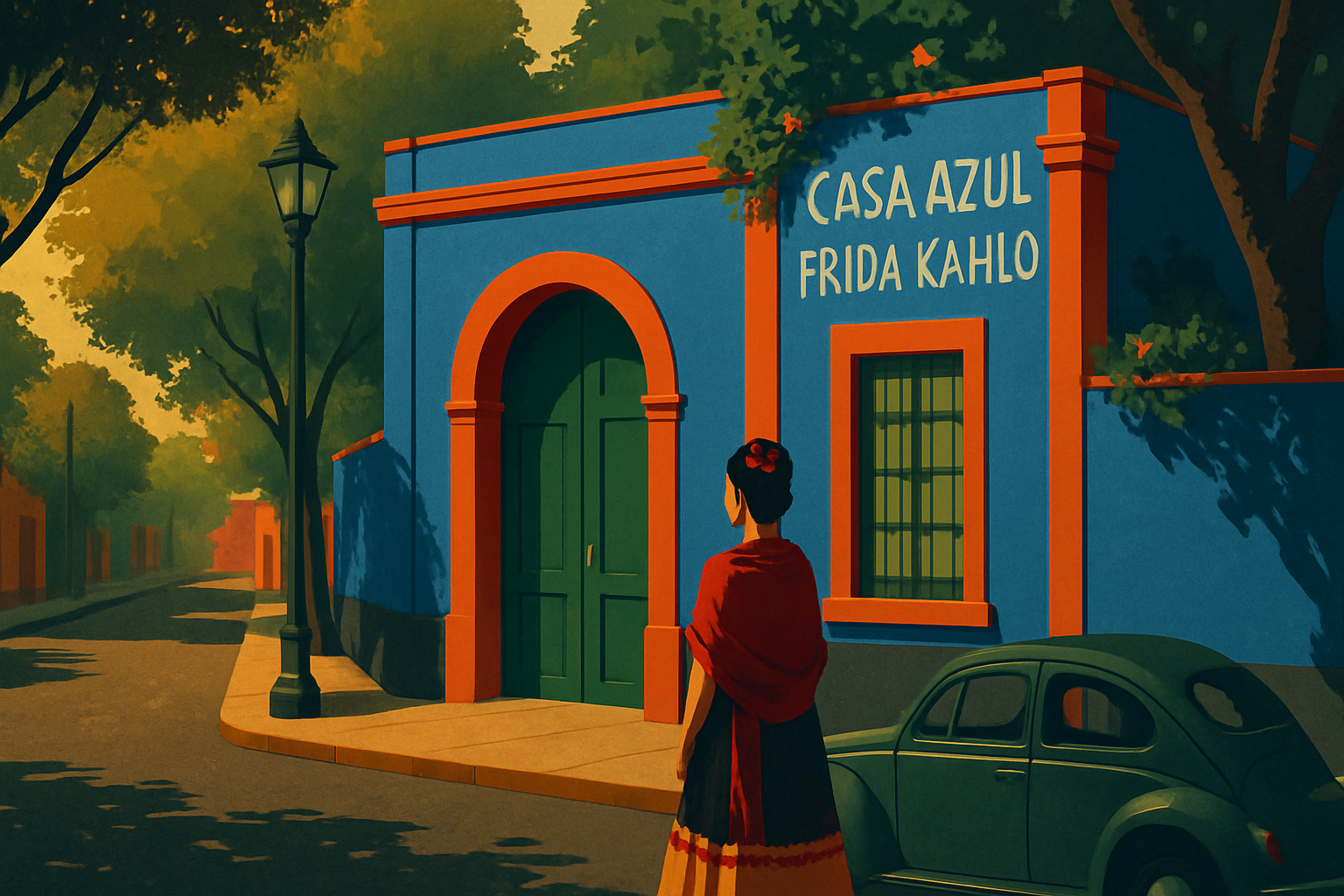
Casa Azul is the cobalt-blue corner house at Calle Londres 247 in Coyoacán where Frida Kahlo was born in 1907, lived most of her life with Diego Rivera, and died in 1954. It isn't a museum someone designed about Frida — it's her actual house, mostly preserved as she left it. Diego donated the property to Mexico in 1958 on one condition: keep the rooms unchanged. The walls only got that famous cobalt-blue paint in 1937, the year Leon Trotsky and Natalia Sedova moved in upstairs as political exiles. Today the house pulls in roughly 25,000 visitors a month, which is why timed-entry tickets and online booking are now non-negotiable.
•Address: Calle Londres 247, corner of Londres and Allende, Colonia Del Carmen, Coyoacán
•Frida lived here 1907–1954 with breaks; the cobalt blue dates to 1937
•Opened as a museum in 1958 per Diego Rivera's will
2. The bathroom Diego sealed for fifty years
This is the part most travelers don't know walking in. After Frida died in July 1954, Diego asked his patron Dolores Olmedo to seal her dressing room, the adjoining bathroom, and several large trunks — and to keep them locked until fifteen years after his own death. Olmedo outlived Diego by more than forty years and never opened them. The rooms were finally unlocked in 2004 by curator Hilda Trujillo and Frida's grand-niece Cristina Kahlo. Inside: more than 22,000 documents, 6,000 photographs, hundreds of personal letters, plaster medical corsets that Frida had painted herself, a prosthetic leg with an embroidered red boot, and around 300 pieces of her clothing — Tehuana skirts, embroidered huipiles, the long rebozos she used to hide the corsets. Most of what you see in the museum's clothing exhibition came out of those locked rooms. When you walk through, it helps to know that half of this collection was hidden from the world for half a century.
•Diego sealed Frida's dressing room and bathroom shortly after her death in 1954
•They stayed locked until 2004 — fifty years
•22,000 documents, 6,000 photos, and ~300 garments came out of those rooms
3. Room by room: what to actually look for
The visit is short (about an hour) and the rooms get crowded, so know what you're looking at. In Frida's day-bed room, the four-poster bed has a mirror mounted into the canopy — her mother installed it during her recovery from the 1925 streetcar accident, and that mirror is the literal reason for the self-portraits. The painted plaster corsets in a glass case nearby are part of the same story. The studio upstairs still has her wheelchair pulled up to the easel, paintbrushes in their jars, and the unfinished portrait of Stalin she was working on at the end of her life. The kitchen has her and Diego's names spelled out in small yellow tiles around the cabinets, with the date 1929 — the year they married. The dining room is hung with the painted papier-mâché Judas figures and tin votive paintings the couple collected obsessively. End in the front parlor, where her last canvas — a wax-pencil watermelon still life that reads 'Viva la Vida' — sits opposite her plaster death mask.
•Day-bed room: the canopy mirror that started the self-portraits
•Studio: her wheelchair, easel, and the unfinished Stalin portrait
•Kitchen: 'Frida y Diego 1929' spelled in yellow tiles
4. The garden, the urn, and Diego's pre-Hispanic pyramid
Don't skip the courtyard. Diego built a small stepped pyramid in the back garden out of volcanic stone and crowned it with pre-Hispanic figures from his own collection — a private archeology display he assembled long before Mexico had public museums for the same pieces. The frog-shaped pre-Hispanic urn that holds Frida's ashes is displayed on a plinth in her bedroom rather than the garden, but it's part of the same collecting habit. Sit for a minute on the bench under the orange tree in the courtyard. That's the angle in dozens of the photos of the house you've already seen, and the courtyard is the only part of the visit where the crowd usually thins out.
5. How to book tickets (and why you actually have to)
Walk-up tickets at the door are gone. Everything is online and timed-entry through the official site at boletos.museofridakahlo.org.mx — pick a slot, pay, save the QR code on your phone. In high season (December through April, plus July and August), Saturday and Sunday slots regularly sell out two to three weeks in advance. Weekday morning slots open up later. Admission as of 2026 runs around 270 MXN on weekdays and 320 MXN on weekends, with a separate 30 MXN permit if you want to take photos inside. The permit is worth it. There's also a combo ticket that bundles Casa Azul with the Anahuacalli Museum — Diego Rivera's basalt pyramid in southern Coyoacán — and saves you about 15% if you're planning to do both. Anahuacalli even runs a free shuttle from Casa Azul on Sundays.
•Book online at boletos.museofridakahlo.org.mx — no walk-ups
•~270 MXN weekday, ~320 MXN weekend, plus 30 MXN photo permit
•Combo with Anahuacalli saves ~15% and includes a Sunday shuttle
6. When to go: early Tuesday, Blue Night Thursday, or Museum Night
The 10 a.m. slot on a Tuesday or Thursday — right after the Monday closure — is the quietest you'll ever see the house. Half the rooms will be effectively empty for the first thirty minutes. The opposite of that is Sunday at noon, which is uncomfortable. Two special hours are worth knowing about: Blue Night runs every Thursday until 9 p.m. (Frida's bedroom under courtyard lamps is its own thing), and Museum Night on the last Wednesday of every month also runs until 9 p.m. Both require the same online booking. April and May are the last clear stretch before Mexico City's afternoon thunderstorms start in June, so a courtyard-heavy visit right now is the easiest it gets all year.
•Quietest: Tuesday or Thursday 10 a.m.
•Best atmosphere: Blue Night every Thursday until 9 p.m.
•Worst: Sunday between 11 a.m. and 3 p.m.
7. How to get there — and what to combine with it in Coyoacán
The museum sits at Calle Londres 247, on the corner of Londres and Allende in Colonia Del Carmen. From Roma Norte or Condesa, take an Uber (around 60–120 MXN, 25–40 minutes depending on traffic). From Centro Histórico, Metro Coyoacán on Line 3 is the closest stop, but it's a 20-minute walk and most travelers Uber the last leg. Once you're in Coyoacán, plan to stay all afternoon. Casa Azul is an eight-minute walk north of Jardín Hidalgo, the colonial main plaza, and the adjoining Plaza de la Conchita with its 16th-century chapel. The Mercado de Coyoacán on Allende is the right place for tostadas de tinga and a glass of agua de jamaica around 2 p.m. If you bought the combo ticket, end the day at Diego Rivera's Anahuacalli Museum, fifteen minutes south by Uber.
•Uber from Roma/Condesa: 25–40 minutes, 60–120 MXN
•Walking radius: Jardín Hidalgo, Plaza de la Conchita, Mercado de Coyoacán
•Anahuacalli Museum: 15 min south by Uber, free shuttle on Sundays
8. Is it worth it? And the questions everyone asks
Yes — but only if you book ahead. The Casa Azul without a ticket is a closed cobalt-blue door, full stop. Is photography allowed? Yes, with the 30 MXN photo permit, no flash and no video. Is there a guide included? No, but the wall texts are bilingual in Spanish and English, and the official audio guide app is free to download before you go. Wheelchair access? The ground floor and courtyard are accessible; the upstairs studio is reached only by stairs. Children? Allowed, but the rooms are dense and quiet — better for kids over eight. How long should I budget? About 90 minutes for the museum itself, then plan another two to three hours for Jardín Hidalgo, the Mercado de Coyoacán, and a coffee on the plaza. That second half is what turns Casa Azul from a museum stop into the best afternoon you'll have in Mexico City. And for a nearby southern CDMX pairing, San Ángel is only 20 minutes west by Uber.
•Photography: yes, with the 30 MXN permit, no flash, no video
•Accessibility: ground floor yes, upstairs studio is stairs only
•Time budget: 90 min inside + 2–3 hr in Coyoacán