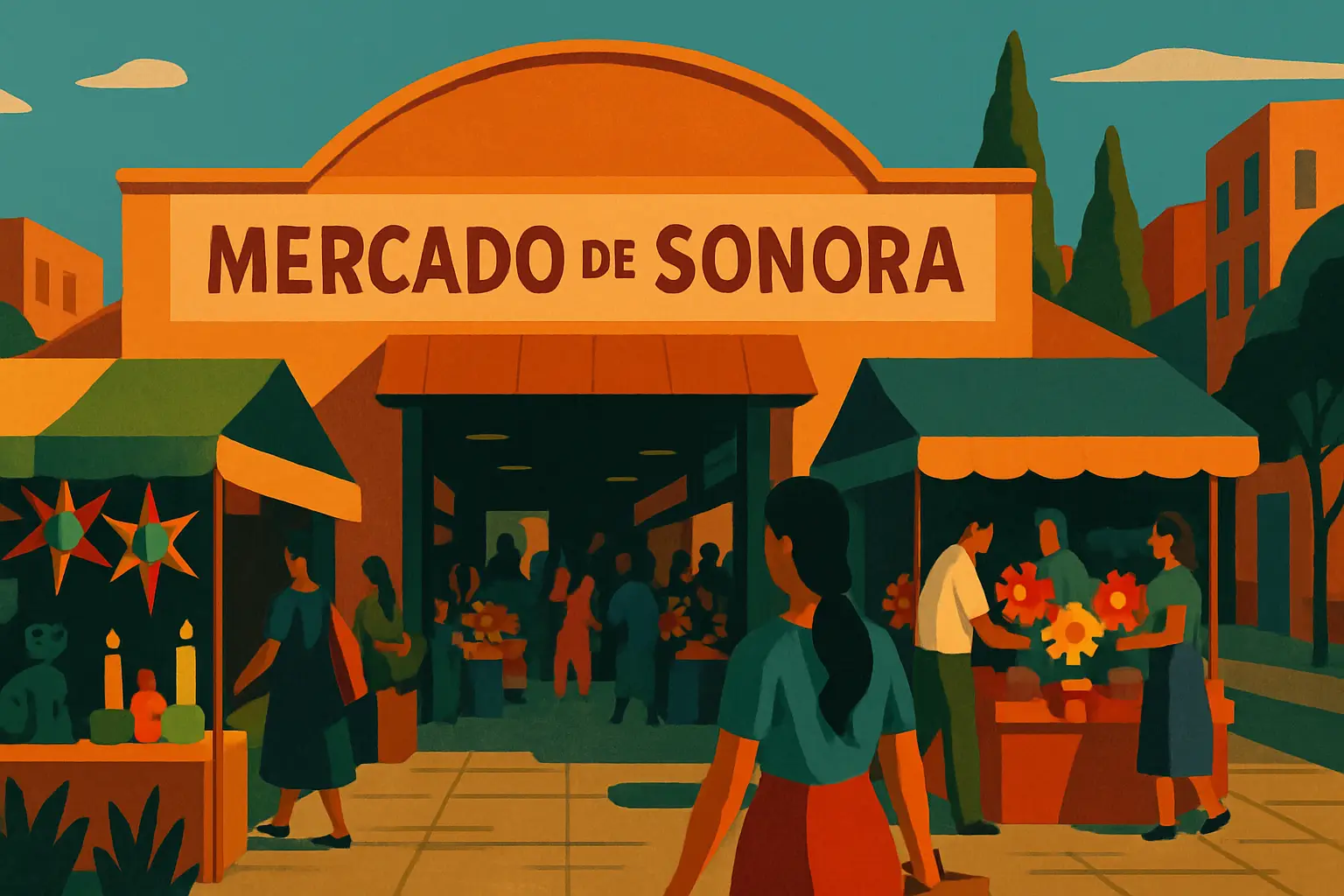
Mercado de Sonora is not a tourist attraction that happens to look exotic. It's a government-built working market that opened in 1957 in the Merced Balbuena neighborhood of Venustiano Carranza, established to centralize an informal trade in folk medicine, religious supplies, and seasonal goods that had grown up across the city. Today it spans multiple buildings and thousands of stalls, and the vast majority of its customers are Mexico City residents — not tourists. The esoteric section is just one wing of a market that also sells pottery, party supplies, toys, piñata frames, and seasonal decorations. What makes it genuinely unlike anything in North America is the scale of the folk spiritual trade: hundreds of stalls organized around pre-Hispanic medicine, Catholicism, Santería, the Santa Muerte cult, and syncretic traditions that blend all of the above into a living, daily practice. Vendors here aren't performing for visitors — they're supplying a real demand that has existed in Mexican urban life for centuries.
The section most visitors come for is concentrated in the market's interior, where the smell arrives before anything else — copal incense, dried herbs, and candle smoke layered together. Stalls carry herbal bundles (ramos) tied for specific purposes: cleansing, attraction, protection, or breaking negative energy. Prayer candles are organized by color and saint, each combination corresponding to a specific intention, and the vendors know the system completely. The curandero aisle — often described as Aisle 8 — is where traditional healers work directly with clients behind fabric partitions. Alongside them, stalls carry Santa Muerte figurines: the folk saint of death, depicted as a robed skeleton in colors that mirror the candle system (white for protection, red for love, black for banishment of enemies). Santa Muerte has millions of devotees across Mexico and the U.S. despite no recognition from the Catholic Church. On the same shelves: images of San Judas Tadeo (patron of lost causes), Jesús Malverde (the narco-saint venerated in Sinaloa), and pre-Hispanic figures like Tlaloc and Coatlicue. A single vendor's display can span three thousand years of Mexican spiritual history.
Copal incense, herb bundles, and color-coded prayer candles organized by intention
Santa Muerte figurines: folk saint of death, millions of devotees, not officially Catholic
San Judas Tadeo, Jesús Malverde, and pre-Hispanic imagery often share the same shelf
Get short, interactive stories that make each place easier to remember while you travel.
A limpia is a spiritual cleansing ritual, and Mercado de Sonora is the most accessible place in Mexico City to experience one. The basic version involves a curandero passing a raw egg slowly over your body — the egg is believed to absorb negative energy — followed by a brushing with an herb bundle, typically ruda (rue) and albahaca (basil), and a cloud of copal smoke blown from a ceramic brazier. Some practitioners add a tarot reading or spoken prayer. The session takes 10–20 minutes and costs around 200–400 pesos depending on the practitioner and depth of the reading. You don't need to believe in the mechanics for it to be meaningful — limpias are an unbroken thread from pre-Hispanic Mesoamerican healing traditions, blended with Catholic elements introduced after 1521. After the session, the curandero cracks the egg into a glass of water and reads it: bubbles, shapes, and clouding in the white are interpreted as evidence of what was cleared. Sitting with a curandero at Mercado de Sonora for 20 minutes teaches you more about living Mexican folk spirituality than any museum exhibit in the city.
The ritual: egg pass, herb brushing, copal smoke — 10–20 minutes per session
Cost: 200–400 pesos in cash; tipping is appropriate and appreciated
The egg is cracked into water and read afterward — the patterns carry the diagnosis
The esoteric wing gets all the attention, but Mercado de Sonora is enormous and the other sections are worth understanding. The pottery wing is one of the better places in Mexico City to buy functional Mexican ceramics — Talavera-style plates, clay molcajetes, incense burners, and decorative pieces at prices significantly below what you'd find in Polanco or at the Mercado de Artesanías near Insurgentes. The party supply section is essentially a universe of piñatas organized by size and character, papel picado, streamers, and costume accessories. And the seasonal sections shift the entire market's atmosphere: in October the building transforms with Día de Muertos altar supplies — marigold arrangements, sugar skulls, papel picado in purple and black, and saint imagery for home altars. In December, nativity figures, poinsettias, and posada decorations pack every aisle. Visiting during one of those seasons layers the folk spiritual atmosphere with the sheer festivity of Mexican ritual decoration, and makes the market feel even more like a window into something that actually matters to people.
Pottery section: functional Mexican ceramics at better prices than tourist-facing markets
October: the market transforms entirely for Día de Muertos supply season
December: nativity sets and posada decorations pack every aisle alongside the esoteric stalls
Understanding what's on the shelves at Mercado de Sonora requires a short briefing on Mexican religious syncretism. When Spanish missionaries arrived in the 16th century, they layered Catholic saints over pre-Hispanic deities — sometimes deliberately, sometimes because festival timing aligned too closely to ignore. The result is a living hybrid: a Mexico City resident might venerate the Virgin of Guadalupe, leave offerings on a mountain peak for Tlaloc, buy a Santa Muerte candle on Fray Servando, and attend Mass all within the same week, without experiencing any contradiction. The market reflects this precisely. Rue and copal — both used in ancient Mesoamerican ritual — sit next to printed Catholic prayer cards. Santa Muerte herself has no direct pre-Hispanic equivalent; she emerged as a folk tradition in the mid-20th century, growing fastest in neighborhoods with high insecurity and limited institutional protection. The murals Diego Rivera painted at the Palacio de Bellas Artes depict the pre-Hispanic end of this tradition; Mercado de Sonora shows you the living present-day version, unmediated.
Post-1521 syncretism: Catholic saints blended with pre-Hispanic deities — still actively practiced
Santa Muerte emerged mid-20th century, not ancient — grew fastest in working-class urban neighborhoods
Copal and rue have been used in Mesoamerican ritual since before the Aztec empire
Mercado de Sonora is in the Merced Balbuena area — a working-class, dense neighborhood that's fully active during market hours but not somewhere to wander after dark or down unmarked side streets. Arrive by Uber or Metro and walk directly to the market entrance on Fray Servando Teresa de Mier. Inside the market, the atmosphere is normal market atmosphere: families, regulars, and a steady stream of visitors navigating stalls. The standard Mexico City common sense applies — don't have your phone out constantly, carry a modest amount of cash in an accessible pocket rather than digging through a bag, and keep your bearings. One specific note on behavior: when you're near an active spiritual consultation — a curandero working with a client behind a curtain — treat it like walking past someone's medical appointment. These are real sessions for real clients, not demonstrations. Photography: always ask first with '¿Puedo tomar una foto?' Most vendors are fine with it; some practitioners aren't. The live animal section is a separate wing of the market and sells birds, reptiles, and small animals. It's culturally significant but often distressing for visitors unfamiliar with traditional market conditions — the esoteric section is the cultural draw, and you can skip the animal wing entirely.
Arrive by Uber or Metro Merced — the market is fine during daytime hours, avoid surrounding streets at night
Ask before photographing vendors or clients — 'Puedo tomar una foto?' goes a long way
The live animal wing is separate and optional — you can skip it entirely
Metro Line 1 to Merced station is the cleanest approach — exit toward Fray Servando Teresa de Mier and walk east for about 5–7 minutes. The market entrance is a large building with vendors spilling onto the sidewalk; you'll know it by the smell and the density of activity. Uber also drops off reliably at the main entrance during market hours. The market is open daily, but weekends (Saturday and Sunday) are when the esoteric section is most alive — vendors confirm roughly 2,000 visitors per weekend come specifically for spiritual consultations. Weekday mornings from Tuesday through Friday, between 9 and 11 a.m., are the quietest window: shorter waits with curanderos, less crowded aisles, and vendors who have time to explain what a specific herb or candle is for. One navigation note: Mercado de Sonora is a distinct building from La Merced, the massive wholesale food market a few blocks northwest. It's easy to end up in the wrong market — La Merced is enormous and sells produce, meat, and dried goods. Sonora is the one with incense. Budget 60–90 minutes for a real visit: 20 minutes through the pottery and seasonal sections, 40–60 minutes in the esoteric wing including a limpia if you want one.
Metro Line 1 to Merced, then 5–7 min east along Fray Servando Teresa de Mier
Don't confuse it with La Merced — Mercado de Sonora is the one with incense, not produce
Budget 60–90 minutes — 20 min pottery/seasonal sections, 40 min esoteric wing + limpia