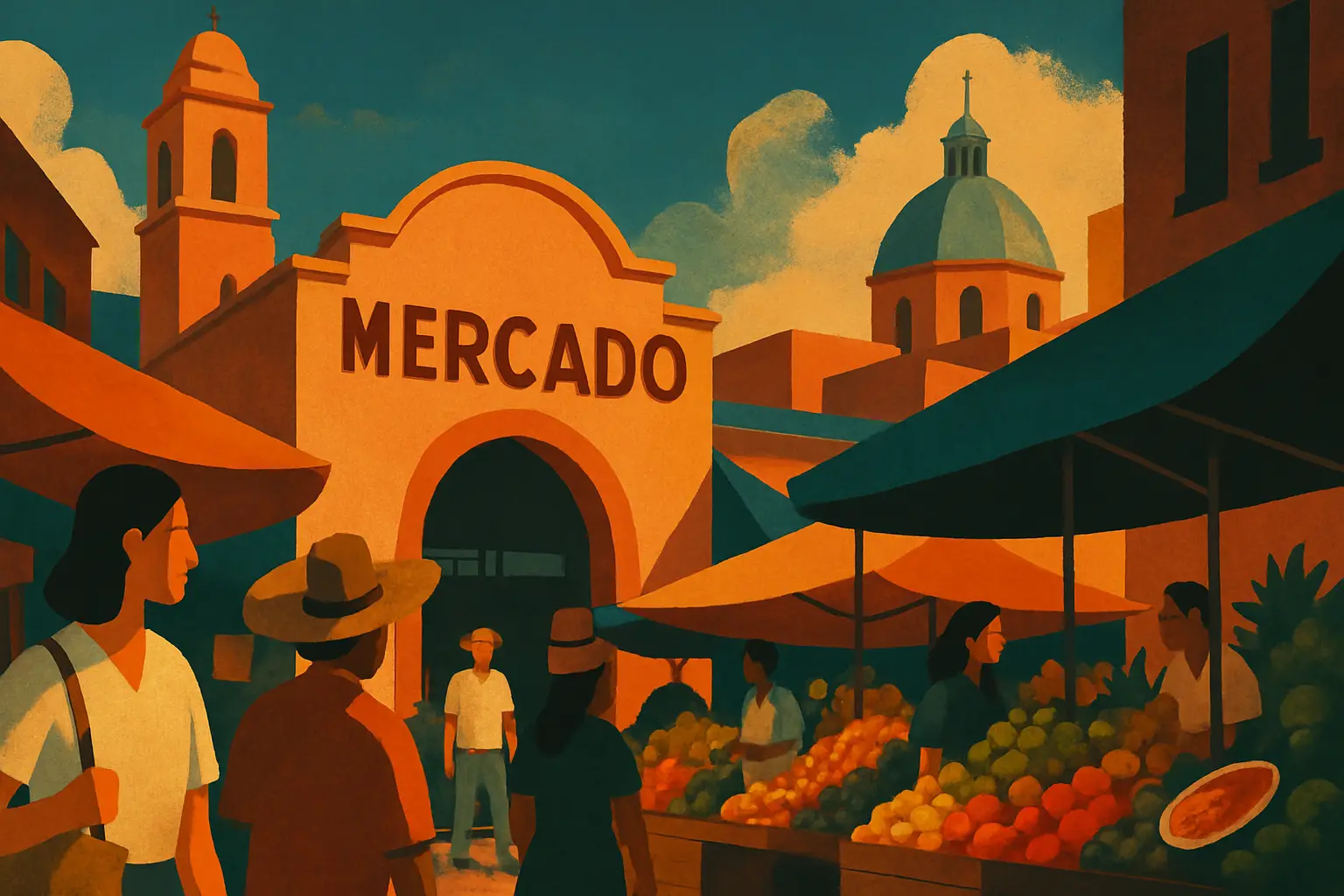
Mexico City has roughly 300 public markets, and almost all of them follow a similar format: produce, cooked food, clothing, hardware, and household goods in rough equal measure. Mercado de San Juan, which sits on Calle Ernesto Pugibet 21 just south of the Alameda Central in Centro Histórico, took a different path. Over decades, it became the market where the city's specialty importers and gourmet food vendors concentrated — which meant the cheesemongers, the charcutiers, the exotic meat traders, and the sashimi-grade seafood suppliers who also sold to restaurants all ended up here. By the 2000s it had become the go-to source for European cheeses, Iberian charcuterie, wild mushrooms, and ingredients that simply don't exist in regular Mexican supermarkets. The result is an odd, specific place: a functioning neighborhood market with local staples on one end and imported Italian truffle and Japanese sake on the other. The building occupies a full city block, with around 200 vendor stalls organized loosely by category — cheese and charcuterie on one side, seafood and cooked food along the back, produce and specialty dry goods through the middle. It's clean, well-lit, and navigable on a first visit once you walk the full loop.
Located at Calle Ernesto Pugibet 21, Centro Histórico — nearest metro: Salto del Agua (Lines 1 and 8)
Open Monday–Saturday 9 AM–6 PM, Sunday 9 AM–5 PM
Around 200 vendor stalls in a single enclosed building
The cheese selection at San Juan is probably the best you'll find in Mexico City outside of a specialty import shop. Several stalls carry aged Spanish manchego — the real sheep's-milk version produced in La Mancha, not the mild domestic cow's-milk product sold everywhere else under the same name. You'll also find French camembert, Italian parmigiano-reggiano sold by the wedge, cave-aged Roquefort, Dutch gouda in several ages, and Spanish idiazábal. A useful exercise for first-time visitors: ask a vendor to let you taste the imported Spanish manchego next to the Mexican domestic version side by side. The difference — nutty and firm versus mild and rubbery — explains immediately why San Juan exists and why chefs make the trip from Polanco to shop here. The charcuterie stalls carry similar depth: jamón ibérico de bellota sliced to order, bresaola from Italian producers, prosciutto di Parma, and Spanish chorizo ibérico alongside excellent Mexican products including cecina from Yecapixtla (the Morelos town famous for its air-dried beef) and black chorizo from Oaxacan producers. The vendors are patient and accustomed to questions — this is one of the few markets in the city where asking for tastes before buying is normal and expected.
Get short, interactive stories that make each place easier to remember while you travel.
The seafood section runs along one side of the building, and a handful of vendors have built what amounts to a standing raw bar right between the stalls. The format is simple: fresh oysters opened to order, served with limón and hot sauce, eaten standing at a small counter. The oysters come from Baja California (Pacific oysters, briny and clean) or the Gulf of Mexico — ask the vendor which batch is freshest if both are available, since they don't restock at the same frequency. Beyond oysters, the same vendors sell tostadas de atún — raw tuna on a fried corn tostada with avocado, cucumber, and a swipe of mayo — and aguachile de camarón, raw shrimp marinated in lime juice and serrano chile until the acid 'cooks' the protein into something bright and clean-tasting with real heat at the end. The seafood vendors at San Juan source directly from suppliers who also sell to high-end restaurants, which means the quality and freshness track closely to what you'd get at a sit-down restaurant in Roma Norte for significantly less money. Expect to pay around 80–120 pesos for a serving of oysters, 60–80 for a tostada.
Pacific oysters from Baja California: briny and firm — the more reliably consistent option
Tostadas de atún: raw tuna, avocado, cucumber on a fried tostada — the best value item in the market
Aguachile: ask for the spice level before ordering — San Juan versions tend toward serious heat
The exotic meat stalls are the part of Mercado de San Juan that generates the most social media content, and they deserve both the attention and a little context. Yes, you can buy ostrich, crocodile, venison, wild boar, and occasionally lion meat at certain stalls. The vendors are licensed and the products legally sourced from registered farms — this is not a black market situation. The crocodile, which comes from regulated farms in Tabasco and Chiapas, is the most approachable option: the tail meat is lean and firm with a texture somewhere between chicken and a dense white fish, usually served as tacos with salsa verde. It's genuinely good and worth ordering once. Ostrich from Hidalgo farms is served as a steak cut — lower in fat than beef, darker in color, and mild enough that it takes a chile marinade well. The lion meat, when it appears, comes from exotic animal operations and is expensive enough that vendors price it by the gram; the flavor itself is unremarkable — mild and lean — and the price premium is entirely for the novelty. Order the crocodile. Skip the lion unless the story is the whole point for you.
Crocodile: farmed in Tabasco and Chiapas — lean tail meat served as tacos with salsa verde, genuinely worth trying
Ostrich: from Hidalgo farms — steak cut, lower fat than beef, takes seasoning well
Lion: legally sourced, overpriced for what it is — the story costs more than the flavor
San Juan is small enough to cover fully in an hour, but the most satisfying way to visit is to plan around the food counters rather than treating it as a grocery run. Start near the entrance with a slow pass through the produce section — the stacks of dried chiles, heirloom corn varieties, and specialty mushrooms (huitlacoche, morels, chanterelles) give you a sense of the market's range before you commit to anything. Move to the cheese stalls and ask for tastes — this is expected, not pushy. The raw bar vendors are usually midway through the building and are the natural midpoint break: order oysters or a tostada, eat standing, and watch the market work around you. After the raw bar, work toward the back wall where the cooked food counters concentrate — chilaquiles, tacos, and the exotic meat preparations if you want to experiment. Finish at the specialty importers near the far wall, which carry Japanese sake, Spanish paprika, French mustard, and quality olive oils that are genuinely hard to find at competitive prices elsewhere in the city. The full loop with stops takes about 90 minutes and costs around 300–400 pesos if you eat and taste along the way.
The detail that makes San Juan more interesting than just a shopping stop is that it's a working procurement market for the city's restaurant scene. Chefs from restaurants in Polanco, Roma, and Condesa send staff here for ingredients that either don't exist at regular suppliers or are better quality than anything available through conventional channels. The sashimi-grade bluefin and yellowfin tuna — which changes by season — goes to Japanese restaurants across the city. The aged European cheeses supply hotel kitchens and European-style bistros. The huitlacoche (corn fungus, a pre-Hispanic ingredient sometimes called 'Mexican truffle') that appears in season goes to contemporary Mexican restaurants where it gets plated as a luxury product. Understanding this supply chain context changes how you look at the pricing: yes, San Juan costs more than a neighborhood tianguis. But you're buying at the same level as a professional kitchen — the gap between what ends up on a 600-peso tasting menu and what you can buy here at cost is narrower than it looks. You can read more about how Mexico City's food traditions developed across centuries to understand why a market like this emerged in the first place.
Mercado de San Juan is at Calle Ernesto Pugibet 21, Centro Histórico. The nearest metro stations are Salto del Agua (Lines 1 and 8), about a four-minute walk south, and Balderas (Lines 1 and 3), about six minutes to the northwest. It's also an easy walk from the Alameda Central park (eight minutes), Palacio de Bellas Artes (twelve minutes), and the Zócalo (fifteen minutes) — making it a natural add-on to any Centro Histórico morning. Best time to visit is Tuesday through Friday between 10 AM and 1 PM: the seafood is at peak freshness, the cooked food counters are fully running, and the crowds are thin enough that vendors have time to talk. Saturday mornings are good but noticeably busier. Sunday is the quietest day but some specialty vendors reduce stock or close early. Avoid arriving right at 9 AM — most vendors take 20–30 minutes to set up fully, and the prepared food counters often don't start cooking until closer to 10.
Metro: Salto del Agua (Lines 1 and 8) — four-minute walk north to the market entrance
Best window: Tuesday–Friday, 10 AM–1 PM — peak freshness, thin crowds
Sunday hours: 9 AM–5 PM — quieter but some vendors reduce stock or skip the day
The most common complaint about San Juan — in expat forums and travel reviews — is that it's expensive compared to regular markets. That's partially true and worth addressing directly. Compared to a neighborhood tianguis or a standard mercado, San Juan is definitely more expensive. Imported Spanish manchego costs more than domestic manchego. Fresh oysters cost more than canned seafood. Sashimi-grade tuna costs more than supermarket cuts. But the right comparison isn't to a tianguis — it's to a specialty import grocer or a seafood restaurant, and by that standard San Juan is competitive. An oyster at San Juan costs about the same as at a seafood restaurant in Roma Norte, and you're getting it fresher and eating it standing up in a 150-year-old market building. The European cheeses are priced similarly to what you'd pay at a specialty import store — without the import store markup. The exotic meats are priced as novelties, which they are. For expats who miss European cheese, or travelers who want to understand how Mexico City's restaurant kitchens actually work, San Juan delivers specific value. For visitors expecting tianguis prices at a gourmet market, the expectation is wrong rather than the market.