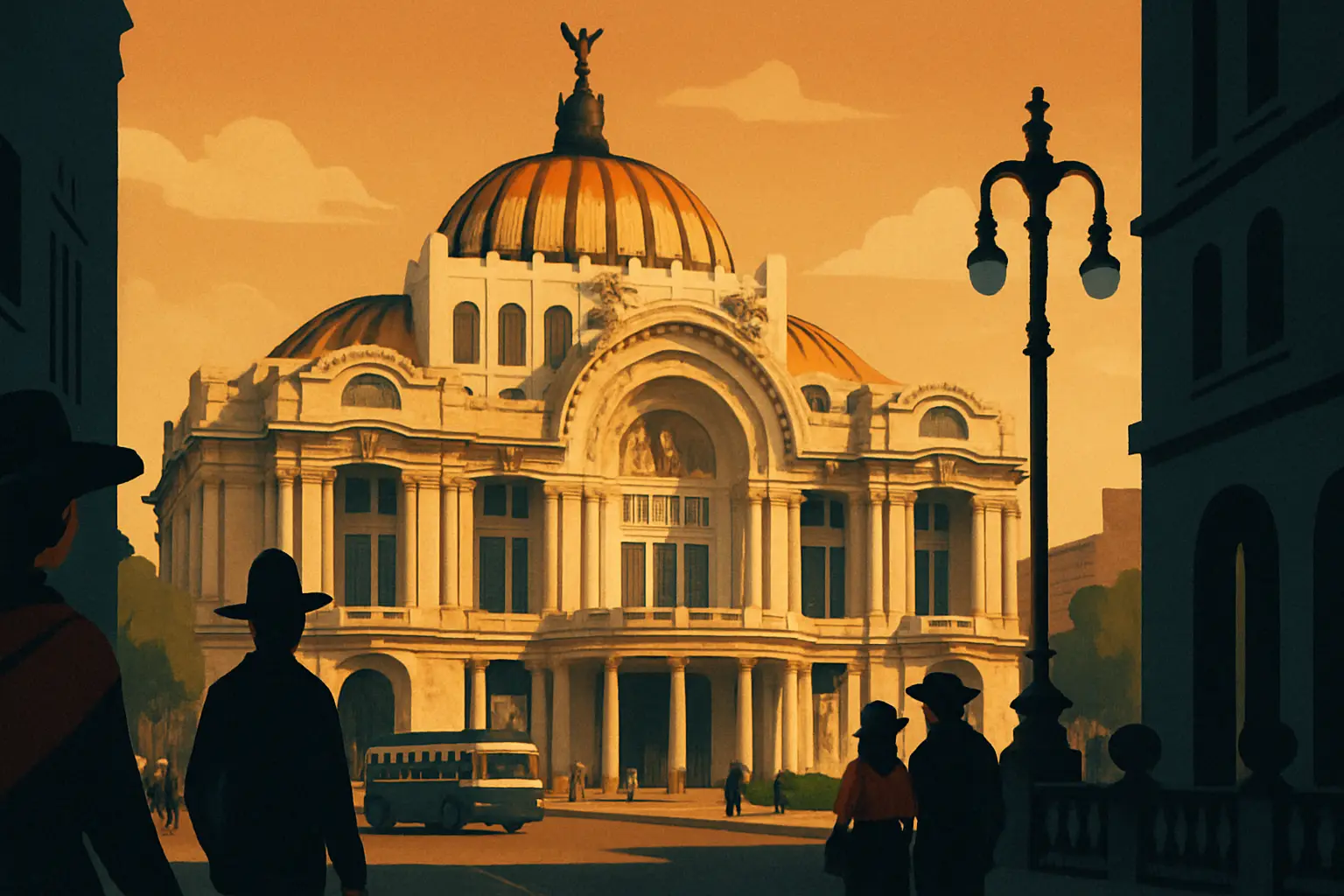
The Palacio de Bellas Artes started as an act of Porfirian ambition and ended as a testament to Mexico's inability to be rushed. President Porfirio Díaz commissioned Italian architect Adamo Boari in 1904 to build a grand opera house that would signal Mexico's arrival as a modern nation — something to rival Paris. The original plan was ten years. The result was thirty. Mexico City sits on the compacted sediment of an ancient lake bed, and the building began sinking almost immediately, delaying construction so severely that the Mexican Revolution came and went before the doors opened. Federico Mariscal, a Mexican architect, ultimately finished the interior in Art Deco style after Boari abandoned the project — which is why the exterior (white Carrera marble, Art Nouveau flourishes, a crystal-and-iron dome) and the interior (angular copper accents, black marble staircases, geometric tile) feel like they belong to different centuries. The building has sunk more than three meters since construction began. You notice it the moment you approach from Avenida Juárez: you walk down a short flight of steps to reach the main entrance, descending to a floor that was once level with the street.
Before every performance at the Palacio de Bellas Artes, the stage crew lowers a glass curtain that took four years to fabricate and weighs approximately 22 tons. The curtain was designed by Mexican painter Gerardo Murillo — better known as Dr. Atl — and assembled by Tiffany Studios in New York between 1907 and 1911 from nearly 700,000 hand-cut pieces of opalescent glass. What it depicts: the Valley of Mexico as it would have looked in the 19th century, with Popocatépetl and Iztaccíhuatl rising snow-capped above the city. Both volcanoes are still visible from Mexico City on clear days — look southeast from Chapultepec Park or from the observation deck of the Torre Latinoamericana on Madero. The curtain is not on display during museum hours — it's only lowered for audiences attending a live performance. Watching it descend slowly before the Ballet Folklórico begins is one of those moments the city reserves as a reward for people who actually buy a ticket.
Get short, interactive stories that make each place easier to remember while you travel.
The Palacio de Bellas Artes holds murals by four of the most important Mexican painters of the 20th century, organized across the second and third floors. On the second floor: José Clemente Orozco's Katharsis (1934), a dark and chaotic work showing civilization consuming itself, painted in burning oranges and smoke-grays. David Alfaro Siqueiros contributed Nueva Democracia (1944) — a monumental figure breaking free of chains — and Tormento de Cuauhtémoc, depicting the Spanish torture of the last Aztec emperor. The third floor belongs to Diego Rivera's Man, Controller of the Universe — but the story behind it is the reason you should read the label before you look at the painting. Rivera originally painted this mural in 1933 for Rockefeller Center in New York. When Nelson Rockefeller noticed the face of Vladimir Lenin visible in the crowd of workers, he asked Rivera to remove it. Rivera refused. Rockefeller had the mural destroyed. Rivera recreated it from memory and photographs at Bellas Artes in 1934, this time adding Nelson Rockefeller himself to the capitalist side of the composition — drinking a martini at a dinner party, surrounded by social disease bacteria made visible under a microscope. That version is the one that exists today. You can read the full arc of Rivera's work across the city in the Diego Rivera murals guide.
Floor 2: Orozco's Katharsis, Siqueiros's Nueva Democracia and Tormento de Cuauhtémoc
Floor 3: Rivera's Man, Controller of the Universe — the recreated Rockefeller Center mural
Labels on the murals are detailed — read them before looking at the work
The Ballet Folklórico de México has performed at the Palacio de Bellas Artes since 1952, when choreographer Amalia Hernández founded the company with eight dancers and a vision for what Mexican folk dance could look like on a world stage. The company now has more than 75 dancers and performs every Wednesday evening at 8:30 p.m. and Sunday evening at 8:30 p.m., with occasional Sunday matinees added during peak season — check the current schedule at palacio.inba.gob.mx before you plan. The show runs two hours with no intermission and covers nine regional traditions: Jalisco's jarabe tapatío with full mariachi, the feathered spectacle of the Danza de los Quetzales from Puebla, the Yucatán's Jarana, and Día de Muertos sequences from Michoacán, among others. Each segment is full choreography, full period costume, full live band — nothing abbreviated or symbolic. Ticket prices range from roughly 200 to 2,500 MXN depending on seat location. The balcony at 300 to 500 MXN is a legitimate option: for a show this wide, the elevated angle gives a better view of the formations than the orchestra level.
Performances: every Wednesday and Sunday at 8:30 p.m. — year-round
Tickets: 200–2,500 MXN depending on seat; balcony is the value pick
Book in advance on weekends — sold out regularly during high season
Beyond the Ballet Folklórico, the Palacio de Bellas Artes is home to four other national companies: the National Theater, the National Dance Company, the National Symphony Orchestra, and the National Opera. The Orquesta Sinfónica Nacional performs in the main hall — a 1,800-seat auditorium with acoustics that have been benchmarked against European concert halls — and tickets typically run 50 to 400 MXN, making it one of the best-value cultural experiences in the city by any international standard. The National Opera season runs roughly September through June, with a program that mixes Italian and German classics with Mexican premieres. The smaller Sala Manuel M. Ponce, accessed from the ground floor lobby, hosts chamber music, recitals, and smaller productions — often free or under 100 MXN. The full monthly calendar is at palacio.inba.gob.mx. Symphony and opera tickets are generally available last-minute; Ballet Folklórico is not.
The museum galleries cost M$75 per adult, Tuesday through Saturday. On Sundays, admission is free for everyone — no reservation required, no proof of residency needed, foreign visitors included. Children under 13 and visitors with disabilities are free every day. The museum is open Tuesday through Sunday, 10 a.m. to 6 p.m. With a museum ticket you access all four floors of galleries: the permanent mural collection on floors two and three, rotating temporary exhibitions on the upper floors, and a bookshop and café on the ground level. Performances are separately ticketed through the box office or palacio.inba.gob.mx — the museum ticket does not include any show. The most common visitor mistake: spending 45 minutes on the ground floor admiring the lobby architecture, then leaving without going upstairs. The lobby is beautiful. The murals on floors two and three are the reason the building exists. Take the main marble staircase all the way up and work your way back down.
Museum: M$75 Tuesday–Saturday; free on Sundays for everyone
Open Tuesday–Sunday, 10 a.m. to 6 p.m.
Performances are separately ticketed — museum entry does not include shows
The Palacio de Bellas Artes sits at the eastern edge of Alameda Central — the oldest public park in the Americas, originally planted in the 16th century — and the Metro Bellas Artes station (Line 2 blue, Line 8 green) exits directly into the park, about a three-minute walk from the main entrance. If you're coming from the Zócalo, the walk along Calle Francisco I. Madero is ten minutes and passes the Torre Latinoamericana (the best publicly accessible rooftop view in Centro), the Palacio de Iturbide, and a stretch of 18th-century facades. The most natural Centro day: start at Templo Mayor and the Zócalo, walk west on Madero, arrive at Bellas Artes for the murals and a floor-by-floor walkthrough, then sit in Alameda Central to decompress. Arriving at 10 a.m. on a weekday gets you ahead of school groups and tour buses, which tend to arrive after 11. Sunday mornings are free but notably more crowded — worth it if the budget matters, slower if it doesn't.
Metro: Bellas Artes station, Line 2 (blue) or Line 8 (green) — exit into Alameda Central
From Zócalo: 10-minute walk west along Francisco I. Madero
Best combo: Templo Mayor → walk Madero → Bellas Artes → Alameda Central
Yes — but only if you give it enough time. Twenty minutes for the exterior and lobby is a partial visit that will leave you with photographs and nothing else. The murals on floors two and three justify 90 minutes of unhurried looking, especially if you read the context panels that explain who commissioned what and why. The building itself rewards a slow walk: the dome visible from the street is crystal and iron, the interior staircase is black marble with bronze railings, and the Art Deco detailing in the upper galleries is some of the finest in Latin America. If you're choosing one performance to attend during your stay in Mexico City, the Ballet Folklórico is the answer — it runs year-round, tickets are accessible, and nothing else in the city puts nine regional Mexican traditions on a world-class stage in two hours. On any given Sunday you can see the full mural collection for free, walk all four floors, and sit in Alameda Central afterward. That's a full cultural morning for zero pesos.