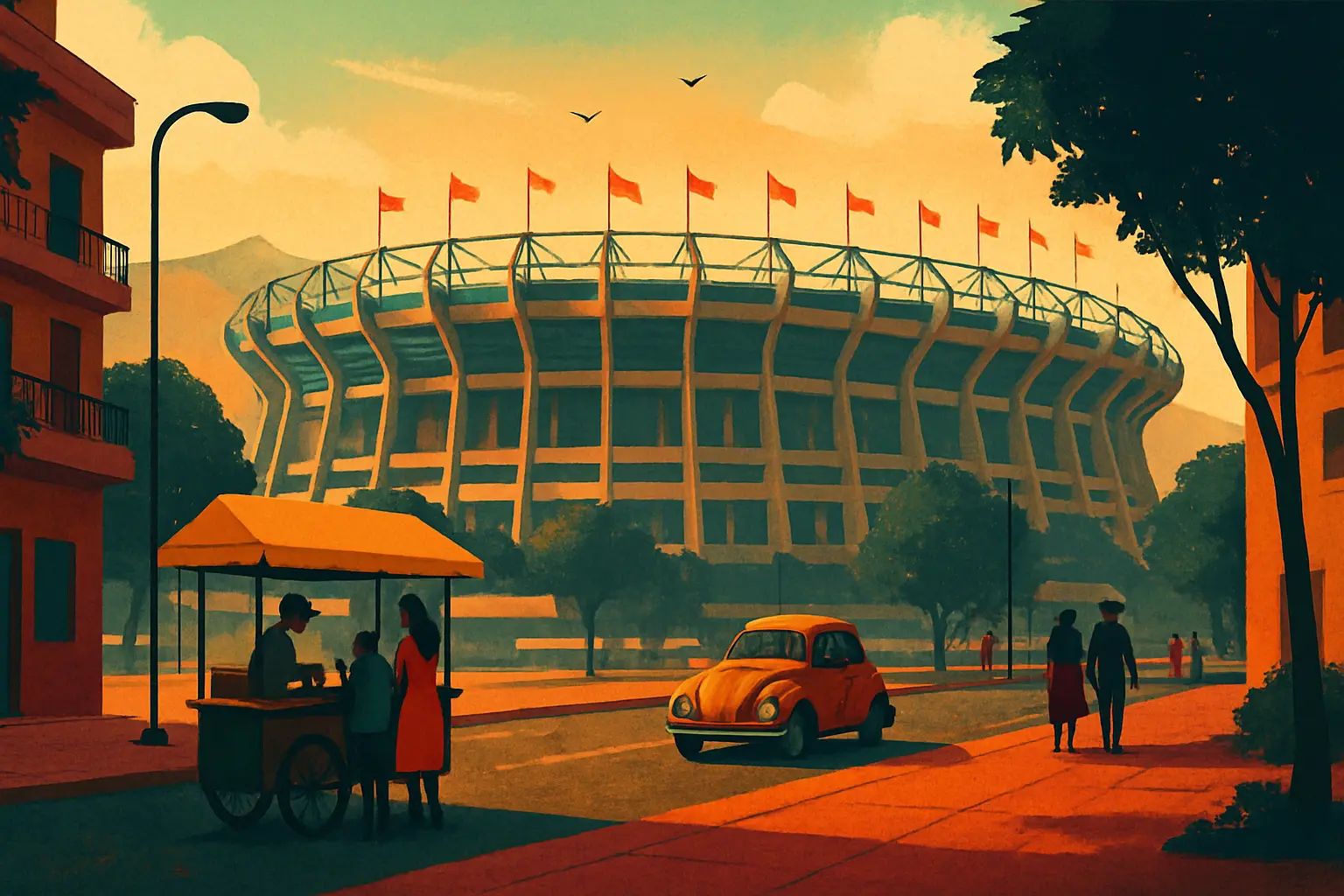
Estadio Azteca's nickname — El Templo Mayor del Fútbol (the Great Temple of Football) — is not accidental. The Templo Mayor was the central pyramid of Tenochtitlán, the sacred axis of the Aztec cosmos, the place where the most important ceremonies of the civilization took place. Mexicans gave that name to their football stadium because football — fútbol — occupies a similar place in the country's emotional and social architecture. Matches at the Azteca are not sporting events in the way a game in a neutral country might be — they are civic rituals, collective emotional experiences, and moments of national self-definition. The stadium has seen more of Mexico's significant cultural moments than almost any other single location in the country: World Cup finals, the 1985 earthquake (when the Azteca became a refuge and field hospital), political speeches, concerts attended by millions, and the matches where a generation of Mexicans defined their relationship to the national team. Understanding the Azteca requires understanding that in Mexico, football is not separate from culture. It is part of it.
El Templo Mayor del Fútbol: the nickname connects the stadium directly to the Aztec sacred precinct in cultural significance
The Azteca has hosted more significant Mexican national moments than almost any other single site
Mexican football culture treats El Tri matches at the Azteca as civic ceremonies, not entertainment
Estadio Azteca was designed by the architects Pedro Ramírez Vázquez and Rafael Mijares — the same Pedro Ramírez Vázquez who would design the Museo Nacional de Antropología, which opened in 1964 while the Azteca was still under construction. The commission reflected the same national ambition that produced the Museo: Mexico in the early 1960s was a country projecting itself as a modern, internationally significant power. The stadium was built on the lava fields of the Pedregal de San Ángel in southern Mexico City, in what was then largely undeveloped terrain. Construction began in 1961 and was completed in 1966. The capacity at opening was 112,000 — then the largest football stadium ever built. The name 'Azteca' was chosen partly for national pride and partly as a signal to FIFA that Mexico was a serious candidate for the World Cup. Mexico was awarded the 1970 World Cup in 1964, two years before the stadium opened. The bet paid off.
Designed by Pedro Ramírez Vázquez — the same architect as the Museo Nacional de Antropología, in the same ambitious national mood
Original capacity: 112,000 — the largest football stadium in the world at opening in 1966
Named 'Azteca' as an explicit [post-revolutionary national identity](/blog/mexican-revolution-explained) statement — Mexico as heir to a great civilization
Mexico 1970 is widely considered the greatest World Cup in history, and the Azteca hosted its defining moments. The tournament introduced color television broadcasting globally — and the Azteca's green pitch, in brilliant color, became one of the most watched images in the world. The final on June 21, 1970, pitted Brazil against Italy in front of a crowd of 107,412. Brazil's 4–1 victory — with Pelé opening the scoring and Carlos Alberto closing it with one of the greatest goals ever scored — gave Pelé his third World Cup title and was the performance that cemented Brazil's 1970 team as perhaps the greatest in football history. The tournament also produced the greatest individual duel in World Cup history: the England–West Germany quarterfinal was played here, but more important was the Brazil–England group-stage match, famous for Pelé's missed header ('the save of the century' by Gordon Banks) and Bobby Moore and Pelé exchanging shirts after the game — a moment often cited as the most sportsmanlike in World Cup history. The Azteca's altitude — 2,240 meters above sea level — favored the acclimatized Mexican and South American teams throughout the tournament.
June 21, 1970: the World Cup final — Brazil 4, Italy 1 — in front of 107,412 at the Azteca
The first World Cup broadcast in color globally: Mexico 1970 made the Azteca's green pitch one of the most seen images in the world
Pelé–Bobby Moore shirt exchange after the Brazil–England group match: often cited as the most sportsmanlike moment in World Cup history
Get short, interactive stories that make each place easier to remember while you travel.
Mexico hosted the 1986 World Cup under extraordinary circumstances — it had originally been awarded to Colombia, which gave it back due to financial difficulties. Mexico stepped in just two years before the tournament, despite the devastating 1985 earthquakes that had killed thousands in Mexico City. The Azteca, barely affected by the quake (its structural design protected it), became the stage for what is arguably the most famous 4 minutes in football history. On June 22, 1986, in the quarterfinal between Argentina and England, Diego Maradona scored two goals within four minutes. The first, at 51 minutes, was punched into the net with his left hand — illegal, undetected by the referee, and later described by Maradona himself as 'a little with the head of Maradona and a little with the hand of God.' The second, at 55 minutes, saw Maradona receive the ball in his own half, run 60 meters, beat five English players and the goalkeeper, and score what was voted the Goal of the Century by FIFA in 2002. Argentina beat England 2–1. Argentina won the tournament. The Azteca hosted both the 1986 group-stage game and the final — the only stadium to have hosted two World Cup finals.
June 22, 1986, 51st minute: the Hand of God goal — Maradona punches the ball in with his left hand, referee doesn't see it
55th minute: the Goal of the Century — Maradona beats 5 players and runs 60 meters before scoring
The Azteca is the only stadium in history to have hosted two FIFA World Cup finals (1970 and 1986)
On September 19, 1985, a magnitude 8.1 earthquake struck Mexico City at 7:19 a.m. The destruction was concentrated in areas built on former lake bed — thousands of buildings collapsed, and the death toll is estimated between 5,000 and 45,000 (official figures and independent estimates differ significantly). The Azteca stadium — built on the volcanic lava rock of the Pedregal, not on lake sediment — survived with minimal structural damage. Within hours it became a logistics hub: the pitch was used as a helicopter landing zone, the dressing rooms and concourses became medical triage areas, and the parking areas were used for emergency supply distribution. In subsequent days it housed thousands of displaced people. The earthquake's destruction accelerated major changes in Mexico City: new building codes, the strengthening of civil society organizations, and a shift in the political relationship between the Mexican government and Mexico City residents that historians now consider a turning point toward the country's eventual democratic transition. The Azteca was one of the few structures in the affected zone that functioned the morning after.
September 19, 1985: the Azteca survived the 8.1 earthquake because it's built on volcanic rock, not lake sediment
The pitch was used as a helicopter landing zone; the stadium served as triage center, supply hub, and refuge
The 1985 earthquake is considered a turning point in Mexican civil society — the government's response led to major democratic changes
El Tri — named for the three colors of the Mexican flag — has played home matches at the Azteca for 60 years, and the stadium's atmosphere during international matches is one of football's most intense experiences. The home crowd is known for its specific chant culture: the Cielito Lindo chorus after Mexican goals, the collective 'Eh!' that punctuates goalkeeper kicks before the crowd shouts 'Puto!' (a chant that has been the subject of ongoing FIFA sanctions against the Mexican federation). The atmosphere is warm toward opponents who play attacking football and withering toward teams perceived as defensive or cynical. El Tri's record at the Azteca in World Cup qualifying is extraordinary — the combination of altitude (opponents arrive from sea level and struggle for oxygen), the passionate crowd, and the weight of history has made it one of the most difficult home venues in world football. Mexico has qualified for every World Cup since 1994, with the team's famous 'Quinto Partido' (fifth game) — reaching the Round of 16 and failing to advance — becoming a dark cultural joke in the country.
El Tri at the Azteca: the altitude (2,240 m) affects sea-level opponents significantly — acclimatization takes 2–3 weeks at altitude
FIFA has fined the Mexican federation multiple times for the crowd's 'Puto!' chant — the issue remains unresolved
El Quinto Partido: Mexico has reached the Round of 16 in every World Cup since 1994 and failed to advance every time — a national obsession
The Azteca is home to Club América — the most successful club in Mexican football history, with 14 Liga MX titles. Club América's rivalry with Guadalajara (Chivas) — El Clásico Nacional — is the biggest club fixture in Mexican football and one of the most emotionally charged derbies in the Americas. América's home matches at the Azteca draw crowds of 60,000–80,000 regularly, and the club's fanbase crosses class, regional, and generational lines in a way few sports teams in Mexico do. The Azteca also occasionally hosts Cruz Azul matches. Liga MX is one of the most watched football leagues in North America — its Mexican broadcast numbers consistently exceed Major League Soccer, and it has significant viewership in the United States. For visitors to Mexico City, attending a Liga MX match at the Azteca — not a World Cup, not an El Tri qualifier, just a regular club match — is one of the most authentic experiences the city offers. The crowd, the atmosphere, and the food stands (elotes, carnitas tortas, micheladas sold in the stands by vendors who somehow navigate the crowd) are the real event.
Club América: 14 Liga MX titles — the most successful club in Mexican football history
El Clásico Nacional (América vs Chivas): the biggest fixture in Mexican football — equivalent to Real Madrid vs Barcelona in emotional intensity
Liga MX viewership in North America exceeds MLS — the league has significant US audiences in Mexican diaspora communities
The 2026 FIFA World Cup — co-hosted by the United States, Canada, and Mexico — returns the tournament to the Azteca for the first time since 1986. Mexico's venues are Mexico City (Estadio Azteca), Guadalajara (Estadio Akron), and Monterrey (Estadio BBVA). The Azteca is scheduled to host the tournament's opening match — a symbolic choice given the stadium's two previous finals — as well as several group-stage games. The tournament runs June through July 2026. The World Cup timing coincides with Mexico City's most culturally alive season: warm dry weather, minimal rain, and a city that has organized large public celebrations since the Aztec era. For visitors coming for the World Cup, the Mexico City culture guide gives the full cultural context. The practical reality: book accommodation months in advance, use the Metro Line 3 to reach the stadium (traffic makes Uber impractical on match days), and budget significant time in the neighborhoods around the stadium, where vendors, food stalls, and pre-match atmosphere begin hours before kickoff.
2026 World Cup: Azteca hosts the opening match — the third time the stadium has hosted a major World Cup moment
Mexico City's three World Cup venues: Azteca (CDMX), Estadio Akron (Guadalajara), Estadio BBVA (Monterrey)
Metro Line 3 to Estadio Azteca: the only reliable transportation on match days — traffic in the surrounding area stops completely
The Azteca offers stadium tours on non-match days — walking the pitch, visiting the dressing rooms, and entering the VIP areas that are otherwise inaccessible. Tours typically run Tuesday through Sunday and are a good option for football fans visiting Mexico City outside of match week. For actual matches: Club América's home schedule runs through the Liga MX season (roughly August to May, with a break in December). Tickets are available through Ticketmaster México and at the stadium box office. Prices range from 150–600 pesos depending on section — significantly cheaper than equivalent European club football. The standing sections (La Guardia Blanquiazul and La Monumental) are the most atmospheric but most intense; the lateral sections offer better sightlines. The stadium food is worth budgeting for: the tortas de carnitas at the stadium are not a secondary experience. Getting there: Metro Line 3 to Estadio Azteca station puts you at the main entrance. On match days, arrive 60–90 minutes early for the atmosphere. On non-match days, Uber is straightforward — the area is in the Coyoacán/Xochimilco zone of southern Mexico City, close to Xochimilco's canals if you want to extend the day.
Stadium tours: Tuesday–Sunday on non-match days — pitch, dressing rooms, VIP areas, trophy room
Liga MX match tickets: 150–600 pesos — significantly cheaper than equivalent club football in Europe
Metro Line 3 to Estadio Azteca: the correct answer on match days — Uber traffic stops for 2+ km in every direction