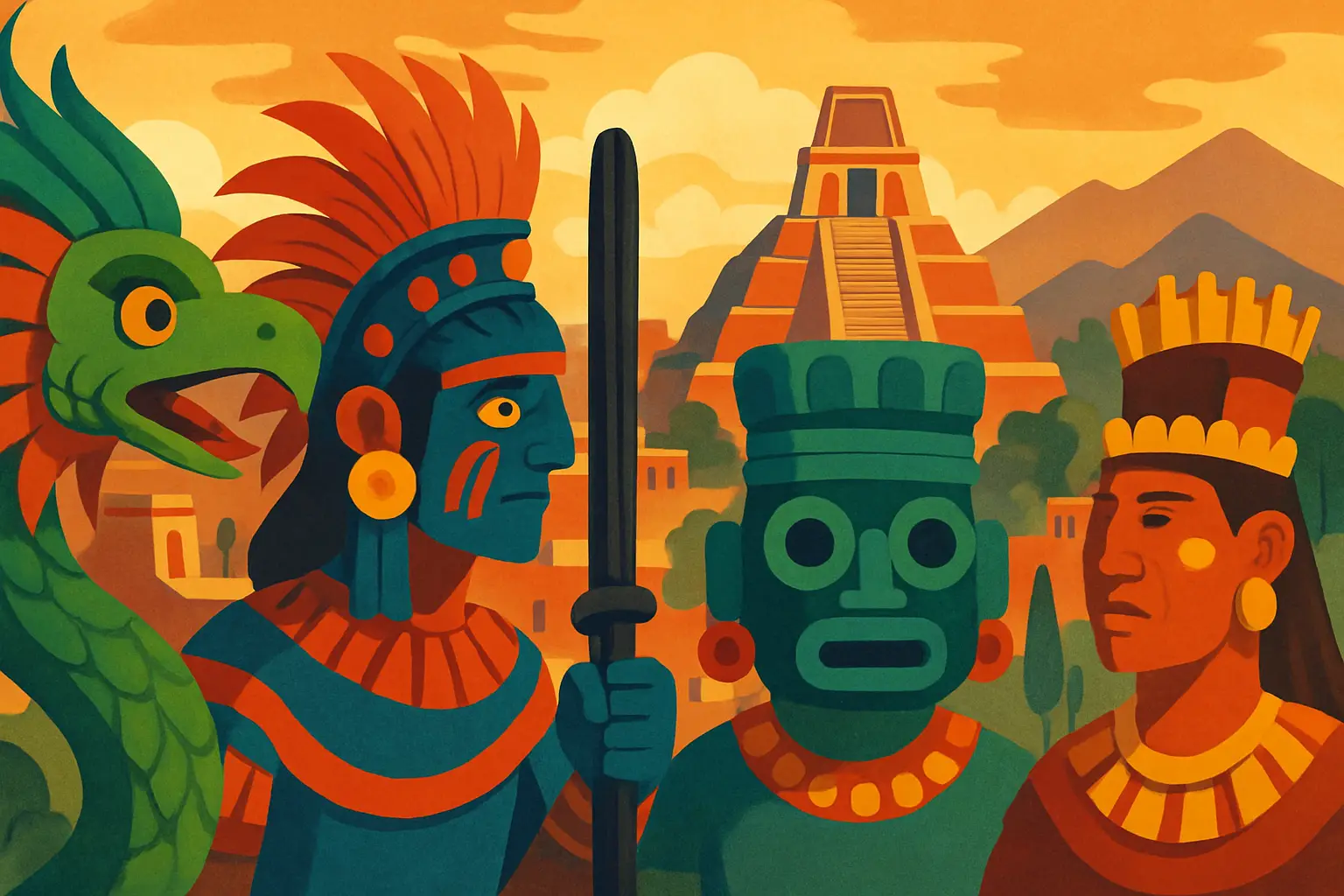
The Aztec gods are often discussed as 'mythology' — the same category as Greek or Norse gods, understood as stories rather than active forces. This is a post-conquest framing. For the Mexica, the gods were not characters in a narrative: they were the forces that operated the universe, and maintaining a relationship with them through ritual, sacrifice, and ceremony was not optional. The cosmos could fail. The sun could stop rising. Rain could stop falling. The gods required human energy — blood, offerings, attention — to continue doing what they did. This is why the Aztec religious system was inseparable from politics, military organization, agriculture, and daily life. The temple was not a place of individual spiritual practice: it was civic infrastructure. Understanding this makes the Templo Mayor ruins in Centro Histórico legible in a way they aren't if you approach them as ruins of an old religion.
The gods were active forces, not narrative characters — the cosmos required ongoing human participation to function
Religion was civic infrastructure: the temple organized the political, military, and agricultural calendar
The Aztec pantheon had hundreds of deities — most specialized in specific natural forces, crafts, or calendar periods
Huitzilopochtli (weet-zee-loh-POCH-tlee — 'Hummingbird of the South') was the patron deity of the Mexica people and the god of the sun and warfare. He was the reason the Aztec empire existed: the Mexica believed he had guided their migration from Aztlan, chosen the site of Tenochtitlán, and required the military expansion that fed him with the sacrificial captives he needed to rise each morning. The Aztec cosmological belief was that the current sun — the 'Fifth Sun' — was powered by sacrifice, and that without it, Huitzilopochtli would fail to rise and the world would end. Every morning the sun rose was a victory. Every captive sacrificed at the Templo Mayor fed that victory. The south face of the Templo Mayor was dedicated to Huitzilopochtli. At the summit stood his temple, painted blue and white to represent the sky. His image — a warrior in blue with a hummingbird helmet, carrying a fire serpent (xiuhcoatl) as a weapon — appears repeatedly in Aztec stone carving. The Museo Nacional de Antropología has the most significant collection of Huitzilopochtli imagery outside the original archaeological context.
The Fifth Sun cosmology: Huitzilopochtli required sacrifice to rise each morning — every dawn was a ritual victory renewed
The south face of the Templo Mayor was his temple — the north face belonged to Tlaloc, the rain god
The Mexica's military expansionism was theological: more territory meant more captives meant more sacrificial fuel for the sun
Get short, interactive stories that make each place easier to remember while you travel.
Tlaloc (TLAH-lohk) is the rain god — and one of the oldest continuously worshipped deities in Mesoamerica, predating the Aztecs by at least a thousand years. Images of Tlaloc appear at Teotihuacán, in Olmec art, in Maya contexts, and throughout the Aztec tradition. His iconography is immediately recognizable: large goggle eyes (sometimes described as made from serpents coiled into circles), long fangs, and a headdress associated with mist and clouds. He was worshipped both as a beneficent giver of rain and fertility and as a fearsome destroyer — droughts, floods, and lightning were all his domain. Children sacrificed in Tlaloc's honor (specifically children whose tears were believed to invoke rain) were one of the most disturbing aspects of Aztec ritual in Spanish accounts. The north face of the Templo Mayor — the blue-and-white tiled side facing rain — was Tlaloc's temple. The giant Tlaloc monolith now at the entrance to the Museo Nacional de Antropología was moved from the town of Coatlinchan in 1964: legend holds it rained on the day of the move, after a years-long drought.
Tlaloc predates the Aztecs by 1,000+ years — one of the oldest continuously worshipped deities in Mesoamerican history
The north face of the Templo Mayor was Tlaloc's — the twin-pyramid design reflected the two things civilization requires: war (south) and rain (north)
The Tlaloc monolith at the Museo de Antropología entrance: 167 tons, moved from Coatlinchan in 1964 — it reportedly rained on moving day
Quetzalcoatl (ket-zal-KOH-atl — 'feathered serpent' or 'quetzal-feather serpent') is the most internationally recognized Aztec deity — and the most frequently misrepresented. He was the god of wind (Ehecatl), learning, craftsmanship, and the planet Venus. His image — a serpent covered in quetzal feathers — appears across centuries and civilizations in Mesoamerica, from the Feathered Serpent pyramid at Teotihuacán to the Toltec site of Tula to the Aztec Templo Mayor. He was also associated with a legendary priest-king of the Toltecs named Quetzalcóatl, who according to Aztec accounts had been exiled from Tula and promised to return from the east. The popular narrative that Moctezuma II mistook Hernán Cortés for the returning Quetzalcóatl and surrendered on that basis is almost certainly a post-conquest invention — no contemporary Aztec account supports it, and historians now believe it was constructed after the fact to explain the Mexica's apparent passivity. The actual story of the conquest is far more complex. The feathered serpent motif remains one of the most powerful images in Mexican visual culture: it appears in Diego Rivera's murals and throughout contemporary Mexican art.
Quetzalcoatl = wind, learning, Venus, craftsmanship — not a war god, and not the god who 'caused' the Aztec surrender
The Cortés-as-Quetzalcoatl story is post-conquest mythology, not Aztec belief — no contemporary Aztec source supports it
The feathered serpent image appears across 1,500 years of Mesoamerican art: Teotihuacán, Toltec Tula, Aztec Tenochtitlán
Coatlicue (koh-at-LEE-kway — 'skirt of serpents') is the earth goddess — mother of Huitzilopochtli and the moon and stars — and the subject of the most extraordinary piece of Aztec sculpture in existence. The Coatlicue monolith, housed in the Museo Nacional de Antropología, stands 2.7 meters tall and depicts a figure whose head is two facing serpents (representing blood gushing from her severed neck), whose hands are serpent claws, whose skirt is writhing snakes, and whose necklace is made of human hearts, hands, and a skull pendant. She is simultaneously the force of creation and destruction — she gives birth and she devours. When the statue was unearthed in the Zócalo in 1790 during colonial-era construction, the Spanish authorities had it reburied because they considered it too disturbing. It was unearthed again in the 19th century. The German polymath Alexander von Humboldt saw it and described it as one of the most extraordinary objects he had ever encountered. It remains one of the most viscerally powerful sculptures ever made anywhere.
The Coatlicue monolith: 2.7 meters, 2 tons, unearthed in the Zócalo in 1790 — the Spanish reburied it for being too disturbing
Her iconography: serpent heads for a face, human hearts and skull necklace, serpent skirt — simultaneously creation and destruction
Von Humboldt's reaction on seeing it in 1803: one of the most powerful objects he had ever encountered in a lifetime of world travel
Tezcatlipoca (tez-cat-lee-POH-kah — 'smoking mirror') was one of the most powerful and feared deities in the Aztec pantheon — the god of the night sky, sorcery, discord, and change. He was often portrayed as the eternal rival of Quetzalcoatl: the two gods were said to have fought repeatedly, each destroying and creating new worlds in the process. His signature attribute was a black obsidian mirror in which he could see all events in the universe — past and future — and sometimes showed his victims terrifying visions of their fates. He was associated with jaguars (the animals of the night), sorcerers (nahuales), and unexpected catastrophe. Unlike most Aztec gods, Tezcatlipoca was actively malevolent in many accounts — he could ruin a king, destroy a harvest, or bring plague without requiring ritual provocation. One of the Aztec calendar system's most feared dates was controlled by Tezcatlipoca. Obsidian mirrors — the actual objects — were ritual tools used by priests for divination, and examples are in the Museo Nacional de Antropología and in the British Museum (Aztec mirrors were among the objects Cortés sent to Europe as gifts).
The smoking mirror: an obsidian scrying tool that showed all events in the universe — real objects survive in museums today
Eternal rival of Quetzalcoatl: Aztec creation mythology involves their repeated battles destroying and recreating successive worlds
Associated with jaguars, sorcerers, and unexpected catastrophe — one of the most actively fearsome Aztec deities
Xipe Tótec (SHEE-peh TOH-tek — 'our lord the flayed one') is the Aztec god of agriculture, seasons, and renewal — and the deity whose ritual is the most disturbing in the Aztec religious calendar. He was depicted wearing the flayed skin of a sacrificed person — the skin representing the husk of a seed that must be shed for new growth to emerge. In the spring festival of Tlacaxipehualiztli, priests sacrificed captives and then wore their skins for 20 days, representing the earth wearing its new skin of spring vegetation. The imagery is grotesque and the ritual is often cited as an example of Aztec barbarism in popular accounts — but the symbolism has its own internal logic: agricultural renewal requires death, the old season must be shed for the new one, the seed casing must split before the plant can grow. Several significant stone sculptures of Xipe Tótec — showing the characteristic double face of the deity inside the flayed victim's skin — are in the Templo Mayor museum and the Museo Nacional de Antropología.
Xipe Tótec = agricultural renewal — the deity of the spring planting season, not a war god
The 'wearing of the skin': a 20-day ritual in which priests wore the flayed skin of sacrificial victims, representing earth's new spring growth
The symbolism: the flayed skin = a seed husk — death and shedding are required for agricultural renewal
The Aztec deities did not disappear after the conquest — they were partially absorbed, partially disguised, and partially preserved in the objects that survived. The Museo Nacional de Antropología has the most comprehensive collection: the Aztec hall contains the Sun Stone (Tonatiuh, the sun god, at its center), the Coatlicue monolith, Tlaloc and Tezcatlipoca imagery, and dozens of smaller deity sculptures. The Templo Mayor museum has objects from the original excavation context — including burial offerings dedicated to Huitzilopochtli and Tlaloc. Diego Rivera's murals at the Palacio Nacional depict the Aztec gods in their pre-conquest context as part of the post-revolutionary argument about Mexican identity — the project of positioning Aztec civilization as Mexico's national origin. The Mercado de Sonora sells images of Tlaloc alongside Santa Muerte and Catholic saints — the folk spiritual market where the pre-Hispanic pantheon has not been forgotten, just reorganized. And the eagle devouring a serpent on the Mexican flag directly inherits the imagery of Huitzilopochtli's founding prophecy — the sun god's sign, on every Mexican document, every day.
Museo Nacional de Antropología: the Aztec hall has the Sun Stone, Coatlicue, Tlaloc, and major deity sculptures — the essential visit
Mercado de Sonora: Tlaloc imagery is still sold alongside Catholic and Santa Muerte supplies — the pantheon lives in folk practice
Mexican flag: the eagle-cactus-serpent is Huitzilopochtli's founding prophecy — the sun god's sign inherited directly into national identity