To understand why the Mexican Revolution happened, you need to understand the Porfiriato — the 35-year dictatorship of Porfirio Díaz that preceded it. Díaz came to power in 1876 with the slogan 'Effective Suffrage, No Re-election.' He then held power through rigged elections and political repression until 1911, canceling the principle of re-election entirely. Under Díaz, Mexico modernized at extraordinary speed: railways were built, foreign investment poured in, cities grew, and the economy expanded rapidly. The problem was who benefited. The Díaz model concentrated land and economic power in the hands of a tiny elite — the so-called científicos (technocrats who ran economic policy) — and foreign investors, primarily American and British. Indigenous and mestizo peasant communities who had farmed their land communally for generations were dispossessed through legal manipulation of land titling laws. By 1910, a small number of hacienda families owned an estimated 97% of Mexico's cultivable land. Rural Mexicans were bound to haciendas through debt peonage — a system barely distinguishable from the colonial-era encomienda. The political repression was absolute: opposition was jailed, exiled, or killed. By 1910 Díaz was 80 years old, had ruled for 35 years, and the system was straining under its own contradictions.
Porfirio Díaz ruled from 1876 to 1911 — 35 years of modernization-with-repression, known as the Porfiriato
By 1910, an estimated 97% of Mexico's cultivable land was owned by a tiny hacienda elite — peasants worked as virtual serfs in debt peonage
The científicos: Díaz's technocratic inner circle who ran economic policy in favor of foreign investment and against the rural majority
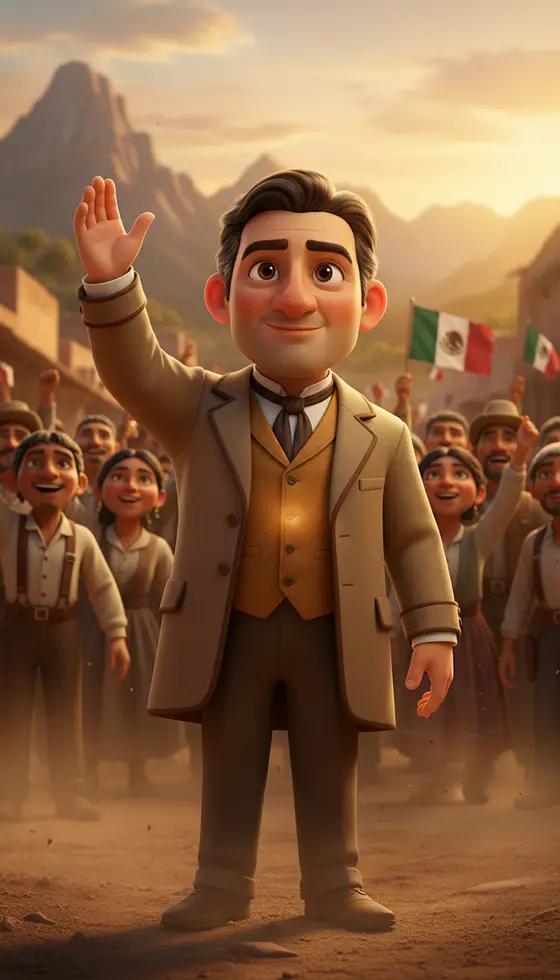
The Revolution began not with the radical land reformers Zapata and Villa, but with a wealthy landowner from Coahuila named Francisco Madero — a gentle, idealistic politician from a rich northern family who had written a book calling for democratic elections and genuine no-re-election enforcement. When Díaz jailed Madero before the 1910 election (to prevent him from winning), Madero escaped to the US, declared the election invalid, and called for armed uprising. The response was far beyond what Madero anticipated. Decades of dispossession and resentment detonated. In the north, the insurgent armies of Pascual Orozco and Francisco 'Pancho' Villa — a former cattle rustler and social bandit from Chihuahua who had assembled a formidable guerrilla force — swept through Chihuahua. In the south, Emiliano Zapata had already been organizing indigenous and mestizo peasants in Morelos around a simple demand: return the land. Díaz resigned in May 1911 and went into exile in Paris, where he died in 1915. He had not understood that Madero's political opening was a crack through which far more fundamental demands would pour.
Madero's demand was democratic elections — not land reform. The radical content of the Revolution came from Zapata and Villa, not its initiator.
Porfirio Díaz resigned May 25, 1911, and died in Parisian exile in 1915 — he never returned to Mexico
The Revolution spread faster than anyone expected: decades of dispossession meant the kindling was everywhere
Get short, interactive stories that make each place easier to remember while you travel.
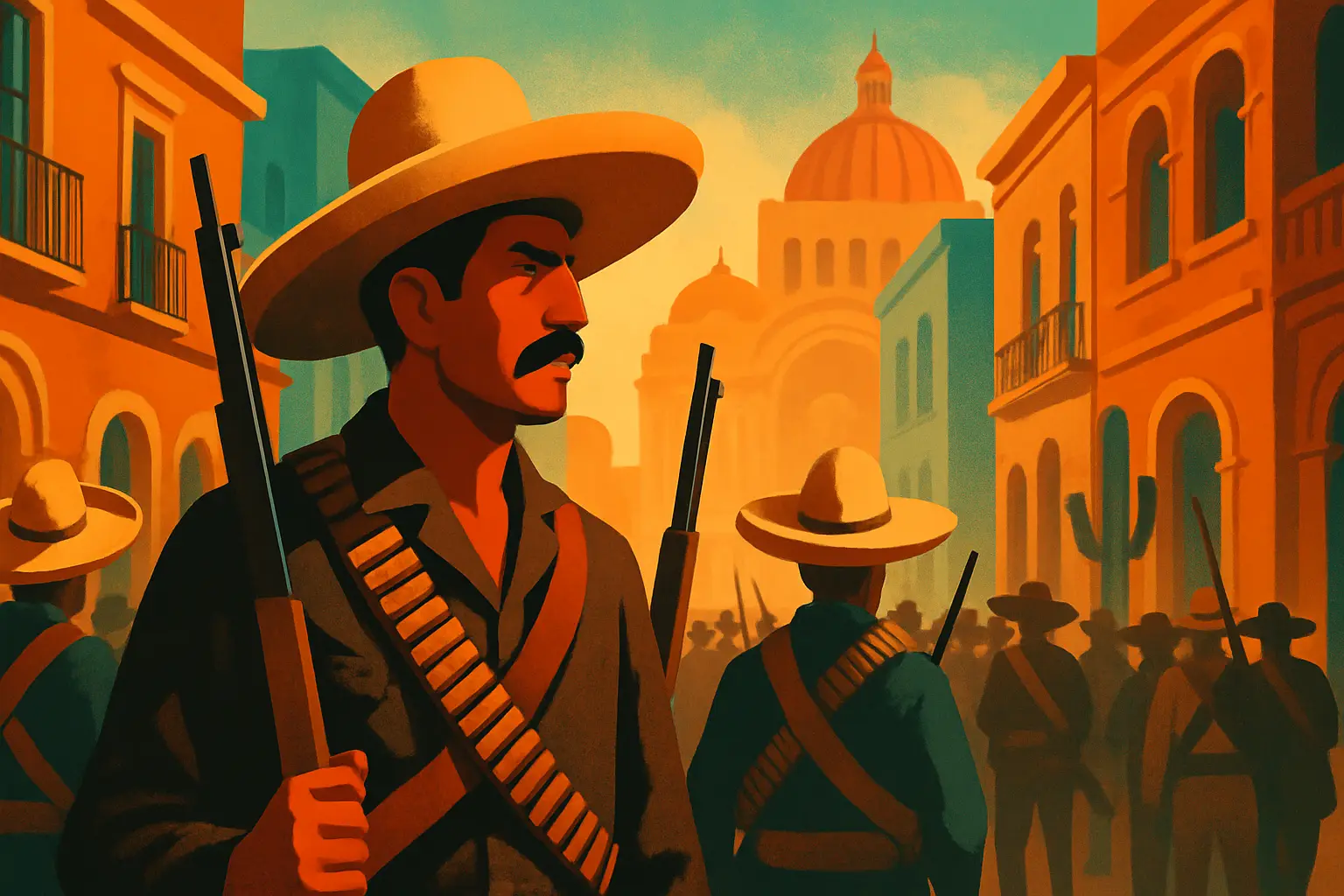
Emiliano Zapata is the figure the Revolution is most associated with globally, and for reason: his demand was the most direct and radical, his cause was unambiguous, and his image — the wide-brimmed sombrero, the ammunition belts, the revolutionary stare — became the visual icon of Mexican agrarianism. Zapata was a village leader from Anenecuilco, Morelos, an indigenous mestizo community that had been fighting a legal battle to recover its communal lands from a sugarcane hacienda for decades. When the Revolution began, he organized the Ejército Libertador del Sur (Liberation Army of the South) and in 1911 published the Plan de Ayala — one of the most important documents in Mexican history. The Plan de Ayala demanded the immediate restitution of communally held lands (ejidos) stolen from indigenous and mestizo villages, the nationalization of hacienda land, and land redistribution. It is one of the purest statements of agrarian reform in the 20th century. Zapata was willing to support any national political faction that committed to land reform and withdraw support from any that betrayed it — he supported Madero, then turned against him; he allied with Villa, then operated independently. He was assassinated in an ambush in 1919, arranged by Carranza's government. His name is still invoked in Mexican land rights movements — the EZLN (Zapatista Army of National Liberation) that rebelled in Chiapas in 1994 took his name deliberately.
Plan de Ayala (1911): Zapata's demand for immediate return of communal lands stolen by haciendas — one of history's clearest agrarian reform documents
Zapata was assassinated in April 1919 in an ambush organized by Carranza's government — he had refused to compromise on land reform
The Zapatista EZLN rebellion in Chiapas (1994) explicitly invoked his legacy — Tierra y Libertad remains an active slogan
Francisco 'Pancho' Villa is the Revolution's most internationally recognized figure — partly because he invited American filmmakers to film his battles in good lighting conditions. Born Doroteo Arango, an illegitimate son of a sharecropper who became a cattle thief and social bandit before transforming himself into one of the most effective military commanders in North American history, Villa led the División del Norte (Division of the North), which at its peak was the largest military force in Mexico. He was charismatic, ruthless, strategically brilliant in improvised guerrilla warfare, and utterly pragmatic in his politics — he supported Madero, then Zapata, then operated independently, then briefly invaded the United States (Columbus, New Mexico, 1916), prompting General Pershing's famous Punitive Expedition that never caught him. Villa's political ideology was simpler than Zapata's — he was an agrarian populist who wanted land for northern rancheros and peasants, but never formalized it into a comprehensive document. He was assassinated in 1923, shot in his car in Parral, Chihuahua — after years in retirement under an amnesty arrangement, someone decided he was still too dangerous to leave alive.
División del Norte: at its peak, the largest military force in Mexico — Villa was a self-taught military commander of extraordinary effectiveness
The Columbus raid (1916): Villa attacked Columbus, New Mexico, killing 18 Americans — prompting Pershing's Punitive Expedition that failed to catch him
Villa was assassinated in 1923 in Parral, Chihuahua — shot in his car, likely on orders from political figures who feared his continued influence
The most lasting product of the Mexican Revolution is not a military victory or a specific leader — it is the Constitution of 1917, which remains Mexico's current constitution and was, at the time of its passage, the most progressive national constitution in the world. It was drafted in Querétaro by the Constitutionalist faction under Venustiano Carranza, but its most significant articles were pushed by radical delegates against Carranza's own preferences. Article 27 — the land reform article — nationalized all subsoil resources (oil, minerals) and established that the nation could distribute and redistribute land in the national interest, providing the legal basis for the ejido system of communal land holding. This article was the legal foundation for the oil nationalization of 1938 by Lázaro Cárdenas. Article 123 established labor rights — the 8-hour workday, the right to strike, equal pay for equal work — decades before similar provisions appeared in most industrialized countries. Article 3 established free, secular, compulsory public education. Article 130 severely restricted the Catholic Church's legal standing — no religious organizations could own property, clergy could not vote, religious education in public schools was prohibited. The Constitution encoded the Revolution's core demands into law while keeping the most radical (Zapata's full land redistribution) contained within a framework that preserved large private landholdings alongside reformed ejidos.
Article 27: nationalized subsoil resources and legalized land redistribution — the legal basis for the 1938 oil nationalization and the ejido system
Article 123: 8-hour workday, right to strike, equal pay — among the most progressive labor rights provisions in the world in 1917
The 1917 Constitution is still Mexico's current constitution — with amendments, it has governed Mexico for over 100 years
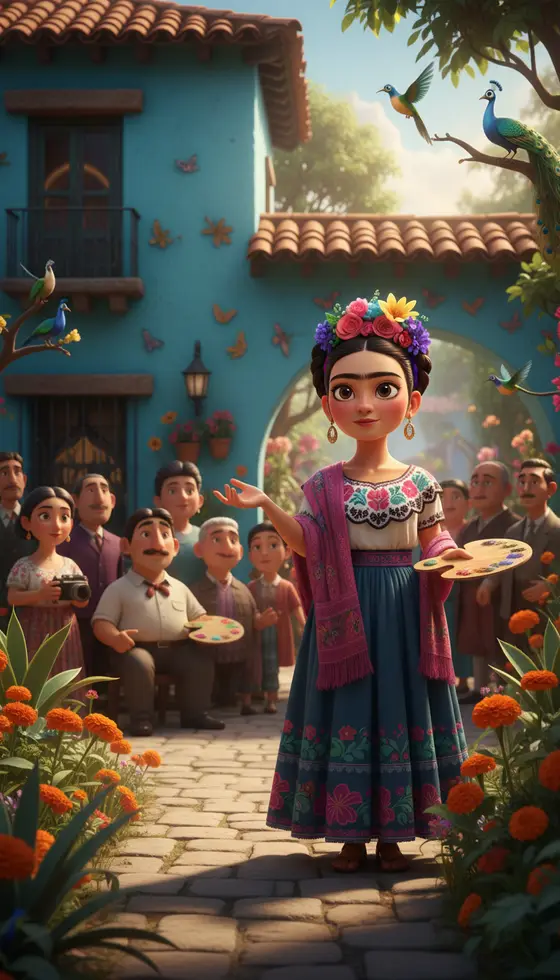
The cultural legacy of the Revolution is embodied most visibly in the muralist movement — the decision by post-revolutionary education minister José Vasconcelos to commission massive painted histories of Mexico on the walls of public buildings as a form of mass political education in a country where most people could not read. Beginning in 1921, Diego Rivera, José Clemente Orozco, and David Alfaro Siqueiros — the 'tres grandes' (three greats) — painted histories that celebrated pre-Hispanic civilization. Rivera's wife, Frida Kahlo, represented the private counterpart to the muralists' public statements — her intimate, autobiographical paintings explored the same indigenous-mestizo identity politics from the inside., documented the conquest and colonial exploitation, and framed the Revolution as the fulfillment of a centuries-long struggle. Rivera's murals at the Palacio Nacional are the largest and most significant: a panoramic history of Mexico from the Aztec civilization through the conquest, the colonial period, the Independence movement, the Reform, and the Revolution. The Museo Nacional de Antropología was also designed as a post-revolutionary statement — the Aztec civilization as Mexico's proud origin. Orozco's murals at the National Preparatory School and at the Hospicio Cabañas in Guadalajara are arguably more emotionally powerful — darker, more ambivalent about the Revolution's achievements. The muralist movement placed Mexican visual art on the world stage and directly influenced American Social Realism and the WPA murals of the 1930s.
Vasconcelos's project: commission murals as mass political education in a largely illiterate country — the walls as textbooks
The 'tres grandes' (Rivera, Orozco, Siqueiros) were given major public buildings to paint — the Palacio Nacional, the National Preparatory School, the Secretary of Education
The murals shaped how Mexicans understand their own history — the visual narrative of Aztec greatness → conquest → Revolution is largely a muralist construction
The most direct structural outcome of the Revolution was land reform — but it came slowly and unevenly. Zapata's demand for immediate full restitution was never fully met. Under the post-revolutionary governments of the 1920s, land redistribution proceeded cautiously. The great acceleration came under President Lázaro Cárdenas (1934–1940), who distributed more land in six years than all previous post-revolutionary governments combined — approximately 18 million hectares redistributed to ejido communities. The ejido system — communally held land that could not be sold or individually titled — became the central institution of rural Mexican land tenure. By 1940, approximately half of Mexico's agricultural land was organized as ejidos. The system worked to break up the hacienda concentration and give millions of families land access, but it also created a form of land tenure that critics argued prevented agricultural modernization: ejido land could not be collateralized for loans, could not be sold to consolidate efficient farms, and became increasingly fragmented as it was divided among heirs. In 1992, under President Carlos Salinas (as part of the NAFTA negotiations), Article 27 was amended to permit the privatization of ejido land. This was the specific trigger for the Zapatista uprising on January 1, 1994 — the EZLN chose the first day of NAFTA precisely to protest the revision of Zapata's foundational article.
Cárdenas (1934–1940): distributed 18 million hectares to ejido communities — more than all previous post-revolutionary governments combined
The ejido system: communal land that could not be sold or individually titled — intentionally designed to prevent re-concentration
1992 Article 27 amendment permitting ejido privatization triggered the Zapatista uprising on January 1, 1994 — the day NAFTA took effect
The Mexican Revolution's physical legacy is visible throughout Mexico City, most immediately in the buildings covered by murals that Vasconcelos commissioned. The Palacio Nacional murals on the east side of the Zócalo are the first stop — Rivera's staircase mural alone is one of the great historical paintings anywhere. The Secretaría de Educación Pública (SEP building, two blocks from the Palacio Nacional) has Rivera's most extensive mural cycle, 235 panels across two courtyards. The National Preparatory School (Colegio de San Ildefonso, one block from the Templo Mayor) has Orozco's early murals, including the famous Cortés and La Malinche. The Monumento a la Revolución — the massive Art Deco dome in Plaza de la República — was built as a legislative palace under Díaz, left unfinished by the Revolution, and repurposed as the Revolution's monument. Inside are the tombs of Madero, Zapata, Villa, Carranza, and Cárdenas. The Revolution's most enduring cultural legacy may be its framing of Mexican identity: the idea that Mexico is a mestizo nation forged from indigenous and Spanish heritage, that the Aztec past is a source of pride, and that peasant and indigenous communities have claims on the state — these are post-revolutionary constructions that remain central to how Mexico understands itself.
Palacio Nacional: Rivera's staircase mural — the entire sweep of Mexican history, the most visited mural in the country
SEP building (near Zócalo): 235 Rivera mural panels across two courtyards — free to visit, almost completely overlooked by tourists
Monumento a la Revolución (Plaza de la República): contains the tombs of Madero, Zapata, Villa, Carranza, and Cárdenas