The comparison is understandable: both involve skulls, costumes, and a focus on death, and they fall on adjacent calendar dates (Halloween October 31, Día de Muertos November 1–2). But the underlying beliefs are opposite. Halloween descends from Celtic and Christian traditions in which the dead are feared — potentially malevolent spirits that need to be warded off or placated. Día de Muertos is built on the belief that the dead are family members who miss you and want to come back for a visit. The holiday is not about fear of death but about the continuation of relationship across it. A family building an ofrenda (altar) for a deceased grandmother is not performing a dark ritual — they are setting the table for someone they love who can't make it in person anymore. This distinction is not superficial. It explains why Día de Muertos celebrations are festive rather than spooky, communal rather than individualistic, and emotionally complex in a way Halloween rarely is.
Halloween: ward off the dead. Día de Muertos: welcome the dead home for a visit
The mood is celebratory and warm, not spooky — families cook favorite dishes, play favorite songs, tell favorite stories
The skull imagery is not morbid in context — it's a symbol of continuity, not horror
Día de Muertos has roots that predate the Catholic overlay by at least a thousand years. The Aztec civilization had a complex relationship with death built into their cosmological system: death was not an ending but a transition to one of several afterlife destinations determined by how you died, not how you lived. The Aztec calendar included dedicated month-long festival periods for the dead — one honoring children who had died (in roughly what is now August) and one honoring adults (in roughly what is now October). When the Spanish arrived and imposed Catholicism, they moved these observances to align with the Catholic feasts of All Saints Day (November 1) and All Souls Day (November 2) — dates the Church had established centuries earlier to honor the Christian dead. What survived was not the specific Aztec rituals, but the belief structure underneath them: that the dead remain connected to the living, that they can return, and that maintaining that connection is a human obligation. The complete cultural guide to Mexico gives more context on how this pattern of survival-through-adaptation works throughout Mexican culture.
The Aztec calendar had dedicated month-long celebrations for the dead — predating Spanish contact by 1,000+ years
Spanish missionaries moved the dates to All Saints/All Souls Day (Nov 1–2) but couldn't displace the belief structure underneath
What survived was not just custom but cosmology: the dead remain connected to the living and can return
The ofrenda (altar) is the physical center of Día de Muertos. It's built in homes, schools, workplaces, and public spaces in the weeks before November 2, and it's not symbolic decoration — it's a functioning invitation. The altar is designed to guide the spirit of a specific person (or multiple people) back home and make them feel welcomed. The elements follow a logic. Photographs of the deceased anchor the spirit's identity. Food and drink — especially the deceased's favorite dishes — provide nourishment for the journey. Marigolds (cempasúchil) mark the path with scent; their smell is believed to guide spirits across the threshold between worlds. Copal incense (also used in Aztec religious ceremony) purifies the space. Water refreshes after the journey. A lit candle represents the soul's light. Salt purifies. Pan de muerto — the sweet egg bread baked specifically for this holiday, shaped to suggest crossed bones — is both offering and communion. Some ofrendas include the person's belongings: their tools, their musical instruments, their favorite bottle of mezcal. Building an ofrenda is an act of detailed, personal memory.
Every element serves a specific function — the ofrenda is a functional invitation, not symbolic decoration
Marigolds: the scent guides spirits home. Copal: purifies the space. Water: refreshes after the journey.
Pan de muerto is baked specifically for this holiday — sweet egg bread shaped to suggest crossed bones and the four cardinal directions
Get short, interactive stories that make each place easier to remember while you travel.
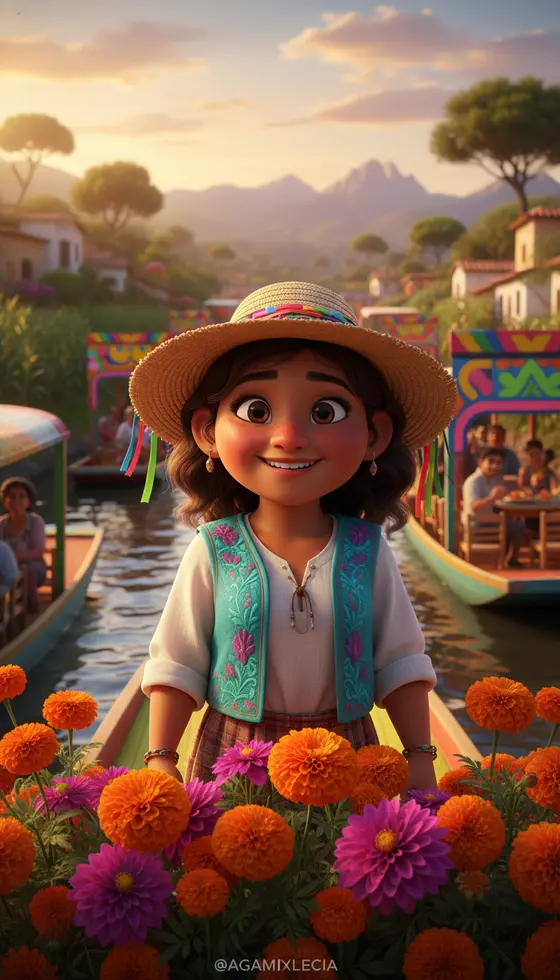
Cempasúchil — the bright orange marigold — is the flower of Día de Muertos, and its supply chain reveals how deeply the holiday is embedded in Mexican civic life. Every October, Mercado de Jamaica — Mexico City's only 24-hour flower market — becomes the supply center for millions of marigold stems destined for ofrendas across the metropolitan area. The wholesale operation runs through the night for weeks. Petals are used to create paths from the street to the front door of homes, guiding spirits along the route home. The flower was associated with the dead in Aztec ritual long before the Spanish arrived — its specific scent and color were believed to attract spiritual attention. Copal, the resin incense burned on ofrendas and at spiritual markets like Mercado de Sonora, is also pre-Hispanic in origin, used in Aztec religious ceremony to communicate with the gods. It burns with a pale smoke that both purifies and rises — carrying intention upward. The combination of marigold scent, copal smoke, and candlelight creates the specific sensory signature of Día de Muertos that travelers remember long after the trip.
Mercado de Jamaica supplies millions of marigold stems to Mexico City every October — the market operates 24 hours for weeks
Marigold petals are laid from the street to the front door: a literal path for spirits to follow home
Copal incense has been used in Mesoamerican ritual for 3,000+ years — the same resin sold at Mercado de Sonora today
The experience of Día de Muertos varies significantly by region, urban vs. rural setting, and family tradition — but the core shape is similar across Mexico. In the days before November 2, families build ofrendas at home and clean and decorate graves in the local cemetery. On the night of November 1 (the night of the children's spirits) and the night of November 2 (for adult spirits), families gather at the cemetery with food, drink, candles, marigolds, and music. This is not a solemn vigil — it's a family reunion with an additional guest. People eat the deceased's favorite foods sitting beside the grave. They play their favorite music — including hiring mariachi bands to perform songs the departed loved. They tell stories about the person, laugh at their remembered quirks, and cry without embarrassment. The night ends when the candles burn down. This ritual happens in cemeteries across Mexico, from the most remote indigenous villages to urban neighborhoods in Mexico City, Coyoacán, and Xochimilco.
Cemetery nights of Nov 1–2: family gatherings with food, music, and candles — not solemn vigils
Mariachi bands are hired to play the deceased's favorite songs at the graveside — it's a performance of love, not mourning
The tradition is pan-Mexican — from remote Mixtec villages to Mexico City neighborhoods, the same ritual core
The most internationally famous Día de Muertos celebrations are in Oaxaca — specifically in the cemeteries of Xoxocotlán and San Felipe del Agua on the nights of November 1–2, where thousands of marigold-lit graves create one of the most visually extraordinary scenes anywhere in Mexico. Pátzcuaro in Michoacán is similarly iconic: the candlelit boat procession across Lake Pátzcuaro to the island of Janitzio is one of the purest surviving expressions of the holiday's indigenous P'urhépecha roots. In Mexico City, the celebration is more urban but no less real. Xochimilco hosts a candlelit boat procession on the ancient canals on November 2 that draws thousands. Coyoacán's central plaza and streets fill with elaborate altar installations and street performers. The Zócalo hosts a large government-sponsored ofrenda display. And in neighborhoods throughout the city, ordinary families display home altars in their windows and doorways through the first days of November — a private ritual made briefly public.
Oaxaca: cemeteries of Xoxocotlán — marigold-covered graves lit by candlelight all night, the most photographed version
Michoacán (Pátzcuaro): P'urhépecha candlelit boat procession across Lake Pátzcuaro — one of the oldest surviving indigenous versions
Mexico City: Xochimilco canal procession, Coyoacán altar installations, and home altars visible in windows citywide
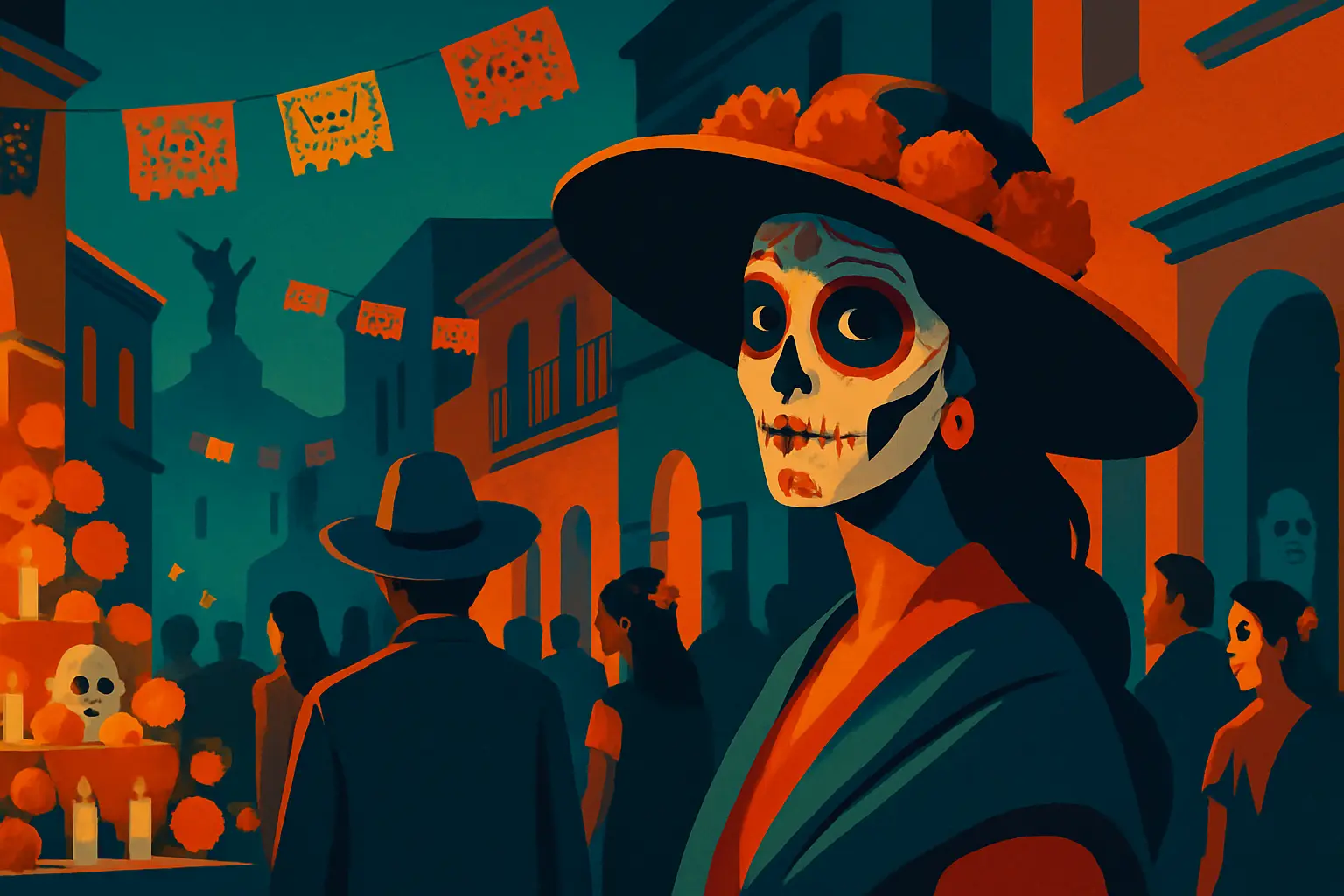
The elegant skeleton figure in a wide-brimmed hat that you see on every piece of Día de Muertos merchandise is La Catrina — and she is not ancient. She was created by illustrator José Guadalupe Posada in 1910 as a political cartoon satirizing Mexican upper-class women who adopted European fashion and forgot their indigenous roots. The original zinc etching showed just a skull in an ornate French hat — a commentary on social pretension. Diego Rivera added the body in his 1948 mural Dream of a Sunday Afternoon in Alameda Park, turning the skull into a full skeleton in aristocratic dress, and named her La Calavera Garbancera ('the chickpea skull'). The name 'Catrina' came later, in popular use. Today she's the visual symbol of the holiday globally — which Posada, who died in poverty, would probably find darkly amusing. The broader calavera (skull) tradition in Mexican visual culture is older: skull imagery in pre-Hispanic art represented the cycle of life, death, and renewal, not mortality as a finality. The Mexican cultural context is important: in a civilization that built cosmology around cyclical time and divine sacrifice, skulls were not memento mori — they were symbols of transformation.
La Catrina was created in 1910 as political satire by José Guadalupe Posada — not an ancient symbol
Diego Rivera added her body in 1948 and named her; the figure you see on merchandise is largely his creation
Pre-Hispanic skull imagery represented cyclical transformation, not mortality as finality — a fundamentally different meaning
Visitors often ask whether Día de Muertos is sad, and the honest answer is: yes and no, in the same breath. The holiday creates a container for grief that is different from Northern European or North American grieving traditions. Crying at the graveside while eating your deceased father's favorite tamales and laughing at a story about something he did is not a contradiction in Mexican Día de Muertos culture — it's the whole point. The tradition holds that death does not end relationship; it changes its form. The dead are still present, still loved, still capable of being pleased or offended (an ofrenda with the wrong food is a real faux pas in traditional families). This is a different relationship with mortality than the one dominant in most Western cultures, where death is typically hidden, professionalized, and separated from daily life. Octavio Paz — Mexico's Nobel laureate — wrote in The Labyrinth of Solitude that 'the Mexican is familiar with death, jokes about it, caresses it, sleeps with it; it is one of his favorite toys and his most steadfast love.' This familiarity is not macabre. It is intimate.
Grief and celebration coexist — laughing and crying at the same graveside is the intended emotional experience
The dead are understood to still be present, still capable of relationship — the ofrenda is a real communication, not metaphor
Octavio Paz: 'The Mexican is familiar with death, jokes about it, caresses it' — the holiday enacts this philosophy literally
Día de Muertos has become one of Mexico's most visited tourist events, which creates genuine tension: cemetery nights in Oaxaca and Michoacán can feel more like photo opportunities than family gatherings, and the commercialization of calavera imagery globally has stripped it of much of its meaning. Visiting respectfully means understanding that when you enter a cemetery on November 2, you are a guest at someone's family gathering — not a spectator at a performance. Ask before photographing, be quiet near families in private moments, and dress modestly. Participating is welcome: buying marigolds from a street vendor and placing them at a public altar is not cultural appropriation — it's participation. Hiring a local guide, eating at a market where families are celebrating, attending a public altar installation in Coyoacán or the Zócalo — all of these are appropriate entry points. The commercialized 'Day of the Dead party' version — skull face paint at a bar, plastic skeleton decorations — is not what you came to Mexico for. The real thing is available. You just need to know where to look.
Cemetery visits: you are a guest at a family gathering — ask before photographing, dress modestly, be quiet near private moments
Participation is welcome: buying marigolds, placing flowers at a public altar, eating the seasonal foods
The commercialized 'Dia de los Muertos party' is a North American export — the real tradition is available in every Mexican neighborhood in October–November
If you want to experience Día de Muertos in Mexico City, the key dates are October 28 through November 2. Altars start appearing in windows and public spaces in late October. November 1 (Día de Todos Santos) is dedicated to children's spirits; November 2 is the main day for adult spirits. The Xochimilco canal procession typically happens the night of November 2 — book boats early as they fill weeks in advance. Coyoacán hosts altar competitions and exhibitions in the main plaza throughout the week. The Zócalo ofrenda installation is visible from late October. The Mercado de Jamaica is worth visiting in the week before November 2 — the market is transformed by the wholesale marigold trade, and the scale of the flower operation is itself a lesson in how embedded this holiday is in the city's logistics. Hotel rates in CDMX spike in late October; book 6–8 weeks ahead if visiting during Día de Muertos.
Key dates: October 28 (altars appear) through November 2 (main night for adult spirits)
Xochimilco canal procession: night of November 2 — book boats weeks in advance
Hotel rates spike in late October for Día de Muertos — book 6–8 weeks ahead