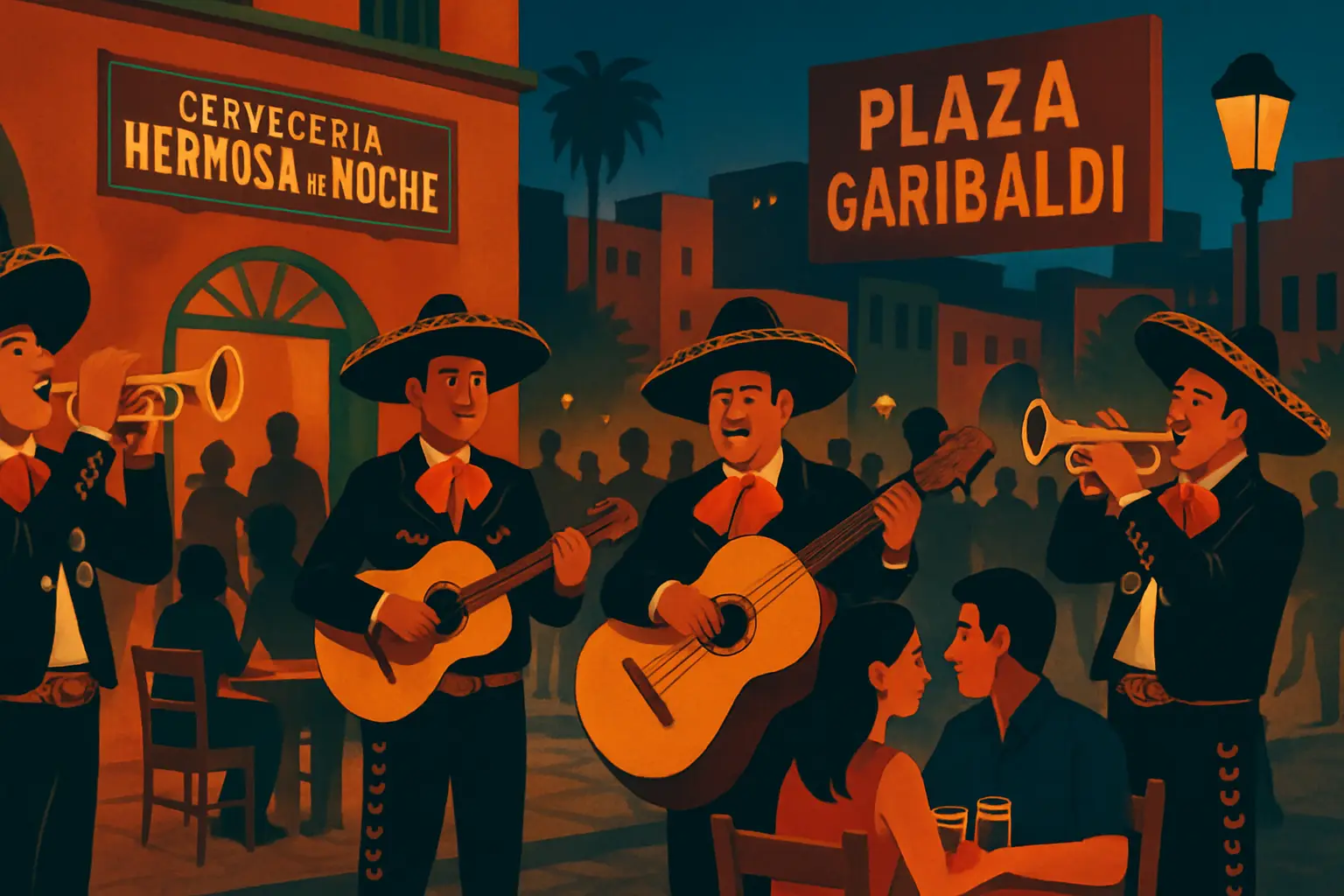
Plaza Garibaldi is Mexico City's dedicated mariachi square: a functioning open-air plaza at the intersection of Eje Central Lazaro Cardenas and Republica de Honduras, just north of Centro Historico, where dozens of bands gather every evening in full charro regalia. The plaza has worked this way since the 1920s, when mariachi musicians from Jalisco migrated to the capital looking for work and needed a fixed spot to find customers. Instead of roaming the city randomly, they converged on a single square — a live marketplace for music. That logic hasn't changed. Walk in on any Friday night and you'll find four or five bands competing at once, each trying to catch your eye before the others do.
Active from around 7pm; energy peaks after 9pm on weekends
Dozens of bands in embroidered charro suits compete for customers
Functioning as a musicians' marketplace since the 1920s
The mechanics are simple. Bands circulate the plaza and drift into the surrounding cantinas looking for anyone who'll buy a song. You flag one down — or let them approach you — and agree on a tune. A single song typically runs 100 to 200 pesos; a full set of five or six songs runs 400 to 800 pesos depending on the band and your negotiating energy. Negotiation is expected and friendly. If you want to be surprised, say 'sorpréndeme' (surprise me) and let them choose. If a band approaches when you're not ready, a simple 'no, gracias' ends it without awkwardness. The most important thing: commit. Point at a band you like, name a song or a genre, and let the performance unfold right in front of you.
Single song: 100–200 MXN depending on band and negotiation
Full set of 5–6 songs: 400–800 MXN — worth it for the experience
Say 'sorpréndeme' (surprise me) if you can't think of a request
Get short, interactive stories that make each place easier to remember while you travel.
Salon Tenampa has occupied the northeast corner of Plaza Garibaldi since 1925, when a merchant from Cocula, Jalisco opened it specifically to house his mariachi band and sell drinks to the crowds who came to listen. The formula hasn't changed much: mural-lined walls depicting scenes from Mexican folk life, tequila at every table, and bands walking the room taking requests between sets. It's the place where Mexico City's cantina culture and mariachi tradition fused into something that felt permanent. Go there first, sit anywhere, order a tequila blanco, and let the music come to you. You won't wait long.
Founded 1925 — the oldest cantina anchoring the plaza
Interior murals depict mariachi musicians and Mexican folk life
Bands enter and circulate among tables throughout the night
On the west side of the plaza sits MUTEM — Mexico City's dedicated museum for tequila and mezcal. The exhibits walk through the agave plant from cultivation to bottle, explaining why tequila must be made from blue agave in Jalisco while mezcal can come from multiple agave varieties across Oaxaca, Guerrero, and nine other states. The cultural history sections are genuinely engaging. Entry costs around 70 pesos, and the rooftop bar has one of the better elevated views of the plaza's organized chaos below. A visit before your cantina session is a smart way to set context for what you're about to drink.
Admission: roughly 70 MXN per person
Rooftop bar overlooks Plaza Garibaldi — good pre-night views
Covers the tequila vs mezcal distinction with real depth
Garibaldi is tequila territory. The move is a blanco or reposado served neat alongside a sangrita chaser — a spiced mix of tomato, citrus, and chile that you sip alternately with the tequila rather than mixing. Salon Tenampa's house pour is solid; if you want to ask for something specific, request a reposado from Los Altos de Jalisco, the highland region known for cleaner, more floral expressions. The food at the cantinas is secondary but honest: botanas (small plates that often arrive automatically with drinks), tacos de canasta, and menudo on weekends. Don't come here expecting a restaurant experience — come for the music, the spirit, and the company.
Friday and Saturday after 9pm are the undisputed peak. Every band in the city seems to converge on the plaza, the cantinas overflow, and the noise is glorious. If you want the full spectacle without competing for a table, arrive by 8:30pm on Friday and claim your spot before the rush. Weekday evenings — especially Wednesday and Thursday — offer a noticeably quieter version with more working musicians and fewer tourists. Sunday afternoons have a relaxed family energy and active bands playing for the lunch crowd. Early weekday evenings before 8pm are thin on energy; the plaza genuinely lives at night.
Peak: Friday and Saturday after 9pm — the real experience
Lower key but authentic: Wednesday or Thursday evenings
Sunday afternoon: family-friendly crowd, still plenty of music
Garibaldi has a rougher reputation than Roma Norte or Polanco — and like any large urban square after midnight, awareness matters. Inside Salon Tenampa and the other cantinas, you're in a staffed, crowded, well-lit environment with no unusual risk. On the plaza itself, earlier in the evening (7–10pm) feels comfortable for most visitors. The streets immediately northwest of the plaza, toward Tepito, are where caution increases. Practical rules that make the difference: arrive and leave with at least one other person, keep your phone out of sight when not using it, and use an app (Uber or DiDi) to call a ride home from inside the cantina rather than hailing a cab on the street after midnight.
Plaza Garibaldi sits at Eje Central Lazaro Cardenas and Republica de Honduras, just north of Centro Historico. The simplest option is Metro Garibaldi — served by Line B (direction Buenavista) and Line 8 — which puts you at the entrance in a two-minute walk from the turnstiles. An Uber from Roma Norte or Condesa takes 10–15 minutes and costs 80–130 pesos. Budget roughly 300–500 pesos per person for drinks over the course of the evening, plus 300–500 pesos if you commission two or three songs at your table. A full night — transport included — lands comfortably under 1,200 pesos per person.
Metro Garibaldi (Line B or Line 8) — 2-minute walk from station
Uber from Roma Norte: 10–15 min, 80–130 MXN each way
Full evening budget: 700–1,200 MXN per person including music