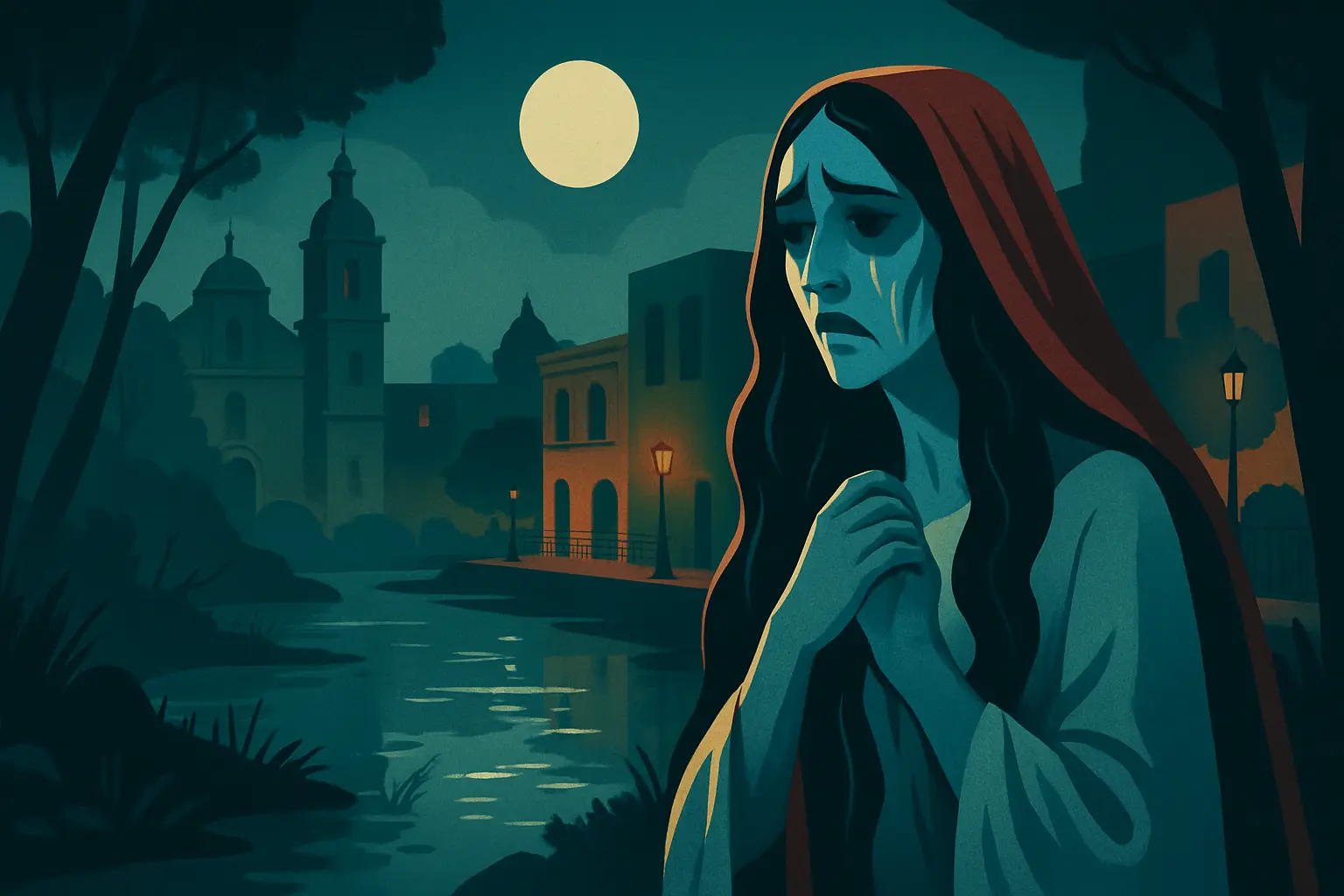
La Llorona (lah yoh-ROH-nah — 'the weeping woman' or 'the crying woman') is a ghost who wanders rivers, lakes, and waterways at night, wailing for her lost children. In the most common version of the legend, she was a beautiful woman who fell in love with a wealthy man who would not marry her. When he abandoned her for a woman of his own class, she drowned her children in a river — some versions say in rage, others in a tragic attempt to free them from poverty. Immediately after, she was overwhelmed by what she had done and ran to the water calling for them, but they were gone. She died — sometimes of grief, sometimes by her own hand — and her soul was refused entry into the afterlife until she could find her children. She wanders forever. Her cry — 'Ay, mis hijos!' (Oh, my children!) — is the sound that signals her presence. Children are warned not to go near water at night because she may take them, mistaking them for her own. In some regional versions, she takes the living as replacements for what she lost.
Her cry: 'Ay, mis hijos!' — Oh, my children! — is the identifying marker in every regional version
The afterlife refusal: she cannot rest until she finds her children — making her wandering eternal
A warning legend for children: the practical function of many versions is keeping children away from rivers and lakes at night
The most startling fact about La Llorona is that she may be older than her most famous version. When Spanish Franciscan friars collected oral testimony from Aztec informants in the decades after the conquest — compiling what became the Florentine Codex — those informants described eight omens that preceded the fall of Tenochtitlán. The sixth omen: a woman appeared at night, wandering through the streets of Tenochtitlán, wailing 'Oh my children, we are lost!' and 'Oh my children, where shall I take you?' The Aztec accounts describe this apparition appearing years before the Spanish arrived — a supernatural warning that the world was about to change. Some scholars see this omen as the origin myth of La Llorona; others see a parallel tradition that merged with the colonial-era version after the conquest. What is certain is that the figure of the weeping woman was already present in the Aztec cosmological imagination before any Spanish influence — and the Aztec relationship with omens, prophecy, and the supernatural was central to how they understood historical events.
Florentine Codex (1540s–1570s): Aztec informants described a weeping woman wandering Tenochtitlán as a pre-conquest omen
The omen cry: 'Oh my children, we are lost!' — structurally identical to the colonial-era legend
This makes La Llorona possibly the only Mexican legend with documented pre-Hispanic and colonial-era versions of the same figure
Get short, interactive stories that make each place easier to remember while you travel.
La Llorona is not a single story — she is a template, and every region in Mexico fills it differently. In some versions she is a mestiza woman wronged by a Spanish colonial man; in others, a pre-Hispanic figure connected to the Aztec goddess Cihuacóatl (the serpent woman, a deity associated with motherhood and death who was also said to wail in the night). In Oaxacan versions she is sometimes described as wearing indigenous dress and grieving children taken by colonial violence, giving the legend explicitly political dimensions. In the US Southwest — where the legend traveled with Mexican communities — she is sometimes conflated with 'La Malinche' (the indigenous woman who served as Cortés's interpreter) and her supposed grief over the children she had with the Spanish. In coastal regions she haunts rivers and the sea; in highland Central Mexico she haunts lakes and the remaining canals. Xochimilco — the ancient canal system in southern Mexico City — is one of the places most frequently associated with La Llorona sightings in the city. The variation itself is meaningful: La Llorona adapts to carry whatever grief a particular community needs to process.
Oaxacan versions: La Llorona mourns children taken by colonial violence — the legend as political memory
US Southwest versions: sometimes merged with La Malinche, reflecting Mexican-American community grief over cultural displacement
Xochimilco: the ancient canals in southern Mexico City are the city's most La Llorona-associated location
The pre-Hispanic figure most commonly linked to La Llorona is Cihuacóatl (the Serpent Woman) — an Aztec goddess associated with motherhood, childbirth, earth, and death. Cihuacóatl was the patron deity of midwives and women who died in childbirth, and she was believed to wail and appear at crossroads — especially at night — as an omen. Aztec sources describe her appearing as a beautiful woman in white who would leave a cradle in the marketplace; when people looked inside, they found a flint sacrificial knife instead of a child. She is one of the most prominent figures in the Aztec religious system — part of the same pantheon as Huitzilopochtli, Tlaloc, and Coatlicue — depicted in stone sculpture carrying a skull-decorated shield. The Templo Mayor in Centro Histórico contains significant imagery associated with her. The connection to La Llorona is not direct — Cihuacóatl was a goddess, not a ghost — but the overlap in characteristics (a woman, white or pale, associated with water and crossroads, wailing and carrying grief) suggests a genuine cultural lineage. The colonial-era La Llorona legend may have been the post-conquest form taken by a pre-Hispanic supernatural figure.
Cihuacóatl: Aztec goddess who wailed at crossroads at night, left false children in cradles, appeared as an omen of disaster
Women who died in childbirth were believed to become cihuateteo — dangerous female spirits who haunted crossroads and could harm children
The overlap between Cihuacóatl's characteristics and La Llorona's is too specific to be coincidental — a pre-conquest origin is likely
Every culture's ghost stories reveal what it fears and what it cannot process through ordinary conversation. La Llorona encodes several things that are genuinely central to Mexican cultural history. She embodies grief that has no resolution — a grief that cannot end because what was lost cannot be recovered. In a country whose history includes the loss of entire civilizations through conquest, epidemic, and forced assimilation, the figure of an inconsolable woman wandering forever near water is not just a warning story for children. She also encodes the specific grief of women in a patriarchal colonial society: abandoned by a man who would not acknowledge what they had created together, punished for their response, condemned for eternity. Contemporary Mexican feminist writers and artists have reclaimed La Llorona as a figure of female rage rather than female failure — an indigenous woman mourning what colonialism destroyed, not a mad woman who killed her children. The Day of the Dead tradition offers a counterpoint: a culture that can celebrate death because it has processed its relationship with it. La Llorona is what happens when that processing never completes.
La Llorona encodes a grief that cannot resolve — historically resonant in a country whose founding involved civilizational loss
Contemporary feminist rereadings: La Llorona as an indigenous woman mourning what colonialism destroyed, not a failed mother
Contrast with Día de Muertos: where Day of the Dead processes grief into celebration, La Llorona is grief that never reached resolution
La Llorona has been one of Mexico's most culturally productive legends — inspiring work across every artistic medium for over four centuries. The traditional song 'La Llorona' — an Oaxacan canción that became one of the most recognized Mexican folk compositions internationally — predates the 20th century and exists in hundreds of regional versions. Chavela Vargas's recording is often called the definitive version; it was featured in the opening of Pedro Almodóvar's film Volver (2006) and has been covered by artists across genres. The character appeared in a major animated sequence in Disney/Pixar's Coco (2017), though significantly softened. The horror film La Llorona (2019, Guatemalan director Jayro Bustamante) used her as a metaphor for political violence and impunity surrounding a Guatemalan dictator. In Mexico City's cultural calendar, Día de Muertos events frequently include La Llorona performances — theatrical recreations staged on the Xochimilco canals after dark, with actors in white crossing between boats on the ancient waterways. These performances are atmospheric but should not be confused with the living folk tradition, which does not require a theatrical setting.
The canción 'La Llorona': an Oaxacan folk song predating the 20th century, covered by hundreds of artists including Chavela Vargas
Coco (2017): the animated film includes a La Llorona sequence — significantly simplified from the legend's actual emotional complexity
Xochimilco night performances: theatrical La Llorona shows run during Día de Muertos on the ancient canals — atmospheric, worth booking in advance
La Llorona is the most widely known but not the only legend that structures the Mexican folk imagination. El Chupacabras (the goat-sucker) is a more recent legend — 1990s origin, Puerto Rican in its first recorded form — that rapidly became Mexican folk currency, blamed for livestock deaths across rural areas. El Nahual is much older: a shape-shifter who can transform between human and animal form, with roots in pre-Hispanic religious practice (Aztec priests were believed capable of taking animal form). La Siguanaba (Central American but present in southern Mexico) is La Llorona's close relative — a beautiful woman who lures unfaithful men to their deaths. El Aluxe (Yucatán Maya tradition) is a small, mischievous forest spirit that must be appeased by farmers and builders. In Mexico City specifically, neighborhood legends attach to specific locations: the tunnel under the Zócalo said to connect to Aztec-era passages, the haunted house in Coyoacán associated with colonial-era criminal activity, the figures said to appear on the Xochimilco canals on moonless nights. Mexico's legends are geographically and culturally specific — they belong to particular rivers, mountains, and streets, not to 'Mexico' as an abstraction.
El Nahual: a shape-shifter with documented pre-Hispanic roots — Aztec priests were believed to have nahual animal forms
El Aluxe: a Yucatán Maya forest spirit that must be ritually appeased when building on new land — still consulted by some Maya farmers
Mexico City urban legends: specific tunnels, houses, and canal stretches carry their own ghost stories attached to particular historical events
The Mercado de Sonora — Mexico City's folk-spiritual market — sells the practical equipment of La Llorona's world: copal incense, spiritual cleansing herbs, prayer candles organized by intention, and Santa Muerte imagery. The curanderos (folk healers) there operate within the same cosmological system that produced La Llorona. Xochimilco at night — particularly if you take a trajinera (flat-bottomed boat) beyond the tourist section into the quieter canals — is the atmospheric environment the legend describes: dark water, willow trees, the smell of plants and mud, silence. The Museo Nacional de Antropología houses the Cihuacóatl stone sculpture and other pre-Hispanic female deity imagery that connects to La Llorona's deep roots. The Day of the Dead celebrations in late October and early November are the moment when the boundary between the living and the dead is culturally at its thinnest — the season when La Llorona feels most present in Mexico City's collective imagination.
Mercado de Sonora: the living folk-spiritual practice that La Llorona is part of — copal, cleansing herbs, and Santa Muerte on the same shelves
Xochimilco night canals: the environment the legend describes — dark water, ancient canals, silence away from the tourist trajineras
Museo Nacional de Antropología: the Cihuacóatl sculpture room is the pre-Hispanic context for La Llorona's deeper roots