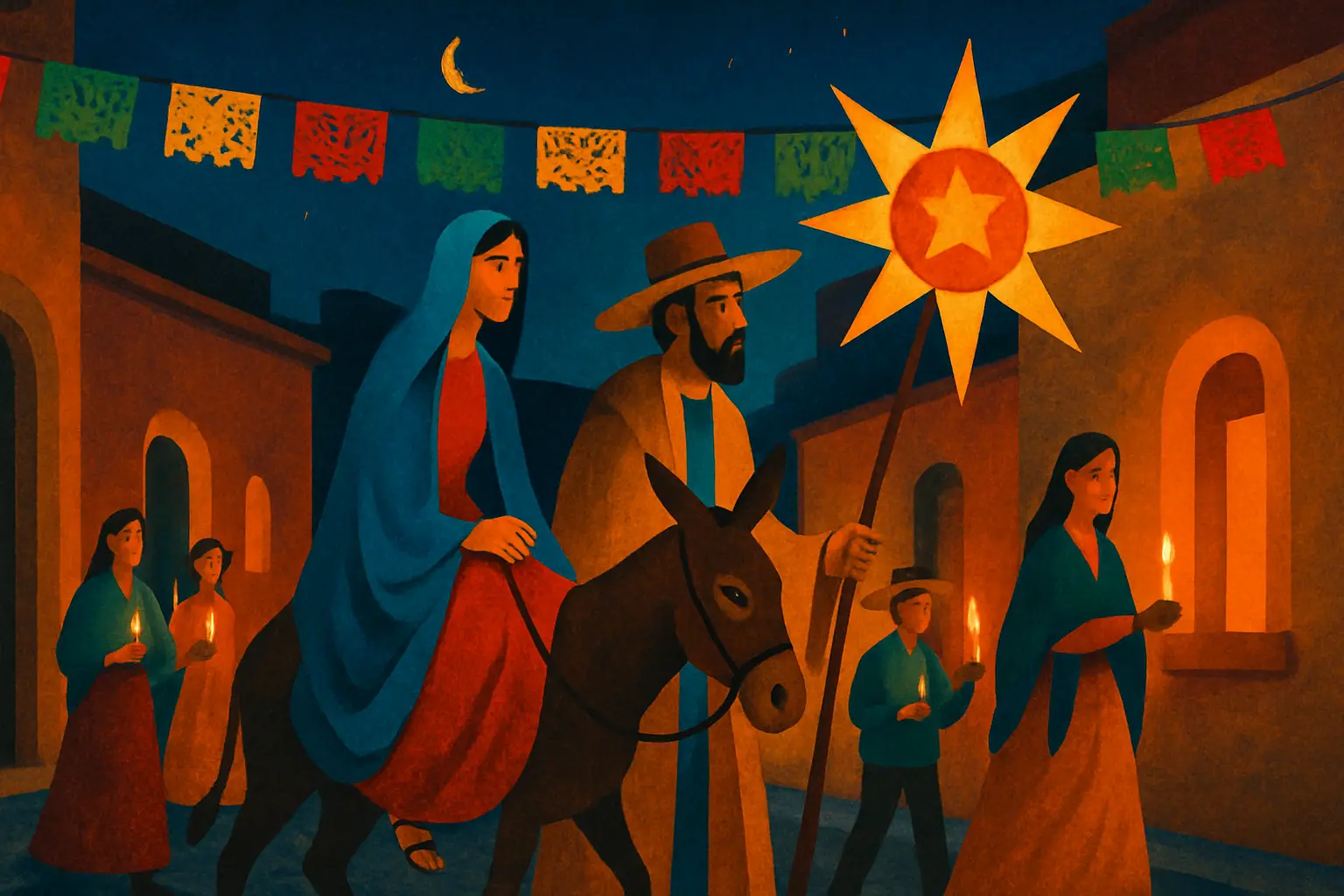
Las Posadas (Spanish for 'lodgings' or 'inns') is a nine-night celebration in Mexico observed from December 16 to December 24. Each night reenacts a specific episode from the Nativity narrative: the journey of Mary (María) and Joseph (José) from Nazareth to Bethlehem and their search for shelter (posada) before the birth of Jesus. The tradition takes the form of a procession: participants carrying candles and small figures of Mary and Joseph move through a street or courtyard, singing a traditional call-and-response song in which one group (los peregrinos — the pilgrims) asks for shelter and another group (los posaderos — the innkeepers) refuses. After several verses of rejection, the innkeepers recognize the pilgrims as holy travelers and grant entry, at which point the tone shifts to celebration: the procession enters, a piñata is broken, and food and drink are shared. The nine nights correspond to the nine days of Mary's journey — and the nine nights of prayer (novena) that Spanish missionaries mapped the tradition onto. Each night in a community is typically hosted by a different family, church group, business, or neighborhood organization.
Nine nights (December 16–24): each night a separate procession-and-celebration hosted by a different family or group
The call-and-response song: pilgrims ask for shelter in verses, innkeepers refuse in verses, then recognition and celebration follow
Each night corresponds to one of the nine days of Mary's journey and one day of the Catholic novena
Las Posadas was introduced to Mexico by Augustinian missionaries in the 16th century as a deliberate religious strategy. The Aztec and other Mesoamerican peoples celebrated the end of the solar year with major festivals near the winter solstice — the month of Panquetzaliztli, dedicated to Huitzilopochtli (approximately November–December in the Aztec calendar), included multi-day communal celebrations with music, food, and processions. The Spanish missionaries recognized that suppressing these winter celebrations entirely was impossible; instead, they created a Catholic alternative that preserved the communal, processional, multi-night structure while replacing the pre-Hispanic content with the Nativity narrative. The Augustinian friar Diego de Soria is credited with introducing the first formal posadas in 1587, at the Acolman convent in what is now Mexico state — he obtained papal permission to hold outdoor 'Misas de Aguinaldo' (Christmas gift masses) that incorporated the procession format. The tradition spread rapidly because it mapped so precisely onto existing indigenous communal celebration patterns. By the 17th century, posadas were established throughout New Spain. The colonial synthesis was so complete that the tradition appears fully indigenous in form — communal, nocturnal, participatory, centered on food and collective singing — while the content is Christian.
Origin: Augustinian missionary Diego de Soria, 1587, Acolman convent (Mexico state) — obtained papal permission for outdoor Christmas masses with processions
The missionaries mapped the tradition onto existing Aztec winter solstice celebrations — the communal, multi-night, processional form was deliberately preserved
The colonial synthesis is so complete that the tradition looks pre-Hispanic in form but is Catholic in content
Get short, interactive stories that make each place easier to remember while you travel.
The traditional posada song — sung in two parts by the pilgrims and the innkeepers — is one of the most widely known pieces of Mexican folk music, sung in some version by virtually every Mexican child. The song structure is a dramatic dialogue: the pilgrims announce themselves as weary travelers in need of shelter; the innkeepers respond that they are suspicious of strangers and refuse; the dialogue continues through multiple verses of pleading and refusal; then comes the moment of recognition — the pilgrims identify themselves as heaven-sent — and the innkeepers open their doors in joyous welcome. The final verses shift to communal celebration. The song is sung in unison, with the procession divided into two groups: the 'outside' group (pilgrims, typically children carrying candles) and the 'inside' group (innkeepers, waiting at the host household). The song ends when the procession is admitted and the celebration begins. Regional variations exist across Mexico — the Oaxacan posada song differs from the Jalisco version, and urban Mexico City posadas often use simplified versions — but the call-and-response structure and the journey-and-welcome narrative are consistent everywhere.
The song is a dramatic dialogue across two groups: pilgrims outside asking for shelter, innkeepers inside refusing
The moment of recognition — when the innkeepers open their doors — is the emotional center of each posada
Regional variations exist, but the call-and-response structure is consistent across all Mexican states
The piñata used in Las Posadas is one of the clearest examples of the colonial religious synthesis in Mexican culture. The traditional posada piñata is a star-shaped clay pot with seven points, covered in colored paper — each point representing one of the seven deadly sins. The act of breaking the piñata while blindfolded represents the triumph of faith over temptation, with the candy and fruits inside representing the rewards of virtue. The clay pot piñata itself predates the Spanish contact: Aztec ceremonial practice included clay pots filled with offerings that were broken as part of rituals. Spanish missionaries recognized the formal similarity and mapped Christian theological meaning onto the existing practice. The result is an object that is simultaneously a pre-Hispanic ritual vessel and a Catholic theological allegory — and, in its modern commercial form, a brightly colored donkey filled with candy that children beat with a stick. Contemporary piñatas have lost much of the theological symbolism in favor of commercial shapes, though the traditional seven-pointed star version is still used in many traditional posadas. In Mexico City, Mercado de Sonora and the markets around the Zócalo sell handmade traditional piñatas in December.
The traditional posada piñata: a seven-pointed star, each point representing one of the seven deadly sins — breaking it symbolizes triumph over temptation
Pre-Hispanic parallel: Aztec ceremonies included breaking clay pots filled with offerings — missionaries mapped Christian meaning onto the existing form
Traditional seven-pointed star piñatas still made and sold at Mercado de Sonora and Zócalo markets in December
The food and drink served at posadas are as important to the tradition as the procession itself, and they are specific: this is not general holiday food but a defined seasonal set that appears in Mexican households and street stalls every December. Ponche is the defining drink of Las Posadas: a hot fruit punch made by simmering tejocotes (Mexican hawthorn fruits, small and tart), guavas, raisins, dried hibiscus (jamaica), piloncillo (raw cane sugar), cinnamon, and sometimes prunes and sugar cane sticks in water for an hour or more. The result is a dark, warming, fragrant drink with a complex sweet-tart-spice profile. Adults often add a shot of rum, brandy, or mezcal — or the older tradition of pulque, which was the festive drink of central Mexico before beer and mezcal dominated. Children drink it unspiked. Street vendors selling ponche in large clay pots are a defining sensory marker of Mexico City in December — the smell alone signals the season. Tamales are made in enormous quantities for posadas — the communal tamale-making (tamalada) in preparation for a posada is itself a social event. Buñuelos are fried dough fritters dusted with sugar and cinnamon, traditionally served on clay plates that are then smashed for luck after eating — an origin-contested tradition that may connect to the clay-pot-breaking symbolism of the piñata.
Ponche: hot fruit punch with tejocotes, guavas, hibiscus, piloncillo, and cinnamon — the defining drink of Las Posadas, sold by street vendors throughout December
Tamales: made communally (tamalada) in preparation for each posada — the tamale-making is itself a social event
Buñuelos: fried dough with sugar and cinnamon, traditionally served on clay plates that are smashed after eating — a luck tradition with unclear origins
In Mexico City, Las Posadas exists on a spectrum from elaborate traditional neighborhood celebrations to corporate office party versions that bear little resemblance to the original. The most authentic posadas today are found in the historic barrios where vecindades (shared-courtyard housing blocks, a colonial-era form of urban architecture) still function as genuine communities: the courtyards of Tepito, Guerrero, and the barrios of Centro Histórico host posadas that follow the traditional format with genuine communal participation. In Coyoacán — a neighborhood that has maintained more colonial-era spatial organization than most of inner Mexico City — the posadas in the streets around the central market are still organized as neighborhood events with processions and shared food. Xochimilco has some of the most traditional posadas in the metropolitan area, organized by indigenous-heritage communities that have maintained the tradition continuously for centuries. Mexico City's churches organize their own posadas throughout December. For visitors in Mexico City during December, the advice is simple: ask at the hotel or apartment building, ask neighbors — posadas are fundamentally local and you are likely to be invited. The tradition is explicitly communal and designed to include rather than exclude.
Most authentic Mexico City posadas: vecindades in Tepito, Guerrero, and Centro Histórico barrios — shared-courtyard communities that still function as neighborhoods
Coyoacán: neighborhood posadas in the streets around the central market still follow the traditional format with processions
Xochimilco: some of the most traditional metropolitan posadas, organized by communities that have maintained the tradition for centuries
Las Posadas is observed not only in Mexico but throughout Latin America and in Mexican-American communities in the United States, with significant regional variation. In Guatemala, posadas are observed with elaborate processions that incorporate indigenous Mayan textile traditions. In the US Southwest — Texas, New Mexico, California, Arizona — posadas have been part of community life in Mexican-origin communities since the colonial period, predating the US annexation of the region in 1848. San Antonio, Los Angeles, and Albuquerque have major public posadas. The tradition has also diffused into non-Latino American contexts: the concept of a communal, multi-night, participatory Christmas tradition has appealed to communities looking for an alternative to commercial Christmas formats. The spread of Las Posadas outside Mexico has occasionally caused friction around authenticity: the commercialization of the piñata and the 'posada party' concept has stripped the theological and communal content from the tradition in many contexts, leaving a generic party format. Mexican cultural commentators debate whether this represents cultural exchange or cultural loss. The complete Mexican culture guide situates this debate in the broader context of how Mexican traditions travel and change.
Las Posadas in the US Southwest predates American statehood — it has been observed continuously in Texas, New Mexico, and California since the colonial period
San Antonio, Los Angeles, and Albuquerque have major annual public posadas with tens of thousands of participants
The commercialization of the piñata outside Mexico has stripped the seven-sin theological symbolism — what travels is the form without the content
The ninth and final posada on December 24 — Noche Buena (Good Night, Christmas Eve) — is the climax of the tradition and the night when the celebration is largest. In traditional observance, the ninth posada is the most elaborate: the piñata is the biggest, the food is the most extensive, and the celebration continues into Christmas morning. Midnight Mass (Misa de Gallo — literally 'Rooster Mass') is attended after the posada celebration, then families return home for Cena de Noche Buena — the Christmas Eve dinner, which in most Mexican households includes tamales, bacalao (dried salt cod, a colonial-era Spanish tradition), romeritos (a traditional herb dish), and the final ponche of the season. In Mexico City, the night of December 24 transforms the streets of every neighborhood: fireworks, processions, and music from 10 pm through midnight. The Zócalo has public celebrations. The December 24 posada is the best single night to experience the tradition if you are only in Mexico briefly during the season — the ninth night concentrates everything the tradition is about into a single memorable evening.
December 24 (Noche Buena): the ninth and final posada — largest piñata, most food, followed by Misa de Gallo (midnight Mass)
Cena de Noche Buena: tamales, bacalao (salt cod), romeritos, and ponche — the Christmas Eve dinner that follows the final posada
Mexico City on December 24: fireworks, processions, and street celebrations in every neighborhood from 10 pm through midnight