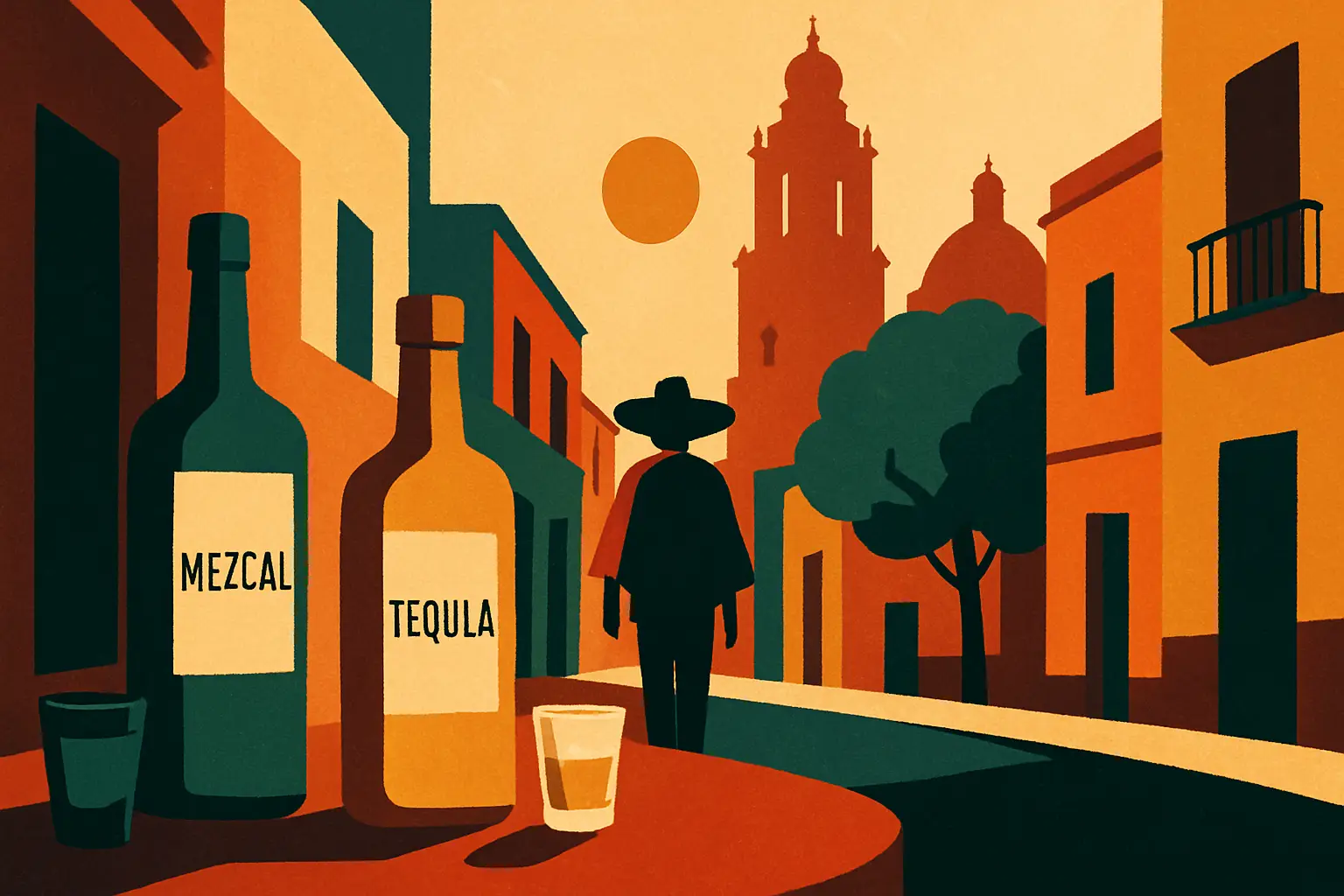
The confusion between mezcal and tequila is understandable because the relationship between them is counterintuitive. Both are produced by cooking, crushing, fermenting, and distilling agave hearts (piñas). Tequila is legally defined as a mezcal — a distilled agave spirit — that meets specific additional requirements: it must be made from blue Weber agave (Agave tequilana) specifically, grown in the state of Jalisco plus four other permitted states (Guanajuato, Michoacán, Nayarit, and Tamaulipas), and it must meet production standards set by the CRT (Consejo Regulador del Tequila). Mezcal, by contrast, can be produced from over 40 different agave species across most of Mexico — primarily in Oaxaca, but also in Durango, Guerrero, Puebla, San Luis Potosí, Zacatecas, and other states. The broader mezcal category was regulated more recently (the Consejo Regulador del Mezcal established in 1994) and contains far more diversity in raw material and production method.
Tequila is legally a type of mezcal — it is the specific, regulated version of the broader category
Tequila: only blue Weber agave, only in Jalisco + 4 other states
Mezcal: 40+ agave species, most of Mexico — significantly more diverse in raw material and flavor profile
Agave is not a cactus — it is a succulent more closely related to asparagus. Mexico has approximately 200 of the world's 270 agave species, and the country's long history of agave use predates both distillation and Spanish contact by thousands of years. Pre-Hispanic Mexicans used agave for food (the roasted piña), fiber (the leaves produce sisal and henequén), fermented drink (pulque, made from the sap), and medicine. What makes agave unusual for distillation purposes is its growth cycle: most agave plants take 8 to 35 years to mature before they can be harvested. Blue Weber agave (for tequila) typically matures in 5–12 years with modern cultivation. Wild agave used in artisanal mezcal production — varieties like tobalá, tepeztate, and sierra negra — can take 25–35 years to reach the maturity at which the plant concentrates enough sugar in its piña (heart) to make distillation viable. This means that a bottle of single-variety mezcal made from tobalá agave represents a plant that was growing for 25 years before it was harvested. It also means that artisanal mezcal production requires land that is left fallow for decades — a different relationship to agriculture than any other major spirits category.
Blue Weber agave (tequila): 5–12 years to mature — relatively fast for a plant that only reproduces once before dying
Wild mezcal agave (tobalá, tepeztate): 25–35 years to mature — the bottle in your hand contains decades of plant growth
Pre-Hispanic agave use: food, fiber, pulque (fermented sap), and medicine — the plant was central to Mesoamerican civilization long before distillation
Get short, interactive stories that make each place easier to remember while you travel.
The most obvious flavor difference between mezcal and tequila comes from production method, not agave variety — specifically, how the piña (the heart of the agave plant, which can weigh 50–200 kg) is cooked before fermentation. Tequila: the piñas are cooked in industrial steam autoclaves or brick ovens (hornos), then mechanically shredded, then fermented with added commercial yeast in large tanks. Modern industrial tequila production is efficient, consistent, and fast. Artisanal mezcal: the piñas are cooked in underground earthen pits, typically lined with volcanic rock and heated by burning wood or charcoal for 3–7 days. This pit-roasting process is where the smoky character of many mezcals comes from — the piña absorbs the smoke during the long underground cook. After cooking, the roasted piñas are crushed by a stone wheel (tahona) pulled by a horse or mule, fermented with wild ambient yeast in open wooden vats, and distilled in small clay or copper pot stills. The entire process for an artisanal mezcal from pit to bottle can take 3–6 weeks for a single batch. Industrial tequila production condenses a similar process to days.
Tequila: steam autoclaves or brick ovens, mechanical shredders, commercial yeast, industrial scale — fast and consistent
Artisanal mezcal: underground earthen pit (3–7 days), stone tahona wheel, wild yeast, clay pot still — slow and variable
The smokiness in mezcal comes from pit-roasting the piñas — not from smoke being added directly to the spirit
Tequila is inextricably linked to the state of Jalisco — specifically the highlands (Los Altos) and lowlands (El Valle) regions around the town of Tequila (yes, there is literally a town called Tequila in Jalisco). The volcanic red clay soil and high altitude of Jalisco's highlands produce blue Weber agave with a slightly different sugar profile from the lowland version, which is why highland and lowland tequilas taste different despite using the same agave variety. Guadalajara — a 2026 World Cup host city — is Jalisco's capital and the commercial center of the tequila industry. Oaxaca is the capital of artisanal mezcal: the Sierra Sur and Cañada regions around Miahuatlán, Sola de Vega, and Ejutla produce the mezcals most highly regarded by the international spirits community. The town of Teotitlán del Valle, near Oaxaca City, is surrounded by mezcal palenques (distilleries). In Mexico City, the mezcalerías in Roma Norte and Condesa carry mezcals from Oaxaca, Durango, Guerrero, and other producing states — and the better ones organize their lists by agave variety and state of origin rather than by brand.
Tequila geography: Jalisco (the highlands of Los Altos and the lowlands of El Valle) — plus Guanajuato, Michoacán, Nayarit, Tamaulipas
Mezcal geography: Oaxaca is the primary state, but also Durango, Guerrero, Puebla, San Luis Potosí, Zacatecas
Mexico City mezcalerías in Roma Norte and Condesa: the best way to taste across regions and agave varieties in one sitting
The flavor profiles of tequila and mezcal differ across a wide spectrum depending on variety, region, and production method — but some generalizations hold. Blanco (unaged) tequila from Los Altos is typically crisp, minerally, with green pepper and citrus notes from the blue Weber agave. Blanco from El Valle is fruitier and more vegetal. Reposado tequila (rested 2–12 months in oak) adds vanilla and caramel notes. Añejo (aged 1–3 years) and extra añejo (3+ years) approach the character of whiskey or cognac — smooth, wood-forward, with diminished agave character. Mezcal from espadín agave (the most commonly cultivated mezcal agave) has the characteristic smoky note plus roasted agave flavors, often with fruit (cooked apple, peach), pepper, and mineral complexity. Mezcal from tobalá is floral, lighter, and markedly different — often described as herbal and honeyed, without the heaviness of espadín. Mezcal from tepeztate (a wild agave that takes 25–35 years to mature) is among the most complex spirits produced anywhere: earthy, green, wild, with flavors that have no easy analogue in other drink categories.
Tequila blanco (Los Altos): crisp, minerally, green pepper, citrus — the character of blue Weber agave most clearly expressed
Mezcal espadín: the entry point — smoked agave, roasted fruit, pepper. The most widely available artisanal mezcal variety.
Mezcal tepeztate: 25–35 year wild agave — earthy, green, complex, without easy analogue in other spirits. A different category of drink.
Both tequila and mezcal exist on a spectrum from artisanal to industrial, and the difference within each category is sometimes more significant than the difference between them. Industrial tequila — the kind in the well at every bar and on every margarita menu — is made in large distilleries with autoclaves, diffusers (which skip the cooking step entirely and extract sugars with hot water and enzymes), and column stills. The result is consistent but often thin in flavor. Artisanal tequila from small producers using brick hornos and traditional production methods is a different drink. Similarly, commercial mezcal from larger Oaxacan producers uses industrial equipment and produces a consistent, approachable product. Ancestral mezcal — the highest category in the Mexican regulatory system — requires clay pot stills, stone tahona, and specific traditional methods. When you are at a mezcalería and a bottle costs 2,000 pesos, you are paying for 25 years of plant growth, weeks of hand production, and a batch size that might be 200 bottles total. When you are drinking a 300-peso cocktail mezcal, you are drinking industrial production with artisanal labeling. Knowing the difference is the useful knowledge.
The diffuser: an industrial process that extracts agave sugars without cooking — legal for tequila, not permitted for mezcal — produces a thinner, faster spirit
Ancestral mezcal: the highest regulatory category — requires clay still, stone tahona, no commercial yeast — fewer than 50 producers qualify
A 200-bottle batch from a 25-year tobalá plant costs what it costs — the price of rare mezcal is about the math of plant biology, not marketing
The gusano (worm) in mezcal bottles is a marketing invention from the 1940s, not a traditional practice. A Oaxacan mezcal producer named Jacobo Lozano Páez reportedly added the moth larva (gusano rojo — the larva of the Hipopta agavis moth that lives on agave plants) to mezcal bottles in 1940 as a marketing novelty for the US market. It spread through cheaper commercial mezcal brands as a way to signal 'authenticity' to foreign buyers. Serious mezcal producers — and the mezcalerías in Mexico City — do not use the worm. The salt and orange slice served with mezcal is genuinely traditional in Oaxaca — sal de gusano (worm salt, made from grinding the dried gusano with salt and chile) is a real Oaxacan condiment. For tequila, the lime-and-salt combination ('tequila shots') is a Mexican tradition, but experienced drinkers of good tequila skip the lime and salt, which mask the flavor of the spirit. A caballito (small glass) of good blanco tequila or a copita of artisanal mezcal, drunk slowly without accompaniment, is how both drinks are meant to be experienced.
The worm: invented in 1940s Oaxaca as a US marketing novelty — not traditional, not in serious mezcals
Sal de gusano (worm salt): a genuine Oaxacan condiment made from dried gusano larva, salt, and chile — traditionally served with mezcal
The lime-and-salt shot: masks the flavor of quality tequila — good tequila is sipped, not shot
The mezcalerías of Roma Norte and Condesa in Mexico City are among the best places in the world to explore mezcal — the selection rivals Oaxaca itself, and the staff are usually knowledgeable. How to approach the experience: ask for a tasting flight (vuelo) organized by agave variety, not by brand. Start with espadín as your reference point, then move to a more unusual variety — tobalá, tepeztate, or cuixe — to understand how dramatically different agaves produce different spirits. Ask where the mezcal is from: the state and the maestro mezcalero (the distiller) matter. If the staff cannot tell you the agave variety, the region, and the distiller, the mezcalería is not serious. Cocktail mezcal — good mezcal in a margarita or a negroni — is not a waste; the smokiness works well in citrus cocktails. But for the purpose of understanding what mezcal actually is, a copita of single-variety mezcal served at room temperature, drunk slowly, is the correct order. Budget 200–500 pesos per pour for quality artisanal mezcal in Mexico City.
Order by agave variety, not by brand — start with espadín, then move to tobalá or tepeztate to understand the range
A serious mezcalería can tell you the agave variety, the producing state, and the maestro mezcalero — if they can't, keep looking
Budget: 200–500 pesos per pour for artisanal single-variety mezcal in Roma Norte and Condesa