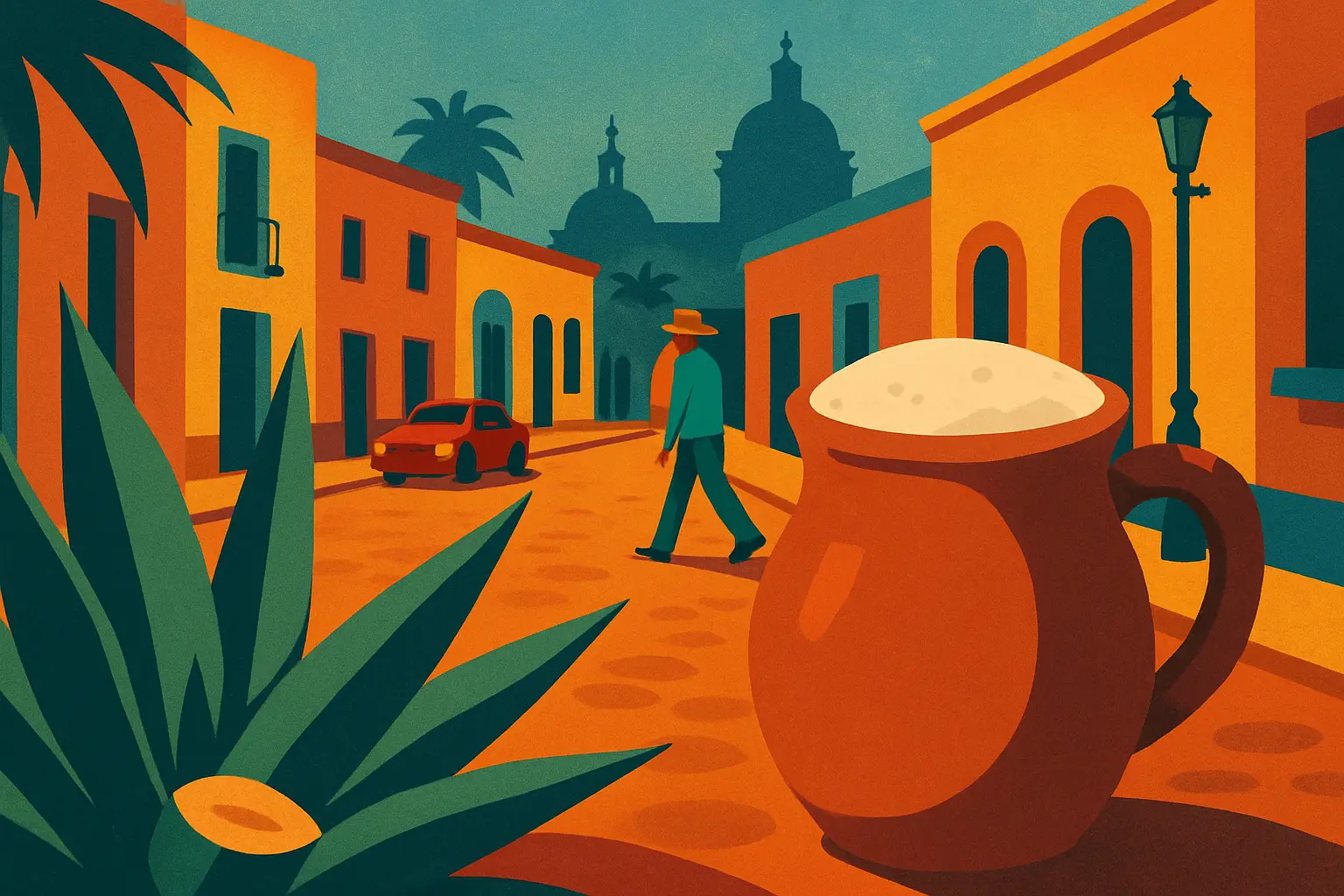
Pulque is a fermented alcoholic beverage made from the fresh sap of the maguey agave — specifically the aguamiel (honey water) that collects in the heart of the plant when the central flower stalk is cut. Unlike tequila and mezcal, which are distilled spirits made from cooked agave piñas, pulque involves no cooking and no distillation: the aguamiel is collected daily from the living plant, then fermented using naturally occurring bacteria and wild yeast. The result is a low-alcohol beverage (3–8% ABV, similar to beer) with a thick, slightly viscous texture, a mildly sour flavor, and a funky, fermented character that Western palates often find unexpected. Pulque cannot be pasteurized or bottled for long-distance transport without dramatically changing its character — it is active, living, and highly perishable. This is why pulque has always been a strictly local drink: it must be consumed within 24–48 hours of fermentation and cannot survive international export. It is the only major Mexican drink that is essentially invisible outside Mexico.
Pulque = fermented maguey sap, not distilled — 3–8% ABV, similar to beer rather than spirits
It cannot be pasteurized or bottled for export — it is a living, perishable drink that must be consumed within 48 hours
Unlike mezcal and tequila, which use cooked agave hearts (piñas), pulque uses fresh sap (aguamiel) from the living plant
The history of pulque in Mexico spans at least 2,000 years and possibly much longer — fermented maguey sap was likely consumed in Mesoamerica before the rise of the major civilizations. In Aztec society, pulque occupied a contradictory position: it was sacred (associated with the goddess Mayahuel, who personified the maguey plant, and with the 400 Rabbits — the Centzon Totochtin — the gods of drunkenness and excess — a specialized subset of the broader Aztec pantheon) and simultaneously tightly controlled. Commoners were generally prohibited from drinking it except at specific festivals; elderly people and pregnant women were permitted it medicinally. The Aztec penalty for public drunkenness was death or shaving of the head — one of the harsher social regulations in Aztec civil life. After the conquest, the Spanish colonizers initially attempted to restrict pulque — it was associated with indigenous religious practice and perceived as a social disorder risk. But the economics were too compelling: the colonial government eventually licensed pulque sales as a major tax revenue source, and by the 18th century the pulquerías of Mexico City were among its primary social institutions. The colonial-era buildings of Centro Histórico were built in a city where pulque was the dominant alcoholic beverage.
Mayahuel: the Aztec goddess of the maguey plant and pulque — one of the few deities associated with a specific beverage
In Aztec society, pulque was ceremonially sacred and socially restricted — public drunkenness was punishable by death or public humiliation
Under colonial rule, the Spanish government licensed and taxed pulquerías as a major revenue source — pulque became the dominant drink of colonial Mexico City
Get short, interactive stories that make each place easier to remember while you travel.
The 19th century was the golden age of pulque production in central Mexico, and the pulque haciendas that produced it were among the wealthiest enterprises in the country. The Llano region of Hidalgo and Mexico state — the 'pulque belt' north of Mexico City — was covered in vast maguey plantations, and the hacienda owners who controlled them were among Mexico's most powerful figures. The Mexico City to Hidalgo railway (built specifically partly to transport pulque, which deteriorated too quickly for the previous mule cart distribution system) made urban distribution possible at scale: by the 1890s, Mexico City had over a thousand pulquerías. The hacendados who controlled pulque production wielded significant political power — several of them funded candidacies and political factions that shaped the period leading to the Mexican Revolution. The Revolution, which targeted hacienda power in general, significantly disrupted the pulque industry. But the killing blow came later, and from a different direction.
The Hidalgo/Mexico state 'pulque belt': vast maguey haciendas whose owners were among Mexico's wealthiest people in the 19th century
The Mexico City–Hidalgo railway was partly built to transport fresh pulque — before rail, it couldn't reach the city in good condition
Mexico City had 1,000+ pulquerías in the 1890s — pulque was the dominant working-class drink in the capital
The decline of pulque in the 20th century is one of the more remarkable stories in beverage industry history, and it involves deliberate corporate sabotage. In the 1920s, the Mexican beer industry — led by German-immigrant brewers in Monterrey and Guadalajara who had established Cervecería Cuauhtémoc and other major operations — funded a public health campaign claiming that pulque was produced using a process involving human excrement as a fermentation starter. The claim: that pulquerías added a raw fermenting agent colloquially called 'muñeca' (doll) — a bag of human feces — to accelerate fermentation. This was false. Pulque ferments through wild bacterial and yeast cultures present in the maguey plant itself and in the wooden barrels used to transport it. But the campaign was highly effective: it ran in newspapers, was echoed by public health officials, and successfully stigmatized pulque as a dirty, backward, indigenous drink versus beer as a modern, clean, European one. Pulque consumption collapsed across the urban middle class. By the 1970s, most traditional pulquerías in Mexico City had closed. The drink survived primarily in rural Hidalgo and Mexico state communities where the stigma was weaker.
1920s beer industry disinformation: funded newspaper campaigns claiming pulque was fermented with human feces — factually false, commercially devastating
The campaign exploited class and racial dynamics: pulque was coded as indigenous/backward, beer as modern/European
By 1970, most Mexico City pulquerías had closed — the drink survived mainly in rural Hidalgo producing communities
Pulque production requires a specific agave variety — primarily the maguey pulquero (Agave salmiana or related species), which takes 8–12 years to mature. Unlike the blue Weber agave used for tequila, which is harvested at the piña, the maguey pulquero is tapped while still alive. When the plant is approximately 8 years old, the central flower stalk (quiote) is identified as it begins to form and is cut off — this redirects the plant's energy into producing aguamiel (literally 'honey water') in the hollow heart. A specialist called a tlachiquero then visits the plant twice daily, using a long gourd (acocote) to suction out the accumulated aguamiel. A productive plant can yield 4–6 liters of aguamiel per day for 3–6 months before it is exhausted and dies. The aguamiel is transferred to wooden or leather vats (tinacales) where it ferments through contact with naturally occurring bacteria — primarily Zymomonas mobilis — within 24 hours. The resulting pulque is then transported fresh to pulquerías. A skilled tlachiquero can manage 100–200 plants simultaneously; it is a specialized agricultural skill passed down across generations in the pulque-producing communities of Hidalgo.
The tlachiquero: a specialized pulque harvester who uses a gourd (acocote) to siphon aguamiel from the maguey heart twice daily
Each plant produces 4–6 liters of aguamiel per day for 3–6 months — then it is exhausted and dies
Fermentation occurs in 24 hours through naturally occurring bacteria — no added yeast or fermentation agent required
Fresh pulque (natural) has a taste that is genuinely difficult to describe in terms of Western drink analogues. It is mildly alcoholic (3–8%), slightly viscous (the texture is sometimes described as having a slight 'slipperiness' from the plant's natural polysaccharides), mildly sour from lactic acid fermentation, and has a faintly grassy, vegetal quality that comes from the aguamiel itself. Some people find it immediately appealing; others find the texture or the funk confronting. The curado — flavored pulque — is the entry point that makes pulque accessible to most first-timers. A curado is simply fresh pulque blended with fruit, seeds, or other flavorings in a blender. Common varieties include: celery (apio), which produces a surprisingly savory, umami-forward drink; guava (guayaba); strawberry (fresa); oat (avena); pine nut (piñon); and tomato-based versions that function like a pulque Bloody Mary. The best pulquerías in Mexico City make their curados fresh daily from whatever is in season. A competent curado largely masks the texture and funk of natural pulque behind fruit flavor — it is the drink for beginners. Natural pulque, drunk straight, is the connoisseur's choice.
Natural pulque: mildly sour, slightly viscous, 3–8% ABV — no real equivalent in Western drink culture
Curado: pulque blended with fruit, seeds, or vegetables — the entry point for first-timers, served fresh at pulquerías
Common curado varieties: celery (apio), guava, strawberry, oat, tomato — flavors vary entirely by pulquería and season
Since roughly 2010, a pulquería revival has been underway in Mexico City — driven by a combination of urban nostalgia, craft beverage interest, and a reassessment of indigenous food and drink traditions as cultural patrimony rather than sources of shame. New pulquerías have opened in Roma Norte, Condesa, and Coyoacán alongside the handful of traditional pulquerías that survived in working-class neighborhoods like Guerrero, Tepito, and Centro Histórico. The revival involves both authentic traditional-style operations and a new wave of 'artisanal' pulque bars that serve curados alongside mezcal and craft beer. The Hidalgo pulque producers who survived the 20th-century decline — particularly in the towns of Apan, Zempoala, and the Llano region — now have growing urban demand. Mexico City's UNAM campus area has a cluster of long-running pulquerías that serve the student population and have maintained continuity from the pre-decline era. The revival remains incomplete: pulque production is still far below its 19th-century peak, and the drink remains largely invisible to international visitors who do not specifically seek it out.
Post-2010 revival: new pulquerías in Roma Norte, Condesa, and Coyoacán alongside surviving traditional operations in Centro and Guerrero
Hidalgo producers — Apan, Zempoala, the Llano region — are the source of most Mexico City pulque, transported fresh daily
The revival is real but incomplete: pulque production is still far below 19th-century levels
The traditional pulquerías are still the best places to understand what pulque actually is. Las Duelistas (Aranda 28, Centro Histórico) is one of the oldest surviving pulquerías in the city, open since 1912, with traditional wooden barrels and a working-class atmosphere. La Antigua Roma (Orizaba 176, Roma Norte) is a more recently revived traditional-style operation with a good selection of curados. El Templo de Diana in the Guerrero neighborhood operates in the traditional format with natural and curado varieties. For pulque in a more modern setting, Pulquería Insurgentes (near the Insurgentes market) and several Roma Norte operations serve artisanal curados alongside other Mexican drinks. The best approach: arrive during peak hours (Sunday afternoon is traditional pulque-drinking time in Mexico City), order a natural to understand the base, then a curado to understand why the drink has survived 2,000 years. Budget around 40–80 pesos per half-liter. If you want to see where the pulque comes from, the town of Apan in Hidalgo is 90 minutes from Mexico City by bus — it is still surrounded by maguey fields and has active tinacales you can visit.
Las Duelistas (Centro Histórico): open since 1912 — one of the oldest continuously operating pulquerías in Mexico City
La Antigua Roma (Roma Norte): the revival-era pulquería with the most accessible entry point for visitors
Apan, Hidalgo: 90 minutes from Mexico City — the source community, surrounded by maguey fields and active production