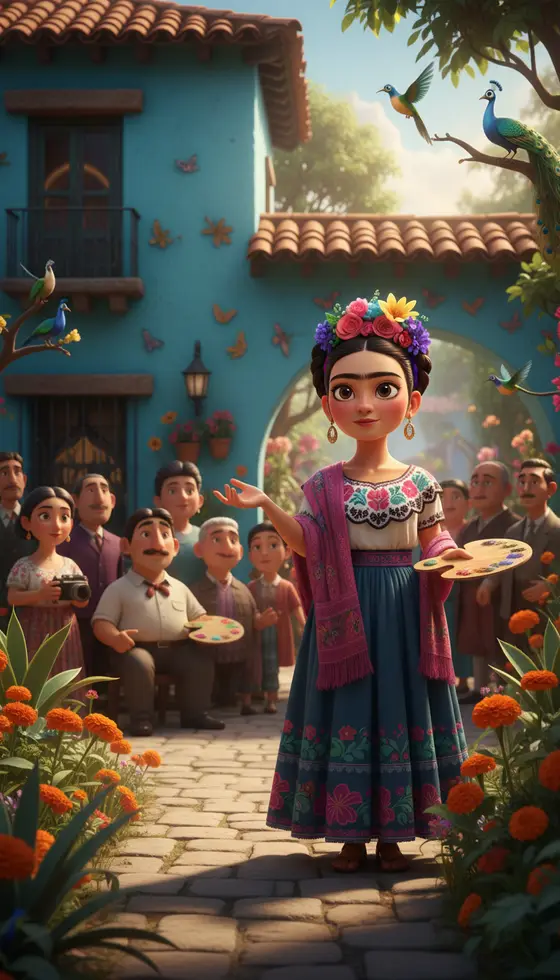
The most important fact about Frida Kahlo is one that gets almost no attention in the global brand built around her image: she was not famous when she was alive. During her lifetime (1907–1954), Kahlo was known in Mexico primarily as the wife of Diego Rivera — the more internationally acclaimed muralist. Her solo exhibition at the Gallery of Contemporary Art in Mexico City in 1953 — one of the first in Mexico — drew a crowd largely because word spread she might attend (she arrived on a stretcher in her bed, too ill to walk). Internationally, she had one solo show in New York in 1938 and Paris in 1939, where she attracted attention from the Surrealists but was never fully embraced by the movement. She died in 1954, officially of pulmonary embolism, though the circumstances have long been debated. The global reassessment began in the 1970s, driven partly by the feminist art movement's reclamation of marginalized women artists, and accelerated through the 1980s and 90s into the cultural phenomenon that exists today.
Kahlo's first Mexican solo exhibition was in 1953 — the year before she died, when she was already terminally ill
Internationally known primarily as Diego Rivera's wife during her lifetime, not as an artist in her own right
The feminist art movement of the 1970s drove the reassessment — Kahlo is now the world's most commercially recognized female artist
Magdalena Carmen Frida Kahlo y Calderón was born on July 6, 1907, in Coyoacán — the neighborhood in Mexico City where she would spend most of her life and die in the same house she was born in. At six, she contracted polio, which left her right leg thinner than her left — a physical asymmetry she concealed for the rest of her life with long skirts. At eighteen, on September 17, 1925, a wooden bus she was riding collided with a streetcar in Mexico City. She suffered eighteen fractures to her right leg, a shattered collarbone, a broken collarbone, a broken pelvis, and a steel handrail that entered her hip and exited through her vagina. She was expected to die. Instead, she survived — but spent the rest of her life in near-constant pain, underwent thirty-five surgical operations, and spent months at a time immobilized in full-body casts. Her mother installed a mirror above the bed during her first recovery so she could see herself. She began to paint. The accident was not a footnote to Kahlo's art — it was its origin, its subject matter, and its emotional engine for the next 27 years.
September 1925: the bus accident left her with 35+ injuries including a steel handrail through her pelvis
35 surgical operations over 29 years — she lived in near-constant pain, which she described as her primary subject matter
She began painting during her first long recovery, using a specially designed easel that could be used while lying down
Kahlo painted 143 works total across 27 years of active painting — a small output compared to contemporaries like Rivera (who completed hundreds of large-scale murals). Of those 143, 55 are self-portraits. When asked why she painted herself so obsessively, she said: 'I paint myself because I am so often alone and because I am the subject I know best.' The self-portraits are not vanity documents — they are medical reports, political arguments, and emotional confessions. They show her with medical devices, with pre-Hispanic symbolism, with animals that represented specific psychological states, with the wounds of her accident and surgeries depicted with the clinical precision of an anatomical illustration. The Two Fridas (1939), painted after her divorce from Rivera, shows two versions of herself with exposed, anatomically detailed hearts — one whole, one severed and bleeding. The Broken Column (1944) shows her torso split open to reveal a crumbling Ionic column, her body held together by a medical corset and pierced by nails. These are not Surrealist fantasies. They are accurate accounts of her physical and emotional state.
55 of her 143 paintings are self-portraits — painted because she was her most available and best-understood subject
The Two Fridas (1939): painted after her divorce from Rivera, sold to the Museo de Arte Moderno in 1943 for $4,000
Her style is often mislabeled 'surrealist' — she insisted she painted reality, not dreams: 'I never painted dreams. I painted my own reality.'
Get short, interactive stories that make each place easier to remember while you travel.
Frida Kahlo and Diego Rivera met when she was 15 and he was painting his first major mural at the National Preparatory School where she was a student. She showed him her paintings in 1928 and asked for his honest opinion. He told her she had talent. They married in 1929 — she was 22, he was 43. Her father called it 'a marriage between an elephant and a dove.' The relationship was intense, mutually unfaithful (Kahlo had relationships with men and women; Rivera had affairs including, most infamously, with Kahlo's younger sister Cristina), politically aligned (both were committed communists), and artistically entangled. They divorced in 1939. Remarried in 1940 on the condition that the marriage would be sexless. The murals Diego Rivera painted at the Palacio de Bellas Artes and elsewhere in Mexico City represent Rivera's public art at its most ambitious; Kahlo's work is his inverse — intimate, physically small, autobiographical. Their relationship appears explicitly in many of her paintings, including Diego in My Thoughts (1943), in which Rivera's face appears as a third eye on her forehead.
First met when Kahlo was 15 and Rivera was painting murals at her school — she reportedly announced she would marry him
Married 1929, divorced 1939, remarried 1940 — the second marriage stipulated mutual financial independence and no sex
Both affairs and political commitment ran in both directions — it was a relationship of equals, not subordination
Kahlo's politics were as central to her identity as her painting. She joined the Mexican Communist Party at 16, re-joined after a period of lapse in 1948, and carried her party card to her death. She and Rivera offered their home in Coyoacán as asylum to Leon Trotsky — the Russian revolutionary in exile — when he fled Stalin's purges in 1937. Trotsky lived in the Casa Azul for two years, and the two had a brief affair. He was assassinated in the neighboring house on Calle Viena in 1940 — the murder weapon was an ice axe, and the assassin was a Stalinist agent. Kahlo was briefly considered a suspect. Her politics shaped her art: she dressed in traditional Tehuana indigenous clothing as a political statement of Mexican national identity against European fashion, collected pre-Hispanic artifacts at a time when indigenous art was still dismissed by the Mexican academic establishment, and explicitly aligned herself with Mexico's indigenous heritage over its Spanish colonial one. She is a study in how personal art can be simultaneously deeply political.
Mexican Communist Party member from age 16 — she re-joined on her deathbed in 1948 and her party card was buried with her
Trotsky lived in the Casa Azul 1937–1939; his own house one street over is also a museum in Coyoacán
Tehuana dress was a political act: asserting indigenous Mexican identity against European fashion and colonial cultural hierarchy
Kahlo collected pre-Columbian artifacts with the intensity of a scholar. At the time of her death, the Casa Azul contained over 2,000 pre-Hispanic pieces — figurines, vessels, masks, and objects from the Aztec, Mayan, Olmec, and other Mesoamerican traditions. She displayed them throughout the house alongside her paintings, treating them not as archaeological objects but as living cultural presences. Many appear in her paintings: pre-Hispanic figures appear in her studio portraits, and the symbolic language of Aztec iconography — serpents, skulls, animals — runs through her work. This collection was deliberate self-positioning: at a time when the Mexican intellectual elite was navigating between European modernism and nationalist indigenismo — a debate launched by the Mexican Revolution's project of constructing a mestizo national identity — Kahlo placed herself unambiguously on the indigenous side. The collection is still in the Casa Azul today and is one of the things most worth looking at when you visit the museum. The complete cultural guide to Mexico provides the broader context for what Kahlo's political act meant in the cultural landscape of the 1930s–50s.
2,000+ pre-Hispanic objects at her death — collected over decades and still on display at the Casa Azul today
Pre-Columbian figures appear in her self-portraits: her art and her collection were part of the same argument
Her indigenismo was political: an assertion of Mexican identity against European modernism, colonial Catholic culture, and the art establishment
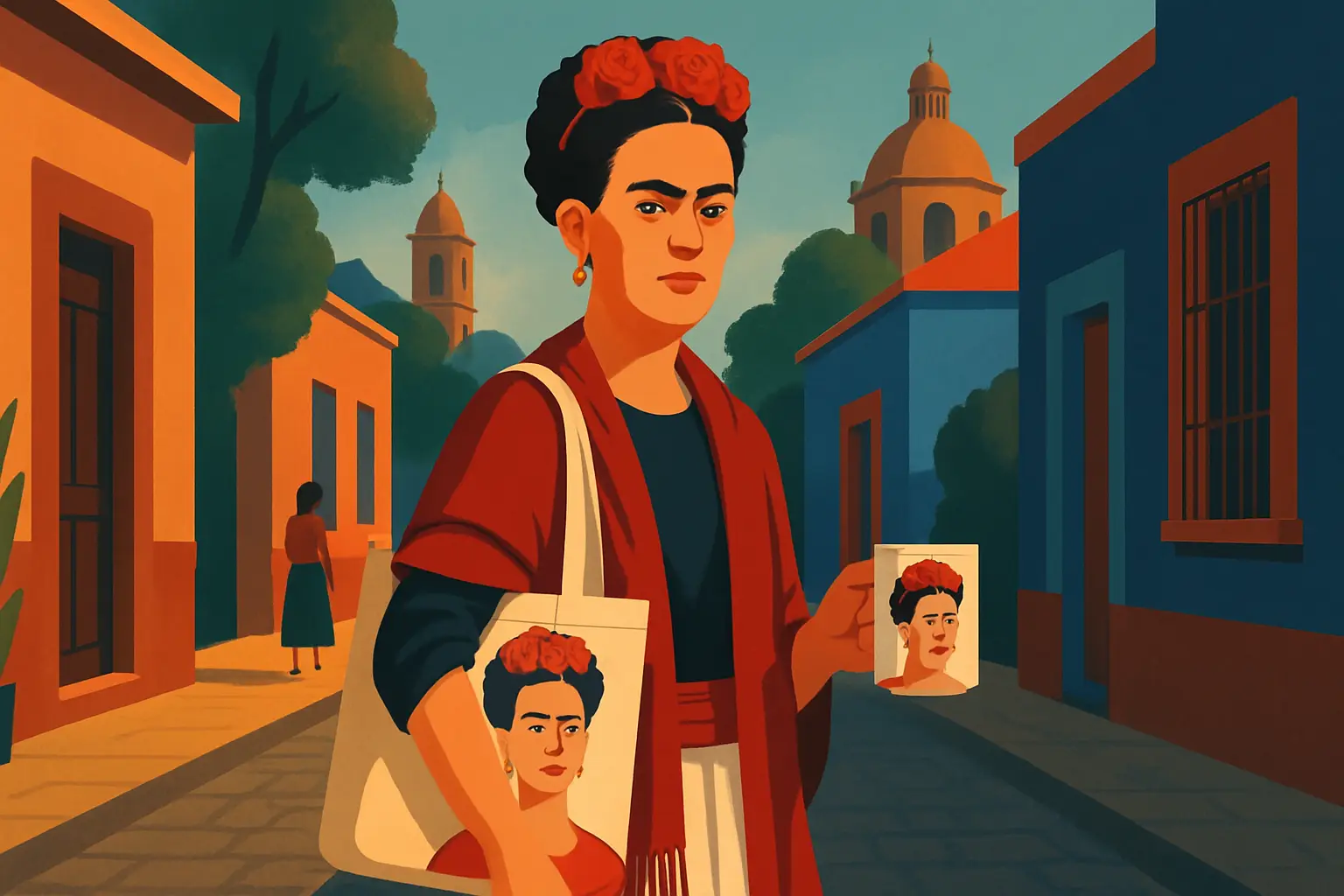
The Kahlo on tote bags is a face, not a person — and the face itself is not quite hers. The global icon combines the strong brows, the Tehuana dress, the flowers in the hair, and the serious gaze from photographs taken by Nickolas Muray and others in the 1930s and 40s. What's typically missing from the icon: the pain, the politics, the communism, the sexual complexity (she had documented relationships with women including Georgia O'Keeffe and the photographer Tina Modotti), the pre-Hispanic scholarship, the surgical corsets, the missing leg (amputated in 1953, the year before her death). The 2002 film Frida, with Salma Hayek, introduced millions to the broad outline of her story. Madonna's collection of her work and use of her imagery in the 1980s and 90s drove the commercial version. The feminist art movement that recovered her in the 1970s was interested in the political artist. What the market found was the image. Both are real, but one is more interesting than the other.
The global 'Frida brand' dates primarily to the 1980s–90s, driven by celebrity collectors and the fashion industry
Her documented relationships with women are consistently downplayed or omitted in commercial representations of her life
Her amputated right leg (removed 1953), which she painted in her diary, is almost never referenced in popular Frida imagery
The Casa Azul (Blue House) in Coyoacán is one of Mexico City's most visited cultural sites, and the experience divides visitors: some find it transcendent, others surprisingly small. The house is exactly as Kahlo left it — or as close to that as decades of museum management allow. The kitchen is vivid yellow, tiled, and hung with copper pots. The studio contains her wheelchair-mounted easel, her paint-stained palette, her collection of folk art dolls, and photographs of Marx, Stalin, Lenin, and Mao on the walls (she was not subtle about her politics). The pre-Hispanic artifact collection is throughout the house. Her bed is visible, with the mirror overhead that her mother installed during her first recovery. Her corsets — decorated with paintings, political slogans, and symbols — are displayed. A small annex houses temporary exhibitions of her work and Rivera's. The visit guide covers the practical logistics. The cultural context: what you're visiting is not a monument to a dead icon but the working environment of a specific person — a communist with a disability who collected indigenous art and painted her own pain. The house reflects that person accurately.
Book tickets 3–6 weeks in advance online — the museum has strict capacity limits and often sells out
The studio: wheelchair-mounted easel, paint-stained palette, photos of Marx and Lenin, folk art collection — all original
The medical corsets: 4 are on display, each painted by Kahlo herself — they are among the most affecting objects in the museum
In Mexico City, Frida Kahlo's presence is layered across multiple registers — from the Casa Azul museum to the Kahlo mural reproductions on Roma Norte apartment buildings to the tourist-facing street art in Coyoacán's central plaza. Her image has become the most reproduced face in Mexican commercial culture, which she would have found politically offensive and perhaps privately amusing. More seriously: she is the reason the world knows Coyoacán, the reason the pre-Columbian art collection she assembled is now recognized as culturally significant, and one of the primary reasons that Mexican visual culture's indigenous-inflected tradition is internationally understood as distinct from European modernism. Diego Rivera's public murals define the walls of Mexico City's official buildings. Kahlo's intimate, autobiographical work defines how the world understands the interior life of that same culture. Both are essential. Neither is complete without the other.
Coyoacán's identity as a cultural destination is largely built on Kahlo's association with the neighborhood
Her collection of pre-Columbian art contributed to the Mexican academic and artistic rehabilitation of indigenous material culture
Rivera's murals tell Mexico's public story; Kahlo's paintings tell its private one — together they form the most complete picture of a culture from a single era