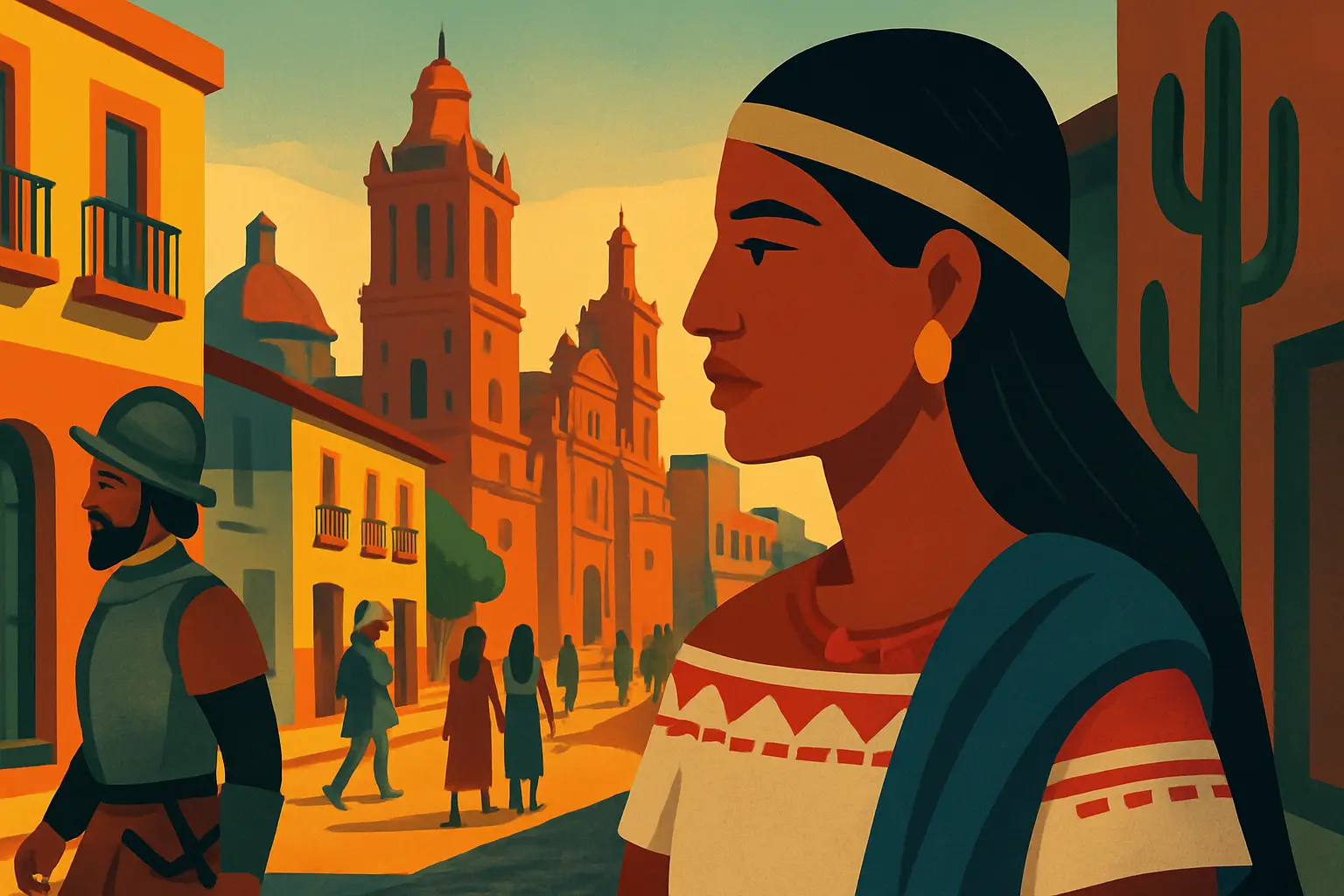
The woman known as La Malinche was born around 1500 CE, likely in the border region between Nahua and Maya territory — possibly in what is now the state of Veracruz or Tabasco. Her birth name is uncertain: sources suggest Malinalli (a day-name from the Aztec calendar) or Malintzin (a Nahuatl honorific). She was of Nahua origin and spoke Nahuatl as her first language. As a child, she was sold into slavery — accounts differ on whether she was sold by her mother after the death of her father or captured during a raid — and ended up among the Maya-speaking people of Tabasco, where she learned Mayan. In March 1519, the Tabascans presented 20 enslaved women to Hernán Cortés after a military defeat. One of them was Malintzin. She was baptized as Doña Marina. When Cortés's Cuban-Spanish interpreter Jerónimo de Aguilar (who spoke Maya from years of shipwreck captivity) could not communicate in Nahuatl, the combination of Aguilar's Maya and Malintzin's bilingual Nahuatl-Maya created a functioning translation chain. Within weeks she had acquired sufficient Spanish to translate directly, making Aguilar unnecessary. She became Cortés's primary interpreter for the entire campaign.
Born ~1500 CE, likely in the Nahua-Maya border region of what is now Veracruz or Tabasco
Sold into slavery as a child — ended up among Maya speakers, learning Mayan as a second language before being presented to Cortés
Baptized as Doña Marina — 'La Malinche' is the Spanish corruption of her Nahuatl honorific 'Malintzin'
The role Malintzin played during the conquest was not that of a passive translator — it was that of a strategic cultural broker with enormous influence over the outcome of events. Her most critical moment came at Cholula in October 1519, where she reportedly warned Cortés of a planned Cholulan ambush — allowing him to preemptively attack, killing thousands and terrorizing the region into submission. Whether the 'Cholula massacre' was a response to a genuine plot or a preemptive atrocity rationalized after the fact remains debated, but Malintzin's role in the events is not. More broadly: the Aztec empire fell partly because of the coalition Cortés assembled from resentful subject peoples — Tlaxcalans, Texcocans, and dozens of others. Those alliances were negotiated largely through Malintzin's translation and cultural mediation. She understood the political landscape of central Mexico — the tribute resentments, the inter-city rivalries, the symbolic weight of specific speeches — in ways Cortés could not. The conquest as it happened is not thinkable without her.
The Cholula warning: Malintzin reportedly alerted Cortés to a planned ambush — enabling a preemptive attack that killed thousands
Alliance-building: the indigenous coalitions that took Tenochtitlán were negotiated through her translation and cultural mediation
She translated not just words but political meaning — understanding the subtext of Aztec diplomatic speech that literal translation could not convey
Get short, interactive stories that make each place easier to remember while you travel.
Malintzin had a son with Hernán Cortés — Martín Cortés, born around 1523 — who is often described as one of the first mestizo children in Mexican history (though the historical record of 'first' is contested and the claim is largely symbolic). The nature of her relationship with Cortés is impossible to assess by contemporary consent standards: she was a slave presented as a gift to a military conqueror, and the power differential is absolute. Later accounts from her son Martín and others suggest she had genuine influence over Cortés and that he treated her with a degree of respect unusual for the period — she was referred to as Doña Marina in official Spanish documents, a noble title, and was present at major political events as a recognized participant. After the conclusion of the main conquest campaign, Cortés arranged for her to marry a Spanish soldier, Juan Jaramillo, in 1524 — providing her legal Spanish status and land grants. She accompanied Cortés on his 1524–1526 expedition to Honduras and had a documented meeting with her biological mother during the journey. She disappears from the historical record around 1527–1529.
Martín Cortés: her son with Hernán Cortés, born ~1523, often symbolically called the 'first mestizo' — though the claim is contested
She held the title 'Doña Marina' in official Spanish documents — an acknowledgment of her status unusual for an indigenous enslaved woman
She married Spanish soldier Juan Jaramillo in 1524 — gaining legal Spanish status and land grants before disappearing from the historical record
La Malinche's place in Mexican historical memory has shifted dramatically across five centuries — and the shifts reveal more about Mexican political culture than about her. In the colonial period she was largely absent from official memory: the Spanish had little interest in elevating an indigenous woman, and indigenous communities had little reason to celebrate her. The 19th-century construction of Mexican national identity largely ignored her. The 20th century made her a villain: the post-revolutionary project of constructing a unified mestizo Mexican identity needed an origin myth, and Octavio Paz provided it. The cultural critic and Nobel laureate, in his 1950 essay The Labyrinth of Solitude, described the mestizo as 'the son of La Malinche' — the product of violation, the 'hijo de la chingada' (son of the violated woman). In Paz's framing, Malintzin was the symbol of indigenous Mexico's surrender to the Spanish — the open wound at the center of Mexican identity. The word malinchismo — preferring foreign things over Mexican ones, betraying your own culture — entered Mexican Spanish from her name. From the 1970s onward, feminist Mexican scholars and writers began a sustained reassessment: Malintzin as a woman who survived slavery, mastered multiple languages, navigated a catastrophic historical moment with intelligence, and whose 'betrayal' narrative says more about patriarchal national mythology than about her actual agency.
Octavio Paz (1950): positioned Malintzin as the symbol of indigenous Mexico's violated submission — the 'open wound' of mestizo identity
Malinchismo: a Mexican Spanish term for cultural betrayal, preferring foreign to Mexican — derived from her name, still in active use as an insult
Feminist reassessment (1970s–present): Malintzin as a survivor and cultural broker, not a traitor — the betrayal narrative as patriarchal myth
The framing of La Malinche as a 'traitor' contains a hidden assumption: that she had a primary loyalty to the Aztec empire that she violated. But Malintzin was not Aztec in any straightforward sense. She was a Nahua-speaking woman from the margins of Aztec territory, sold into slavery, who had spent years as a captive among Maya speakers. The Aztec empire, for someone in her position, was the power that enabled her enslavement — or at least did nothing to prevent it. The peoples who allied with Cortés against the Aztecs — Tlaxcalans, Totonacs, and dozens of other groups — were not 'traitors to Mexico' because no entity called Mexico existed. They were peoples with specific political interests in the fall of a tribute-extracting empire that had oppressed them. Malintzin's motivations are not fully knowable from the historical record — she left no first-person account. What we can say is that the 'traitor' label requires projecting a 20th-century nationalist framework onto a 16th-century woman who had no reason to share it. The complete cultural guide to Mexico situates this debate in the broader context of how Mexico has constructed its national identity.
The 'traitor' framing assumes she had a primary loyalty to the Aztec empire — but she was a Nahua-speaking enslaved woman on the empire's periphery
The Aztec empire's tributary peoples who allied with Cortés were not 'traitors to Mexico' — Mexico as a concept did not exist
She left no first-person account — everything we know about her motivations comes from Spanish and indigenous sources written after the fact
Malintzin has been a subject of Mexican art since the colonial period, though the interpretations have changed completely across centuries. In colonial-era paintings she appears primarily as a background figure — an instrument in Spanish hands, seldom the focus. The post-revolutionary muralists engaged with her more directly: Diego Rivera's murals at the Palacio Nacional depict her prominently in the conquest scenes, always in the shadow of Cortés. José Clemente Orozco's painting Cortés and La Malinche (1926) at the National Preparatory School in Mexico City shows the two figures seated together — Cortés's hand resting on her shoulder, her expression ambiguous — above a prostrate indigenous body. It is one of the most discussed paintings in Mexican cultural history. From the 1970s onward, indigenous and feminist artists have produced counter-images: Malintzin as a central, powerful figure rather than a peripheral instrument. Contemporary Mexican literature — including work by Elena Poniatowska, Laura Esquivel, and Margo Glantz — has returned repeatedly to Malintzin's story as a lens for examining gender, colonialism, and national identity.
Orozco's Cortés and La Malinche (1926): one of the most discussed paintings in Mexican cultural history — ambiguous, unsettling, still visible at the National Preparatory School
Rivera's Palacio Nacional murals: Malintzin appears in conquest scenes, always in a secondary position relative to Cortés
Contemporary literary reassessments: Elena Poniatowska, Laura Esquivel, and Margo Glantz have all returned to Malintzin as a central subject
The most direct encounter with Malintzin's historical context in Mexico City is Tlatelolco's Plaza de las Tres Culturas — the site of the last battle of Tenochtitlán (where she would have been present as translator) and of subsequent centuries of Mexican identity negotiation. The plaque at Tlatelolco reads: 'This was neither a triumph nor a defeat — it was the painful birth of the mestizo people that is Mexico today.' That phrase — which deliberately avoids blame and assigns the conquest to both sides — is the political settlement that La Malinche's legacy inhabits. The Museo Nacional de Antropología has codex images depicting her in the conquest scenes. The Palacio Nacional murals show her in Rivera's visual history. And in any conversation with Mexicans about national identity, colonial history, or gender — in bars, classrooms, and political debates — La Malinche remains an active presence. She is arguably the most contested figure in Mexican history precisely because the questions her story raises — about loyalty, survival, betrayal, gender, and colonial violence — have never been settled.
Tlatelolco Plaza de las Tres Culturas: the site of the final conquest battle and the plaque that frames the mestizo origin — La Malinche's context
Palacio Nacional murals: Rivera depicts her in the conquest sequence — worth knowing her story before you see the murals
She remains a living presence in Mexican political and cultural debate — the argument about what she represents has not ended