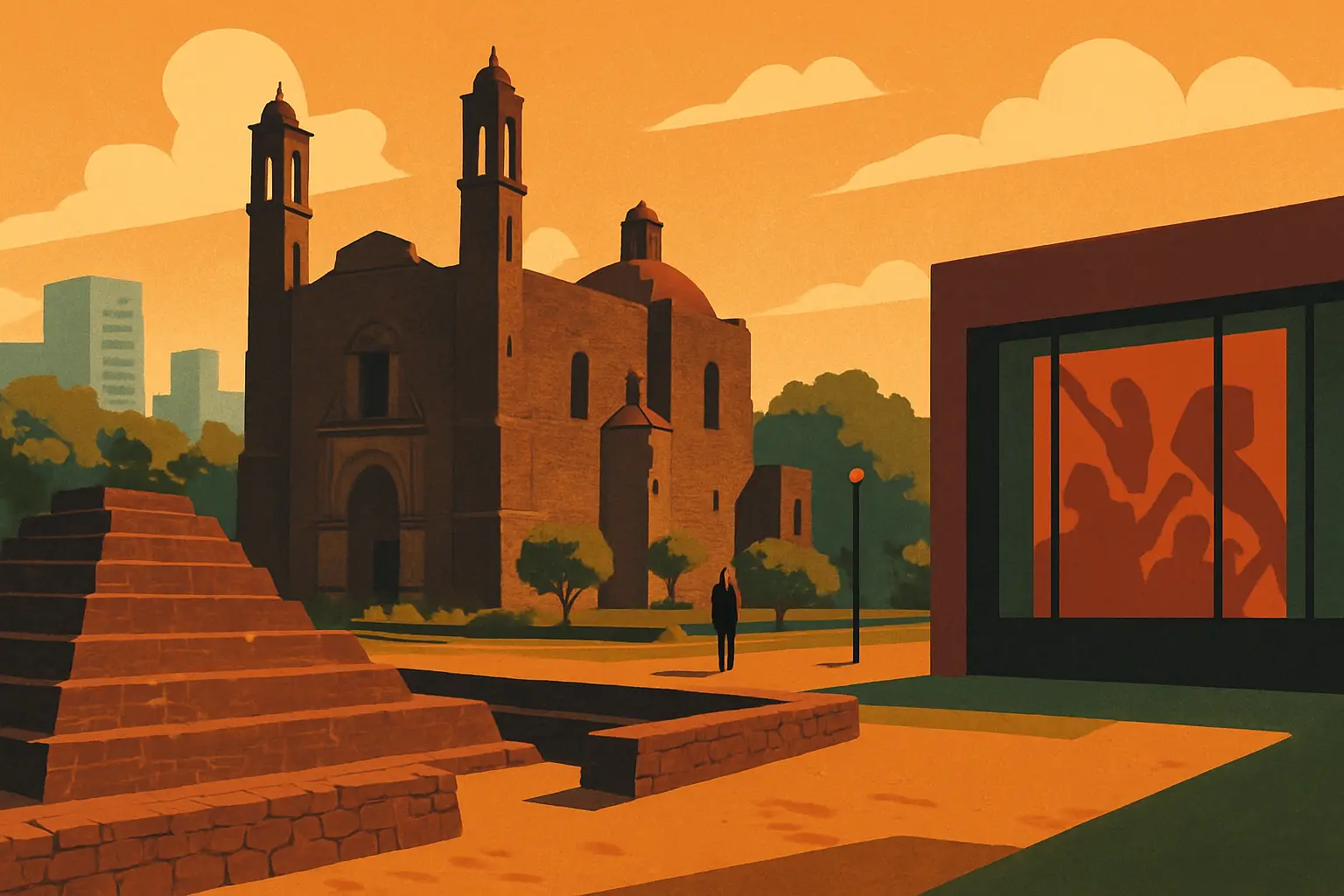
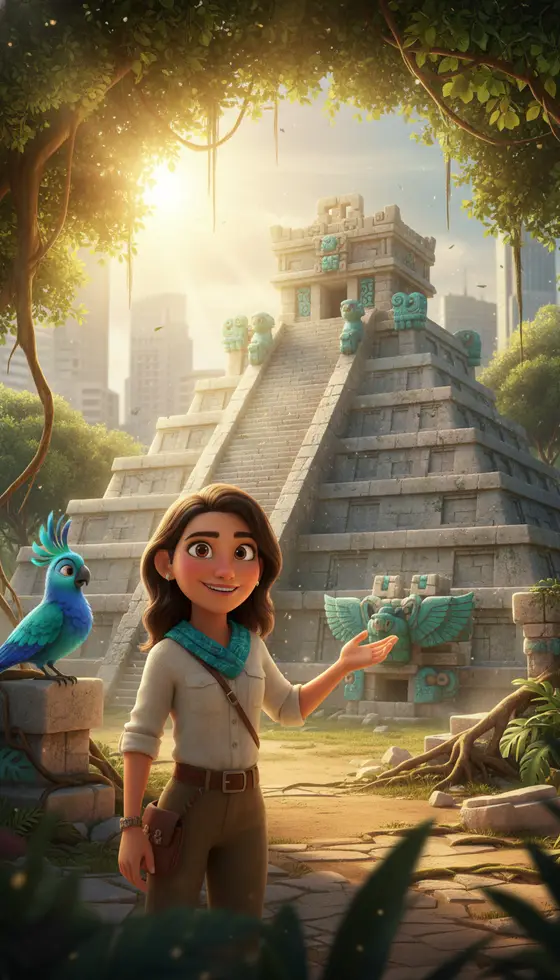
The Plaza de las Tres Culturas is one of those places where the facts are stranger than any museum exhibit. In a single city block in the Tlatelolco neighborhood — about 4 km north of the Zócalo via Metro — you can stand on a viewing walkway above ancient Aztec pyramid foundations, turn left to face a 17th-century Spanish church, and look up at the concrete towers of a 1960s federal housing project. The plaza's name says it plainly: three cultures, three eras, physically coexisting on the same ground. But unlike a designed museum, none of these layers were arranged for your convenience. They're here because each civilization felt compelled to make a statement about what came before. The Aztecs built their pyramids here because Tlatelolco was the commercial heart of their empire. The Spanish demolished those pyramids and built their church from the same stones — partly to save money, partly to make a theological point. And the 20th-century Mexican government added modernist housing towers to signal the birth of a new nation, then turned the plaza into the site of one of the worst state massacres of the 20th century. This is Mexican history at its most layered and most literal.
Located at Eje Central Lázaro Cárdenas and Ricardo Flores Magón, Cuauhtémoc
Metro Line 3 (green line) to Tlatelolco station — 5-minute walk to the plaza
Three distinct eras visible simultaneously: pre-Hispanic ruins, colonial church, 1960s towers
Most visitors to Mexico City know Tenochtitlan — the Aztec capital built on a lake island, now buried under the Zócalo and the Templo Mayor in Centro Histórico. Fewer know it had a twin city, founded on an adjacent island in the same lake in 1338, thirteen years after Tenochtitlan. Tlatelolco was politically subordinate — the Aztec ruler Axayacatl defeated and absorbed it in 1473 — but commercially, it was dominant. Every major trade route in the Aztec world ran through here. While Tenochtitlan was the political and religious capital, Tlatelolco was where business happened. Merchants from the Gulf Coast, Oaxaca, and the Pacific brought cotton, cacao, jade, obsidian, dried chiles, live birds, and slaves to its market. The city had its own merchant class, the pochteca, who traveled the empire's roads as long-distance traders protected by their own legal code. Fray Bernardino de Sahagún later established the Colegio de Santa Cruz de Tlatelolco here in 1536 — the first school of higher learning in the Americas — and the Nahuatl-Spanish dictionaries and indigenous codices produced there are a primary reason we understand Aztec civilization as well as we do today.
Founded 1338 — 13 years after Tenochtitlan, on a neighboring island in the same lake
The pochteca (long-distance merchant class) were based here with their own legal protections
Colegio de Santa Cruz (1536) — the first higher-education institution in the Americas — stood on this ground
Get short, interactive stories that make each place easier to remember while you travel.
On November 8, 1519, Hernán Cortés climbed to the top of the Tlatelolco pyramid to look down at the market below. What he saw made him write to the King of Spain that the market was twice the size of Seville — then one of the largest cities in Europe — and operated with an order and efficiency no European market could match. His soldier and chronicler Bernal Díaz del Castillo described the experience with unusual humility: 'I almost despaired trying to describe it all in detail,' he wrote, noting that even two days would not be enough to see every section. Modern scholars estimate 20,000 to 60,000 people passed through daily, surging to 60,000 on the special market day that recurred every five days in the Aztec calendar. The market had dedicated zones for gold and silver goods, featherwork cloaks, rubber balls, medicinal herbs, obsidian blades, pottery, food, live animals, and slaves — each section with its own pricing customs and a market court that resolved disputes on the spot. The Spanish military conquest of Tenochtitlan took two more years. But the commercial DNA of Tlatelolco's tianguis never disappeared — the open-air market format it perfected still runs in every Mexican neighborhood today.
Cortés estimated it as twice the size of Seville — Díaz compared it favorably to Constantinople and Rome
Up to 60,000 traders on special market days (every 5 days in the Aztec calendar)
Had a market court for dispute resolution — more organized than any contemporary European market
The military conquest of Tenochtitlan ended in Tlatelolco. After months of siege — Cortés cut off the causeways, starved the city of fresh water, and set fire to districts block by block — the Aztec forces made their last stand in the narrow streets of Tlatelolco in August 1521. The last Aztec ruler, Cuauhtémoc, was captured on August 13 attempting to escape by canoe across what remained of the lake. A stone marker in the plaza records the moment without declaring a winner. It reads: 'This was neither a triumph nor a defeat. It was the painful birth of the mestizo nation that is the Mexico of today.' That inscription — written in 1964 — remains one of the more honest summaries of Mexican identity you'll find engraved in stone anywhere in the city. The demolition of the pyramids began almost immediately after the conquest, with the Spanish taking cut stones for their own building projects. What you see in the archaeological zone today — 60+ structures including altars, platforms, and ceremonial staircases — survived because they were buried under rubble and later excavated, not because the Spanish left them standing.
August 13, 1521: Cuauhtémoc captured by canoe, formal end of the Aztec Empire
The memorial stone inscription — 'neither a triumph nor a defeat' — was written in 1964
60+ structures visible in the ruins, all excavated from rubble rather than preserved in place
The Church of Santiago Tlatelolco visible in the plaza today was built in stages between the 1520s and 1609, completed under the Franciscan friar Juan de Torquemada. It was built almost entirely from Aztec stones stripped from the demolished pyramids. Look closely at the exterior walls and you can see the irregularity: stones of different sizes, some with the smooth-cut quality of ceremonial pyramid cladding, others rougher. The most interesting detail is at the rear exterior wall of the church's atrium. Embedded there is a stone carved with a petroglyph that archaeologists have identified as Tlaloc — the Aztec god of rain and water. Its placement is almost certainly not accidental. The prevailing scholarly interpretation is that indigenous workers who built the church incorporated the Tlaloc stone themselves — so that worshippers facing the altar in Christian prayer were simultaneously facing Tlaloc behind them. Whether the Franciscans noticed and tolerated it, or never recognized what they were looking at, remains unknown. The church interior contains the Chapel of the Indians, built specifically for indigenous converts, and a disputed tradition holds that Cuauhtémoc's remains are buried somewhere within the complex.
Built 1520s–1609 by Franciscans using stone from demolished Aztec pyramids
The Tlaloc petroglyph is embedded in the rear atrium wall — easily missed without knowing to look
Photography generally permitted inside except during active services
On October 2, 1968 — ten days before Mexico City was to host the Summer Olympics — between 5,000 and 10,000 students, workers, and residents gathered in this plaza for a protest organized by the National Student Strike Council. The students were demanding democratic reforms from the PRI, the single party that had controlled Mexican politics since 1929. The government response was catastrophic. Army troops and a covert paramilitary unit called the Batallón Olimpia surrounded the plaza and opened fire. The official government death toll was 44. Declassified U.S. State Department documents and survivor testimony suggest the actual number was between 300 and 400. The bodies were disposed of in secret. For decades the Mexican government denied, minimized, or suppressed the record of what happened here. The first formal government apology came in October 2024, when President Claudia Sheinbaum acknowledged the state's responsibility — 56 years after the event. Memorial 68, opened by UNAM in 2007 inside the Conjunto Nonoalco-Tlatelolco building at the north end of the plaza, documents the student movement with photographs, personal testimonies, and declassified documents. Entry is free and takes about 45 minutes. The exhibits are primarily in Spanish. Every October 2, the anniversary march through Mexico City ends at this plaza — the largest annual civil demonstration in the country.
October 2, 1968: army and paramilitary opened fire on student protesters 10 days before the Olympics
Official toll: 44 dead — estimated actual toll: 300–400; covered up for decades
Memorial 68 museum (free, UNAM-run) is inside the north building of the Conjunto Nonoalco-Tlatelolco
It is, but it rewards visitors who arrive prepared. The ruins alone — without context — look like any outdoor archaeological zone in Mexico City: low stone foundations, interpretive signs, a viewing walkway. What makes Tlatelolco worth the trip is the layered reading: the market the Spanish couldn't believe, the church that hides an Aztec god in its wall, the massacre Mexico only officially acknowledged in 2024. Plan for 90 minutes to two hours: 30 minutes walking the ruins, 15 minutes inside the church, 45 minutes in Memorial 68. The ruins are open Tuesday through Sunday, approximately 8 a.m. to 5 p.m. Memorial 68 runs Tuesday through Sunday, typically 10 a.m. to 6 p.m. Both are free. Get here via Metro Line 3 (green line) to Tlatelolco station, exit toward Manuel González, and walk two blocks east — the plaza is immediately visible. For food after, Mercado Cuauhtémoc one block north has cheap comida corrida stalls with neighborhood pricing. Avoid Sunday mornings if a church service is scheduled — the atrium fills and the ruins walkway gets congested. Weekday mornings before 11 a.m. give you the ruins mostly to yourself.
Combined visit: ruins + church + Memorial 68 = 90–120 minutes
Metro: Line 3 (green) to Tlatelolco station, exit Manuel González, 2 blocks east
Mercado Cuauhtémoc one block north — neighborhood comida corrida, no tourist pricing