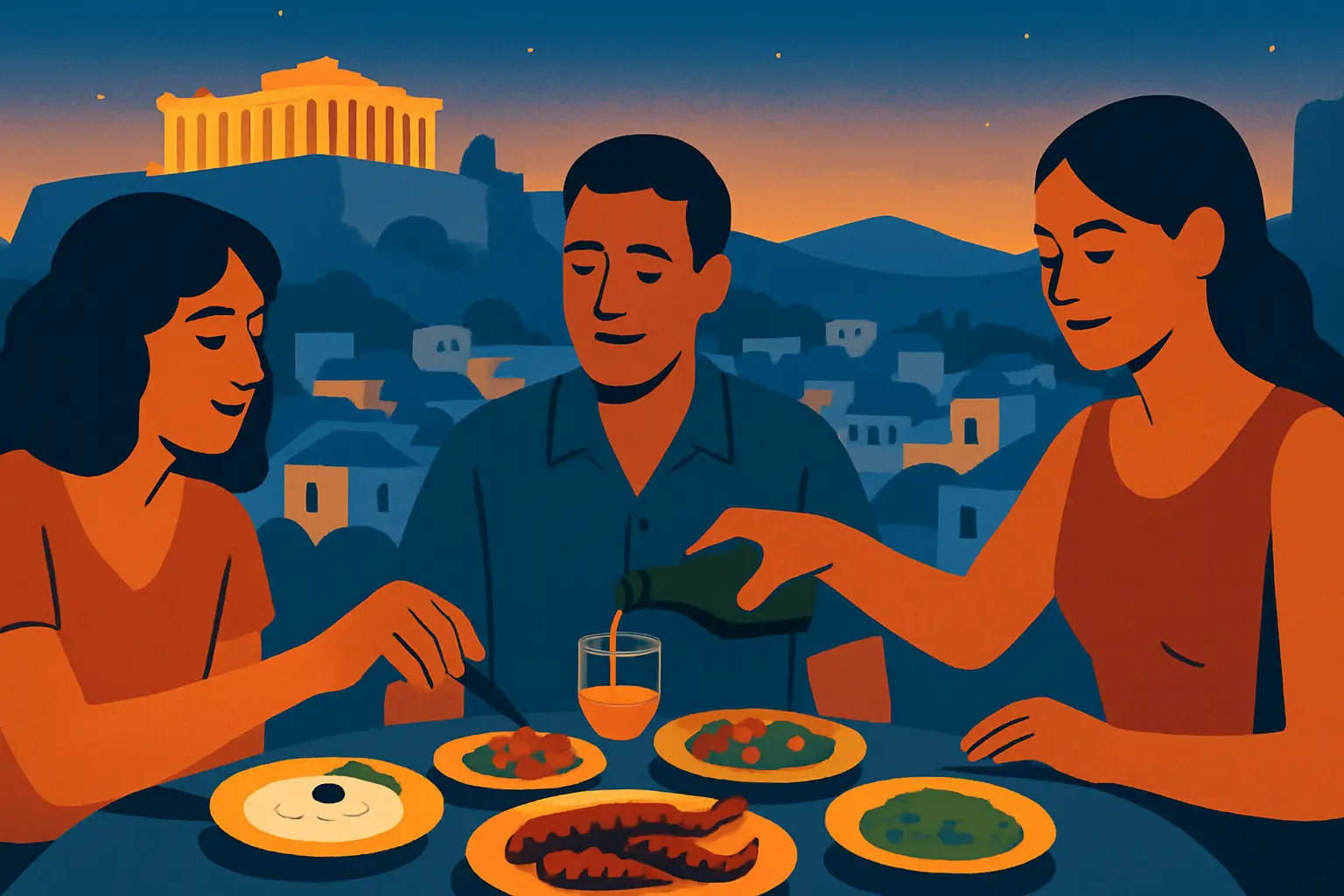
Athens runs on a food schedule that is genuinely different from northern Europe and North America. Breakfast is small or skipped: a freddo espresso at a neighborhood cafe, a tiropita (cheese pie) picked up from a bakery, or nothing. Lunch is treated as optional — a light plate, a sandwich, sometimes coffee and conversation and nothing else. Dinner is the serious meal, and it starts late.
Athenian kitchens aimed at local regulars begin filling at 9 p.m. and peak between 10 and 11. Before 8 p.m., the restaurants that are busy are the ones running on tourist timing — the food is the same, but the room is empty and the evening's energy is absent. The late schedule is not affectation; it reflects the actual rhythm of a city where working days often extend past 7 p.m. and the midday break is still observed.
The practical implication: treat the early evening as aperitivo time — a wine, a walk, a coffee on an outdoor terrace. Let dinner begin when the locals arrive. An Athens dinner that ends at 11 p.m. is considered early; one that runs to 1 a.m. is entirely ordinary.
The most important food distinction in Athens is the one visitors most often get wrong: souvlaki and gyros are not interchangeable, and Athenians treat the difference seriously.
Souvlaki is grilled meat on a skewer — typically pork, sometimes chicken — marinated in olive oil, dried oregano, and lemon, cooked over charcoal, and served either on the stick or wrapped in pita with tomatoes, onions, fries, and tzatziki. Gyros is rotisserie-cooked meat: a vertical spit of layered seasoned pork (or chicken) shaved in thin strips and wrapped in pita with the same accompaniments. The textures are distinct — gyros is tender and fatty from slow cooking, souvlaki is leaner with more direct char from the grill — and regulars have strong preferences between them.
The souvlaki strip on Mitropoleos Street, running east from Monastiraki Square toward the Byzantine cathedral, is the most concentrated spot for both. Savvas has operated there for decades and is the benchmark for the Athenian pita souvlaki; the queue at lunchtime is almost entirely local office workers. For the broader Monastiraki neighborhood context, the full guide covers what else is worth finding in the area.
Get short, interactive stories that make each place easier to remember while you travel.
A mezedopoleio is a specific type of Greek restaurant organized around shared small plates — mezedes — ordered progressively over the course of a long meal. It is not a tapas analog (portions are larger and the pace is slower), not a normal restaurant (there is no fixed menu and ordering is continuous throughout the evening), and not a quick dinner. It is closer to a social event that happens to involve a substantial amount of food.
The format runs in a consistent sequence. Cold dishes arrive first: taramosalata (whipped fish-roe dip with lemon and olive oil), melitzanosalata (roasted eggplant mashed with garlic and parsley), tzatziki, and horiatiki. These are eaten slowly with bread alongside a first carafe of retsina or a round of ouzo. Fried dishes come second: saganaki (a slab of kefalograviera cheese fried until the outside crisps and the interior softens), calamari, zucchini fritters. Grilled items close the meal — lamb chops (paidakia), grilled octopus dressed with olive oil and red wine vinegar, swordfish, or the fresh fish the kitchen sourced that morning.
The best mezedopolia in Athens are concentrated in Psyrri, where the format runs in its most traditional form. Ta Serbetia stou Psyrri on Eschilou Street near Plateia Iroon is the neighborhood's most reliable example — the cold plates are correct, the portions are honest, and on weekend evenings there is usually live music drifting through the room.
Moussaka is not a Greek shepherd's pie. A properly executed moussaka layers salted-and-fried eggplant slices, spiced ground beef (or beef-and-lamb), and a béchamel enriched with egg yolk and nutmeg — baked until the layers fuse and the top turns golden. The béchamel should be firm enough to hold the slice but light enough to cut cleanly. It is labor-intensive and shortcuts easily; a taverna running moussaka made fresh that morning is a better bet than any tourist-facing restaurant heating yesterday's tray.
Horta — boiled wild greens dressed with olive oil and lemon — is often the best item on a taverna table. Dandelion, chicory, amaranth, depending on the season and the market. The olive oil is doing the work, so the kitchen's sourcing determines whether this is interesting or forgettable.
Tiropita (cheese pie) is the food to eat walking in Athens: phyllo dough filled with feta and egg, baked until the exterior flakes. Every fournos (bakery) in the city sells them fresh from the oven in the morning. The best version has hand-rolled phyllo buttered between every layer, with an interior that is still slightly soft rather than fully dried. The bakeries near Varvakios Agora on Athinas and Evripidou streets are consistently good.
Grilled octopus requires preparation before it touches the grill — tenderized by sun-drying or freezing. An octopus grilled without this step will be tough rubber. A properly prepared piece has a charred exterior and tender interior with a slight chew, dressed with nothing except olive oil, red wine vinegar, and dried oregano.
Loukoumades — deep-fried honey dough balls — have their own full guide. The short version: eat them immediately from a dedicated shop, with thyme honey and crushed walnuts, not as a cafe afterthought.
The full Greek coffee culture — the freddo espresso, the traditional Greek coffee, and the range of Athenian cafe formats — is covered in the Greek coffee guide. For the evening side, what matters is the wine and spirits pairing.
Retsina — wine with pine resin added during fermentation — is the traditional mezedopoleio pairing. It is slightly tart, lightly astringent, and specifically calibrated to cut through the fat in taramosalata and fried cheese. Malamatina is the standard label, served very cold in small bottles. Retsina with taramosalata is a combination that has survived in Athens for a reason: they actually work together.
Ouzo is the anise-flavored spirit of Greece — served with ice or cold water, which turns it milky white through a process called louching. It is drunk slowly alongside cold mezedes, not as a shot. Ordering ouzo at a traditional kafeneion will typically bring a small complimentary plate of accompaniments — olives, a piece of cheese, sometimes bread.
For wine, two Greek varieties worth knowing before you sit down: Assyrtiko from Santorini is a volcanic white with high acidity and mineral intensity that is genuinely unlike any other white wine produced in Europe. Xinomavro from Naoussa in northern Greece is a red with Barolo-level structure — high tannin, sharp acidity, long finish — and the correct match for lamb at a taverna. Both are available by the glass at the better Athenian wine bars and by the bottle at most restaurants.
Monastiraki is the street food center of Athens: souvlaki on Mitropoleos Street, loukoumades at the dedicated shops, and the produce, fish, and olive vendors inside Varvakios Agora. The spice and herb shops along Evripidou Street — the market's northern boundary — are worth the detour for fresh mountain teas, dried figs, and bulk herbs that smell nothing like the rest of central Athens.
Psyrri, three minutes west of Monastiraki on foot, is the mezedopoleio neighborhood: late dinners, live rebetiko music, and Greek eating at its most traditional. The streets around Plateia Iroon have enough options that walking and choosing by the sound of the room works better than a reservation. The full Psyrri guide covers the neighborhood in detail.
Koukaki, directly south of the Acropolis, is where to eat if you want a kitchen thinking carefully about what is on the plate. Voulkanizater on Falirou Street — a converted auto repair shop with bare concrete and exposed ventilation — runs modern Greek dishes built from regional ingredients. Dodekapiata resets its twelve-dish menu with each new moon. The Koukaki neighborhood guide has the complete breakdown.
Exarcheia, north of the National Archaeological Museum, runs younger and more affordable: neighborhood tavernas, the organic-leaning Yiantes on Valtetsiou Street, and a concentration of plates in the 12–16€ per person range that are no worse for the price.
Budget: A standard mezedopoleio dinner — four or five shared plates, a carafe of house wine, coffee — runs 20–28€ per person when eating with two or more. A street souvlaki or gyros is 3–4€. A freddo espresso at a cafe is 2.50–3€. Better restaurants in Koukaki or Kolonaki cost 35–55€ per person with drinks. Greek restaurants do not typically add service charges to the bill; tipping by rounding up or leaving 5–10% is appreciated but not expected.
Vegetarian? Greek food is genuinely good for non-meat eaters. The cold meze plates are mostly vegetable and dairy. Gigantes plaki — giant white beans baked in tomato sauce with celery and olive oil — is one of the most satisfying dishes in the cuisine and contains no meat. Fava from Santorini (a smooth yellow split-pea dip dressed with raw onion and capers) is similarly serious. The horta, the horiatiki, the tiropita, and the spanakopita are all naturally meat-free and worth ordering regardless of diet.
Best month to eat in Athens? June is genuinely good: the city's full population is still present before the August island exodus, outdoor terraces are running, and the evening temperatures (22–25°C) make dining outside until midnight comfortable. The summer tomatoes — which determine the quality of half the menu — are at peak ripeness right now. September and October offer the full season with a calmer, more local atmosphere once the summer crowds have cleared.