Loukoumades in Athens: The Ancient Street Food You Need to Try
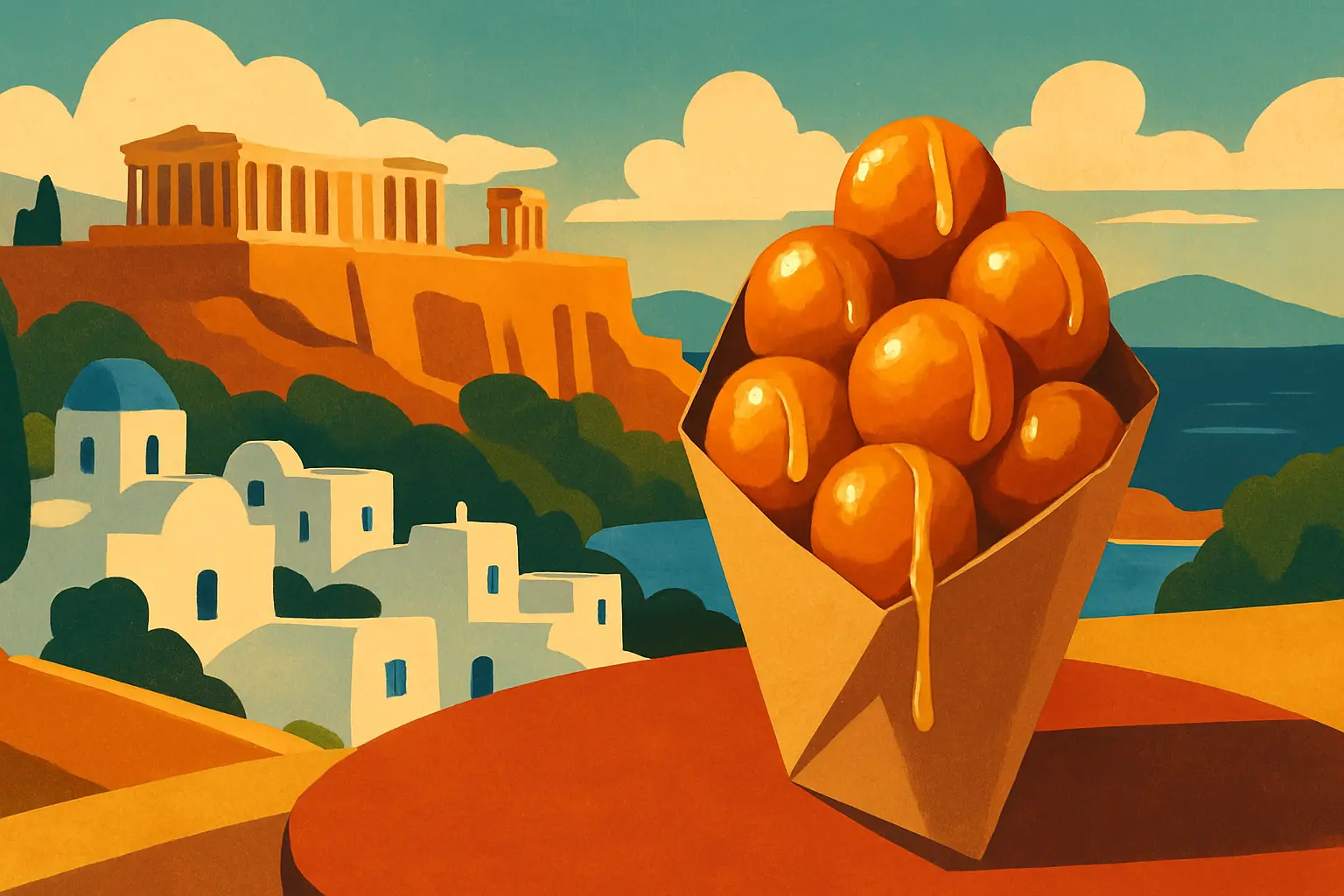
They arrive at the table stacked in a paper cone — small, perfectly round, deep golden, and drizzled with honey before they've had a chance to cool. Loukoumades are Athens' original street food, with a history that runs from the corner of Aiolou Street back through Byzantine monasteries and all the way to the ancient Olympic Games. This is the guide to what they are, why they're significant, and where in Athens you'll find the best — from a shop that has been frying them since 1912 to a modern spot rewriting the toppings menu entirely.
🍯 Short stories • Collectible cards • Learn as you travel
Loukoumades are at their best within 3 minutes of leaving the fryer — crispy shell, airy inside, honey still warm. They go soft and heavy fast. Order small batches and eat standing up.
Go traditional first
Try the classic version — honey, cinnamon, sesame seeds — before the gourmet variations. The base recipe is 2,500 years old for a reason. Nutella can wait.
Ktistakis for the real thing
Ktistakis at Sokratous 40, near Omonia Square, has been making loukoumades since 1912. No decoration, no menu, no tables. You eat them at the counter. This is the benchmark.
Loukoumades: Athens from ancient prize to street corner
1What loukoumades actually are
Loukoumades (singular: loukoumas) are small fried dough balls made from a leavened batter — flour, yeast, water, and a small amount of salt — dropped into hot oil by the spoonful and fried until they form a thin, blistered golden shell around a hollow, airy interior. The texture is the point: the outside should crack slightly when you bite in, the inside should be soft and almost steam-filled, and the whole thing should be light enough that you can eat eight to ten of them without feeling heavy. They weigh almost nothing.
The classic presentation is simple: a pile of hot loukoumades drizzled with thyme honey, dusted with cinnamon, and scattered with sesame seeds. The honey soaks into the shell slightly as it cools, which is why timing matters. A loukoumas eaten sixty seconds out of the fryer is a different experience from one that's been sitting for ten minutes — the shell softens, the honey pools at the bottom, and the delicate crunch is gone.
What separates loukoumades from a beignet or a donut is the batter, the size, and the complete absence of sweetness in the dough itself. The fried ball has no sugar in it. All the sweetness comes from what's poured on top, which is why the quality of the honey is so important — and why the traditional shops in Athens are particular about sourcing theirs from specific regions of Greece.
2The ancient origins: how loukoumades became the world's oldest recorded street food
The loukoumas has a documented history that makes it unusual among street foods. The ancient Greek writer Athenaeus, in his third-century text Deipnosophistae (roughly: 'The Dinner Table Philosophers'), describes a fried dough ball called 'enkrides' — coated in honey and eaten warm — that was distributed to athletes as a prize at the ancient Olympic Games in Olympia. Scholars have debated the exact relationship between enkrides and modern loukoumades, but the technique is clearly continuous: leavened dough, hot oil, honey.
The Byzantine period deepened the connection. The dish appears repeatedly in Byzantine monastic records under the name 'loukoumades' — derived from the Arabic 'luqma,' meaning 'bite' or 'morsel,' which entered Greek through medieval trade — where monks prepared them on feast days and distributed them to the poor. This is how loukoumades acquired their enduring association with celebration and communal eating. In Greece today, they still appear at religious festivals, village panegyria (saints' day celebrations), and name-day parties alongside the formal food.
The word itself tells you something about Athens' position as a crossroads city. The Arabic root arrived via the medieval Levantine trade routes that ran through Constantinople and into the Greek peninsula. A food with ancient Greek technique, a Byzantine monastic tradition, and an Arabic-origin name — served today in a shop founded in 1912 on a street named after a pre-Christian Greek god. That layering is very much the Athens experience.
Keep touring
Discover more about Greece in minutes
Get short, interactive stories that make each place easier to remember while you travel.
3Ktistakis: the benchmark, operating since 1912
The most important loukoumades address in Athens is Loukoumades Ktistakis at Sokratous 40, a five-minute walk north of Monastiraki Square toward Omonia. The shop opened in 1912 and is now in its third generation of family ownership. There is no menu. There is no seating. There is a counter, a fryer, and two options: honey-and-cinnamon, or honey-and-cinnamon with sesame. The paper cone costs around €3 and contains more loukoumades than most people expect.
Ktistakis is not marketed to tourists. The clientele is largely Athenian — market workers from the surrounding area, office employees on a midmorning break, students from the nearby polytechnic. The loukoumades here are slightly denser and chewier than the airy versions you'll find at more modern spots — the recipe leans toward the traditional batter that ferments longer and develops more flavor. The honey is poured on thick. Sesame seeds are pressed in while the balls are still hot.
The surrounding streets, particularly Evripidou, are worth exploring before or after. Evripidou runs parallel to Sokratous and functions as Athens' spice market — narrow, covered, packed with sacks of dried herbs, wheels of cheese, barrels of olives, and hanging charcuterie. The cheese and herb vendors have been there for decades. You can stand at the Ktistakis counter eating loukoumades and smell cumin and dried oregano drifting in from the adjacent stalls. This is central Athens in a five-block radius.
4Krinos: 100 years on Aiolou Street
Krinos at Aiolou 87, a few blocks south toward Monastiraki, opened in 1923 and is the other essential traditional stop. Where Ktistakis makes round dough balls, Krinos makes something unusual for loukoumades: a ring-shaped version, closer in silhouette to an American donut, fried in the same honey-and-cinnamon tradition. The recipe has not changed in a century.
Aiolou is one of Athens' most interesting walking streets — a pedestrianized corridor that runs from Omonia down through the historic center, lined with cafes, independent shops, and old commercial buildings. At the Krinos end of the street, a few blocks north of Monastiraki Square and right next to the lively Agias Eirinis Square, you'll find the cafe almost exactly as it looked when it opened. The counter is marble. The display cases are vintage. The espresso comes in small white cups.
Krinos also serves a range of traditional Greek pastries alongside the loukoumades — kataifi (shredded wheat dough soaked in syrup), galaktoboureko (custard in phyllo), kourabiedes (almond shortbread) — which makes it a useful single stop for understanding the full range of Athenian sweet shop culture. Morning hours before 11 a.m. are when the loukoumades come out freshest and the crowds are thinnest.
5The modern revival: gourmet loukoumades and the new wave
Roughly fifteen years ago, a new generation of loukoumades shops opened across Athens that treat the fried dough ball as a platform rather than a finished product. The most prominent is Lukumades (note the altered spelling) at Aiolou 5, just steps from Agias Eirinis Square — the coffee-and-outdoor-seating hub of the trendy Monastiraki-to-Psyrri axis.
Lukumades offers the classic version and an expanding menu of variations: loukoumades filled with Cretan mizithra cheese and honey, loukoumades drizzled with dark chocolate and sea salt, versions with tahini and petimezi (grape molasses), and seasonal specials with Greek mountain tea syrup. The savory direction — cheese-filled loukoumades with hot honey — has become its signature and was genuinely novel when it launched.
The aesthetic is intentionally modern — the shop is photographed constantly — but the quality is real. The batter is made fresh, the oil is clean, and the execution is consistent. For first-timers who might find the pure-honey traditional version too intense, Lukumades' chocolate-and-cinnamon version is a calibrated entry point. The tourist volume on Agias Eirinis Square on a June afternoon is high; go before noon or after 4 p.m. to avoid the worst of the crowds. The outdoor tables on the square itself are excellent for watching the neighborhood's foot traffic while the loukoumades cool just enough to eat.
6How to order and what to say
At traditional shops like Ktistakis and Krinos, the process is direct: you walk in, indicate a small or large portion (usually just by holding up a finger or pointing at the serving size you see on the counter), pay, and receive a paper cone. The staff does not need your Greek to be good.
At modern shops, the menu is usually posted in both Greek and English. A few useful phrases:
- 'Mia meritsa loukoumades, parakalo' — 'One portion of loukoumades, please'
- 'Me meli ke kanela' — 'With honey and cinnamon'
- 'Zesta, parakalo' — 'Hot, please' (useful if you see a batch sitting out)
On toppings: the traditional combination is thyme honey, cinnamon, and sesame seeds. Thyme honey from Mount Hymettus — the long ridge visible east of central Athens — has been considered the finest Greek honey since antiquity, with a slightly herbal bitterness that balances the sweetness. If a shop specifies hymettian honey, it means they're taking the product seriously.
Avoid ordering loukoumades to go in a box if you plan to eat them more than five minutes later. The steam condenses in the container, softening the shell. The paper cone, while informal, is the correct serving vessel — it keeps one side of the dough exposed to air so the texture holds longer.
7When to eat them, how much they cost, and what else to know
When do Athenians eat loukoumades? They are not dessert in the formal sense. They are a mid-morning snack (around 10 to 11 a.m.), occasionally an afternoon break, and a late-night street food after bars. At panegyria and village festivals, they are eaten throughout the evening. You will not typically see loukoumades at a sit-down restaurant as a dessert course — that space is occupied by baklava, galaktoboureko, or a small serve of Greek yogurt with honey. Loukoumades belong to the street and the counter.
How much do they cost? At traditional shops, a portion (typically eight to twelve balls) costs €2.50 to €3.50. At modern spots, €4 to €6 depending on toppings and size. A loukoumas is still among Athens' most genuinely affordable foods — the price at Ktistakis has risen slowly over a hundred years of operation.
Is June a good time? Yes — Athens in June is hot (regularly 32-35°C), and the loukoumades shops are busy with both tourists and Athenians. The traditional shops open early (from 8 or 9 a.m.) and often sell out their freshest batches by early afternoon. If you arrive after 2 p.m. at Krinos on a busy Saturday, you may find the morning's full variety of pastries gone. For loukoumades specifically, the fryer runs continuously as long as the shop is open — but the queue at Lukumades on a summer Friday evening can stretch to 15 minutes.
Keep touring
Want to explore Athens' food culture with the story behind every dish and street?
TourMe turns Athens' neighborhoods, ancient history, and food traditions into short interactive stories and collectible cards — organized so every corner you visit comes with context. Walk Aiolou Street with the full history in your pocket.