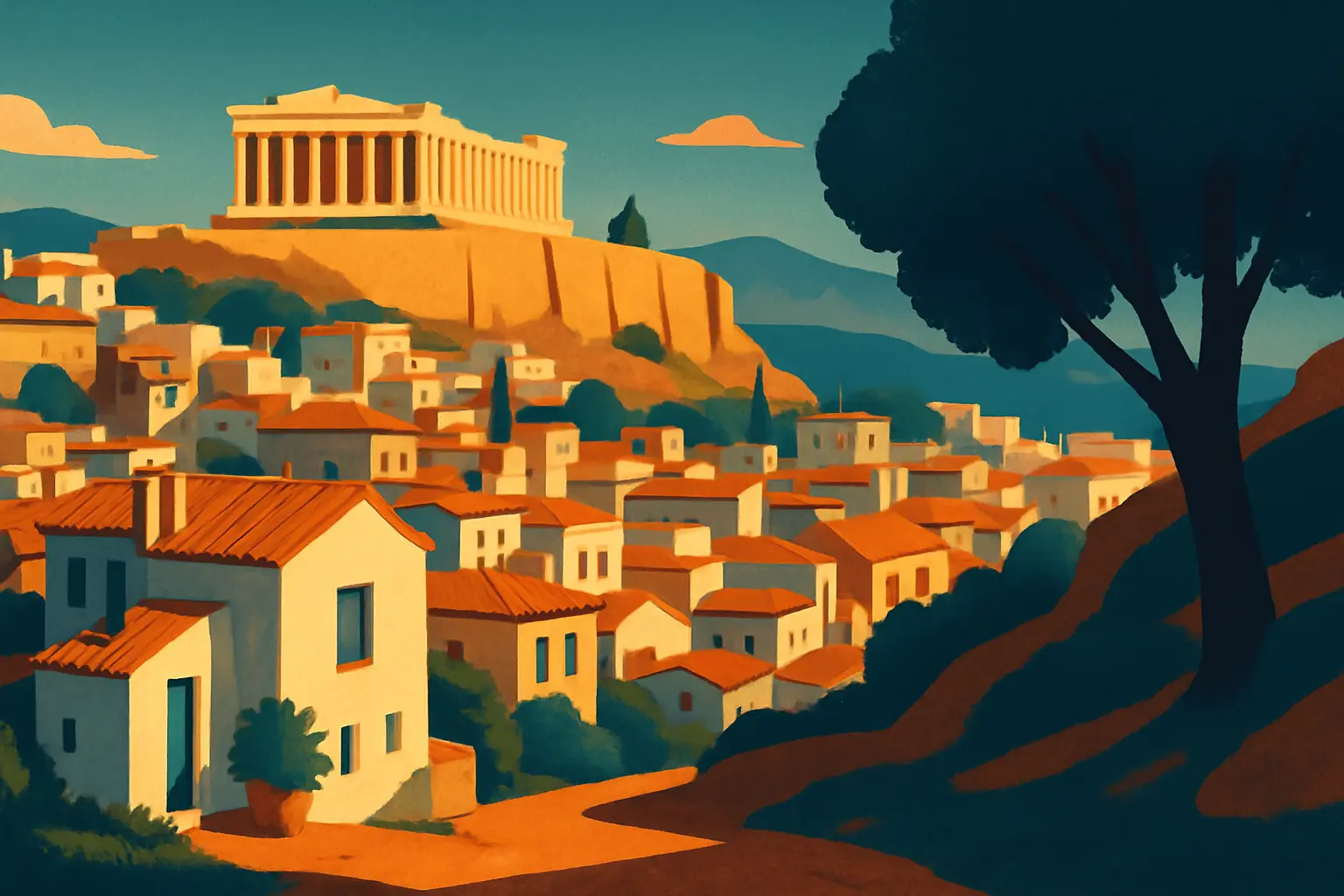
Koukaki occupies the quiet grid of 1930s apartment blocks directly south of the Acropolis, bounded by Syngrou Avenue to the east, Filopappou Hill to the west, and the Makrigianni district — the Acropolis Museum's immediate neighborhood — to the north. The main commercial streets, Falirou, Veikou, and Dimitrakopoulos, run east-west through the grid in parallel, each with its own character.
For most of the 20th century, Koukaki was a solidly middle-class Athenian residential neighborhood without particular tourist interest. That changed gradually after the Acropolis Museum opened in 2009 on Dionysiou Areopagitou — the boulevard that marks Koukaki's northern edge — which made the neighborhood the most convenient sleeping location for the city's single most important cultural attraction. Accommodation stayed cheaper than Plaka. Restaurants serving actual Athenians opened on Veikou and Drakou. The combination attracted a wave of digital nomads and foreign creatives in the early 2020s, which in turn accelerated the cafe and wine bar scene.
The result is a neighborhood that feels genuinely cosmopolitan without having lost its residential character. Families still occupy those 1930s buildings. The laundromat on Zitrou Street is busy on Tuesday mornings. The evening crowd at Opos Palia is still mostly Greek. The international layer sits on top of an Athenian foundation rather than replacing it — and that is exactly what makes Koukaki the most interesting base in Athens right now.
Two pedestrian streets give Koukaki its social structure. Drakou Street runs a few blocks from the neighborhood's northern edge southward, lined with cafes, a fish taverna, small bars, and the kind of independent shops that survive on local loyalty rather than passing foot traffic. It works well from midmorning to midnight and functions as the neighborhood's main artery across all hours.
Georgaki Olympiou Street, running west from Koukaki Square, has a different atmosphere entirely. The buildings on either side have been colonized by hanging plants, climbing vines, and street trees tall enough that the canopy nearly closes over the tables below. On a summer evening the light through the leaves turns the street into something that looks less like urban Athens and more like a garden party that got very good at hosting itself. Tables from four or five different bars and cafes spill into the same shared outdoor space.
Of the three main east-west streets, Falirou is the most ambitious — the better restaurants and craft bars are here, including the neighborhood's most serious wine bar. Veikou is the most local-feeling, with the legendary Guarantee sandwich shop at 41 and the taproom Blame the Sun at 60. Dimitrakopoulos is quieter and more residential, better for a morning pastry than a late-night cocktail. All three are walkable from any point in the neighborhood in under ten minutes.
Get short, interactive stories that make each place easier to remember while you travel.
The place that best defines Koukaki's current food identity is Voulkanizater on Falirou Street — a former auto repair shop converted into an industrial-chic bar-restaurant where chef Thomas Matsas runs a menu built on traditional Greek ingredients pushed in new directions. Lamb preparations from the western mainland, aged cheeses from Epirus, seafood that actually registers the specific sea it came from. The space retains its original garage bones — bare concrete, exposed ventilation — with lighting and sound that suggest someone thought carefully about atmosphere without making it feel engineered.
Dodekapiata takes an even more specific approach: Chef Manos Lygizos writes twelve dishes on a chalkboard that resets with every new moon. What's on the board is built around whatever is seasonal and interesting at that exact moment — raw amberjack finished with bergamot from the island of Kythera, slow-roasted lamb neck under a rubble of pickled capers and smoked yogurt. The setting is quiet and serious without being stiff. Reservations are essential.
For a more traditional evening, Opos Palia at 2 Veikou delivers straightforward meze: cold dishes first (tzatziki, taramosalata, horta dressed with lemon, stuffed vine leaves), then grilled meats and the day's fish. The menu is small and mostly verbal, the tablecloths are paper, and the beer is cold in the way that only comes from a refrigerator that has been at the same setting for thirty years.
Skoumbri on Drakou Street — the name means 'mackerel' — has white-painted tables and rope fixtures that nod toward the islands, with classic grilled and fried seafood priced in a way that feels almost impossible given the quality. MANIMANI at 10 Falirou occupies a neoclassical building with a garden terrace and focuses specifically on the cuisine of the Mani — the remote middle finger of the Peloponnese — which means dishes built around cured pork, legumes, and vegetables in preparations that predate refrigeration by several centuries.
Koukaki runs on a different schedule from tourist Athens. By 8 a.m. the coffee spots on Drakou and Georgaki Olympiou are open and populated with Athenians who live and work nearby. Lotte at 2 Tsami Karatasou — a small street connecting Drakou to Koukaki Square — has established itself as the neighborhood's most consistent morning cafe: reliable espresso, handmade sweets, homemade pies, tables outside that fill fast. The interior is compact and the crowd is local.
Morning Bar nearby bakes its own sourdough, uses it for sandwiches, and takes coffee seriously enough to source beans from small European roasters. It is not a destination brunch spot; it is a neighborhood cafe that happens to do everything well.
For the neighborhood's most persistently queued-for address, walk to Guarantee at 41 Veikou. Giannis — the owner, who spent years at sea before opening the shop — builds each sandwich from fine-cut cured meats and cheeses sourced from across Europe, handmade sauces, and bread baked fresh daily. There are usually six or seven options on the board, each specific and none generic. The 20-minute midday queue is not a tourist phenomenon; it is an Athenian one, which is the better endorsement.
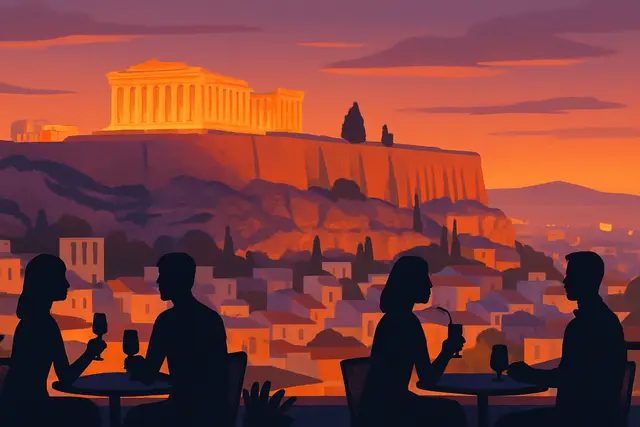
Between 6 and 9 p.m. the pedestrian streets shift. The coffee crowd disperses and the aperitivo crowd arrives, and on the plant-covered stretch of Georgaki Olympiou the late-afternoon light through the canopy becomes one of the better ambient experiences in Athens.
BoBo is the neighborhood's most serious wine bar: a converted garage with a daily chalkboard of roughly 25 biodynamic and organic wines by the glass, rotating continuously, mostly Greek and South European producers. The accompanying food — carpaccio, small salads, a few warm dishes — is exactly sufficient to turn a two-hour wine session into what amounts to dinner. This is the spot Athens wine-interested visitors tell each other about.
Drupes & Drips on Zitrou Street is the dedicated spritzeria: vermouth, soda, bitter citrus, Greek and Balkan spirits in combination, tables outside, small food menu that works as a light meal. The format is Italian aperitivo translated into a Greek context, which means the pours are generous and the accompanying food is taken seriously.
Koukaki does not have a late-night district the way Psyrri or Kerameikos do. The rhythm here is dinner by 9 or 10 p.m., drinks at the bars until midnight or 1 a.m., and mostly quiet after. For craft beer specifically, Blame the Sun at 60 Veikou — a taproom with a Californian aesthetic and rotating Greek craft taps — and Strange Brew on Falirou are the neighborhood's two dedicated options. Both are small, knowledgeable about their inventory, and primarily local crowds.
Koukaki's most underappreciated feature is the hill immediately to its west. Filopappou Hill — the Hill of the Muses — rises to 147 meters and provides the best wide-angle view of the Acropolis available in Athens, because unlike the Acropolis itself you are looking at the Parthenon from the side and at close range, with the city spreading behind it in every direction.
The walk from Drakou Street takes about 20 minutes: head north on Apostolou Pavlou Street (the pedestrianized boulevard that borders the ancient Agora), then follow the trail signs into the park. At the summit, the Monument of Philopappos — a Roman-era funerary monument built in 116 AD for a Syrian prince who served as Athenian magistrate — frames the view. The terrace around it looks directly at the Parthenon, the Saronic Gulf, and on clear days the islands of Aegina and Salamis.
On the way up, look for two specific stops. The Church of Agios Dimitrios Loumbardiaris is a small 16th-century Byzantine church set in a pine grove at the hill's lower section — the courtyard has pine needle-covered stone benches and is almost always empty and quiet. Higher up is the Pnyx: a semicircular stone terrace cut into the hillside in the 5th century BC where the Athenian democratic assembly actually met. Themistocles, Pericles, and Demosthenes gave speeches from this exact curve of rock. There is a simple stone bema — speaker's platform — at the center. No reconstruction, no fence. You can stand on it.
June evenings on Filopappou run long: the sun sets after 8:30 p.m. and the light on the Parthenon from the hill stays exceptional from 7:30 p.m. onward. This is a 40-minute round trip from Koukaki with no entry fee and no crowd management.
Is it safe? Koukaki is one of the quieter, more family-oriented neighborhoods in central Athens. Standard urban awareness applies — bags worn forward in crowds, phones off cafe tables in busy spots — but there is no specific hazard here beyond the ordinary friction of any European city. The streets around Syngrou-Fix metro are quieter after midnight; stick to the pedestrian streets rather than the avenue edges if you are heading home late.
Best time to visit? June is genuinely good: the city is at full population (Athenians haven't left for the islands yet), the restaurants are running their full menus, and the evenings — around 22–24°C — are comfortable enough for outdoor dining until midnight. The Acropolis Museum closes at 8 p.m. in summer, which means the early evening crowd clears from Koukaki's northern edge and the neighborhood becomes more local-feeling. July and August bring more intense heat and more tourists; September offers the best weather and a post-summer calm that many long-term visitors prefer.
Getting there: Take Line 2 (Red Line) to Acropoli station for the northern section of the neighborhood — a seven-minute walk to Drakou Street. Syngrou-Fix station serves the southern edge. From Monastiraki, walk south along Apostolou Pavlou — the pedestrianized route passes the ancient Agora and runs below the Acropolis wall, taking about 20 minutes and being one of the better walks in the city. From the airport, take the metro to Syntagma and change to Line 2 toward Piraeus; Acropoli is two stops south.