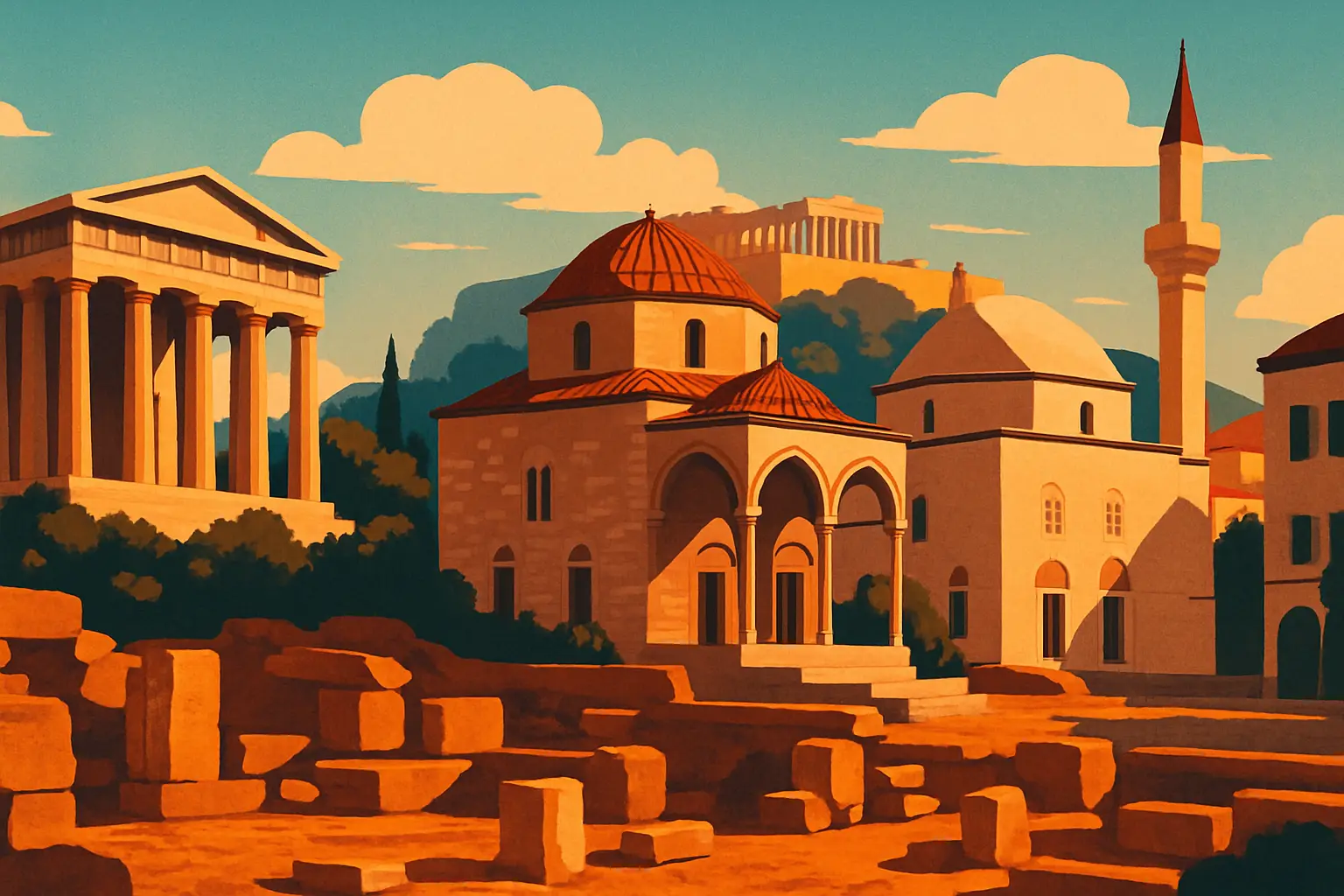
The name Monastiraki means 'little monastery' in Greek — a nod to the Pantanassa Monastery that once dominated the square and gave the neighborhood its identity. That monastery is still there, tucked into the south edge of Monastiraki Square, its 17th-century facade easy to miss between the souvlaki shops and metro entrance signs. Beside it stands the Fethiye Mosque, built in 1458, seven years after the Ottoman conquest. Directly to the west, the fence of the Ancient Agora — the civic heart of classical Athens — runs along Adrianou Street. Look up and south from anywhere on the square: the Acropolis is visible from almost every angle.
What makes Monastiraki different from every other neighborhood in Athens isn't just that it has old things — Athens has old things everywhere. It's that these layers are simultaneous and adjacent. You can trace a walk from a Mycenaean-era burial ground (excavated beneath the Metro station in 1991) to a classical-era courthouse (in the Agora), to a Byzantine church (the Pantanassa), to an Ottoman mosque, to a 19th-century flea market, to a rooftop bar with a DJ set and Acropolis cocktail views — all within about 800 meters. That compression is what makes Monastiraki the neighborhood every first-time Athens visitor lands in and what keeps it interesting for everyone else too.
Most visitors to Athens sprint up to the Acropolis and consider the job done. The Ancient Agora, directly west of Monastiraki Square along Adrianou 24, is where the city's actual daily life unfolded for nearly a thousand years — and it's significantly undervisited by comparison. The Agora was Athens' civic, commercial, and philosophical center: courts operated here, the assembly met nearby, merchants set up stalls along the colonnaded walkways, and philosophers argued in the open space between. Socrates walked here and was tried here. Saint Paul preached here in 51 CE, as described in Acts 17.
Two things make the Agora worth at least two hours of your time. First: the Temple of Hephaestus (the Theseion), on the western ridge of the site. Built around 450 BCE, it is one of the most complete ancient Greek temples in existence — its roof, its columns, most of its sculptural decoration intact. It's more complete than anything on the Acropolis itself, and almost nobody goes to photograph it specifically. Second: the Stoa of Attalos, a reconstructed 2nd-century BCE market hall on the eastern edge of the site. The reconstruction (completed 1956 by the American School of Classical Studies) is meticulous — real ancient marble, ancient construction techniques — and now houses the Agora Museum, with finds pulled from the excavation: bronze jurors' ballots, pottery shards with political candidates' names scratched into them, actual ostracism shards used to exile Athenian politicians by popular vote.
Address: Adrianou 24, Monastiraki — entrance on Adrianou Street, 3 minutes from the metro
Hours: daily 8am–8pm in summer; €10 entry (included in the Acropolis combined ticket)
Temple of Hephaestus: one of the best-preserved Greek temples anywhere — far more complete than the Parthenon
Get short, interactive stories that make each place easier to remember while you travel.
On the north side of Monastiraki Square, directly beside the metro entrance, stands a low stone building with a dome and the remains of a minaret base. Most visitors walk past it without a second glance, assuming it's a closed museum or a decorative feature. It is the Fethiye Mosque, built in 1458 — and it is one of the only surviving Ottoman structures in central Athens.
The Ottomans controlled Athens from 1458 to 1821, a period of 363 years that left almost no visible trace in the city's official self-presentation. The Fethiye Mosque is the most significant exception. 'Fethiye' means 'conquest' in Turkish — the mosque was built by Sultan Mehmed II immediately after he visited Athens following his conquest of Constantinople, partly as a symbolic act of possession. During the Ottoman period it served as the main mosque of Athens; after Greek independence it became a warehouse for antiquities, then a prison, then storage again. A recent restoration has converted it into an exhibition space. The Greek state has been careful about how it frames the building publicly, which may be why it remains one of the least-discussed major historical monuments on Monastiraki Square despite sitting directly in front of thousands of visitors every day.
The Monastiraki flea market is not a single contained market with a gate and an entrance fee. It is a sprawling, semi-organized network of permanent shops, weekend dealers, and street vendors that radiates outward from Monastiraki Square along Ifestou Street, Adrianou Street, and through the surrounding lanes into Avyssinia Square. The permanent shops along Ifestou are open daily and sell roughly what you'd expect: leather goods, reproduction icons, ceramic plates, brass items, and a great deal of 'vintage' material that was manufactured last Tuesday.
The Sunday version is different. From roughly 7am until noon, outdoor dealers set up along the street and in Avyssinia Square at the far end of Ifestou — and these dealers bring genuine estate lots: cameras, military surplus, old coins, Ottoman-era copper vessels, communist-era Albanian currency, pre-war German tools. The quality and authenticity varies wildly, but the Sunday morning market has a specific energy — actual collectors, actual negotiation, actual surprise finds — that the daily permanent shops do not. Walk all the way to Avyssinia Square rather than stopping at the first row of stalls near the metro. The further you go from the tourist center, the more interesting the material gets and the more the prices reflect actual value rather than assumed tourist budget.
Daily shops: Ifestou Street — open roughly 9am–7pm, leather goods, reproductions, brass items
Sunday market: outdoor dealers from ~7am, best before 11am — Avyssinia Square at the far end is worth the walk
Avoid: stalls within 50 meters of Monastiraki Square itself — tourist pricing, low authenticity
Two minutes from Monastiraki Square on Mitropoleos Street, Bairaktaris and Thanasis face each other across the pavement and have been feeding Athens — and arguing over who does it better — since the 1970s. Both serve souvlaki and kebab in pita, both have lines at lunch, and both are cheap by any measure: a full pita with lamb kebab (the *kalamaki*), tomato, onion, and tzatziki runs around €3.50. Thanasis is generally considered the stronger choice, particularly for the lamb — the meat is coarser, less processed, with visible char from the charcoal grill.
The proper Monastiraki eating sequence: grab a pita from Thanasis, eat it standing or on the steps of the Stoa nearby, then follow with a small Greek coffee (*ellinikós kafés*) from one of the cafes in the square. Greek coffee is brewed directly in the cup, unfiltered — the grounds sink to the bottom and you stop drinking before you reach them. It's served with a small glass of water and no rush whatsoever. This is a €7 meal total, eaten in about 20 minutes, and it is one of the genuinely good cheap eating experiences left in a European capital.
Monastiraki has the best rooftop Acropolis views in Athens — better than Plaka, better than the Acropolis neighborhood itself, because the sightline from here includes the full rock with the Parthenon at the top and the ancient theater of Herodes Atticus on the slope. Two rooftop bars are worth knowing. A for Athens (Mitropoleos 2, on the corner of the square) is the better-known choice — good cocktails, consistent view, usually full by 8pm. Couleur Locale (Normanou 3, reached through a small passage off the square) is slightly more local in feel, less prominently marketed, and has a view that's marginally more centered on the Acropolis rock itself.
The timing matters more than the choice of bar. In June, sunset is around 8:45pm — arrive by 7:30pm to get a table and watch the light shift from harsh afternoon white to golden on the marble. The period between 8pm and 9pm is the money shot: the Parthenon catches the horizontal light and turns a warm amber while the sky above it goes blue-purple. Don't wait for full dark — by then the illuminated Acropolis is beautiful in a different way, but the golden-hour version is the one worth planning around.
Monastiraki is one of the most heavily trafficked areas in Athens, surrounded by police presence and with constant foot traffic even late at night. Violent crime is rare. The primary risk is pickpocketing — particularly on the Monastiraki Metro platform (Line 1 is old, crowded, and slow), in the flea market crowd on Sundays, and in the dense tourist cluster around Monastiraki Square itself. Standard precautions apply: keep bags in front, don't use your back pocket for your phone, be alert in the Metro.
Psirri, the neighborhood directly north of Monastiraki Square, looks significantly grittier — graffiti-covered walls, unmarked bars, streets that feel empty until they suddenly aren't. It's not dangerous; it's Athens' main alternative nightlife district and fills up after 11pm. If Monastiraki feels too tourist-facing (which it often is during the day), Psirri is where to go for actual bars, actual local crowds, and restaurants that don't have photographs on the menu.
Monastiraki works at multiple times of day for different reasons. Morning (8–10am) is the best window for the Ancient Agora — it's coolest, least crowded, and the Temple of Hephaestus in early light is genuinely stunning. Sunday mornings add the flea market dimension: the Agora at 8am, then the outdoor dealers on Ifestou Street from 9–11am is the ideal Sunday morning in Athens. Afternoon is flea market shopping and souvlaki on Mitropoleos. Evening is rooftop bars for the Acropolis sunset.
June is one of the better months to be here. The Athens & Epidaurus Festival begins in June, and the Odeon of Herodes Atticus — the 2nd-century Roman theater on the south slope of the Acropolis, directly visible from Monastiraki's rooftops — hosts performances through the summer. Tickets are sold at the festival box office. Temperatures in June run in the high 20s°C, warm but not yet the 38–40°C that Athens hits in August. August is the hardest month to be in Monastiraki: the tourist crowds are at peak, the heat is serious, and the Ancient Agora has almost no shade once the sun rises above the ridge.