1. What makes Samos different from every other Greek island
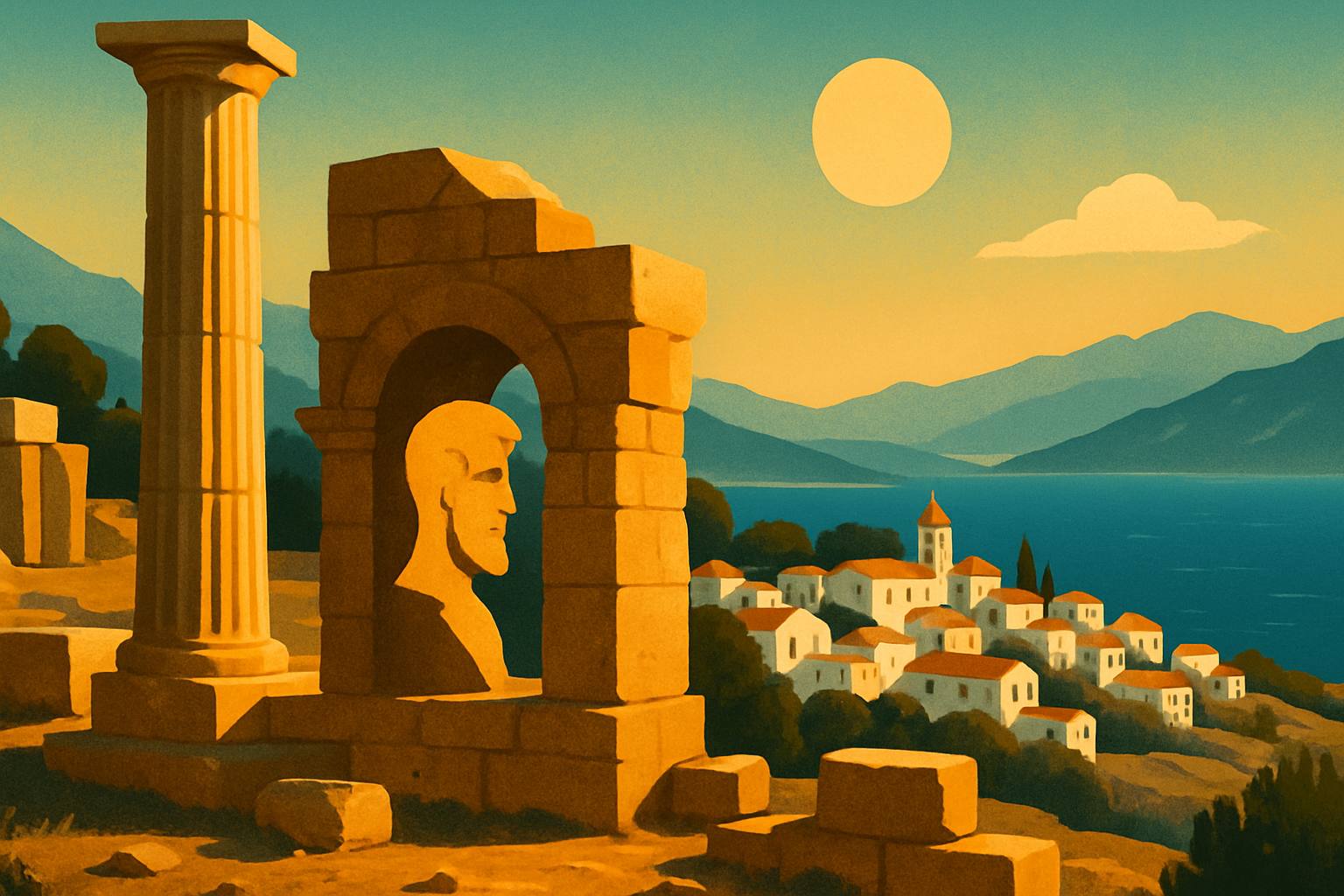
Samos sits in the eastern Aegean, 1.5 kilometers from the Turkish coast at its closest point — close enough that the mountains of Anatolia form the visible horizon from the harbor at Vathy on a clear morning. Geographically and visually, it bears no resemblance to the Cyclades. The island is heavily forested: Aleppo pine and cypress cover the central mountain range, which peaks at Mount Kerkis at 1,434 meters in the southwest. The terraced hillsides below are planted with olive groves and the Muscat vines the island has cultivated without interruption since classical antiquity.
For travelers arriving from Santorini or Paros, the transition from volcanic cube architecture to red-roofed stone villages and pine-covered ridgelines is immediate. The island looks more like a piece of mainland Peloponnese than anything in the Aegean.
What genuinely distinguishes Samos is what happened here. Pythagoras was born in Samos around 570 BCE — and so was Aristarchus, who in the 3rd century BCE proposed the first heliocentric model of the solar system: Earth orbits the sun, not the other way around. The proposition was ignored for 1,700 years until Copernicus. The tyrant Polycrates commissioned the construction of the Eupalinos Tunnel in the 6th century BCE, one of the greatest engineering achievements of antiquity. The island carries more specific intellectual history per square kilometer than almost anywhere in Greece.
2. The Tunnel of Eupalinos: 6th-century BC engineering you can still walk through
The Tunnel of Eupalinos is, without exaggeration, one of the most remarkable surviving structures from the ancient world. It is a 1,036-meter aqueduct cut through the limestone hill behind Pythagoreion, built during the reign of Polycrates around 530 BC. The engineer was Eupalinos of Megara, and he solved a problem with no precedent: how to deliver water from a spring on the northern side of a mountain to the city on the southern side, without an exposed surface pipe that enemies could cut during a siege.
His solution was to dig through the mountain. What was unprecedented was the method: two teams began simultaneously from opposite ends, guided only by geometric calculation, with no ability to communicate. They met in the middle with a horizontal deviation of under half a meter and a vertical error of around two meters — extraordinary precision for 530 BC. Herodotus, writing in the 5th century BC, listed it among the greatest engineering works in the Greek world. It has been a UNESCO World Heritage Site since 1992.
Visitors today walk a narrow pedestrian path through roughly half the tunnel — about 500 meters — before the passage narrows to a maintenance channel too low to continue. The width is roughly 1.8 meters. A walkway runs above the actual water channel, visible below as a slot cut into the tunnel floor. The entrance is a 15-minute walk uphill from the Pythagoreion harbor or a short taxi. The site opens at 8 a.m.; the first hour is consistently the quietest.
3. Pythagoreion and the Heraion: two UNESCO World Heritage Sites, one afternoon
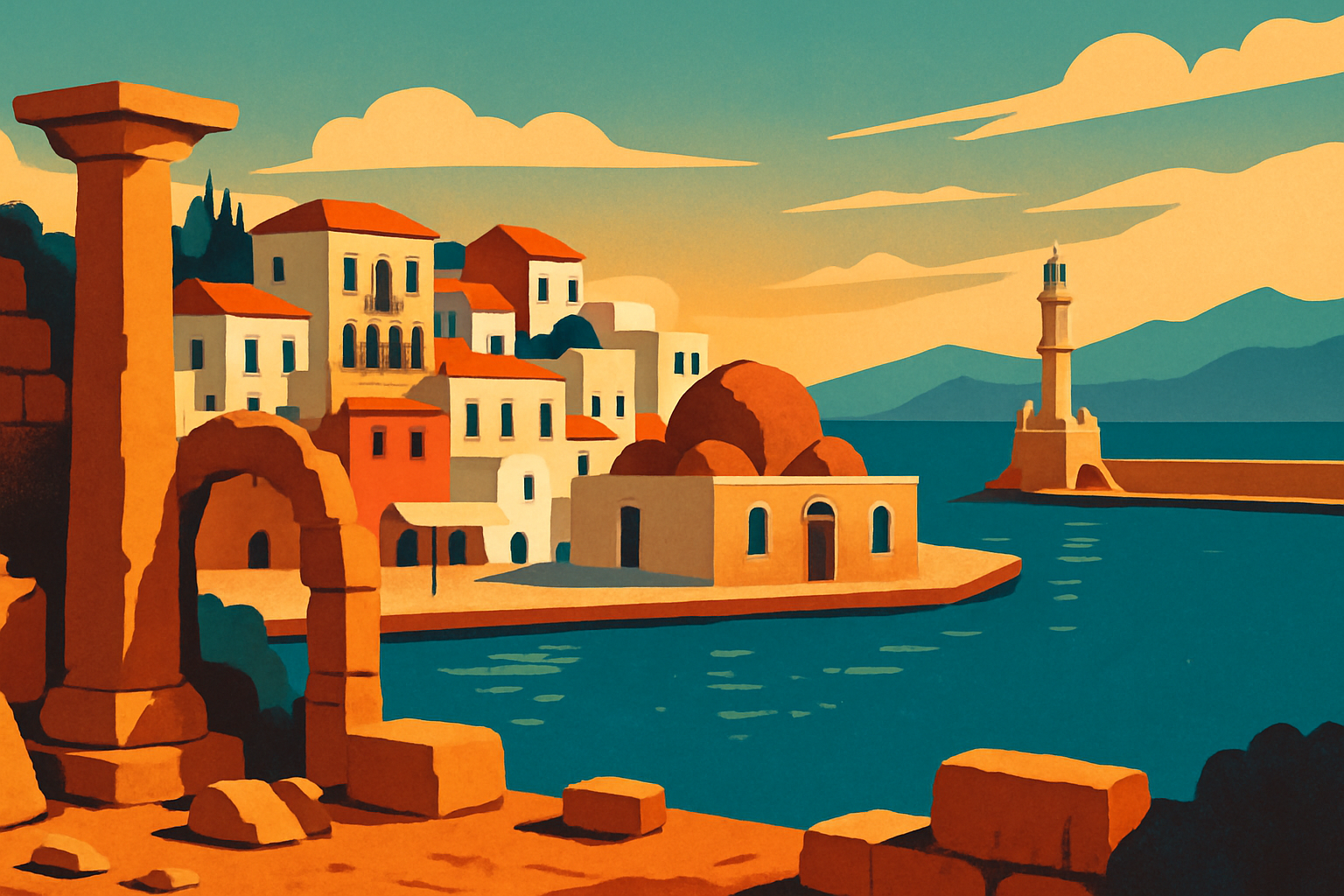
The UNESCO designation covers both Pythagoreion and the Heraion of Samos together — granted in 1992 for the "Pythagoreion and Heraion of Samos" as a single inscription. The harbor town of Pythagoreion occupies the site of the ancient capital of Samos, the city Polycrates ruled and Pythagoras later left. The ancient harbor walls are still visible: stone moles, mooring stones polished by centuries of rope friction, and sections of the old fortification wall that once protected the city. A small branch of the Archaeological Museum of Samos sits in the town center with finds from the immediate site.
The Heraion is the sanctuary of Hera, 8 kilometers west of Pythagoreion on the coastal plain. The temple was begun in the archaic period and expanded repeatedly, reaching a final form of 108 meters long and 55 meters wide with 155 columns in a double colonnade — one of the largest temples in the ancient Greek world. Almost nothing stands above ground now except a single column re-erected in the 19th century. The flat site and the remnant column bases communicate scale in the specifically archaeological way: you walk among the foundations of a building that was once bigger than the Parthenon, surrounded by farmland, and the absence does the work.
Practical logistics: the Heraion is reachable by local bus from Pythagoreion (runs hourly in summer) or by bicycle along the coastal road. Combined with the Eupalinos Tunnel and a lunch stop at the Pythagoreion harbor, this makes a natural full-day circuit.
4. Vathy and Ano Vathy: the capital most visitors move through too quickly
Vathy — the island capital, whose name simply means 'deep,' describing the bay — spreads around a natural harbor lined with palm trees and neoclassical architecture. The waterfront promenade runs the length of the harbor: fishing boats unloading in the morning, the daily market running on Athinas Street two blocks back, and coffee shops filling before 9 a.m. with a population that is mostly local rather than tourist-facing.
The part most visitors skip is Ano Vathy, the original hillside settlement above the port, founded in the 16th century as a fortified village set deliberately back from the coast during the period of intensive pirate raiding in the Aegean. It has survived almost intact: narrow cobbled lanes between stone houses, red-tiled roofs, exterior staircases and wooden balconies, small Orthodox chapels in courtyard corners. No cars. No signs beyond handwritten ones. The walk from the harbor promenade takes around 30 minutes and several hundred feet of elevation.
The Archaeological Museum of Samos (Efpalinos Street, Vathy, 8 euros) holds one of the most significant collections of archaic sculpture in Greece, anchored by the kouros figures retrieved from the Heraion sanctuary. The centerpiece is a colossal 5.5-meter kouros — the largest surviving archaic kouros from the 6th century BC — displayed in its own room. For travelers who found the National Archaeological Museum in Athens overwhelming in scale, this is a focused 90-minute experience directly connected to sites visible 30 minutes away.
5. Manolates, Vourliotis, and the mountain village circuit
The villages of Manolates and Vourliotis sit at roughly 800 meters in the Ambelos massif — the forested central range that gives Samos its distinctly un-Aegean landscape. Both are traditional stone settlements that never rebuilt for mass tourism. Narrow stone paths, spring water flowing through the village plateia, houses with original wooden joinery. The kafeneion in each village will have people in it who are surprised you came.
The walking circuit between the two villages passes through chestnut and strawberry-tree forest, with intermittent views south toward the Turkish coast. The trail takes about two hours at an easy pace. In June the mornings are comfortable hiking weather — cool at elevation before the heat builds below. Both villages have a taverna running on weekends; To Steki in Manolates is the consistent local recommendation for roasted meat and house wine, served at outdoor tables overlooking the valley.
The route from Vathy: take the local bus toward Karlovasi and get off at the Manolates junction, from which it is a short uphill walk to the village. The return can go via Vourliotis, then connect back to the main road and catch a bus toward either coast.
6. Samos Muscat wine: 2,500 years in the same cooperative
Muscat cultivation on Samos dates to at least the 7th century BC, and the wine appears in ancient texts. The modern institutional structure is the Union of Winemaking Cooperatives of Samos — EOSS — founded in 1934 through the merger of 26 local cooperatives representing around 2,800 growers. The cooperative controls nearly all wine production on the island, sourced from terraced Muscat Blanc a Petits Grains vines grown between 100 and 900 meters elevation on the northern and eastern slopes.
The Muscat of Samos PDO — a protected designation of origin active since 1970, among Greece's earliest — is the only Muscat PDO in Greece where the word 'Muscat' is not required on the label. 'Samos' alone is the designation; the name carries its own guarantee.
EOSS produces three primary wines. The Vin Doux is made by stopping fermentation before it completes, leaving natural residual sugar without adding spirits — the classic sweet wine that has been exported to France continuously since the 19th century. The Anthemis is a fortified version, richer and more intensely aromatic, made by adding grape spirit to arrest fermentation. The Muscat Sec is dry, fermented to completion, lighter and brighter, with an orange-blossom and stone-fruit note that works well alongside the island's fresh fish. The cooperative maintains a shop on the Vathy waterfront where all three are available by the bottle at 7–14 euros — direct from the source of a wine tradition running longer than most countries have existed.
7. How to get to Samos from Athens, other islands, and Turkey
By air: Samos International Airport (SMI) is connected to Athens in approximately 55 minutes and to Thessaloniki in about 65 minutes, with multiple daily departures on Aegean Airlines and Olympic Air in summer. Direct charter connections from UK, German, and Dutch airports run June through September.
By ferry from Athens: Ferries from Piraeus port take 8–12 hours depending on the route and service type. The overnight ferry — typically departing Piraeus around 7 p.m. and arriving in Vathy early the following morning — is the efficient option: you lose no daytime and save a night's accommodation. Some routes stop at Chios or Lesvos en route.
Island connections: Samos connects by ferry to Ikaria, Chios, Lesvos, Patmos, and Mykonos during summer. The Samos–Ikaria crossing takes around 1.5 hours and runs several times weekly, making the two islands a natural combination: Samos for archaeological density, Ikaria for the slowest pace in the Aegean.
From Turkey: Regular boat services connect Vathy and Pythagoreion to Kusadasi on the Turkish coast — a 20-minute crossing that makes Samos a logical gateway if combining a Greece trip with western Turkey and the ruins at Ephesus, 17 kilometers inland from Kusadasi.
8. Is Samos crowded in summer? And when is the best time to go?
Samos does not reach Santorini-level crowds. July and August bring visitors — the beaches at Kokkari and Pythagoreion fill, and the Vathy harbor sees more sailing yachts — but the island is large enough at 478 square kilometers that the mountain villages, interior trails, and western beaches at Mikro and Megalo Seitani remain accessible without competition. The island's tourism infrastructure runs primarily toward Greek families and European charter tourists rather than the boutique-hotel circuit, which keeps the atmosphere considerably calmer than the Cyclades.
June and September are the practical sweet spots. June offers good weather (27–30°C), full ferry and flight connections, and the year-round Samian population still in place before the August internal Greek tourism peak. The sea temperature in June runs 23–24°C — comfortable swimming without a wetsuit. September offers equally good weather with thinner crowds, and the Muscat harvest typically runs late August through September, which gives a wine-focused visit an obvious seasonal hook.
Safety and practicalities: Samos is straightforward to navigate. Vathy, Pythagoreion, and Karlovasi all have ATMs, pharmacies, and reliable mobile data. A rental car or scooter unlocks the mountain villages and western beaches most efficiently — public buses connect the main towns but run infrequently to interior villages. The coastal road between Vathy and Pythagoreion is well-maintained and offers the best views of the Turkish coastline across the channel.