1. What Skyros actually is — and why it feels nothing like Skiathos or Skopelos
The Northern Sporades run northeast from the mainland port of Volos: Skiathos first, then Skopelos, then Alonissos, and finally Skyros — sitting alone to the southeast, separated from the others by a wide stretch of open Aegean. Where the first three islands are connected by frequent inter-island ferries and share the same pine-forested character, Skyros has its own ferry line, its own physical landscape, and a cultural identity that marks it as something apart.
At 222 square kilometers, Skyros is larger than Skiathos and Skopelos combined. It divides physically into two zones. The northern two-thirds are densely forested — Aleppo pine covering the mountains, olive and fruit orchards filling the valleys, terrain similar to Skopelos in its green density. The southern third is the opposite: bare, rocky, semi-arid plateau — a moonscape compared to the north. This southern section, called Gerania, is where the Skyrian horses live and where the road eventually reaches Tris Boukes bay and the grave of Rupert Brooke.
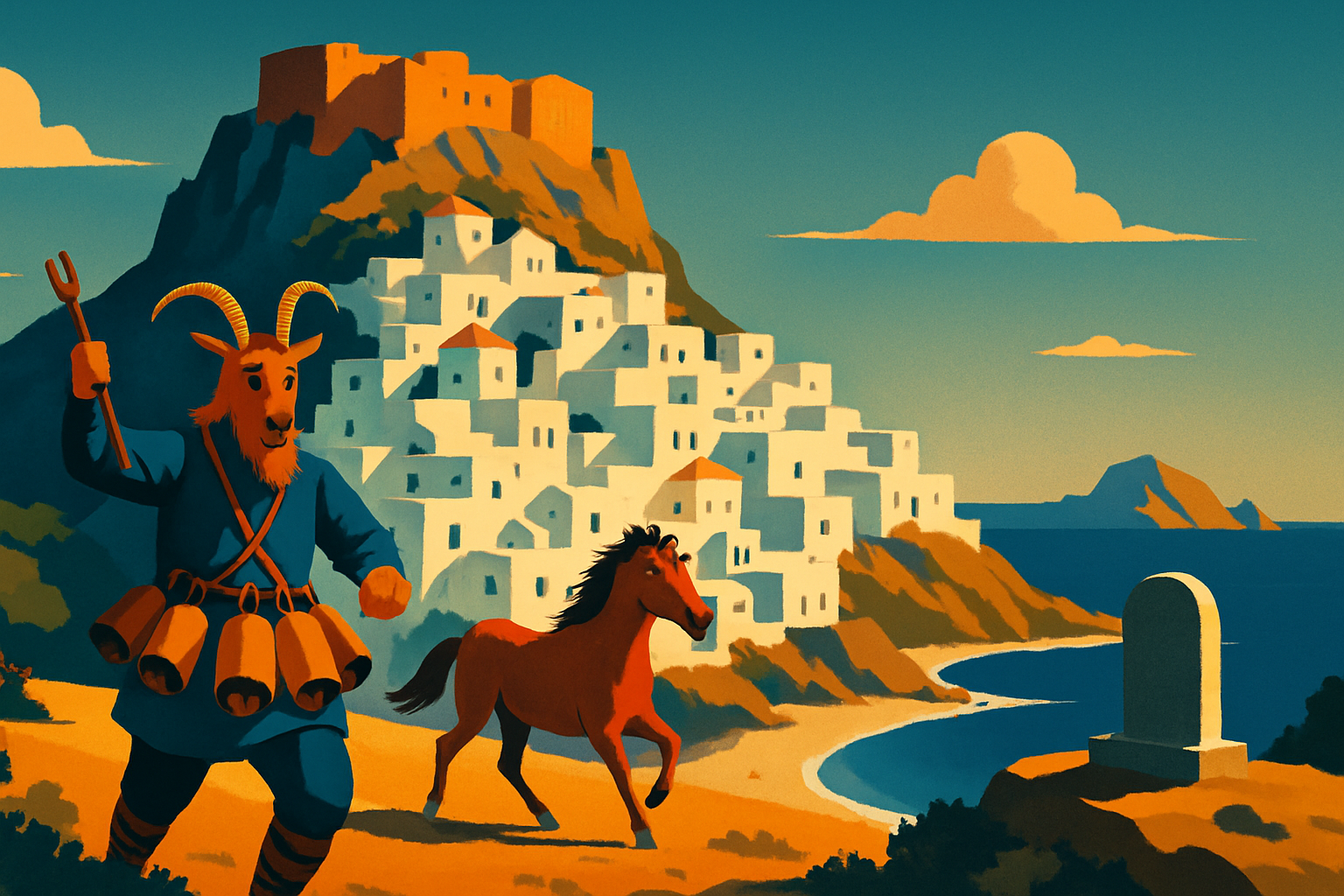
Skyros Town — called interchangeably Hora and Chora — sits at the junction of these two landscapes, on a steep cliff above the east coast. It looks, from the sea, unmistakably Cycladic: white-cube houses, a Byzantine-Venetian kastro at the summit. The resemblance is historical: Skyros was controlled at various points by the Venetian Duchy of the Archipelago — the same island group that included Naxos, Paros, and Amorgos — and the architecture absorbed those Aegean influences across several centuries of shared governance.
2. Skyros Town (Hora): the Venetian castle, carved furniture, and Plateia Rupert Brooke
Hora climbs a near-vertical cliff above the east coast, the white houses packed so tightly they form a continuous whitewashed surface from the lower lanes to the castle walls at the top. The Byzantine-Venetian kastro was built in Byzantine times and reinforced during Venetian rule; embedded inside it is the Monastery of Agios Georgios, founded in the 10th century and still maintained by monks. The monastery's icon of Saint George is said to have been brought from Constantinople during the Byzantine iconoclasm. The climb from the lower town to the castle gate takes about 20 minutes on foot and opens, at the top, to a view that spans the full arc of Magazia and Molos beaches to the east and the forested interior sliding toward Linaria to the west.
The town's main pedestrian lane runs through the older quarter below the castle — a narrow commercial street where the most characteristically Skyrian product is on display in every other shop: Skyrian carved wooden furniture. The tradition produces dark-stained wooden chests, shelving, and chairs inlaid with geometric and figurative motifs. These pieces genuinely furnish Skyrian homes and have done so for centuries; the craft is specific to the island in the way that Fes produces zellige tile and Chinon produces carved furniture in France.
Plateia Rupert Brooke — the main square of Hora — has cafes on three sides and a bronze statue of a nude youth commemorating the English poet, installed in the 1930s. Evening life in Hora converges here from about 8:30 p.m.: an ouzo at one of the kafeneia on the square, then dinner at tavernas in the lanes above. The pace is slow even in summer — Skyros absorbs its visitors into the rhythm of the town rather than building a parallel tourist infrastructure alongside it.
3. The Faltaits Museum: what a Skyrian house actually looked like inside
The Faltaits Historical and Folklore Museum occupies a 19th-century house in the old-town lanes of Hora, the former residence of the Faltaits family — Skyrian intellectuals who spent decades collecting the material evidence of island life before it was lost. Founded in 1964 by Manos Faltaits, the museum predates most Greek regional folk collections and is more coherent than most: it is not a government institution with labeled pottery shards, but a private house in which every room is organized around authentic Skyrian objects in authentic Skyrian arrangements.
The central feature is a reconstructed traditional Skyrian interior: ceiling-height carved wooden shelving running around the room's perimeter and displaying the full range of a Skyrian household's possessions — copper pots, painted ceramics, folded textiles, small religious objects. This high-shelving arrangement is a specifically Skyrian domestic tradition, developed partly in response to earthquake risk and partly as a form of aesthetic display. The configuration gives historic Skyrian rooms an appearance that resembles no other Greek domestic interior: dense, layered, warm.
Also in the collection: Byzantine manuscripts, 17th- and 18th-century maps of the Aegean, embroidered festival clothing from the Carnival tradition, and the full ceremonial costumes of the geros and korela figures — the central characters of the island's winter Carnival. If you visit Skyros outside Carnival season, the Faltaits Museum is how you understand what the ritual looks and feels like. Admission is €3; open Tuesday through Sunday, closing at 2 p.m.
4. The Skyros Carnival: goat bells, Dionysian ritual, and 50 kilos of sound
Every February or March — in the weeks before Orthodox Lent — Skyros holds a Carnival unlike anything elsewhere in Greece. It is called the Goat Festival locally, its formal name is the Apokries masquerade, and its origins are old enough that ethnographers still debate whether the ritual descends from ancient Dionysian rites or from medieval pastoral custom. The most honest answer is: probably both.
The central figure is the geros (the old man). He wears a furry black cape, white traditional trousers, and a belt strung with real goat bells — up to 50 kilograms of iron bells, worn at the waist and ringing with every step. The geros moves through the streets of Hora with a lurching, stamping gait that makes the bells ring continuously. He is accompanied by the korela — traditionally a man dressed in women's Skyrian festival clothing: a white skirt with yellow accents, a veil, and an embroidered blouse — and by the francos, a 'foreigner' in European dress who acts as satirical counterpoint.
The procession moves through Hora for several days during Carnival week, filling the lanes and spilling into Plateia Rupert Brooke. There is no stage and no separation between performers and spectators — the procession and the town occupy the same space. The ritual has been continuously documented on Skyros since the 18th century; local tradition places it much older. The bells themselves tell part of the story: a single set weighing 50 kilograms represents the sound of an agricultural economy built on large flocks grazing the southern plateau over centuries of occupation before mass tourism existed.
The Carnival runs in February or early March, never in summer. If you cannot time a visit around it, the Faltaits Museum displays the complete costumes, and several kafeneia in Hora have photographs of recent processions.
5. The Skyrian horse: an ancient breed on a lunar plateau
The southern plateau of Skyros — Gerania — is a stripped, rocky landscape of low scrub and bare limestone that looks nothing like the forested north. It has been used for grazing for thousands of years, and on it lives the Skyrian horse: a small, compactly built animal averaging 100–115 centimeters at the shoulder — pony-scale in taxonomy, but with the proportions and temperament closer to a full horse. Iconographic evidence in ancient Attic pottery shows horses with the same proportions as the Skyrian breed; some researchers identify them as the horses that pulled Athenian chariots during the classical period.
At their lowest point in the 1990s, fewer than 150 Skyrian horses were estimated to survive. Today the population is slightly larger but still fragile — the breed is listed as critically endangered. The Skyrian Horse Society operates a breeding program on the island and has worked to stabilize numbers. The horses roam semi-wild on the Gerania plateau: they are not farmed or fenced, and they are visible to anyone who drives the southern road, particularly in the early morning and late afternoon when they move between grazing areas. There is no organized viewing facility. You stop the car, and watch them move across the plateau.
The mythological layer adds another dimension: in ancient legend, Achilles was hidden on Skyros by his mother Thetis — disguised as a girl among the daughters of King Lykomedes — before Odysseus came to find him and bring him to the Trojan War. The site of Lykomedes' palace was said to be the ancient acropolis above Hora. The island's association with horses runs through both the mythology and the biology: Skyros has been a horse island for as long as it has been recorded.
6. Beaches: Magazia, Molos, Atsitsa, and where to swim on each coast
The two beaches closest to Hora — Magazia and Molos — form a near-continuous strip of fine sand along the east coast, separated by a small jetty at Magazia's southern end. Magazia is directly below the town, walkable from Hora in about 15 minutes by a stepped path; Molos extends a kilometer further south. Both have clear water over a sandy bottom, gradual enough for children, with a beach bar and sun-lounger rental at Magazia and a more relaxed open stretch at Molos. In June, both operate without the full August pressure — chairs are available without queuing.
Atsitsa is the beach for serious swimmers — a bay on the northwestern coast, about 22 kilometers from Hora by the main road through the pine forest. The drive takes 30–35 minutes. The setting is exceptional: pine trees growing to the water's edge on three sides, the water blue-green and cold from depth, no significant beach infrastructure. The combination of forest, silence, and cold clear water makes Atsitsa unlike the east-coast beaches entirely.
Pefkos sits on the east coast about 8 kilometers south of Hora — an organized beach with a taverna, calmer than Molos and slightly more sheltered. Further south, the beaches thin out and become more remote: Kalamitsa is a shingle cove at the northern edge of the Gerania plateau, and Tris Boukes at the island's southern tip is visited mainly for the Rupert Brooke grave. Sea taxis operating from Linaria and Molos in season reach the harder-to-access northern coves — Kyra Panagia and Agios Fokas — and offer a faster alternative to the dirt tracks.
7. Rupert Brooke's grave: the poet at Tris Boukes bay
On the night of April 23, 1915 — St. George's Day — the English poet Rupert Brooke was buried in an olive grove above Tris Boukes bay, on the southern coast of Skyros. He was 27. He died of septicemia on a French hospital ship moored in the bay while en route with the Royal Naval Division to the Gallipoli landings, his fever and delirium intensifying over several days from an infected mosquito bite. The burial was done at night because the ship needed to sail at dawn.
Weeks earlier, in January 1915, Brooke had published 'The Soldier' — the sonnet opening 'If I should die, think only this of me: / That there's some corner of a foreign field / That is for ever England.' On Easter Sunday 1915, Dean Inge read it from the pulpit of St Paul's Cathedral to the entire congregation. By the time the news of Brooke's death reached England the following week, the poem and the death had fused into a single symbol. He became, in the words of Winston Churchill's obituary, 'the most handsome young man in England' and the emblem of a generation not yet broken by what the war would become.
The grave is marked by a white marble headstone in the olive grove, inscribed with lines from 'The Soldier.' Reaching it requires driving south from Hora through the Gerania plateau — about 30 kilometers on a road that gradually deteriorates — to Kalamitsa bay, then continuing on a rough dirt track to Tris Boukes. Allow 45 minutes from Hora and bring water; there are no facilities at the site. The bay when you arrive is quiet and elongated, flanked by low rocky hills, with nothing visible beyond the mouth of the inlet but open Aegean. It is a genuinely affecting place to find a grave.
8. Getting to Skyros, when to visit, and who the island is actually for
Getting there by ferry: The only ferry connection departs from Kymi, a small port on the eastern coast of Evia. From Athens, reach Kymi by taking the KTEL Evia bus from 260 Liossion terminal to Halkida (about 1.5 hours), then a connecting bus to Kymi (about 1 hour). Skyros Shipping operates the crossing; the journey takes approximately 1 hour 45 minutes and docks at Linaria. In summer, 2–3 daily sailings. Tickets can be bought at the Kymi port office on the day in June, but book in advance for July and August.
Getting there by flight: Sky Express operates seasonal domestic flights from Athens International Airport (Eleftherios Venizelos) to Skyros Island National Airport — approximately 40 minutes, a few times weekly from May through October. For travelers coming from northern Greece, Thessaloniki is also served seasonally.
On the island: Car and scooter rental is available in Hora and through most accommodation providers. A scooter handles all the main roads comfortably and costs approximately €20–25 per day in June. The island is 22 kilometers from north to south; a full circuit of the main road takes about 90 minutes. The Hora-to-Linaria road is paved and well-maintained; the track to Tris Boukes is rough.
Best time to visit: June is the right month — warm, fully open, and not yet at August saturation. September is the other excellent window: warm sea, thinner crowds, exceptional late light. The Carnival runs in February or March, before Orthodox Lent, and is the island's most extraordinary event — worth structuring a trip around if you can.
Who Skyros is for: Travelers who want a Greek island that has not been flattened into a single tourism mold. Anyone who has done Skiathos and Skopelos and is ready to understand why the last island in the chain is so thoroughly different. History readers who will find the layering — Minoan legend, Byzantine monastery, Venetian castle, Ottoman period, World War I — genuinely complex rather than curated. Anyone who finds a semi-wild, critically endangered horse breed on a lunar plateau a sufficient reason to get on a ferry from Evia.