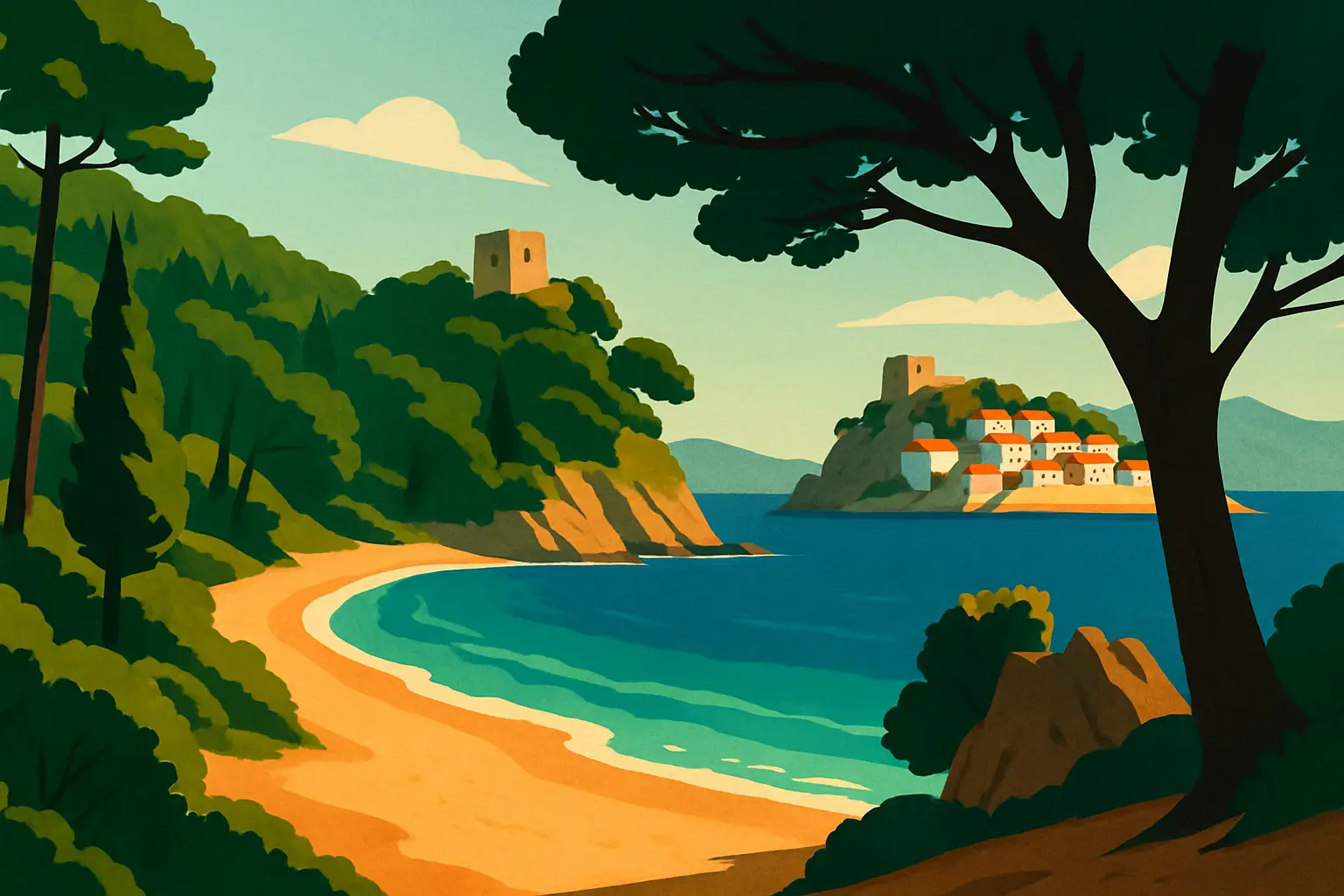
Skiathos sits at the western edge of the Northern Sporades archipelago, roughly 25 nautical miles from the Pelion peninsula on the Greek mainland. It is one of the most forested islands in the Aegean: thick stands of Aleppo and umbrella pine cover most of the interior and do not stop at the cliff edge — they descend the slopes all the way to the sand. This creates a beach experience that is structurally different from the whitewashed caldera views of Santorini or the bleached limestone of Mykonos.
At Koukounaries, the most famous beach, a protected pine grove runs directly behind 800 meters of fine golden sand. At Banana Beach, the hillside above smells of pine and olive in the afternoon heat. At dozens of smaller coves along the south coast, you find the same combination: clear, cold blue water, a pine-shaded path down from the road, and no development beyond a seasonal umbrella rental.
This specific thing — dense Aegean forest meeting fine sand and transparent water — is what the island's reputation rests on and what draws most of its visitors. Understanding it early helps you calibrate which beaches are worth the walk and which are simply more of the same excellent thing.
Skiathos has 62 beaches by official count. Here is how to think about the main ones:
Koukounaries (12 km west of town, served by the main bus line) is 800 meters of fine golden sand set between a natural freshwater lagoon — a protected wetland with waterfowl and reeds — and the sea. The lagoon is a UNESCO-recognized ecosystem; the beach itself is organized with sunbeds, bars, and water sports. In July and August it fills by 9am. In June, uncrowded stretches are available until late morning.
Lalaria (accessible by excursion boat from the Old Port only) is the one beach on Skiathos that earns the word spectacular without qualification. The entire beach is composed of white marble pebbles worn smooth by the sea, set against impossibly blue water. At the northern end, a limestone arch — the Trypes rock formation — frames the water in a way that looks edited in photographs and is exactly what you find in person. The arch is about four meters tall and wide enough to swim through in calm conditions. Excursion boats from the Old Port typically also stop at two sea caves, Skotini (the dark cave) and Galazia (the blue cave), on the way back. The round trip takes most of a morning.
Banana Beach (two adjacent coves past Koukounaries, accessible by bus or on foot from Koukounaries) is divided into Big Banana and Little Banana. Both are pine-backed and family-friendly, with calmer water than the main beach. The setting — shaded approach path, shallow turquoise entry, organized bar — makes this the most relaxed organized beach on the island.
Troulos (halfway between town and Koukounaries on the bus line) is the local option: smaller, shallower entry, mostly Greek families, simple seasonal taverna. No Instagram presence, which is precisely why it is quieter than anything adjacent.
Get short, interactive stories that make each place easier to remember while you travel.
Skiathos Town is built around two harbors. The Old Port, on the left side of the bay, handles excursion boats, water taxis, and smaller ferries. The New Port (Commercial Port), on the right, handles the larger ferry lines from Volos and Agios Konstantinos on the mainland. Between them, a small forested promontory called Bourtzi — a Venetian fortification in the 13th century, now a restaurant and open-air cultural venue — divides the bay. The walk around the Bourtzi path at dusk, with both ports visible on either side, is one of the best free things to do on your first evening.
The town's spine is Papadiamantis Street, a pedestrian lane running from the harbor uphill through the town center. This is where the Papadiamantis House Museum sits, alongside coffee shops, restaurants, the market selling the island's local almond sweets — aspro (almond paste in icing sugar) and haimalia (walnuts, dough, and pine honey) — and the bars that open at 9pm and close when the last person leaves. The street itself is genuinely pleasant: narrow, shaded, and running at the scale of foot traffic rather than vehicles.
Behind Papadiamantis Street, the old town climbs in a grid of whitewashed lanes. Two windmills at the top of the hill — the Windmills of Skiathos Town — give a view over both ports and the outline of Skopelos island in the middle distance. The walk up takes 12 minutes from the harbor. At sunset, with the ferry lights beginning to appear and the pine hills darkening around the bay, the windmill viewpoint is a reliable reason to be standing on this specific island.
In the 16th century, the island's inhabitants abandoned the coastal settlement and built an entirely new city at the most defensible point on Skiathos — a sea cliff on the northern coast, connected to the rest of the island by a single drawbridge. They called it Kastro.
For roughly 300 years, from around 1540 to 1829, Kastro was the island's primary settlement: a complete walled city with 300 houses, 22 churches, and a population of several thousand people living behind medieval fortifications 90 meters above the sea. When Greek independence was secured and the Ottoman-era threat ended, the inhabitants dismantled their own houses for materials and moved back to the coast to found modern Skiathos Town. What survived the dismantling: the outer walls, a defensive tower, and four of the 22 churches — including the church of Christos, which retains 17th-century frescoes inside.
Kastro is accessible two ways. The first is by excursion boat from the Old Port — the same boats that stop at Lalaria sometimes route via Kastro; check the schedule board on the port. The second is a 90-minute hiking trail through the pine forest, starting from the village of Agios Apostoloi in the island's interior and ending at the ruins. The trail is marked, not technically difficult, but steep in sections and requires proper footwear. There is no entrance fee, no cafe, and minimal English signage at the site. What you find instead is the view from the cliff edge — one of the more vertiginous vantages in the Northern Aegean — and the specific quiet of a city that was deliberately abandoned.
By plane: Skiathos National Airport (IATA: JSI) sits at the edge of the sea, runway ending at the waterfront. Planes approach over the rooftops of Skiathos Town in a low banking turn that is either thrilling or uncomfortable depending on how you feel about small airports. Olympic Air and Sky Express run Athens (ATH) to Skiathos in roughly 45 minutes, with 3–4 flights daily during peak summer. Ryanair, easyJet, Jet2, and charter operators run direct seasonal routes from London, Amsterdam, Brussels, and other European cities. In June 2026, London Gatwick to Skiathos has multiple weekly direct services.
By ferry from Athens: The land-and-sea route goes: bus or drive from Athens to Agios Konstantinos, a port on the Euboean Gulf 168 km north of central Athens — roughly 2.5 hours from the Liosion Street KTEL bus terminal. High-speed catamarans (Hellenic Seaways, SeaJets) run the crossing to Skiathos in 2 hours 15 minutes to 2 hours 45 minutes, with multiple daily departures from late May through September. Book ferry tickets in advance in summer — boats sell out, particularly on Friday afternoons and Sunday evenings.
From Thessaloniki: Volos is the closer ferry port for travelers coming from northern Greece — about a 3-hour crossing to Skiathos. Thessaloniki also has direct summer flights to JSI on some carriers.
Skiathos in August hosts between 40,000 and 50,000 visitors on an island whose year-round population is roughly 6,000. Every organized beach fills by 9:30am. Restaurants require reservations days in advance. The Meltemi wind, which picks up across the Aegean from mid-July onward, regularly grounds excursion boats to Lalaria and Kastro — sometimes for several consecutive days. Hotel prices in August run 40–60% higher than June rates for equivalent rooms.
June is structurally different. Sea temperature reaches 22–24°C — comfortable for full-day swimming. Daytime air temperatures average 27–29°C, warm enough for beach days without the energy-draining 35°C heat of August. Island restaurants and bars have just opened for the season: staff are fresh, the fish is good, and most evenings you can walk in without a reservation. Organized beaches have sunbeds and bars in full operation but not at capacity. Lalaria boat trips run on schedule most days.
The practical case for June: you access everything the island offers — 62 beaches, excursion boats, Kastro, the nightlife strip, the Papadiamantis street evening crowd — without the August compression that makes the beaches feel like a departure terminal and the Old Port feel like a bottleneck. The first two weeks of June and the first two weeks of September are the honest answers to when to go.
Yes — and for reasons that have nothing to do with either island. Mykonos is built around cosmopolitan nightlife, designer beach clubs, and a specific social performance; Santorini around the caldera view, volcanic landscape, and sunset restaurants. Skiathos offers neither and makes no effort to.
Skiathos is for people who want actual swimming across diverse, numerous beaches, combined with a town that has genuine nightlife without the Mykonos price point. A beer on the Skiathos Town harborfront costs €4–5 in 2026. A cocktail at a Mykonos beach club reaches €25 before service. The architecture is traditional Sporades: white walls, red tile rooftops, green shutters — not the caldera-edge minimalism of Santorini, but genuinely charming at street level.
The island also rewards exploration in a way that postcard-optimized islands don't. Sixty-two beaches in 64 square kilometers means you are never more than a few kilometers from a cove you haven't tried. The Kastro hike is a genuinely memorable half-day. Lalaria is one of the more unusual beaches in Greece. The Papadiamantis Museum is the kind of place that changes how you read a landscape afterward. For travelers who have already done the Corfu coastline or the Cycladic island circuit, Skiathos is the logical next direction.
The bus: A single line runs from Skiathos Town's Old Port west along the main coastal road to Koukounaries, stopping at 26 beaches. Frequency in summer is every 20–30 minutes from early morning until midnight. Fare is €1.80 per journey paid to the driver. For the organized southern-coast beaches, the bus is fully adequate — it is how most beach-goers without scooters travel.
Water taxis: Small motorboats run from the Old Port to beaches on the eastern and northern coast not served by the road. Rates are posted at the port; trips to nearby beaches like Agia Paraskevi and Megali Ammos run around €5 per person each way. These are also the departure point for excursion boats to Lalaria, Kastro, and the sea caves.
Scooters and ATVs: The most useful option for covering the full island — unmarked coves, the Kastro trailhead at Agios Apostoloi, hilltop viewpoints, and beaches between bus stops. Rental shops cluster near both ports. A full license is legally required for any scooter above 50cc, and police checks happen in summer. Roads are narrow and winding; appropriate speed is 30–40 km/h.
On foot within town: Skiathos Town itself is entirely walkable. The Papadiamantis Museum, Old Port, Bourtzi path, and evening bar strip are all within a 10-minute walk of each other. The windmill viewpoint is a 12-minute uphill walk from the harbor. For anything beyond town boundaries, you need a vehicle or the bus.