Naxos has a quality that is easy to underestimate from a photo: it has an economy that exists independent of tourists. The Naxian potato (naxiotiki patata) is famous across Greece — the volcanic soil of the central valley grows a waxy, earthy variety that Greek restaurant chefs specifically source. The island's dairy sector produces five distinct cheeses including PDO-protected graviera and the aged hard arseniko, both made only here. It produces the only significant olive oil in the Cyclades, local wine, honey, and kitron — a citrus liqueur with Protected Designation of Origin status, made from the leaves of the citron tree, which grows commercially nowhere else in Greece.
What this translates to for a visitor is food that tastes like somewhere specific, villages with an identity beyond tourism, and a landscape — 1,001-meter Mount Zas, marble quarries used by ancient sculptors, Byzantine churches with 7th-century frescos — that rewards actual engagement. Naxos handles summer crowds better than Santorini or Mykonos because it is large enough that they disperse. You can have both: a well-developed beach followed by a village dinner where the kitron comes from a still that has been operating since 1896.
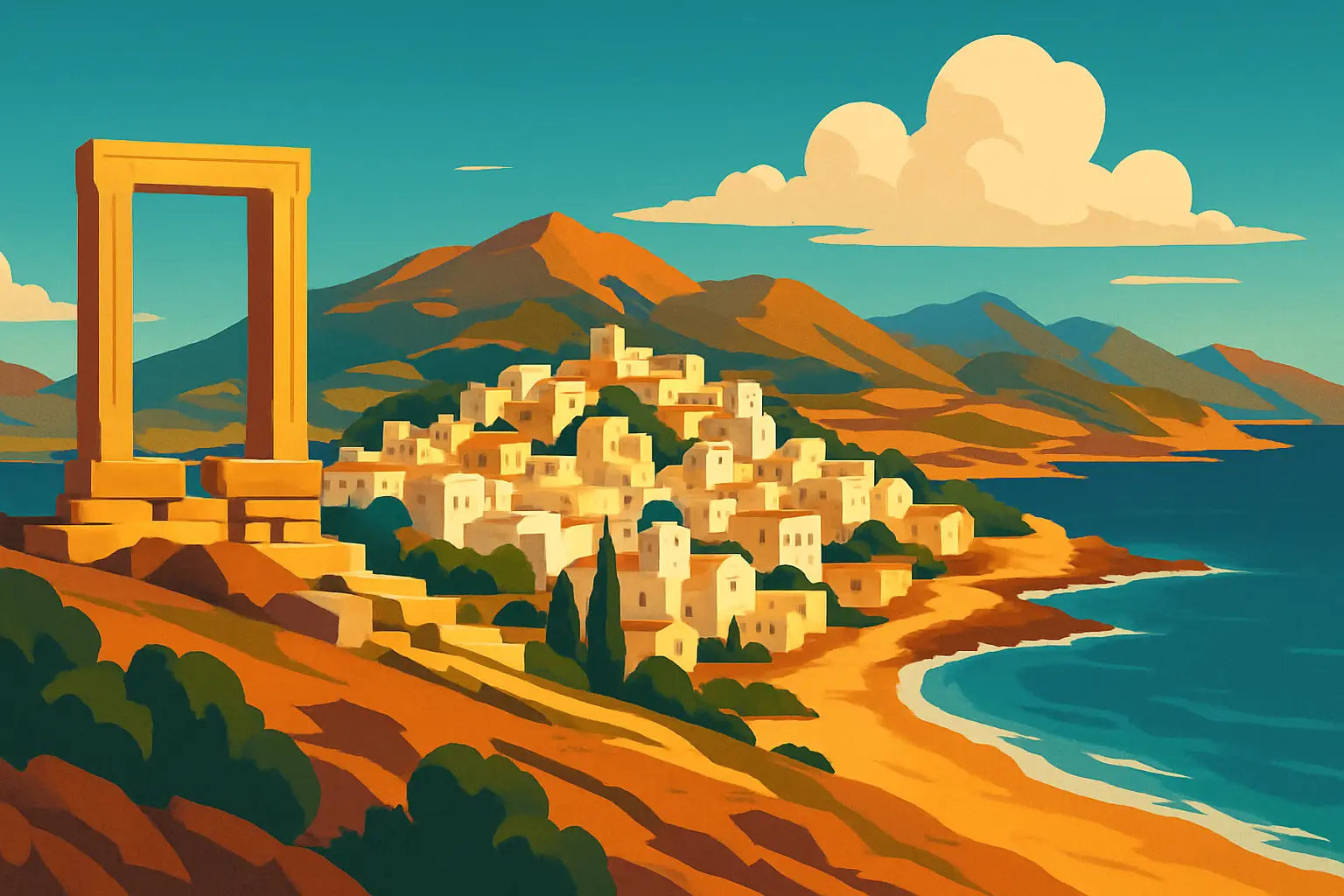
Standing on the small islet of Palatia, connected to Naxos Chora by a stone causeway, the Portara is the sole surviving remnant of the Temple of Apollo — begun around 530 BC under the tyrant Lygdamis, who wanted to build the largest temple in the Greek world. It was never completed. The platform was laid, columns were quarried from the island's marble mountains, and the doorway was set — then political upheaval ended the project and the island moved on.
Each marble block weighs approximately 10 tonnes and was transported from quarries in the island's interior. The gateway stands nearly 6 meters tall, oriented precisely west, so that in summer the sun sets directly through the frame. It has stood for 2,500 years through Roman, Byzantine, Venetian, and Ottoman rule — undisturbed because its weight and size made it easier to leave than to move. At various points the islet served as a fortress, a quarry, and a private garden; the temple stones became a Venetian tower before 19th-century antiquarians stopped the dismantling.
The visit is short and entirely worth it. Walk the causeway from the harbor's northern end (200 meters from the ferry pier), take the low path up to the gateway, and position yourself behind it looking west around 7:30–8:00 PM. From the harbor waterfront — Paralia — the Portara is the sight line from every cafe table, which means you can also just order a drink and watch it from your seat.
Get short, interactive stories that make each place easier to remember while you travel.
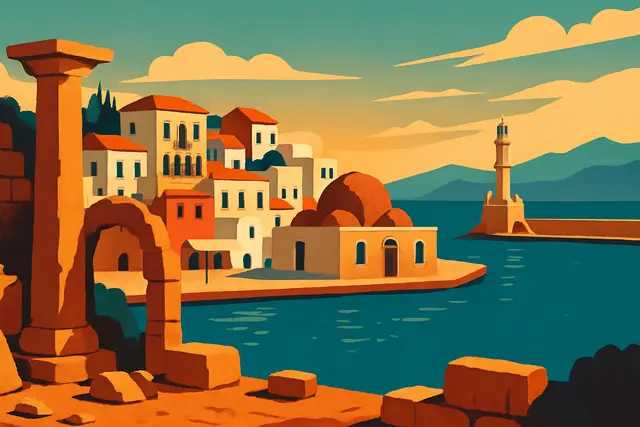
Naxos Chora's structure is immediately readable from the arriving ferry: the harbor waterfront first, then whitewashed neighborhoods climbing the hill, and at the top the walled Venetian Kastro — built in the 13th century by Marco Sanudo, who carved a feudal duchy out of the Cyclades following the Fourth Crusade.
The Kastro is not a ruin. It is a living residential neighborhood occupied by about 40 Catholic families, many bearing surnames — Barozzi, Sommaripa, Grimani — descended from the original Venetian colonists. Walking through the Trani Gate on the north side deposits you inside a 13th-century urban plan still being lived in. The Naxos Archaeological Museum (formerly the Ursuline Convent) holds one of the best collections of Early Cycladic marble figurines in Greece — the flat-faced sculptures that Henry Moore cited as a primary influence on his own work.
Below the Kastro, the Bourgos quarter is the old Greek Orthodox neighborhood that grew alongside the Venetian fortress — a street plan encoding eight centuries of coexistence between the two communities. Narrow marble steps, painted doorways, and frequent cats constitute the scenery; the neighborhood is best walked uphill without a destination.
The harbor waterfront — Paralia — runs along the ferry pier end with cafes and fish restaurants facing the Portara. Market stalls near the pier sell Naxian cheese, bottled kitron, and olive oil within 100 meters of where you disembark. These are honest-price market stalls; the restaurant tables facing the water charge a view premium that is somewhat worth it in the evening.
Halki (Chalkio), 16 kilometers southeast of Chora, was the island's medieval capital. Its architecture reflects it: Venetian tower houses, neoclassical mansions, and the Vallindras Distillery — established in 1896 and still producing kitron on the same premises. The distillery functions as a free museum: three varieties of kitron (green at 30% ABV, colorless at 33%, yellow at 36%) are offered for tasting in rooms lined with original 19th-century copper stills, oak barrels, and bottling equipment. The citron tree (Citrus medica) whose leaves produce the liqueur took root specifically on Naxos and grows commercially nowhere else in Greece, which is the basis for the PDO classification. Walk the main lane through Halki past the gallery and textile workshop fronts, then eat at Mitos restaurant in its outdoor courtyard, cooking with Naxian ingredients at a pace the village sets for itself.
Apiranthos (Apeiranthos), 30 kilometers from Chora at 600 meters elevation, is built entirely from marble. Not decorated with it — built from it. Streets, doorways, church floors, well covers, stairways. The village was reportedly settled by Cretan refugees in the 17th century, which is why its dialect still carries Cretan phonological features that linguists track as distinct. Lefteris restaurant serves from a flower-covered terrace overlooking the valley; it has a following among Greek food writers well beyond the island.
Between the two villages, the road passes through the landscape that produces everything Naxos is known for. The 11th-century Panagia Drossiani church near Moni holds frescos from the 5th and 7th centuries — among the oldest intact Byzantine church paintings in Greece — in a building so small that ten people fill it entirely.
Agios Prokopios, 6 kilometers south of Chora, is the island's most popular beach because of what it protects against: the summer meltemi wind. A headland shields it from the consistent Aegean northerlies, leaving the water calm and the sand stable. Thick golden sand, clear visibility, water at 24–25°C by mid-June, sun beds available without pressure — it is the correct beach for families and for anyone prioritizing reliability over solitude.
Plaka Beach begins where Agios Prokopios ends and runs for several kilometers further south — the longest continuous stretch of sand on Naxos. The northern section is developed: TOHU (hammocks, cushions, cocktails, solid vegetarian food — a Southeast Asian beach bar aesthetic that somehow works on a Greek island) and NOMAD (set up by the founders of the 520 Bar in Chora, sourcing produce from their own farm, notably good cocktails) both operate through summer. Walk south and the development disappears; by the final kilometer the beach is semi-wild with almost no company.
Mikri Vigla, 18 kilometers south of Chora, is where the meltemi becomes an asset. The bay is directly exposed to the consistent northern winds and has been one of Greece's foremost kitesurfing and windsurfing destinations since the 1990s. The Flisvos Kite Center operates on the beach with lessons and rental; the Naxos Kitesurf Club runs from nearby Kastraki. Season runs May to September. Outside the water sports, Mikri Vigla has a small taverna and one of the quietest stretches of quality sand on the southwest coast — the kite crowd concentrates on the water, leaving the beach behind them largely empty.
Naxian cheese is the category to understand before you arrive. Graviera Naxou — semi-hard, lightly sweet, sheep's milk, aged 3+ months — is the most widely exported. Arseniko is the one serious Greek cheese buyers seek: hard, aged 12+ months, deeply savory, with a sharpness between aged Manchego and Pecorino. It was historically the cheese of Naxian shepherds — dense and stable enough to survive months in the mountains without refrigeration. Anthotiro is the fresh mild whey cheese, softer than myzithra, typically eaten with Naxian thyme honey for breakfast or dessert.
Naxian potatoes appear on Cycladic menus specifically labeled as naxiotiki because the volcanic soil of the central valley produces a yellow-fleshed waxy variety with an earthiness that Greek chefs consider impossible to replicate from mainland-grown stock. Fried, roasted with olive oil and oregano, or boiled alongside grilled fish — they are visibly different from standard potatoes and genuinely better.
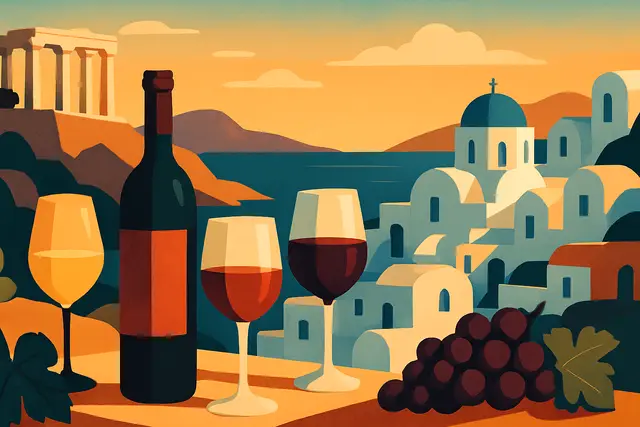
Kitron is the island's signature drink — a liqueur made from the leaves (not the fruit) of the citron tree, which grows commercially only on Naxos. Order it straight as a digestif, over ice, or with soda and lemon. The yellow variety (36% ABV, least sugar) is the most complex; the green (30% ABV) is the sweeter option. The best way to understand the range is the free tasting at the Vallindras Distillery in Halki.
For seafood, the harbor tavernas in Chora serve what arrived that morning: garides saganaki (shrimp with feta and tomato), fried calamari, grilled sardines, and gavros marinatos — marinated anchovies that are a Cycladic specialty. The Naxos anchovy fleet operates out of the harbor, so the gavros marinatos here is noticeably fresher than on islands that import theirs.
June and September are the optimal windows. June delivers warm sea temperatures (~24°C), the longest daylight hours (sunset at 8:45 PM), and the meltemi wind season just starting — the kite beaches are active but the calmer beaches like Agios Prokopios are still comfortable. September sees the peak heat ease, the meltemi weaken, the sea at its warmest (26–27°C by late September), and significantly fewer visitors than the core summer weeks. Plaka Beach in September feels like the 1990s; in mid-August it feels like a music festival without the music.
July and August bring ferry occupancy near 90% and beach bar queues by noon. The experience is still good — Naxos handles summer crowds better than Santorini or Mykonos because the island is physically large enough to absorb them — but the specificity that makes it worth visiting starts to compress toward a standard Greek summer template.
Is Naxos good for families? More than almost any other Cycladic island. Agios Prokopios has shallow, protected water and reliable calm conditions. The Vallindras Distillery in Halki, the marble streets of Apiranthos, the Panagia Drossiani frescos, and the Portara give children concrete things to engage with rather than just scenery. Car rental is available on the harbor. Ferry boarding is easier than at smaller Cycladic ports, which matters with luggage and children.
From Piraeus port, Blue Star Ferries and Seajets run up to 7 departures daily. Blue Star's conventional ferries take 5–6 hours but are stable, comfortable, and cheaper (from ~€35 deck class). Seajets high-speed ferries reach Naxos in 3 hours 15 minutes but cost more (~€55–75) and are rockier in swell. Piraeus is 30 minutes from central Athens by Metro Line 1 (Green Line).
From Rafina port — the correct choice if arriving at Athens International Airport: Rafina is a 20–30 minute taxi from the airport versus 60+ minutes to Piraeus. Rafina–Naxos ferries take about 4 hours. The port is smaller, the boarding process easier, and you skip Athens entirely.
From other Cycladic islands, Naxos is the best-connected island in the archipelago: regular ferries to Paros (30 minutes), Ios (1 hour 15 minutes), Santorini (2 hours), Mykonos (1 hour), and the smaller islands of Koufonisia and Donoussa. Naxos works as the logical hub for any Cyclades island-hopping itinerary that wants to stay grounded in an island with real food culture.
All ferries arrive at the central harbor pier in Naxos Chora, 200 meters from the Portara causeway. Car rental agencies are on the harbor; the island has no airport. Book 2–3 months in advance for July and August — high-speed ferries and vehicle spots on Blue Star fill first.