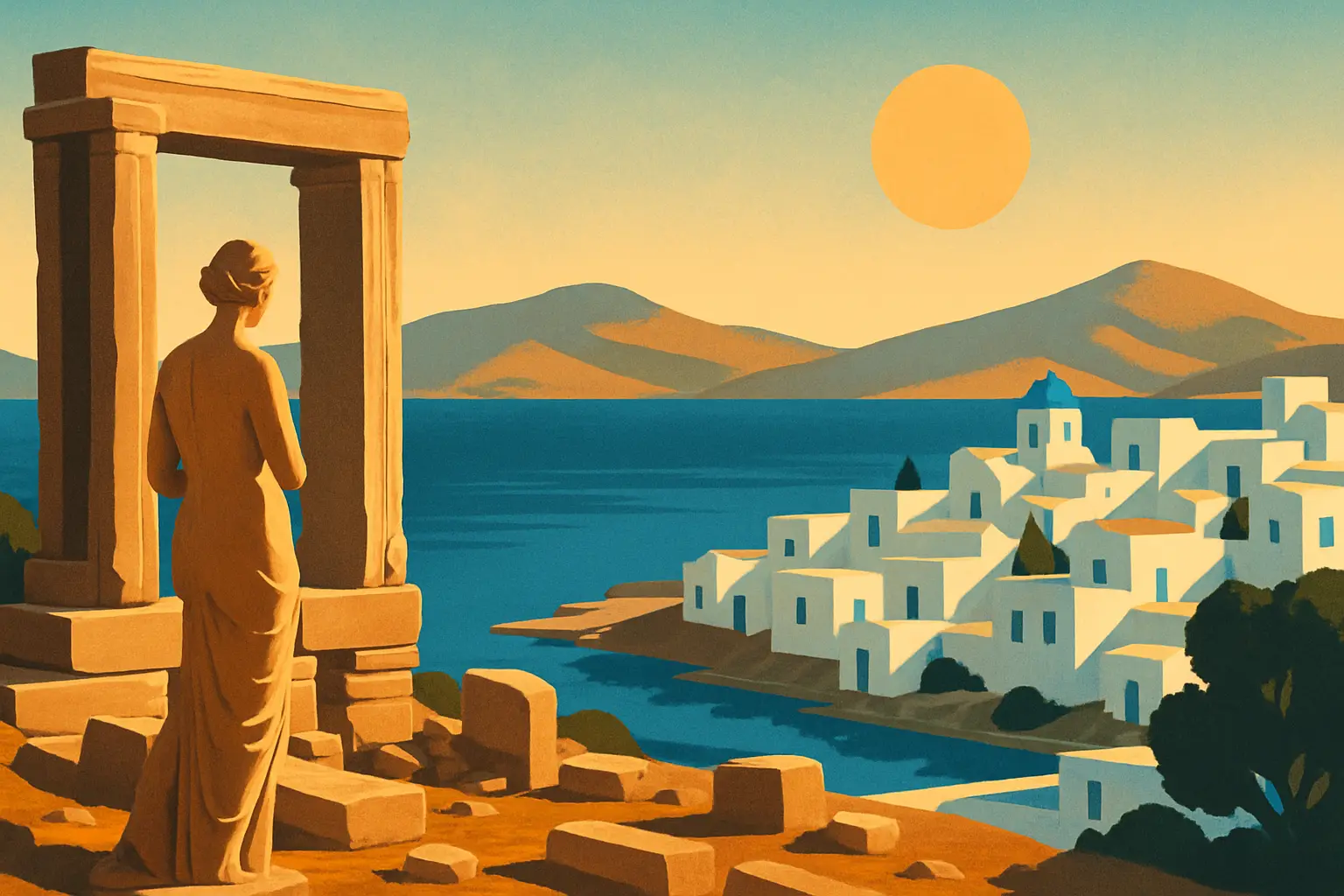
Paros is a Cycladic island of 195 square kilometers, positioned at the near-exact geographic center of the archipelago — roughly equidistant between Mykonos to the north, Naxos to the east, and Santorini to the south. That centrality made it a natural Aegean hub throughout antiquity, and its Parian marble made it one of the most strategically important quarry sources in the ancient Mediterranean.
Parian marble is semi-translucent white stone with an unusually fine crystal grain — a quality of luminosity that ancient sculptors sought specifically for figures meant to catch light. The Venus de Milo (Louvre) is carved from it. The Hermes of Praxiteles (Archaeological Museum of Olympia) is carved from it. The Nike of Samothrace (Louvre again) is partially carved from it. The main source, the Marathi quarry, is still visible today — a network of ancient tunnels cut into the hillside above Parikia, open to walk through, where the pale stone glows faintly when you hold a phone light to it.
Modern Paros has two centers: Parikia, the capital and ferry port on the west coast, and Naoussa, a harbor town on the north coast 12 km by road. The interior — olive groves, marble-veined hillsides, a chain of whitewashed villages — is mostly bypassed by visitors and substantially better for it.
A five-minute walk from Parikia's ferry ramp, in the center of the old town, stands Panagia Ekatontapiliani — the Church of Our Lady of a Hundred Doors. It is one of the oldest continuously functioning church complexes in the Christian world, and the best-preserved early Byzantine monument in the Cyclades.
The founding date is traditionally 326 AD. Saint Helena — mother of the Emperor Constantine and the figure credited with locating the True Cross in Jerusalem — stopped at Paros on her pilgrimage to the Holy Land and prayed at a chapel on this site. She vowed to build a proper church if she arrived safely. She did. The Emperor Justinian substantially expanded the complex in the 6th century, adding the central dome, the colonnaded atrium, and the baptistery.
Three connected structures stand today: the main domed church (Koimisis tis Theotokou, the Dormition of the Virgin), the older Chapel of Agios Nikolaos to the south, and the early Christian Baptistery with its intact cruciform immersion font — one of the few complete early Christian baptisteries remaining anywhere in Greece.
The hundred-doors legend is kept deliberately ambiguous. The complex contains 99 visible doors, windows, arches, and openings. The hundredth, the legend holds, is hidden — and will reveal itself only when Constantinople is restored to Greek hands. The priests do not count publicly. Walk the complex, count carefully, and see what you find. Admission free. Open daily 8 a.m. to 10 p.m. in summer; shoulders and knees covered.
Get short, interactive stories that make each place easier to remember while you travel.
The medieval fortification visible from Parikia harbor was built by the Venetian Duchy of the Archipelago in the 13th century — Marco Sanudo's dynasty, which controlled much of the Cyclades after the Fourth Crusade fractured the Byzantine Empire in 1204. The builders used whatever material was closest: the blocks, column drums, and carved marble of an ancient Greek temple that stood on the same hilltop.
The result is one of the stranger archaeological sights in the Aegean: Kastro walls into which you can clearly identify fluted Doric column drums, with the characteristic grooves still sharply defined in the stone. Ancient inscription fragments and sections of classical-era entablature are embedded in house foundations and garden boundaries. The medieval Venetians were efficient rather than archaeological — the temple became a quarry, and the Kastro became a neighborhood.
The Kastro district is still inhabited. Narrow stepped alleys wind between whitewashed houses built directly over and around the medieval masonry, and at the summit a small church occupies what was almost certainly the highest point of the ancient sanctuary. The view from the top takes in all of Parikia Bay, with the outline of Naxos clearly visible on clear days across the 8 km of water between the islands.
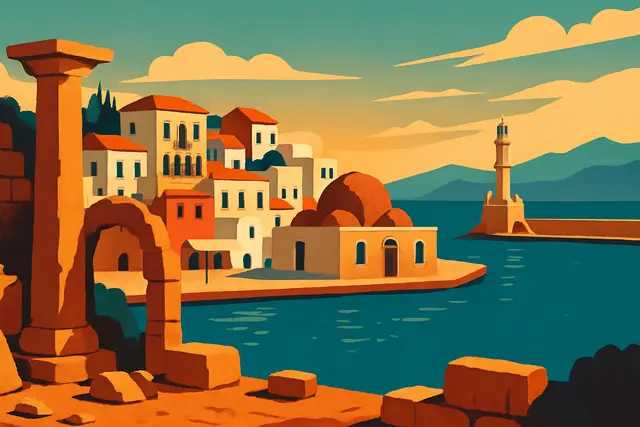
Naoussa is 12 km north of Parikia and feels like a different island. Where Parikia is organized around ferry schedules and departure boards, Naoussa is organized around its own harbor — a near-perfect semicircular bay lined with whitewashed houses, blue-painted woodwork, and seafood tavernas facing the water.
At the harbor mouth stand the partially submerged ruins of a Venetian fortress, the Kastro tou Naoussa, built in the 15th century and half-demolished by the Ottomans in 1537. The remaining fragment of fortification wall projects into the water off the eastern breakwater; at dusk the stone reflects against the harbor surface. Naoussa photographs are regularly described as staged. They are not.
The food is the main reason Greeks from Athens choose Naoussa for their own holidays. Taverna Christos on the harbor front has served fresh lavraki (sea bass), grilled octopus, and local soft cheese for decades; the fish arrives from boats that are visible from the table. Dinner for two with wine runs €35–50. Barbarossa Ouzeri, one block back from the waterfront in the main alley, has no English menu and dries its octopus on a line outside before grilling it to order — the traditional Aegean method, and noticeably better for it.
Naoussa is also the departure point for water taxis to Kolymbithres and the north-coast beaches throughout the day. The harbor jetty is at the far end of the main pedestrian lane.
Three kilometers southwest of Naoussa by the coastal path, the shoreline at Kolymbithres bears no resemblance to the rest of the Cyclades. Ancient granite bedrock — not the island's famous marble, but older exposed granite underneath — has been shaped by wind and water erosion into smooth, curved formations: hollows and arches and rounded barriers that create a series of natural coves.
The effect is lunar. Pale grey-pink granite rounds into bowl and cup shapes; the coves between the formations are sheltered from the Meltemi and hold water so clear the depth is difficult to judge. There are no beach bars beyond a small seasonal kiosk at the main cove. The same smooth sculpted rock continues underwater — snorkeling inside the formations reveals the same shapes below the waterline, with sea urchins in the sheltered depressions and small fish moving through the rock channels.
The 30-to-40-minute walk from Naoussa follows a concrete coastal path with the bay on the left. The water taxi from Naoussa harbor (€5 return, every 30 minutes in summer) gets you there in five minutes, and the same boat continues to Monastiri Beach and Santa Maria Beach — making a full north-coast loop practical in a single day.
The Byzantino Dromo — Byzantine Path — is a marble-paved mule trail connecting the hilltop village of Lefkes to the smaller settlements of Prodromos and Marpissa to the east, approximately 4 km one-way (1.5 to 2 hours). The paving is original: laid down around the 9th to 11th centuries from locally quarried Parian marble, worn smooth by a thousand years of use.
Lefkes sits at roughly 270 meters, the highest village on Paros, noticeably cooler than the coast in high summer. It was used as an inland refuge during the centuries of Aegean piracy — built inland and uphill rather than on the vulnerable shoreline — and retains the architecture of that function: dense whitewashed houses, stepped alleys too narrow for wheeled carts, and a central square anchored by the Church of Agia Triada. Built in 1830–35 from Parian marble in the neoclassical style, it is the second largest church on the island and the finest piece of marble construction in the Cycladic interior.
From Lefkes, the Byzantine Path descends through olive groves and terraced stone walls. In some sections you can still see the shallow grooves cut by pack animal hooves into the softer marble slabs over centuries of use. The trail is marked but not paved with modern materials — it is the same surface that connected these villages for a millennium. At Marpissa, the village square has a small taverna and a KTEL bus stop; the bus returns to Parikia, or a taxi can be called directly from the square.
They are doing different things, and the honest answer depends on what you want.
Santorini is primarily about the caldera experience — the cliff-rim views, volcanic geology, and the ancient Minoan city at Akrotiri. Its beaches are dramatic black and red volcanic sand, visually striking but not the pale Cycladic sand most people have in mind. See Santorini for the full breakdown of what the island actually offers.
Mykonos is primarily about nightlife, luxury beach clubs, and a cosmopolitan social scene. The island has genuinely good south-coast beaches, but the total cost — accommodation, food, club entry, even water taxis to the beaches — runs roughly double what the same experience costs on Paros in high season. If the scene is the point, Mykonos delivers it. If it is not the point, the premium is hard to justify.
Paros has better swimming beaches than Santorini, costs significantly less than Mykonos, has a Byzantine church complex that predates most of Europe's cathedrals, a genuine harbor town in Naoussa that hasn't been fully converted into a service corridor for tourists, and an inland marble trail that almost nobody walks. For most first-time Cyclades visitors who want a real balance of beach, food, and cultural content, Paros is the better choice.
By ferry from Piraeus: The main option from Athens. Seajets and Golden Star high-speed catamarans cover the route in 3.5–4 hours (€50–80 one-way) and book out weeks in advance for July-August. Blue Star Ferries runs a conventional overnight sailing from Piraeus at roughly 7:30 p.m., arriving in Parikia the following morning — 5 hours, €25–40 deck class, rarely sold out. From central Athens, Metro Line 1 (Green Line) from Monastiraki to Piraeus takes about 25 minutes (€1.20). Book fast ferries at least 4–6 weeks ahead for summer travel.
By air: Olympic Air and Aegean operate Athens–Paros in summer (35 minutes, €50–120 one-way). Paros National Airport (PAS) handles only small turboprop aircraft and is weather-dependent — the ferry is more reliable if you have a fixed schedule.
Best time to visit: Late May through June is the optimal window. Sea temperature reaches 22–24°C, daytime highs average 25–28°C, crowds are noticeably below the July-August peak, and accommodation runs at roughly 70% of peak rates. The afternoon Meltemi wind is lighter in June than in August — enough to cool the beaches without making exposed anchorages unpleasant.
July and August: Naoussa fills significantly, Kolymbithres is crowded by late morning, and fast ferries sell out weeks in advance. The island is large enough to absorb summer volumes better than Mykonos or Santorini, but planning ahead — accommodation, ferry tickets, restaurant bookings in Naoussa — is not optional.