1. What Skopelos actually is — before and after the film
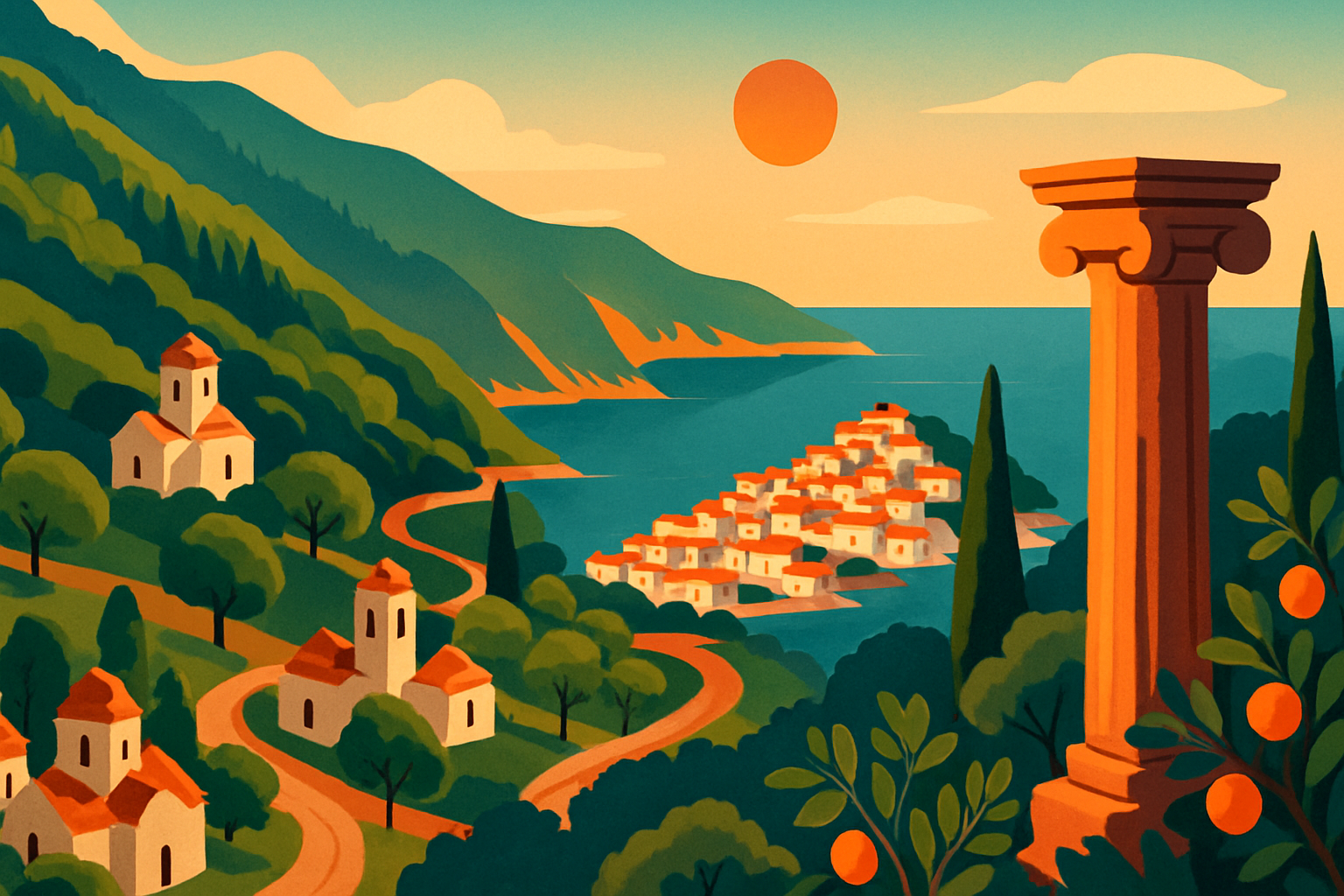
Skopelos is the second-largest of the Northern Sporades, a group of four islands in the northwestern Aegean roughly halfway between Athens and Thessaloniki. Its nearest neighbors are Skiathos to the west (the party island with the airport) and Alonissos to the east (the marine park island). The terrain is unusual for Greece: most of the island is covered in dense Aleppo pine forest, with olive and plum orchards filling the valleys. The hills rise steeply from the coast and the roads hairpin up them — the landscape reads more like a green Ionian island than the bare limestone Cyclades.
The island has been permanently inhabited since the Minoan period. The Sporades were controlled successively by the Macedonians, the Romans, the Byzantines, the Venetians, and the Ottomans — the palimpsest of all those occupations is still readable in the island's architecture. Skopelos Town has 123 churches in a village of roughly 4,000 people, which is extraordinary even by Greek island standards. The explanation is partly religious, partly social: historic Skopelos families built private chapels as acts of devotion and family identity, and over centuries they accumulated.
The 2008 film Mamma Mia! brought the island to international attention, using Agios Ioannis Kastri chapel for the wedding sequence and Kastani beach for the volleyball scene. The sequel, Mamma Mia! Here We Go Again, returned in 2018. The film tourism is real — tour groups arrive daily in July and August — but Skopelos is large enough and forested enough that it absorbs them without the saturation that has overtaken the better-known Cycladic islands.
2. Agios Ioannis Kastri: the 199 steps and why the church matters
The chapel of Agios Ioannis Kastri sits on top of a freestanding limestone rock pinnacle on the northwestern coast, near the village of Glossa. The rock rises about 100 meters from the sea, and access is by 199 steps carved directly into its face — some wide, some narrow, none uniform. The climb takes approximately 10 minutes at a moderate pace.
The chapel itself is small and whitewashed, the interior holding a simple iconostasis and oil lamps. The point is not the chapel but the position: from the top you look north over open Aegean toward the Pelion Peninsula, south along the green pine coastline of Skopelos' west coast, and west toward Skiathos. There is no rail on the seaward side of the steps.
The film staged the wedding of Sophie and Sky here — the exterior of the building and the cliff steps are used for the sequence. In reality, a Greek Orthodox wedding at a chapel this size would be conducted by one priest for a congregation of perhaps 20. The rock was always here; the chapel dates to medieval times and predates the 20th century road that now makes access by car practical.
Go before 10 a.m. to have the steps to yourself. By midday in July and August the path has a queue. A small parking area sits at the base — arrive early enough and you have the view, the silence, and the Aegean from 100 meters up without competition.
3. Skopelos Town (Chora): 123 churches in a harbor village
Skopelos Town occupies a natural harbor on the southeastern coast, the whitewashed buildings stacked against a steep hill behind the waterfront. The New Port — where ferries and catamarans dock — sits at the southern end; the Old Port, protected by a small breakwater, is where the fishing boats moor and where the waterfront cafes look out over the most picturesque part of the anchorage.
The 123 churches are distributed through the old town alleys that climb the hillside above the harbor. Most are private family chapels, locked except on the feast day of their saint. A few are public and open during standard hours: the Church of Agios Nikolaos above the port has a carved wooden iconostasis from the 18th century; the Church of Panagitsa tou Pyrgou sits on a headland at the end of the waterfront road with a view back over the harbor. Walking the alleys above the port — heading uphill from the main waterfront toward the old castle ruins at the summit — takes about 40 minutes and reveals the layers: Venetian-era churches, neoclassical 19th-century houses, and the narrow lanes connecting them.
The waterfront itself runs for about 600 meters from the ferry terminal south to the fishing port, lined with cafes and tavernas. Evenings in Skopelos Town concentrate here from about 8 p.m. onward — an atmosphere closer to a working Greek town than to a resort strip, which is part of the island's appeal.
4. Glossa: the hilltop village that belongs to a different era
Glossa is the second settlement on the island, perched at 400 meters elevation on the northwestern plateau, about 25 kilometers from Skopelos Town by the main coast road. The drive takes about 35 minutes with stops. The village is the island's most visually distinctive: the architecture reflects Macedonian and Pelion Peninsula influences rather than the standard Cycladic white-cube vocabulary. The buildings are multi-story, the walls are pastel-toned rather than white, the roofs carry terracotta and burgundy tiles, and the upper-story windows open onto wooden balconies projecting over the lane.
Glossa has about 1,100 permanent residents and functions as an actual village rather than a tourist destination. There are cafes on the central square, a small market, and a handful of tavernas. The density of visitors is dramatically lower than Skopelos Town, which makes the afternoon before visiting Agios Ioannis Kastri the right time to arrive: coffee in the square, walk the lanes of the old settlement, then drive the 4 kilometers down to the chapel for the late-afternoon light.
The port below Glossa is Loutraki — a small harbor with a few fish tavernas and the ferry stop for boats coming from Skiathos. Less used than the main port in Skopelos Town but the correct arrival point if you're coming from Volos directly or continuing to Alonissos.
5. The beaches: Kastani, Hovolo, Stafylos, and the west coast road
Skopelos' beaches are reached by the main road that runs from Skopelos Town west along the coast and north toward Glossa. The road is good; the beach access roads off it vary from paved to rough track.
Kastani is 22 kilometers from Skopelos Town, a small cove with white and grey pebbles, pine trees reaching the waterline, and intensely clear water. The Mamma Mia volleyball sequence was filmed here. In July and August it's organized with sun loungers; in June the setting is calmer. A beach bar operates in season. The water quality and the wooded setting make it worth the drive even without the film connection.
Hovolo is a few kilometers further north on the same road — a more dramatic setting with white limestone cliffs flanking the cove and pine trees on the cliff edge above the water. Less accessible and therefore less organized; bring your own supplies. The drive from Kastani takes about 10 minutes on unpaved road.
Stafylos is the closest organized beach to Skopelos Town, 4 kilometers south on a paved road. It has a beach bar, loungers, and a taverna on the bay. The beach takes its name from Staphylos, a legendary son of Ariadne and Dionysus whose Minoan-era tomb was excavated on the headland in 1935 — the gold Minoan dagger and bronze sword found inside are now in the National Archaeological Museum in Athens. A short walk around the eastern headland from Stafylos reaches Velanio, the naturist beach.
Milia is often cited as the island's longest beach — a 1.6-kilometer stretch of fine sand and pebble mix on the west coast about 17 kilometers from town, with organized facilities and enough space that it doesn't feel crowded even in high season.
6. What to eat on Skopelos: prunes, cheese pie, and lobster pasta
Skopelos has a more specific food culture than most similarly sized Greek islands, built around three local products: plums (dried into prunes), almonds, and the island's native goat breed, which produces a soft, sharp white cheese found nowhere else.
Skopelos tiropita — the island's cheese pie — is a specific thing: a spiral of hand-rolled phyllo dough filled with local goat's cheese, baked until the exterior flakes and the interior softens without drying out. It differs from standard tiropita in the cheese, the phyllo technique, and the spiral shape. Michalis Pies in Skopelos Chora has made them since 1991 and is the benchmark — the shop is in the old town alleys above the waterfront, recognizable by the queue of locals in the morning.
Prune-forward dishes appear throughout the island's taverna menus: keftedes (meatballs) cooked with prunes in tomato sauce; goat slow-braised with prunes and quinces; spoon sweet 'avgato' made from the island's damask plum variety. These dishes reflect the agricultural reality of Skopelos — the plum orchards have been a central part of the island's economy for several centuries, and the cooking absorbed them.
Astakomakaronada — lobster with orzo pasta — appears on the fish tavernas along Skopelos Town waterfront and at Loutraki port below Glossa. The orzo absorbs the lobster broth in a clay pot; the dish runs around 35–45€ per portion depending on the catch size. Taverna I Skopelitissa, near the Old Port on the waterfront, does the local specialties reliably — cheese pie, octopus fritters, and the daily catch.
For sweets: amygdalota (marzipan-style almond pastries) and strifti galatopita (a twisted milk pie with filo) are the island's dessert signatures. Loukoumades with local thyme honey appear at street-food carts near the port in summer.
7. How to get to Skopelos from Athens and Thessaloniki
From Athens: The most direct route combines an overland leg to Volos — a northern Greek port city 3.5 hours from Athens by intercity bus (KTEL) or 4 hours by car on the E75 highway — followed by a ferry from Volos to Skopelos. Hellenic Seaways and Golden Star Ferries operate the Volos–Skopelos route; the fast catamaran takes approximately 3 hours 20 minutes to Skopelos Town with a stop at Alonissos. Conventional ferries take longer but run overnight options in peak season.
From Thessaloniki: Thessaloniki is 100 kilometers from Volos and connects by intercity bus in about 2 hours. This makes Skopelos a logical extension of a northern Greece trip — a few days in Thessaloniki followed by a ferry from Volos.
Via Skiathos: The island's nearest neighbor with an airport, Skiathos receives direct flights from multiple European cities in summer. From Skiathos port, ferries run to Skopelos Town in approximately 1 hour (high-speed) or 1 hour 45 minutes (conventional). This is the fastest route from the UK or northern Europe — fly to Skiathos, take the ferry, and arrive on Skopelos the same afternoon.
On the island: A local bus runs between Skopelos Town, the mid-island beaches (Panormos, Milia), and Glossa several times daily. It does not serve beach access tracks or the Agios Ioannis Kastri road. A rental car from agencies near the New Port costs approximately 40–60€ per day in June; scooters are available for 25–35€ per day and are sufficient for the main road. The island is 37 kilometers end-to-end.
8. How long to stay, best time, and whether the Mamma Mia crowds are a problem
How long to stay: Three nights is the minimum to see Skopelos Town properly, make the Agios Ioannis Kastri climb, drive the west coast beach road, and eat one slow dinner at a waterfront taverna. Four or five nights allows a day in Glossa, a boat trip to Hovolo, and the kind of pace the island actually rewards.
Best time to visit: June is the right month for 2026. The pine forest is at its most vivid, the water temperature is comfortably warm (22–24°C), all restaurants and beaches are open, and the full July–August peak has not yet arrived. Accommodation is available without booking months in advance. September is the second-best window — high temperatures drop slightly, the summer crowds thin, and the late-season light on the pine-covered hills is exceptional.
Are the Mamma Mia crowds a problem? Less than you would expect. The crowds are real and concentrated at Agios Ioannis Kastri — organized bus tours arrive at the chapel by late morning in high season. Going before 10 a.m. solves this completely. Kastani beach gets recognizably busier than comparable beaches on the island, but it's large enough that the crowd isn't oppressive. The old town alleys of Skopelos Chora are genuinely quiet at any hour because most day-trippers and organized tours don't venture beyond the waterfront. The total accommodation capacity on the island is limited — there are no large resort hotels — which means visitor density has a structural ceiling.