Thessaloniki was founded in 315 BC by the Macedonian king Cassander, who named it after his wife — Alexander the Great's half-sister. For the next two millennia the city's position made it too important to abandon: a deep natural harbor on the Thermaic Gulf, the point where the Via Egnatia — the Roman highway connecting the Adriatic to Constantinople — met the sea.
By the Byzantine period it had become the empire's second city after Constantinople, generating the extraordinary density of churches and mosaics that earned collective UNESCO World Heritage designation in 1988. Fifteen monuments were inscribed as a single site — more than any other location in Greece. When the Ottomans took the city in 1430, they converted churches to mosques but largely preserved the urban infrastructure; the bazaar, the hammam, and the walls survived, and several survive today.
Thessaloniki's Sephardic Jewish community — descendants of Jews expelled from Spain in 1492 — dominated the city's trade and port for four centuries and made up more than half its population at their peak. The community was largely destroyed in the Second World War; the Jewish Museum of Thessaloniki on Agiou Mina Street documents their history directly.
In 1917, a fire starting in a refugee's kitchen burned for thirty-two hours and destroyed most of the lower city. French architect Ernest Hébrard redesigned the grid from ash — wide boulevards, a grand central square, a rational street plan. Only Ano Poli, the old town on the hillside above, was spared. The result is a city of two registers: Hébrard's early-20th-century grid below; five centuries of Ottoman urban texture above.
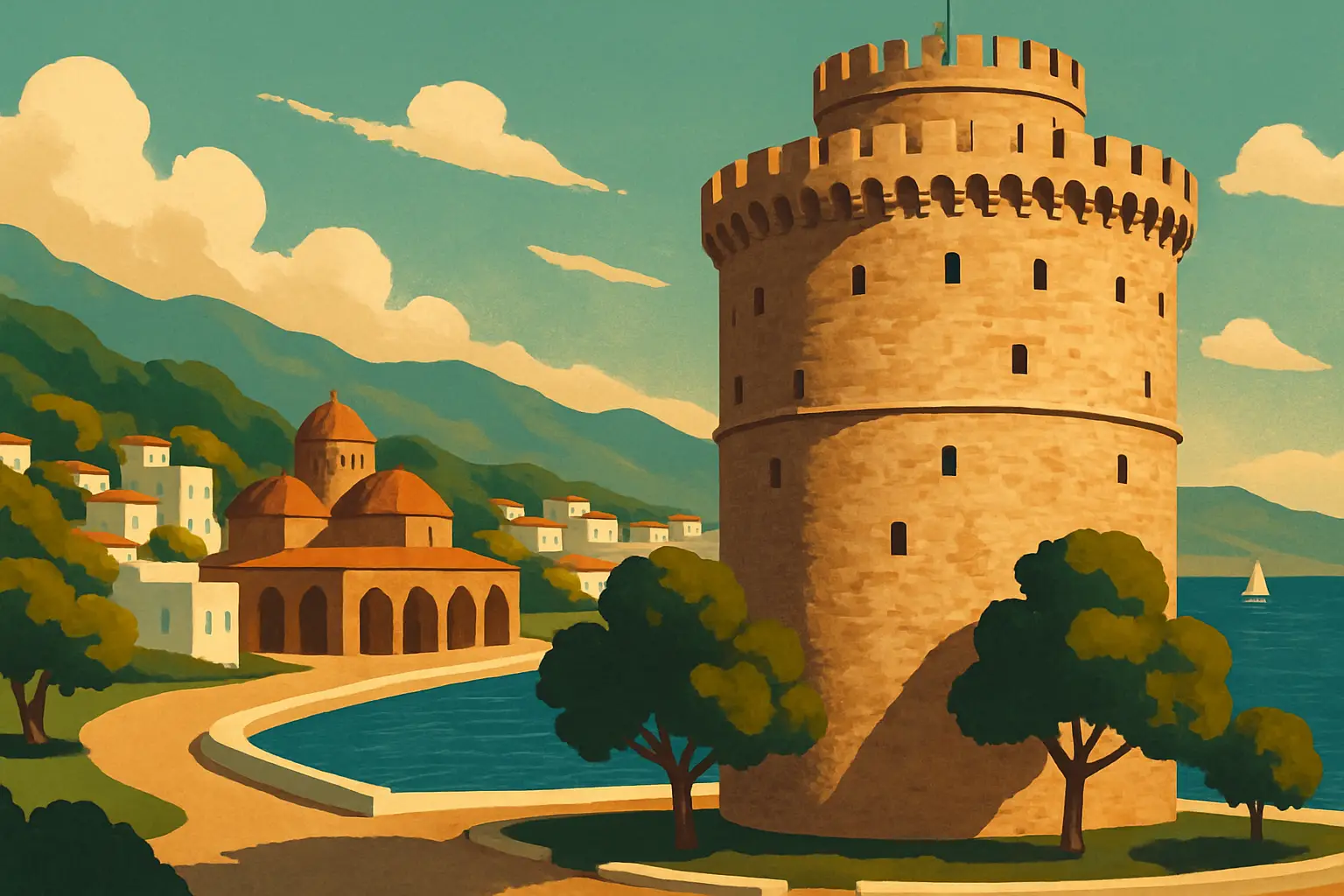
The White Tower (Lefkós Pýrgos) is the one image every traveler arrives with — a six-story Ottoman fortification from 1535, originally at the eastern edge of the city walls, now standing alone on the seafront after the walls were demolished in the 19th century. The tower is open to visitors with a modest museum inside tracing Thessaloniki's history floor by floor; the top level delivers a 360-degree view over the city, the harbor, and on clear days the agricultural plain of Macedonia stretching toward the mountains.
The Nea Paralia — the seafront promenade running west from the White Tower — is the city's common ground. On summer evenings it fills with families on foot, couples on rental bikes, vendors selling corn on the cob and trigona pastries, and groups sitting on the low seawall with beers from a corner kiosk. Walk it all the way west and you reach the old harbor warehouse district of Ladadika, where the mezedopolia open onto pedestrianized streets as the sun drops.
Aristotelous Square, a colonnade of matching neoclassical buildings connected to the waterfront by a formal axis, is Hébrard's central set piece — the design spine of the post-fire city. Walk north through it and you reach the scattered remains of the Roman Forum beneath a street-level excavation site, visible through glass panels. The Forum was the civic center of the Roman city in the 2nd and 3rd centuries AD, contemporary with the Arch of Galerius two blocks east. The layers are that close together.
Get short, interactive stories that make each place easier to remember while you travel.
To reach Ano Poli, walk north from the central city up Kleious Street or Akropoleos Street — either gets you into the upper town in fifteen minutes from Dikastirion Square. The change is immediate: Ottoman-era wooden houses with projecting upper floors overhang the cobblestone lanes, and the streets narrow from avenue width to one-person-and-a-bicycle width within half a block.
The neighborhood survived 1917 not by design but because the fire ran out of momentum before climbing the hill fully. Ano Poli still contains the physical fabric of Ottoman Thessaloniki: the Monastery of Vlatadon, the city's only still-functioning monastery, founded in the 14th century and offering quiet courtyard views across the rooftops and gulf below; the 5th-century Church of Osios David, whose mosaic of a youthful, beardless Christ is considered one of the finest surviving Early Christian mosaics in existence; and the Heptapyrgion (Yedi Kule — 'Seven Towers') fortress at the northeastern corner, a Byzantine fortification reworked by the Ottomans that served as a prison until 1989.
From the Heptapyrgion walls you can trace the full Byzantine fortification line running south and west around the upper city. The views here over the harbor are better than those from the White Tower, and they are shared with far fewer people. Ano Poli is navigated entirely on foot — no buses reach the narrowest lanes — and that requirement keeps the crowds at a walkable scale.
Greece's most-visited archaeological site is the Acropolis of Athens, and for good reason — it is the concentrated expression of classical civilization. But Thessaloniki's density of Byzantine-period monuments has no parallel anywhere in Greece and almost none in Europe. Fifteen sites were collectively inscribed in 1988; the ones worth planning around are within walking distance of the city center.
The Rotunda of Galerius on Egnatia Street is the oldest surviving building in the city — a cylindrical Roman mausoleum built around 306 AD for the emperor Galerius, converted to a Christian church in the 4th century, then to a mosque by the Ottomans (the minaret still stands outside, the only surviving Ottoman minaret in Thessaloniki), then back to a church after 1912. The interior retains Byzantine mosaics covering the 24-meter domed ceiling with extraordinary detail. Entry is inexpensive and the building sees a fraction of the tourist volumes of Athens' monuments.
Agios Demetrios Basilica on Agios Demetriou Street is the city's patron church, built on the site where the Roman soldier Demetrios was martyred in 306 AD. The current five-aisled structure is the third version, rebuilt after fires; original 5th-century mosaic panels survive in the nave. The crypt beneath contains remains of the Roman bath where the saint was reportedly held.
The Museum of Byzantine Culture on Stratou Avenue provides the material context for all of it — a purpose-built museum organized around the shift from ancient to Byzantine Greek life, with galleries of mosaic fragments, burial goods, icons, and silk textiles. The building won the European Union Heritage Award in 2005. Allow two hours minimum.
Greeks from Athens are not typically generous about other regions. They will, however, concede without much argument that Thessaloniki does food better. The city's culinary identity is a direct product of its Ottoman, Sephardic Jewish, and Asia Minor Greek refugee influences meeting in a concentrated urban food culture — with specific dishes, specific shops, and specific traditions that have been doing the same things for generations.
Bougatsa is the essential breakfast: layered phyllo pastry filled with warm semolina custard, dusted with powdered sugar and cinnamon, served in paper-wrapped portions straight from the oven. Bantis on Filipou Street — family-run since 1969 — makes its phyllo by hand on a marble table to a recipe unchanged since the founder's grandfather opened the shop. Thessaloniki has dozens of bougatsa places; Bantis is the benchmark.
Trigona panoramatos are crisp cone-shaped pastry shells filled with cream, originating at a shop in the Panorama neighborhood above the city in the 1960s. The Elenidis family, who invented them, still runs the original Panorama shop and two city-center locations. They are designed for walking — eat one on the promenade.
Kapani Market — the direct descendant of the Ottoman bazaar behind Dikastirion Square — runs on a morning schedule with blocks of feta, live fish tanks, Macedonian saffron, and bulk dried goods sold to restaurants and households rather than tourists. The adjacent covered Modiano Market focuses on dairy and fish. Both close in the early afternoon. For evening eating, the Ladadika district west of the port concentrates tavernas and ouzo bars in a pedestrianized grid of converted warehouse buildings — the mezedopoleio format, with the Gulf's seafood as the emphasis.
Is Thessaloniki worth visiting on its own? Yes, for anyone with more than a week in Greece and an interest in history or food beyond the Athens circuit. The city has no single site that competes with the Acropolis for immediate visual scale, but it has a denser accumulation of historical layers — Roman, Byzantine, Ottoman, Sephardic, modern Greek — in a more navigable geographic area, and it operates as a genuinely functioning European city rather than an open-air museum.
The honest comparison: Athens concentrates the greatest hits of ancient Greek civilization. Thessaloniki concentrates the greatest collection of Byzantine monuments in Greece, one of the most interesting urban food cultures in the Mediterranean, and a daily-life texture that mass tourism has not fully reshaped. Three nights in Thessaloniki after three days in Athens changes the entire register of a Greece trip — it shows the country as something other than ancient ruins and island beaches.
Can you do Thessaloniki as a day trip from Athens? Technically. The fastest option is a 55-minute flight to Thessaloniki Airport (SKG) with multiple daily departures. A day gives you the White Tower, the Rotunda, bougatsa breakfast, and the promenade — meaningful but rushed. Two nights is the minimum that allows Ano Poli, a morning at Kapani, and the Byzantine Museum to fit without running between them.
How to get there: From Athens, flying to Thessaloniki Airport (SKG) takes 55 minutes — Aegean and Sky Express both run multiple daily departures. The airport is 16 kilometers east of the city center; Bus 78X connects it to the center in about 45 minutes, and taxis run around €20. The train from Athens takes 4–5 hours on intercity services and arrives at the Thessaloniki Railway Station on the western edge of the city grid. KTEL buses from Athens' Kifissos terminal take 5–6 hours and are the cheapest option.
Best time to visit: June is solidly good — temperatures around 28–32°C, long days, and the waterfront promenade fully operational. July and August are hotter and busier, when Athenians arrive for their own summer variation. May and October are what locals recommend for food travelers: ideal temperatures, full city activity, and far fewer tourists. Winter (December through February) is cool and overcast, but Thessaloniki's food culture and museum calendar run year-round — the city is fully functional in ways that island destinations are not.