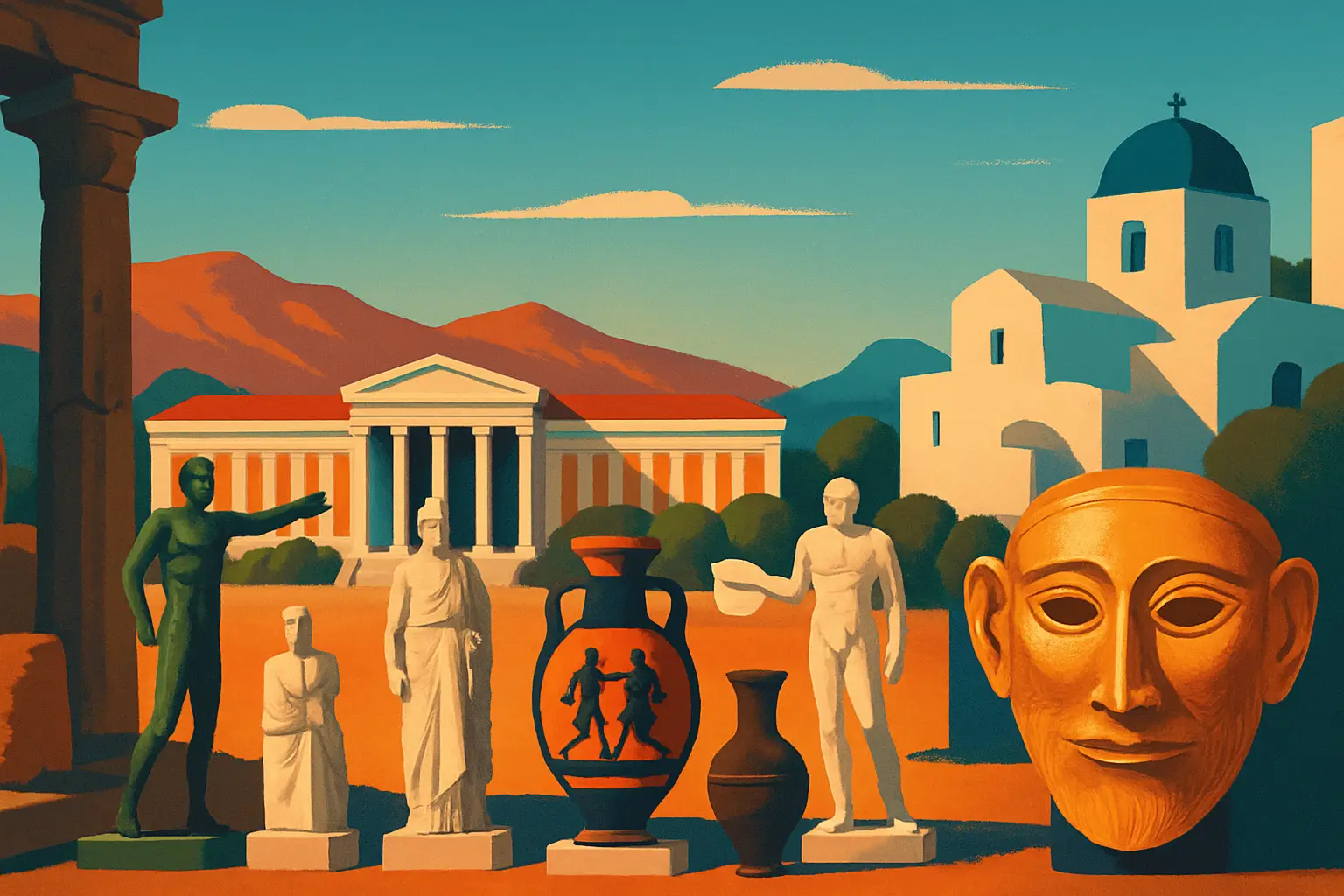
The National Archaeological Museum is the largest archaeological museum in Greece and one of the most significant in the world. Its collection spans roughly 7,000 years of Greek history, from the Neolithic period through late antiquity. That scale is also the problem.
When every room contains world-class objects with three-line placards, everything starts to blur. A Mycenaean gold cup from 1500 BCE sits three meters from a Roman marble portrait from 200 CE with almost identical presentation. Without context, the eye stops distinguishing.
The approach that works is selective. This is not a place to see everything — it's a place to understand six specific things very well. Choose those objects. Know their stories before you walk in. When you stand in front of the Mask of Agamemnon or the Artemision Bronze with the full story already loaded, the experience becomes something different: a confirmation of something you almost already knew, delivered in three dimensions at 1:1 scale.
Room 4 holds the Mycenaean gold collection — funeral goods excavated by Heinrich Schliemann in 1876 from the royal shaft graves at Mycenae, the fortified Bronze Age palace city in the Peloponnese. The room contains extraordinary objects: inlaid daggers, ceremonial drinking cups, amber jewelry. In the center case, behind glass, is a hammered-gold funeral mask the size of a human face.
Schliemann sent a telegram to the King of Greece when he found it: *'I have gazed upon the face of Agamemnon.'* The name has never left the object.
The mask almost certainly does not show Agamemnon. The man depicted was buried around 1550–1500 BCE, and Agamemnon — if he existed — would have lived around 1250 BCE. The mask predates any plausible Trojan War by 250 to 300 years. What it does show is a specific man: heavy beard, mustache, a face of middle age, eyes closed, features pressed from a single sheet of hammered gold by someone who knew this face well enough to render it with personality rather than convention. He was powerful enough to be buried wearing 450 grams of gold, and someone cared about his face enough to record it.
The Mycenaean civilization left almost no narrative texts — Linear B has been deciphered, but the tablets are administrative records, not history. This mask and the objects around it in Room 4 are among the few things from that world that carry the weight of individual human presence.
Get short, interactive stories that make each place easier to remember while you travel.
Near the end of the sculpture gallery, a bronze figure stands in mid-throw. Both arms are fully extended — one forward, one swept back — in a pose of suspended force. The figure is 2.09 meters tall, clearly divine, and dated to approximately 460 BCE, the Early Classical period just before the Parthenon.
The statue was found in 1926 and 1928 in the sea off Cape Artemision, on the northern tip of the island of Euboea — the same waters where the Greeks and Persians fought a major naval battle in 480 BCE. It had been on a ship that sank during Roman-era transport.
The debate that has never been resolved: if the god is holding a trident, he's Poseidon. If he's holding a thunderbolt, he's Zeus. Both weapons would have been thin bronze rods, long since lost. The right hand is open. Art historians have been arguing about the width of that grip for ninety years.
What is unambiguous is the technical achievement. The figure's weight rests on one foot, the torso is rotated nearly 90 degrees, and the extended arms create a span of over two meters — all in solid bronze, all in perfect balance. Whoever cast this in the 5th century BCE was working at a level that would not be matched in Europe for roughly 1,500 years. The Jockey of Artemision, nearby — a small boy on a full-speed galloping horse, his face straining with effort, circa 150 BCE — came from the same underwater site and is equally worth stopping for.
In 1900, a sponge-diving boat caught in a storm off the small island of Antikythera — between Crete and the Peloponnese — dropped anchor in a bay and sent divers down to wait out the weather. One of them surfaced with pieces of bronze. What followed was the first major underwater archaeological excavation in history.
The Antikythera shipwreck was a large Roman-era cargo vessel, probably carrying looted Greek art from the Aegean back to Italy. The haul included life-size statues, glassware, pottery, and one object that would not be fully understood for another century.
The most visible survivor, displayed in the sculpture galleries, is the Youth of Antikythera — a nearly complete bronze figure, 1.96 meters tall, his right arm extended as if he once held something (an apple? a ball? scholarly opinion is divided). The original eyes were glass or stone, now missing. What remains has a quality of arrested presence — someone caught mid-moment, not posed. It is one of the finest surviving bronzes from the 4th century BCE.
Take the staircase to the second floor. In Room 38, behind glass, are fragments of corroded bronze that look like they belong in a geology collection. The placard explains what they are: the remains of a mechanical astronomical calculator built approximately 100 BCE.
The Antikythera Mechanism contained at least 30 interlocking bronze gear wheels inside a hand-sized wooden box, operated by a hand crank. Turning the crank moved pointers on circular dials on the front and back faces. The front dial tracked the positions of the sun and moon in the zodiac. The back dials tracked the Metonic cycle (the 19-year alignment of the lunar and solar calendars), the Saros cycle (an 18-year eclipse prediction cycle), and a games calendar used to schedule the Olympic and Panhellenic festivals.
In plain terms: it predicted where the sun and moon would be on any future date and told you when the next eclipse would occur, 18 years in advance, correctly.
The nearest comparable European technology — mechanical astronomical clocks using similar gear trains — does not appear until the 14th century CE. The Antikythera Mechanism is roughly 1,400 years ahead of anything else in the record. A working reconstruction, built by University College London researchers in 2021, stands next to the fragments. The reconstruction rotates. It is the most useful exhibit in the museum, and most visitors never see it.
Room 48 holds the Thera frescoes — wall paintings from Akrotiri, the Bronze Age settlement on Santorini buried when the Thera volcano erupted around 1600 BCE. Akrotiri was a sophisticated trading city: multi-story buildings, indoor plumbing, elaborate painted walls. The ash preserved it for 3,600 years before excavation began in 1967.
The frescoes are remarkable on two grounds. First, the color: the sealed ash environment preserved the mineral pigments at near-full intensity. A painting of swallows in flight from 1600 BCE looks like it was made recently. Second, the subjects: the Akrotiri painters depicted daily life with unusual warmth and specificity. The 'Boxing Children' fresco shows two boys in gloves sparring, their faces unposed and concentrated. The 'Spring fresco' shows swallows over red lilies growing from rocky outcrops — a landscape painting, which is a genuinely unusual genre in ancient art.
The people of Akrotiri appear to have evacuated before the eruption — no human remains have been found in the ruins, and no gold was left behind. Someone warned them. Who gave the warning and how the population survived is unknown. The paintings they left on their walls are in Room 48.
The ceramic galleries (Rooms 49–56, on the ground and upper floors) are excellent by any specialist standard but visually repetitive without prior knowledge of Greek vase-painting conventions. Spend 10 minutes here rather than 45 unless ceramics are your specific interest.
The Egyptian and Near Eastern collection on the ground floor is a curiosity — these objects came to Athens through ancient trade — but is secondary to the Greek material. A glance is enough.
The audio guide (€5 extra) covers the Mycenaean and sculpture galleries well, but does not meaningfully cover the Antikythera Mechanism or the Akrotiri frescoes. For Rooms 38 and 48, the display placards are more informative. Skip the guide for those rooms.
The museum shop, near the exit, sells a working mini-replica of the Antikythera Mechanism gear model — one of the more legitimate souvenirs available in Athens, since the actual object is housed here. It is not available in most tourist shops.
When to visit? In June, the museum is open daily 8 a.m. to 8 p.m. (Tuesdays from 1 p.m.). Lightest crowds are at opening and the hour before closing. Tour groups typically land between 10 a.m. and 1 p.m. The building is fully air-conditioned — one of the few central Athens attractions that is genuinely comfortable at midday in summer, when outdoor temperatures regularly reach 34–36°C.
How long? The six-object approach in this guide takes about 2 to 2.5 hours at a comfortable pace, including time to read placards and move between floors. A full survey of the museum takes 4 to 5 hours and is genuinely tiring. If you are visiting with children, Room 4 (Mycenaean gold) and Room 15 (the Artemision Bronze) are the most immediately striking for first-timers.
How to get there? The museum is at Patission 44, about 1 km north of Omonia Square. From Omonia metro (Lines 1 and 2), walk north along Patission Street — about 10 minutes. From Exarcheia, the neighborhood directly east, it is a 5-minute walk west along Stournari Street. Combining the museum with lunch in Exarcheia is a natural pairing: Kallidromiou Street market and the cafes around Exarcheia Square are 10 minutes on foot from the museum entrance.