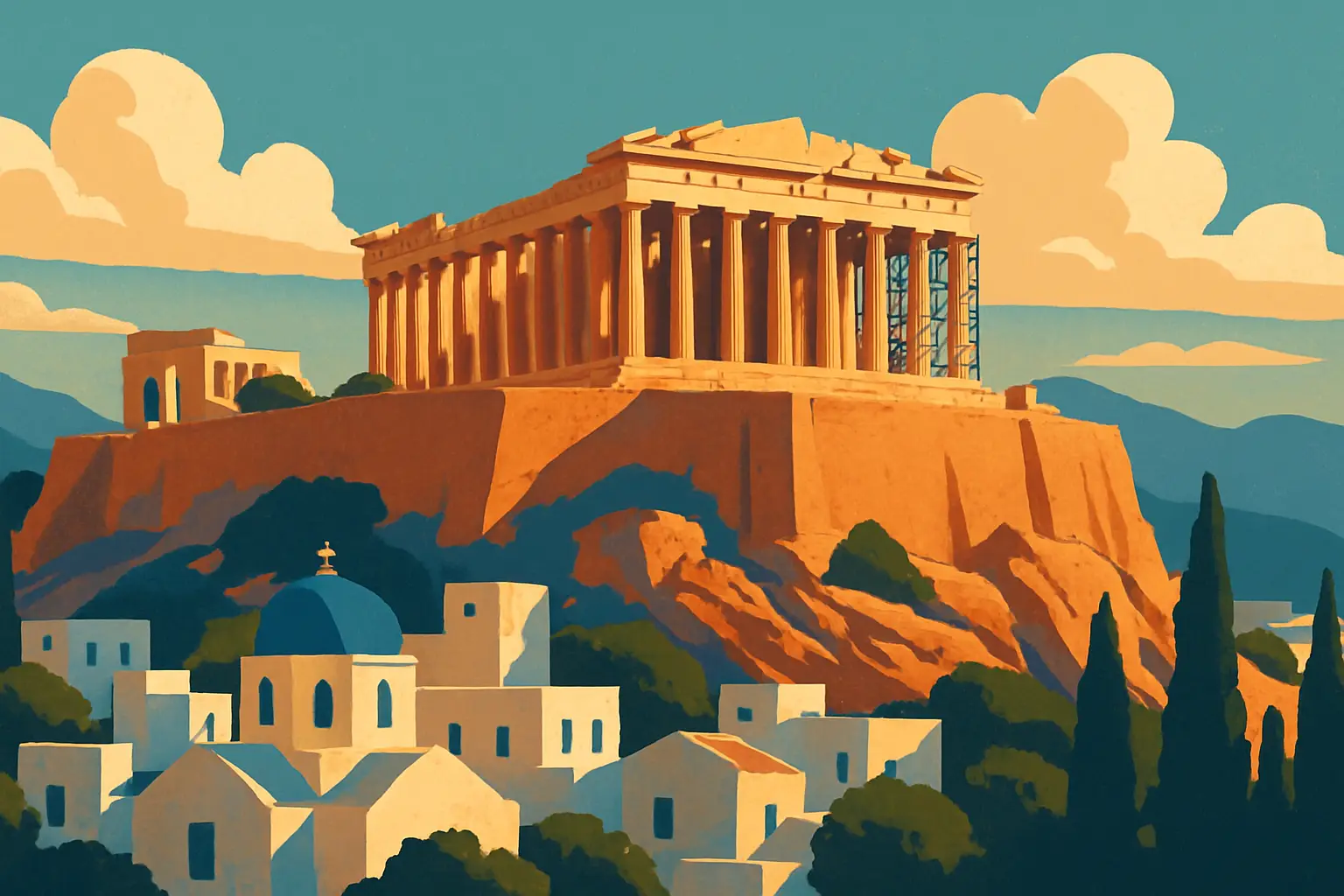
The word acropolis means 'high city' — it describes a type of fortified hilltop, not a unique place — but Athens' Acropolis has been the reference for all others since the 5th century BC. The flat-topped limestone rock rises 156 meters above the surrounding city and has been continuously occupied since at least the 13th century BC. Before the Parthenon, it held a Mycenaean palace. Before the palace, a Neolithic settlement. The hill has never been abandoned.
The surviving monuments date from the mid-5th century BC, specifically from the building program initiated by the statesman Pericles after the Persian army destroyed an earlier temple complex on the site in 480 BC. Pericles commissioned the sculptor Pheidias to oversee the entire project, which took roughly 50 years under a sequence of architects — Iktinos and Kallikrates for the Parthenon, Mnesikles for the Propylaea gateway. The result was the most concentrated declaration of Athenian power and artistic ambition in the ancient world.
What you see today is neither the original nor a ruin in the usual sense. The Parthenon has been a pagan temple, a Christian church, a Catholic cathedral, a Muslim mosque, and a Turkish ammunition dump — which is what caused the 1687 Venetian artillery strike that blew out most of its interior when the gunpowder stored inside ignited. Since 1975, it has been an active restoration project. Every visit you make to this hill carries all of that history.
The Acropolis plateau holds four major structures, and understanding each one before you arrive turns a hot walk into something worth the heat.
The Propylaea is the monumental gateway you pass through to reach the plateau — designed by Mnesikles and begun in 437 BC with the intent to outshine every entrance in the ancient world. Its symmetry is deliberately deceptive: the north wing (the Pinakotheke, a painting gallery in antiquity) is larger than the south wing because the south wing had to avoid the foundations of an earlier sanctuary. Most visitors walk through without noticing the asymmetry, which is exactly what Mnesikles intended.
The Temple of Athena Nike, on the southwest bastion of the rock, is the smallest of the four monuments and the most often rushed past. Its frieze shows the first battle scene ever carved on a Greek temple — specifically the Battle of Plataea in 479 BC, where the Greeks broke the final Persian invasion. The temple was dismantled, used as fill for a fortification wall in 1686, and then rebuilt twice from the recovered stones — most recently in 2010 after an earlier restoration failed. The original carved panels are in the Acropolis Museum.
The Parthenon sits at the exact center of the plateau, built from Pentelic marble cut so precisely that the entire structure uses virtually no mortar — the stones are fitted with lead-coated iron clamps. The building was never technically a temple in the religious sense: Athenians did not worship inside it. It functioned as a treasury and national monument, housing Pheidias's gold-and-ivory statue of Athena Parthenos, which stood approximately 12 meters tall. The statue has been lost since late antiquity.
The Erechtheion stands on the north side on the most sacred ground on the hill — the spot where, according to mythology, Poseidon struck rock with his trident and Athena caused an olive tree to grow during their contest for the city. The building is architecturally unusual because it integrates three separate cult spaces on uneven terrain. Its famous Porch of the Caryatids — six draped female figures serving as columns — is one of the most recognizable images in ancient architecture. All six originals have been moved to the Acropolis Museum to prevent acid rain damage; what you see on the building are high-quality casts.
Get short, interactive stories that make each place easier to remember while you travel.
The Parthenon has been under some form of scaffolding since 1975. The restoration began as emergency stabilization after decades of acid rain and the 1981 Athens earthquake caused measurable structural damage, then expanded into one of the most complex architectural restoration programs ever attempted.
The methodology changed fundamentally from earlier, deeply damaging attempts. 19th and early 20th-century restorers used ordinary iron reinforcement bars — the iron oxidized, expanded, and cracked the marble around it, causing more damage than the original catastrophe. The current team uses titanium rods, chemically inert against marble. New pieces are carved from Pentelic marble from Mount Pentelikon, the same quarry northeast of Athens that supplied the original builders 2,500 years ago, with a color match that becomes indistinguishable after natural weathering. Approximately 1,600 new marble elements have been fabricated so far.
On October 12, 2025, the Parthenon stood completely free of exterior scaffolding for the first time in approximately 200 years. This milestone lasted a matter of weeks — lighter scaffolding went back up on the western facade for the final phase of work there, with the Greek Ministry of Culture stating completion by late summer 2026. In June 2026, the eastern facade and both long flanks of the Parthenon are visible clearly; only the western entrance end carries the remaining frame. It is the most unobstructed view of the building available in living memory.
A second, longer-term project is simultaneously underway inside the cella — the inner chamber that once housed the Athena Parthenos statue. The goal is partial reconstruction of the interior colonnade using original marble blocks recovered from the site over the past century. This interior work carries an estimated 15-year timeline independent of the exterior scaffolding completion.
The south slope of the Acropolis contains two performance venues, and most visitors bypass both by arriving from the Monastiraki side and focusing entirely on the plateau above.
The Theater of Dionysus, carved into the slope directly below the Parthenon, is the oldest stone theater in the world and the origin point of Western drama as a recorded art form. Tragedies by Aeschylus, Sophocles, and Euripides were first performed here in competitions at the annual Dionysia festival, which required each of three competing playwrights to stage four plays — three tragedies plus a satyr play — over a single day. The theater seated approximately 17,000 Athenian citizens. The carved marble Seat of the Priest of Dionysus in the front row, decorated with goat-leg reliefs, is still in place.
The theater is included in the €30 combo ticket and receives a fraction of the crowds on the main plateau. Arriving at the south entrance on Dionysiou Areopagitou Street and walking the slope slowly gives you the theater, then the Stoa of Eumenes (a 197 BC covered walkway built as shelter for festival audiences), then the Odeon of Herodes Atticus, before the path up to the Propylaea. The total ascent via this route is less steep and far less congested than the standard north approach.
For the Odeon of Herodes Atticus at the western end of the slope — the 2nd-century Roman performance venue built by Athenian benefactor Herodes Atticus — check the Athens & Epidaurus Festival schedule for June performances. The festival runs June through August and stages ancient drama, opera, and contemporary work in a 5,000-seat venue with the lit Acropolis immediately above the stage. This is not a generic tourist show; the programming is serious and the setting is unlike any performance space in existence.
The Acropolis Museum at Dionysiou Areopagitou 15 — designed by architect Bernard Tschumi and opened in 2009 — is one of the finest archaeological museums ever constructed, and one of the most architecturally purposeful. Every design decision makes the same argument: these sculptures belong here, in sight of the building they came from.
The glass-floor entrance level reveals an ancient Athenian neighborhood excavated during construction — approximately 4,000 objects were uncovered during the foundation dig and are now displayed beneath your feet in situ. The building steps over and around the excavation rather than removing it.
The top-floor Parthenon Gallery is oriented precisely parallel to the Parthenon on the hill above, with surviving sections of the original Parthenon frieze — a 160-meter carved band depicting the Panathenaic procession in relief — displayed in their original cardinal positions. The sections held at the British Museum (removed by Lord Elgin between 1801 and 1812 and the subject of a continuing repatriation dispute) are represented by white plaster casts beside the warm honey-colored originals. The gap between their tones is immediate and deliberate. The Parthenon itself is visible through the gallery's glass walls as you stand beside its dismembered frieze.
On the second floor, the Peplos Kore — a votive female statue dated to approximately 530 BC — is consistently under-visited relative to the top floor and is one of the most remarkable objects in the building. She retains traces of original red and blue paint on her garment and hair, direct evidence that ancient Greek marble sculpture was painted in vivid color. This is difficult to imagine from looking at white marble; standing in front of actual pigment on a 2,500-year-old surface, it becomes impossible to forget.
The five remaining original Caryatids from the Erechtheion are also on this floor. From their original position on the building, the carving detail in their drapery folds is invisible at 10 meters. At eye level in the museum, they are among the most technically accomplished carvings in the ancient world.
Is it worth it? The question gets asked sincerely and deserves a direct answer: yes, unambiguously, but only if you know what you're looking for. Without context, the Parthenon is a damaged marble building, roughly 70 meters long, with no interior access, surrounded by scaffolding and a great many people. With context — who built it and under what political circumstances, what stood here before the Persians arrived, how it was used across 2,500 years of changing rulers, and what the restoration team has actually been doing since 1975 — it is among the ten most significant human-made objects on the planet.
What else is nearby? The Acropolis sits at the junction of Athens' most walkable neighborhoods. Plaka — the oldest continuously inhabited neighborhood in Athens — begins immediately below the rock's eastern slope, its flagstone streets running directly under the walls. Monastiraki is five minutes northwest and has the best concentration of cafes for recovering after a hot morning climb. Koukaki is five minutes south of the museum and where anyone with good judgment eats lunch — better restaurants, considerably less tourist markup than the Plaka tavernas directly below the hill. Thissio, to the northwest along the pedestrianized walkway below the Ancient Agora, offers the best sunset view of the Acropolis illuminated from the west — from the ridge on Apostolou Pavlou Street, the rock appears to float above the city as the light drops.
Tickets: Book at hhticket.gr. The €30 combo ticket covers 7 sites and is valid for 5 days. In June, book at least a week ahead; 8–10 a.m. and post-4 p.m. slots go first. Free admission days for the Acropolis include March 6, April 18, May 18, October 28, and the first Sunday of each month from November through March — these dates draw very large crowds, which largely defeats the benefit.
Getting there: Akropoli Metro station (Line 2, Red Line) is the correct arrival point for the south entrance — exit and walk two minutes north on Dionysiou Areopagitou. Monastiraki station (Lines 1 and 2) serves the north side via a 10-minute walk through the Ancient Agora area.
Shoes: The ancient marble path from the Propylaea to the Parthenon is polished by approximately 2,500 years of foot traffic to near-mirror smoothness. In wet weather it becomes dangerous. Hard-soled sandals are the worst possible choice. Rubber-soled trainers or shoes with grip are the correct ones. This is the single most practically important piece of advice about the Acropolis that most guides bury or omit.
Water and sun: The plateau has one small water refill point and almost no shade. Bring 1.5 liters minimum per person, sunscreen, and a hat. In June, the rock surface can be 10–15 degrees hotter than the surrounding city by 10 a.m. The solution is early entry — not just for crowds, but for survivable temperatures.