Plaka is the oldest continuously inhabited part of Athens, roughly bounded by Ermou Street to the north, the Acropolis rock to the south and west, and Lysicratous Street to the east. It is the only large section of pre-modern Athens that survived the 19th-century redevelopment that erased most of the Ottoman city after Greek independence in 1830.
That survival is partly accidental and partly topographical. After 1833, Athens was being rebuilt in a neoclassical European style commissioned by Bavaria's King Otto, who had been installed on the Greek throne. Most of the historic urban fabric was demolished to make way for wide avenues and ordered city blocks. Plaka's steep, narrow streets and proximity to the Acropolis made wholesale demolition impractical — and the ruins embedded in its streets were already beginning to attract the archaeologists and antiquarians who formed Athens' first tourist class.
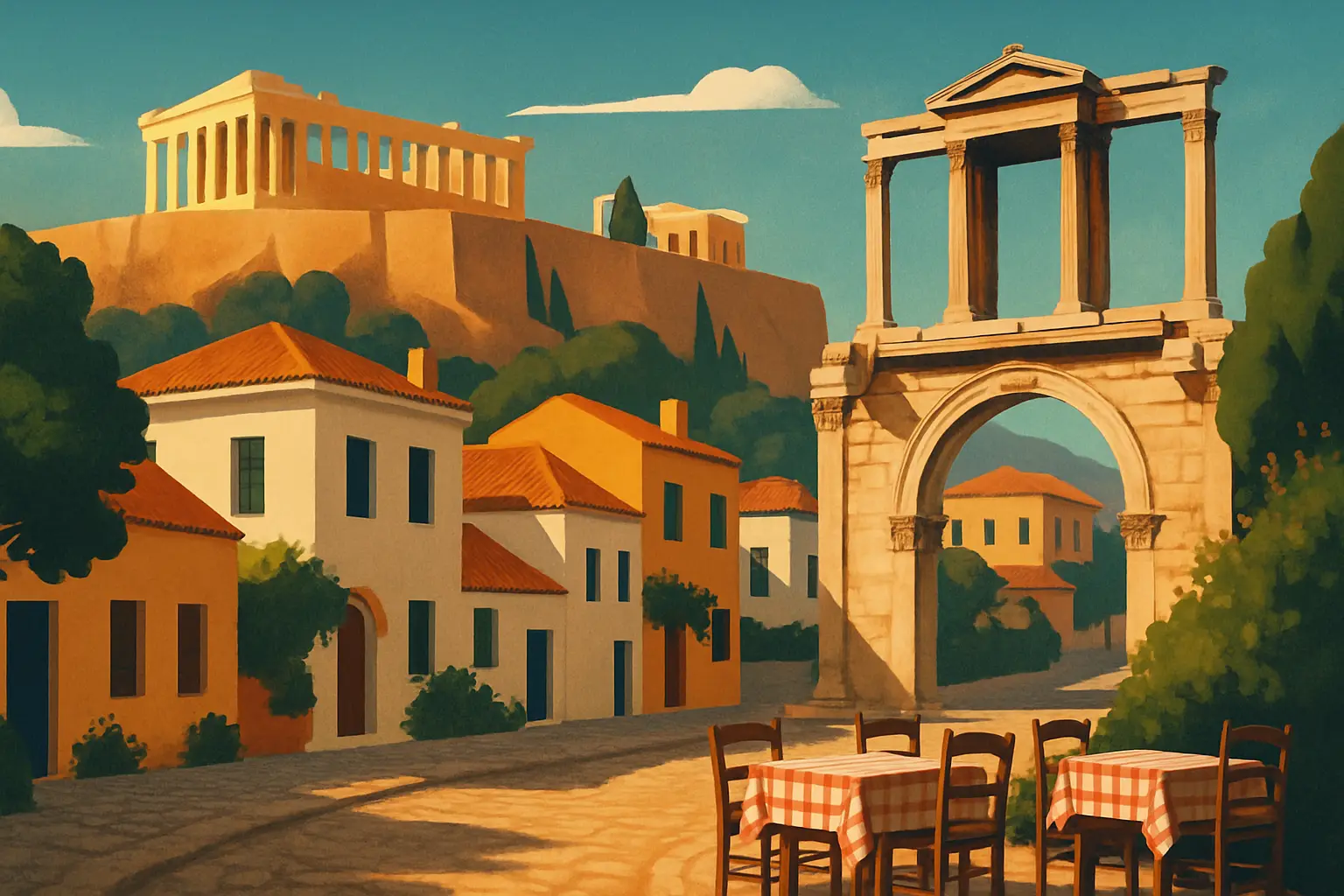
The neighborhood's apparent 'Greek island village' character — white walls, terracotta pots, jasmine over doorways — is largely an invention of the postwar decades, when residents whitewashed their facades and pedestrianization of the main streets created the aesthetic now associated with Plaka. What sits underneath that surface is stranger and considerably older.
On Pelopida Street, just inside the Roman Agora site, stands a marble octagonal tower that is arguably the most quietly astonishing monument in Athens. The Horologion of Andronikos Kyrrhestes — universally called the Tower of the Winds — was built around 50 BCE by Andronikos of Kyrrhus, a Macedonian astronomer and architect.
Each of the eight faces is oriented toward one of the eight compass winds, and each carries a carved relief figure depicting that wind: Boreas (north), Kaikias (northeast), Apeliotes (east), Euros (southeast), Notos (south), Lips (southwest), Zephyros (west), Skiron (northwest). A bronze wind vane in the shape of a Triton once rotated on the conical roof, pointing toward whichever wind figure was active below. The tower functioned simultaneously as a sundial (carved lines on each face), a water clock (a hydraulic clepsydra fed by a stream from the Acropolis), and a wind direction indicator. It was Athens' civic timekeeping infrastructure — consulted daily by merchants in the adjacent marketplace.
At 12 meters tall and 8 meters in diameter, built from Pentelic marble, the Tower of the Winds is the best-preserved ancient monument in Athens. It owes its condition to continuous occupation: the Byzantines used it as a church bell tower; the Ottomans converted it into a tekke, a ceremonial lodge for the whirling dervishes of the Mevlevi order. The Mevlevi whitewashed the interior for their own rituals, which is why the inside walls lack the damage typical of abandoned ancient structures. Something was always happening here.
Get short, interactive stories that make each place easier to remember while you travel.
The Roman Agora was built between 19 and 11 BCE, funded in part by Julius Caesar and completed under Augustus — a commercial marketplace designed to handle the overflow from the older Ancient Agora to the west. The main surviving structure is the Gate of Athena Archegetis, a Doric propylon with four columns still standing, each bearing carved inscriptions that recorded market regulations and the tax exemptions Caesar personally granted to Athenian traders.
In the center of the Roman marketplace courtyard stands the Fethiye Mosque — the Mosque of the Conqueror — built in 1458 by Mehmet II following the Ottoman capture of Athens. The mosque was built directly inside the Roman forum, using the ancient colonnaded market as its site. It is a modest structure by Istanbul standards, but its position is extraordinary: a 15th-century Islamic prayer hall standing in the middle of a 1st-century Roman market, both built on land that had been Greek civic space for five centuries before either of them.
Most of Athens' Ottoman mosques were demolished or repurposed after independence in 1830 — the Fethiye Mosque is one of the few still standing, which makes it genuinely significant as a surviving layer of the city's layered occupation. It is visible from within the archaeological site but closed to the interior.
At the corner of Lysicratous and Tripodon Streets, a five-minute walk east of the Roman Agora, stands the Lysicrates Monument — a circular marble structure on a square base, topped with a carved crown of acanthus leaves where a bronze tripod once sat. It was built in 335 BCE by a wealthy Athenian named Lysicrates to display the bronze tripod he won as choregos — the sponsor of a boys' chorus — at the annual Dionysia theater festival. The tripod was the prize. The monument was essentially a trophy case built on the public street where other choragic monuments once stood.
The Lysicrates Monument matters architecturally because it is the earliest known surviving building to use Corinthian-order columns on its exterior. The elaborate acanthus-leaf capital that became dominant throughout Roman architecture appears here in one of its first fully developed external applications — a data point for architectural historians tracking the transition from Greek to Roman building conventions.
The Byron connection is direct. In 1810 and 1811, Lord Byron stayed in the adjacent Capuchin monastery — since destroyed during the Greek War of Independence — while traveling through Greece and writing what became Childe Harold's Pilgrimage. The monument was incorporated into the monastery's library. Byron carved his name into the marble; the marks are still faintly visible on the lower stone of the base, at roughly waist height, though they are not labeled or highlighted. You are looking at a 2,300-year-old monument with a 200-year-old graffito from one of the most famous poets in the English language. Neither party is mentioned on the site placard.
The restaurants on Kydathinaion and the main pedestrianized stretches are tourist-facing: decent food, outdoor seating, aggressively marketed to passersby, and priced accordingly. The genuinely good options are one or two streets back from the main axis.
O Platanos at Diogenous 4 is a family taverna that opened in 1932, shaded by a centuries-old plane tree in a small square just north of the Roman Agora entrance. The food is classic Athenian: grilled lamb chops, slow-roasted vegetables, fresh horiatiki salad with feta served in a slab, retsina by the carafe. Prices are honest and the clientele is a real mix of Athenians and knowing visitors. The tree alone makes the courtyard worth sitting in.
Scholarhio at Tripodon 14, near the Lysicrates Monument, is a basement ouzeri — an ouzo bar that serves food in the traditional way. You order a carafe of ouzo and the kitchen sends out rotating small plates: olives, taramasalata, grilled halloumi, fried calamari, spiced meatballs. The format is per person (around €12–15), inclusive of the ouzo. This is specifically an Athenian eating tradition, not commonly found in tourist restaurants.
Yiasemi at Mnisikleous 23, on the staircase street climbing toward Anafiotika, is a terraced garden cafe built into the hillside with a view of the Acropolis from its upper level. Better for coffee and breakfast than a full meal. Go early morning, before 9 a.m., when the terrace is quiet and the light on the Acropolis is still low and golden.
Climbing the staircase streets above Mnisikleous Street, you enter Anafiotika — a small enclave of whitewashed cube houses and narrow stepped alleys that looks entirely unlike the rest of Athens, or indeed unlike any mainland Greek city. It does so because it was built by workers from the island of Anafi in the Cyclades, brought to Athens in the 1830s and 1840s to work on the new royal palace under King Otto. Rather than live in the city, they built a replica of the village architecture they knew from home — flat roofs, whitewashed walls, no right angles, doorways draped in bougainvillea — on the slope below the Acropolis, on land they occupied informally.
Anafiotika is today the quietest part of Plaka: no restaurants, no shops, only residential buildings on paths too narrow for more than one person to pass comfortably. Walk through; do not sit on doorsteps or treat it as a photography set — the houses are inhabited. The views from the upper paths, looking south over the Athenian basin toward the sea, are among the best in central Athens without requiring an entrance ticket.
Best time to visit Plaka? June offers long daylight hours, warm evenings, and slightly lower tourist volumes than July and August. The Roman Agora site is shaded in the mornings but exposed by midday — visit the archaeological sites before 10 a.m. or after 5 p.m. in summer when temperatures regularly reach 34–36°C.
June also marks the opening of the Athens Epidaurus Festival, which runs through August across the city's ancient performance venues. The Odeon of Herodes Atticus — the 2nd-century Roman theater on the Acropolis's southern slope, a five-minute walk from Plaka — hosts international concerts and theater throughout the festival season. A Plaka afternoon followed by an Odeon evening is the natural combination, and the approach walk from Plaka up Dionysiou Areopagitou Street passes some of the best views of the Acropolis the city offers.
How long to spend? The Roman Agora, Tower of the Winds, Lysicrates Monument, and Anafiotika take about 2.5 to 3 hours at a comfortable pace. Add a meal at O Platanos or Scholarhio and a morning coffee at Yiasemi and you have a full half-day. Plaka is not a neighborhood that benefits from rushing — the streets are designed for walking slowly.
How to get there? From Monastiraki metro (Lines 1 and 2), exit to the square and walk southeast on Adrianou Street — you are in Plaka within three minutes. From Acropolis metro station (Line 2, Red Line), walk northeast along Makrigianni Street and enter from the southern end. From Syntagma Square, walk west along Mitropoleos Street — about 10 minutes on foot.