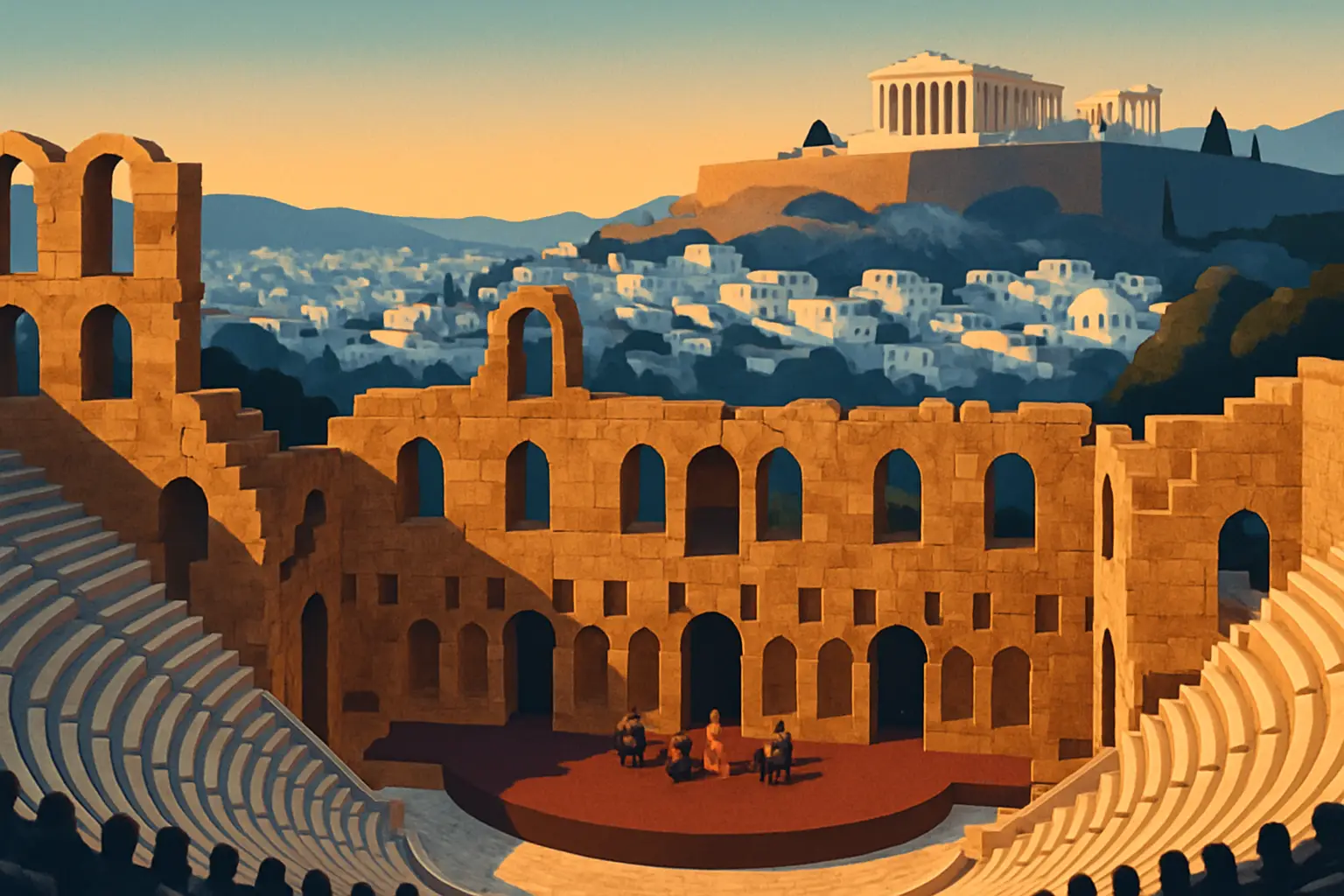
The Odeon of Herodes Atticus — known locally as the Herodeion — sits on the southwest slope of the Acropolis, carved into the rock below the Parthenon. The entrance is from Dionysiou Areopagitou Street, the long pedestrianized boulevard that circles the base of the Acropolis hill. When you approach from street level, the theater's three-story arched stone facade rises in front of you — Roman in construction, severe in proportion, and visually striking even against the mass of the Acropolis above it.
Inside, 33 rows of Pentelic marble seats rise steeply in a semicircle around a flat stone orchestra and a stage backed by the original Roman facade wall — partially intact, partially restored. The capacity is approximately 5,000 people. There is no roof; the sky is the ceiling, which means on a clear Athens night in June, stars appear above the stage while the Acropolis glows behind you. The combination — a Roman theater, an ancient Greek citadel, and a warm southern sky — is among the most striking visual experiences Athens offers.
The theater was completed in 161 AD by Lucius Vibullius Hipparchus Tiberius Claudius Atticus Herodes — Herodes Atticus — a Greek-born rhetorician and philosopher of Roman citizenship who was among the wealthiest private individuals in the ancient world. He had inherited a fortune from his father, grown it through imperial connections, served as Roman consul, and spent a portion of his wealth funding public buildings across Greece. Athens, Olympia, Delphi, and Corinth all have structures he paid for.
The Odeon was built as a funerary monument to his wife, Aspasia Annia Regilla, who died in 160 AD in circumstances that were, at the time, contested — Regilla's brother accused Herodes of causing her death, and the resulting Roman trial was one of the era's most discussed scandals. Herodes was acquitted, and the Odeon was constructed as a memorial. The original cedar-of-Lebanon roof — said to have been the largest wooden roof of its kind in the ancient world — made it famous as much for its engineering as for its acoustics.
Herodes Atticus himself was one of the most complex figures of the Roman world: Greek by culture and identity, Roman by citizenship and politics, educated in rhetoric and philosophy, and genuinely devoted to Athens even while operating at the highest levels of imperial power in Rome.
Get short, interactive stories that make each place easier to remember while you travel.
In 267 AD, a Germanic tribe called the Heruli launched a devastating raid through Greece. Athens was sacked, and the Herodeion was burned — the cedar roof collapsed and destroyed much of the upper structure. For the next 1,700 years, the theater sat as a ruin on the Acropolis slope, used variously as a defensive wall during the Byzantine and Ottoman periods but never restored to use.
Restoration began in the 1950s, overseen by the Greek Archaeological Service. The project stabilized the original Roman walls, replaced the ancient orchestra surface with Pentelic marble, and installed the seating visitors use today. The Athens Epidaurus Festival held its first performance at the restored Herodeion in 1955 — Maria Callas sang there — and the venue has run continuously every summer since. For 70 years it has been the flagship stage of Athens' cultural calendar, hosting opera, classical music, dance, and theater under the same open sky where second-century Athenians first sat.
The Athens Epidaurus Festival is Greece's oldest and most prominent performing arts festival, running every summer across several venues including the Herodeion and the ancient theater at Epidaurus in the Peloponnese. The Athens strand runs from late May through July, with the Herodeion as its main stage.
In June 2026, the festival designed a special 'Farewell Celebrations' program because the Herodeion closes for restoration at the end of the month. The program runs from June 3 to June 30 and is unusually concentrated — organizers described it as presenting the venue 'at its most essential' before the silence begins. The program includes classical piano with Vikingur Olafsson performing Bach, Beethoven, and Schubert (June 3); Blade Runner Live with the Avex Ensemble performing Vangelis's score to the film with full projection (June 4); and several nights of Greek composers and performers honoring the venue's seven decades of continuous use.
Tickets are available at aefestival.gr. Performances consistently start at 9 p.m. Dress code is smart-casual — Athens theater audiences tend to dress up, but not formally. Most shows run 90 minutes to 2 hours.
Tickets are sold per performance through the Athens Epidaurus Festival website. Pricing varies by show and section, ranging roughly €15 to €80 depending on the production and seat position. Seating is divided into the lower cavea (closest to the stage), the diazoma (a horizontal walkway at mid-level), and the upper cavea (highest rows with the widest views).
A few things to know before you go:
- The marble seats are cold, narrow, and hard. Bring a thin cushion or a folded jacket — the venue provides nothing.
- Wear flat-soled shoes. The stone steps are uneven and the row aisles are steep.
- No food or drinks are allowed inside. There is a bar area on the Dionysiou Areopagitou side before the show.
- Shows start at 9 p.m. precisely. Late arrivals are held at the gate until a suitable break — arriving late means missing the opening.
- Photography without flash is generally permitted before and after, not during, performances.
The acoustic geometry of the hillside means sound carries uniformly across the seating. Upper-tier sections are genuinely excellent; the main trade-off is that performers appear smaller. For orchestral concerts this matters less than for theater.
The main access is via Dionysiou Areopagitou Street, the pedestrianized walkway that begins at Acropoli Metro Station (Line 2, red line) and runs along the base of the Acropolis hill westward toward Thissio. The walk from the metro exit to the Herodeion gate is roughly 10 minutes on a flat stone path lined with olive trees and direct views up to the Acropolis walls.
Before a show, the area fills in the hour before curtain. The bars and restaurants along Dionysiou Areopagitou — and the slightly elevated Apostolou Pavlou promenade on the Thissio side — draw pre-theater crowds enjoying the warm night air. For dinner before a performance, the side streets of Koukaki (the residential neighborhood immediately south) offer better value than the tourist corridor: quiet tavernas on streets like Falirou and Drakou serve local Athenians rather than tour groups.
After the show, Psyrri — about 20 minutes on foot northwest — is where post-theater drinking happens, with a dense block of bars and mezedopolia that run until 2 or 3 a.m. on a summer Athens night. Or, if you want a simpler end to the evening, grab a paper cone of loukoumades from Ktistakis on Sokratous 40, just north of Monastiraki Square, before the metro home.
Yes — and this is one of the Herodeion's least-known facts for visitors. The Odeon of Herodes Atticus is included on the Combined Acropolis Ticket, which covers the Acropolis, the Ancient Agora, the Acropolis Museum surrounds, and several other ancient sites for €30 (€15 in winter). This ticket allows you to walk into the theater during site hours — typically 8 a.m. to 8 p.m. in summer — stand on the marble orchestra, examine the Roman stage wall close-up, and understand the scale of the space in full daylight.
What you lose without a show ticket is the experience the Herodeion was actually designed for: nightfall, acoustics, audience, and the Acropolis lit above the open sky. If you plan to attend a performance, doing the daytime visit first is worthwhile — seeing the space empty in the afternoon makes the evening transformation far more legible.
Yes. Following the June 2026 'Farewell Celebrations' program, the Herodeion is scheduled to close in July 2026 for a comprehensive restoration approved by Greece's Central Archaeological Council. The project covers structural reinforcement of the Roman walls, stage reconstruction, acoustic improvements, accessibility upgrades, and protective works over the existing marble seating. Restoration is expected to take approximately three years, meaning the Herodeion will not reopen for live performances until at least 2029.
This is the first major structural closure since the 1950s restoration. The venue has operated every summer without interruption for seven decades — not even for maintenance closures. The June 2026 season is genuinely the last opportunity to attend a performance here for the foreseeable future. For anyone in Athens this month, that is not a small thing.