Anafiotika: Athens' Hidden Cycladic Village Under the Acropolis
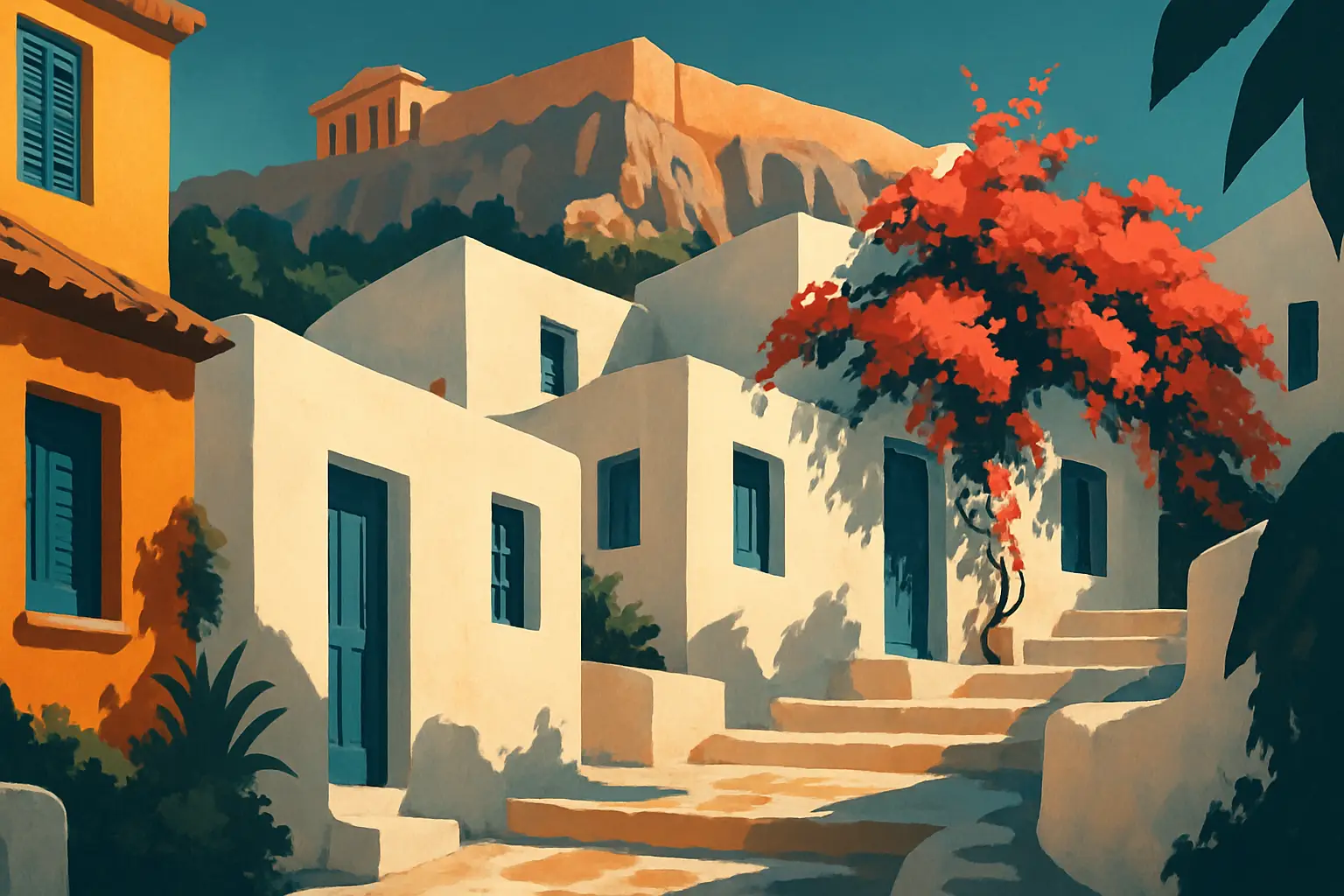
Midway up through Plaka's neoclassical streets, the architecture changes without warning. The terracotta and ochre of the townhouses give way to whitewashed cubic walls, deep-set windows, and bougainvillea cascading over low garden fences. You have just entered Anafiotika — roughly 45 inhabited houses pressed into the northeast face of the Acropolis hill, built in the 1840s by stonemasons from the Aegean island of Anafi using an Ottoman legal loophole, and still lived in today by some of their descendants. This is the guide to what it is, how it got there, and how to visit.
🏛️ Short stories • Collectible cards • Learn as you travel
Cruise ships dock at Piraeus several times a week from April through October. By 10 AM, the stairways into Anafiotika fill with tour groups. Before 9 AM, you often have the alleys entirely to yourself.
No GPS — follow the white walls
The alleys in Anafiotika are too narrow and irregular to be accurately mapped by any app. Ascend from Stratonos Street — when the neoclassical plaster gives way to white cubic walls, you're in.
It's still someone's home
Around 45 houses are in active residential use. Keep noise down in the early morning, stay on the paths, and don't enter walled garden areas. The cats are fine to approach — the residents are used to it.
Anafiotika: a Cycladic island inside Athens
1What you see when you arrive
The shift is abrupt. You're walking up Prytaneiou Street through recognizable Plaka — neoclassical facades, iron balconies, tourist shops still shuttered in the morning — and then, within a single flight of stairs, the buildings change character entirely. White cubic walls. Blue-painted wooden doors. A window box with red geraniums. A cat on a low wall watching you with professional indifference. The alley is barely wide enough for two people to pass.
This is Anafiotika. The name means 'little Anafi' — a direct reference to the small Cycladic island, roughly 45 kilometers northeast of Santorini, whose stonemasons built this neighborhood in the 1840s. The architecture is unmistakably island Greek: thick whitewashed stone walls, deep-set windows, flat or gently sloping roofs, and almost no ornamentation. Looking up from the higher alleys, you can see the Parthenon columns directly above. Looking down, the terracotta rooflines of Plaka drop away toward Monastiraki Square.
Today roughly 45 houses remain — protected under heritage law that restricts alterations and limits sales to outside buyers. Many are still held by descendants of the original Anafi families. It is a lived-in neighborhood, not a museum set. You will see laundry on lines, jasmine growing in pots along the alley walls, and the occasional resident on a doorstep with coffee.
2The builders from Anafi and the overnight rule
When King Otto moved the Greek capital from Nafplio to Athens in 1834, the city required near-total reconstruction. Craftsmen from across Greece arrived to work on the massive building program: the royal palace on Syntagma Square (today the Greek Parliament), the neoclassical university on Panepistimiou Street, and the infrastructure of an emerging European capital.
Among those recruited were stonemasons from Anafi, a small, rugged island in the southern Cyclades with a generations-long tradition of producing exceptional builders — men who had spent their lives constructing domed churches, windmills, and terraced houses in volcanic rock. The Anafi workers arrived in Athens in the 1840s and found themselves without adequate housing near the construction sites.
What followed was one of history's more creative uses of legal precedent. An Ottoman-era custom — retained in practice in the early years of the Greek state — held that if a building was erected between sunset and sunrise, with walls standing and a roof on by morning, the builder could claim the land as their own. The Anafi stonemasons used this systematically. Working through the nights on the slope above Plaka, they constructed whitewashed stone houses modeled on the architecture of their home island. By morning, each new structure was legally defensible.
The authorities noticed and issued demolition orders, which were largely ignored. The settlement grew to an estimated 300 houses at its peak in the late 19th century. The legal status remained contested for decades. Today's 45 remaining houses are the survivors of that expansion — the ones that were never demolished and eventually received full heritage protection.
Keep touring
Discover more about Greece in minutes
Get short, interactive stories that make each place easier to remember while you travel.
3Walking through the neighborhood
The accessible part of Anafiotika can be walked in twenty to thirty minutes at a relaxed pace. A slower visit — sitting on the low wall at the upper terrace, watching the city from above, letting the cats approach — stretches comfortably to an hour.
The alleys are narrow enough that some sections require single-file walking. The walls are thick and whitewashed, with the characteristic slight unevenness of hand-plastered stone construction. Several houses still show remnants of blue or ochre painted trim around the windows — the decorative tradition brought from Anafi. The bougainvillea on several facades goes deep violet in June and is at its most vivid in the morning light before 9 AM.
At the upper level of the neighborhood, a small terrace offers one of the less-crowded elevated views in Athens: the slope dropping down through Plaka toward Monastiraki, the rooftop of the Roman Agora visible in the middle distance, and on clear days the long ridge of Mount Hymettus to the east. This vantage point is perhaps fifteen steps above the spot where most visitors stop. It is worth those fifteen steps.
There is nothing to buy in Anafiotika. No cafe, no shop, no ticket booth. The experience is purely the place itself.
4The two churches inside the neighborhood
Two small churches anchor the neighborhood and give it a historical depth that extends well beyond the 1840s construction story.
Agios Simeon (Saint Simeon), the older of the two, dates from the 17th century — built two centuries before the Anafi stonemasons arrived. It sits at the lower edge of the neighborhood, its carved stone facade barely distinguishable from the surrounding whitewashed walls. The church is small enough that it is easy to walk past without noticing. Look for the carved lintel above the door and the small bell mounted on the exterior wall.
Agios Georgios (Saint George) was built by the Anafi settlers in the 19th century and follows the same white cubic aesthetic as the surrounding houses: flat-roofed, unornamented, a simple cross on the facade. Both churches still hold services. On Saint George's Day, April 23, the annual Anafiotika festival brings together descendants of the original Anafi families for a celebration that has continued uninterrupted since the 19th century — a small island's religious tradition transplanted intact to an urban hillside and kept alive for nearly 180 years.
5How to find your way up
From Monastiraki Square, walk east along Adrianou Street — the main pedestrian commercial street through Plaka — for approximately 600 meters. Turn right (south) onto Prytaneiou Street, which climbs steeply. At the top of Prytaneiou, turn left onto Stratonos Street, which runs along the base of the Acropolis walls. From Stratonos, stairways lead upward into Anafiotika. The transition from neoclassical Plaka to the Cycladic neighborhood happens within two or three flights.
An alternative from the south: from the Acropolis Museum on Dionyssiou Areopagitou Street, walk north through the quiet residential streets of upper Plaka — Tholou Street, Klepsydras Street — which see far fewer tourists than the main Adrianou-Monastiraki axis. The approach from this direction is slightly longer but passes through the section of Plaka that most closely resembles a pre-tourist neighborhood.
GPS is unreliable inside Anafiotika. The alleys are too narrow and irregular to be captured accurately by any mapping app. The practical rule: when you see the whitewashed cubic walls begin, you are there. Keep climbing toward the Acropolis walls above.
6When to visit and what to expect in June
Early morning is the right answer for every season, but it matters most in summer. Athens in June regularly reaches 33-35°C by early afternoon, and the Acropolis-Plaka corridor is among the city's most tourist-dense areas. By 10 AM on weekdays — and earlier on weekends — the lower Plaka stairways are crowded with visitors heading toward the Acropolis entrance. Anafiotika's narrow alleys concentrate this foot traffic and the heat simultaneously.
Before 9 AM, the neighborhood is genuinely quiet. The light falls at a low angle onto the white walls. The cats are active. Residents are beginning their mornings. If you are staying in central Athens, the walk up from Monastiraki takes about fifteen minutes and puts you at the Acropolis entrance — ten minutes west along Stratonos — in time for the 8 AM opening.
Sunset is the second good window. Crowds thin after 6 PM, the light turns warm on the whitewashed walls, and the illuminated Parthenon becomes visible above the neighborhood as the sky darkens. June sunsets in Athens fall around 8:45 PM, making the 7-9 PM period the quietest and most atmospheric evening window.
7Practical questions before you go
Is it still inhabited? Yes — approximately 45 houses are in active residential use. You are walking through a working neighborhood. Keep noise reasonable in the early morning, stay on public paths and stairways, and do not enter walled garden areas or courtyards.
How long does it take? Twenty to thirty minutes to walk through; an hour for a relaxed visit including the upper terrace.
What is nearby? The Acropolis entrance gates are ten minutes west along Stratonos Street. The Acropolis Museum is fifteen minutes downhill to the south. On Prytaneiou Street itself, the 12th-century Byzantine church of Metamorfosi tou Sotiros (Transfiguration of the Savior) is easy to miss on the way up — it is worth pausing at on the descent. The streets around Tholou and Klepsydras in upper Plaka, just below Anafiotika, have quieter tavernas than the main Adrianou strip and a noticeably more neighborhood-scale atmosphere.
Is there anything to eat nearby? Nothing inside Anafiotika itself. For a morning visit, the cafes on Agias Eirinis Square in Monastiraki — about fifteen minutes' walk northwest — are a good starting point before the ascent: coffee on the square, then walk uphill to arrive at Anafiotika before the first tour groups.
Keep touring
Want to walk Athens with the story of every neighborhood in your pocket?
TourMe turns Athens' layers — Anafiotika's island builders, the ancient Agora below Plaka, the Byzantine churches hidden in plain sight — into short interactive stories and collectible cards. Every street corner comes with context. Walk with the full picture.