Day trips to Greek islands from Athens have a reputation for being more logistically painful than they're worth — long ferries, expensive taxis, not enough time to actually see anything. Aegina is the exception, and it's the exception because of pure geography. The island sits 27 kilometers southwest of Piraeus in the Saronic Gulf. The fast hydrofoil takes 40 minutes. The regular ferry takes about 70. Add 20 minutes on Metro Line 1 (the green line) from Monastiraki or Omonia to Piraeus station, and you're on an actual Greek island within 90 minutes of leaving your hotel.
The practical case for Aegina over its Saronic neighbors: Hydra is beautiful but takes 90 minutes each way on the fast ferry and prohibits motor vehicles entirely, which means you spend half the day in transit. Spetses is 2.5 hours. Poros is scenic but thin on things to actually do. Aegina is close enough that you can take a 7:30am ferry, visit the temple, walk the harbor, have a long seafood lunch in the fishing village at the south end of the island, buy pistachios to bring home, and still catch a 6pm boat back — without rushing. That margin is rare in island day-tripping.
June is one of the best months to make the trip. The ferry schedule runs at full summer frequency, the sea is already warm enough to swim (22-24°C), and the island has not yet reached its August saturation point — when Athenians descend en masse every Friday night and the harbor restaurants run out of fresh fish by Saturday at noon. Go on a weekday. The difference in crowds between a Tuesday and a Saturday on Aegina is substantial.
All ferries to Aegina depart from the port of Piraeus, from the E8 and E9 gate area on the northeastern side of the harbor. From Monastiraki, take Metro Line 1 (green, direction Piraeus) to the terminus — Piraeus station — and follow the port signs toward the Saronic Islands gate. The walk from the metro exit to Gate E9 takes about 10 minutes along the waterfront. Budget 35 minutes total from Monastiraki Square to boarding.
Two types of service run to Aegina. The Flying Dolphin hydrofoil (operated by Hellenic Seaways) takes 40 minutes and costs around €16-18 one way in June 2026. The conventional car ferry takes 70 minutes and costs around €8-9 one way. The conventional ferry wins on almost every measure for a day trip: it has an outdoor upper deck you can sit on while the Athens coastline shrinks behind you, it accepts walk-up passengers without reservation on June weekdays, and the extra 30 minutes each way is not time lost — it is time spent on the Saronic Gulf watching the island appear on the horizon.
Ferries run roughly every hour from about 7am to 7pm. The 7:30am or 8:00am departure is the right target, giving you arrival in Aegina Town by 9:30am with the entire day ahead and the heat not yet at its midday peak. Buy tickets at the gate booths or via ferry booking platforms — there is no meaningful advantage to buying in advance on weekdays in June.
Get short, interactive stories that make each place easier to remember while you travel.
The ferry docks at the crescent-shaped harbor of Aegina Town, lined with neoclassical buildings from the 1820s. Between 1827 and 1829, Aegina served as the first capital of the newly independent Greek state — the government moved here after the revolutionary chaos on the mainland, and it was here that the first governor of modern Greece, Ioannis Kapodistrias, established his administration before the capital shifted to Nafplio and eventually to Athens. The Tower of Markellos, a 17th-century Venetian watchtower standing at the harbor's edge, predates all of this and is still intact.
The Aegina Archaeological Museum, five minutes on foot from the ferry dock on Kolona Hill, is small enough to cover in 30 focused minutes and houses finds from the Temple of Aphaea site: pottery from its Bronze Age sanctuary predecessor, a limestone column capital from the first Doric temple destroyed by fire around 510 BCE, and various archaic-period bronzes and ceramics from the island's excavations. Entry is €4. It gives useful visual context before you visit the temple itself — particularly for the scale of the pediment sculptures that are no longer on the island.
The harbor front is lined with pistachio sellers from early morning, which means you can buy your take-home supply immediately on arrival and stow it before doing anything else. Coffee at one of the harborside cafes, then catch the bus to Aphaea.
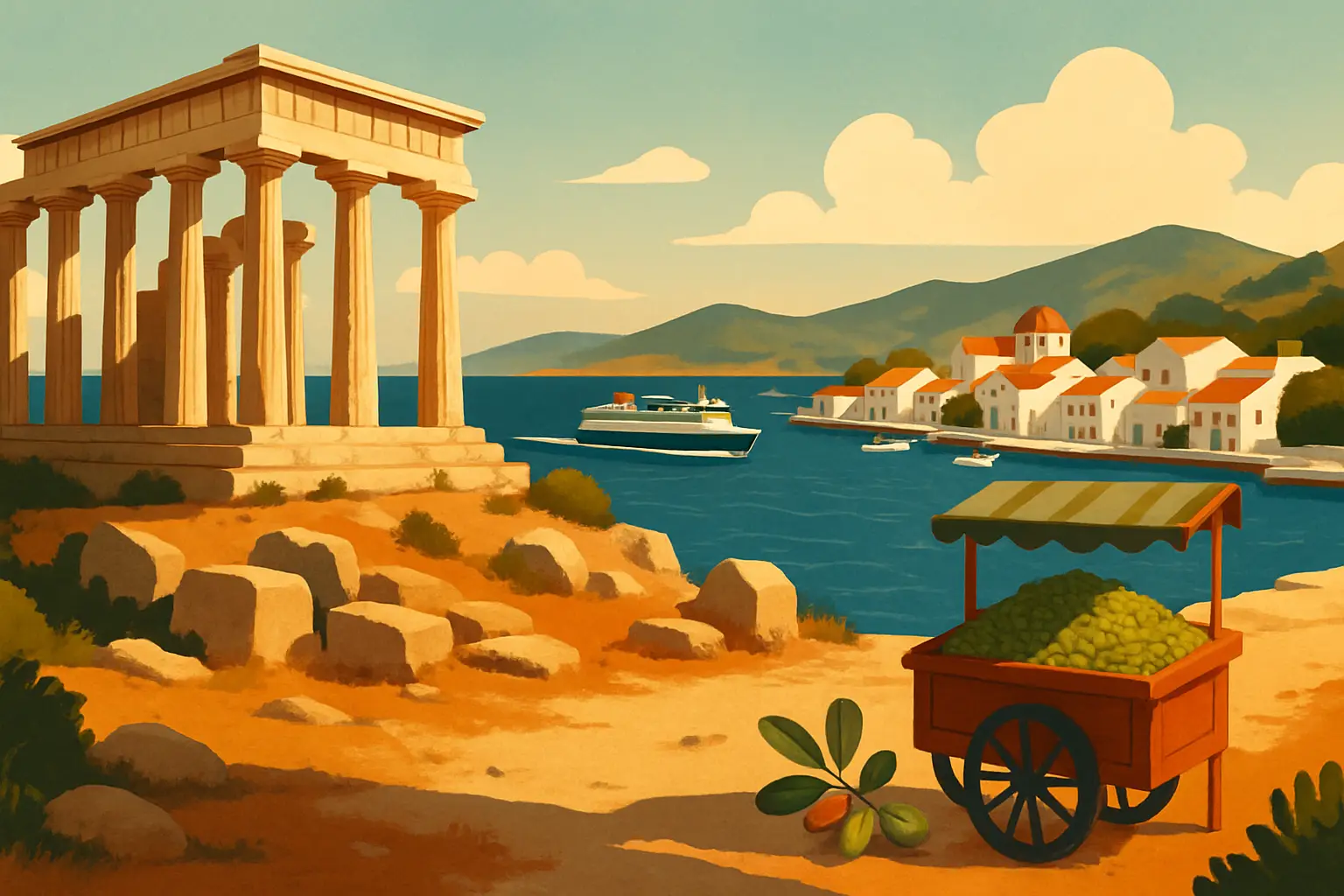
The Temple of Aphaea stands on a pine-forested ridge 160 meters above sea level, 13 kilometers from the harbor by road. On a clear day — and June in the Saronic Gulf is usually clear — the view from the temple plateau includes the Acropolis of Athens to the northeast and Cape Sounion with the Temple of Poseidon to the southeast. Modern archaeologists have noted that these three temples — the Parthenon, the Temple of Aphaea, and the Temple of Poseidon — form a rough triangle over the Attic peninsula, an alignment some scholars believe was intentional and symbolic.
The temple was built in two stages. A first Doric structure of limestone was destroyed by fire around 510 BCE. The replacement, constructed between 500 and 480 BCE in local porous limestone with marble detailing, is what stands today: 23 of the original 32 outer columns remain standing, the entablature above them is largely intact, and the overall proportions are close enough to complete that the building reads as a unified structure rather than a field of fragments. By comparison, the Parthenon retains most of its columns but lost its roof and interior centuries ago.
The goddess Aphaea was worshipped nowhere else in the ancient Greek world. Her mythology describes a Cretan nymph who fled the pursuit of King Minos, was helped by Aeginetan fishermen, leapt into the sea, and simply vanished — 'aphaia' meaning 'she who disappeared' in Greek. The temple's pediment sculptures, depicting scenes from the Trojan War involving Aeginetan heroes, were removed in 1812 by the Bavarian Crown Prince Ludwig — purchased from local caretakers before Greece existed as a nation or had antiquities protection laws. They were restored by the Danish sculptor Bertel Thorvaldsen and are now in the Glyptothek Museum in Munich. Plaster casts of several panels have been installed at the site.
Getting there: KTEL bus from the Aegina port area (€2, roughly hourly — check the posted schedule at the port stop) or taxi (€15 one way, €30 return with waiting time included)
Hours: daily 8am-8pm in summer; entry €6 (reduced €3 for EU students under 25)
Shade on the site is minimal — the pine forest is around the perimeter, not inside the fenced area. Sunscreen, a hat, and water are not optional in June
The pistachio arrived on Aegina in 1896, brought from Syria by a local farmer named Nikolaos Peroglou who planted the first grove on the island's western side near the village of Souvala. Within a generation, the crop had transformed Aegina's agricultural economy. The island's western valleys have calcium-carbonate-rich, dry soil and a microclimate shaped by proximity to the Saronic Gulf — conditions that turned out to be ideal for the variety Peroglou introduced.
The Aegina variety, called koilarati — meaning 'the round one' in the local dialect — is smaller and rounder than Turkish or Californian pistachios, with a sweeter, more intensely flavored kernel that comes from the trees being grown without irrigation. Unirrigated pistachio trees push more of their energy into the nut's oil content. The EU Protected Designation of Origin certification, granted in 1996, means that only pistachios grown on Aegina can be legally sold under the 'Aegina pistachio' label in Europe — the same protection framework that covers Champagne or Parmigiano-Reggiano.
The harvest runs from late August through September, so June visits mean buying last season's dried and roasted crop rather than fresh-picked. This is normal — pistachios are dried for storage and the quality remains excellent year-round. At harbor stands, look for pistachios sold in labeled PDO bags; the better sellers will also stock pistachio cream (a thick, dense paste similar in texture to peanut butter but with a more complex, slightly resinous flavor) and pistachio brittle made with local honey. The cream is the best souvenir: dense enough not to spill, exceptional on bread, and available nowhere else in this form outside Aegina.
Best buys: roasted salted koilarati in shell (for eating immediately), pistachio cream in a jar (for home), pistachio brittle with local honey (for gifting)
Harvest season pistachios: if visiting in September, some farms sell directly — ask at the waterfront stalls about farm-direct purchases
Avoid unlabeled bags near the ferry gate — the price-per-kilo gap between authentic Aegina pistachios and Turkish imports is significant and sellers know tourists rarely check
Nine kilometers south of Aegina Town by taxi (€15-18) or a twice-daily KTEL bus, Perdika is the small fishing village where Athenians who know the island actually go to eat. The village is a compact arc of tavernas around a harbor where fishing boats tie up each morning after the overnight catch. The restaurants have no laminated menus with photographs. They have a small chalkboard or the server simply tells you what came in: sea bream, sea bass, octopus, squid, red mullet in season.
Remetzo is the most consistently recommended taverna in Perdika — outdoor tables directly on the water, straightforward preparation, sourcing from the boats you can see from your chair. Order the octopus grilled over charcoal (dressed afterwards with red wine vinegar and dried Greek oregano), the sea bream whole and either grilled or baked in olive oil, lemon, and herbs, and whatever shellfish the server mentions first. A full lunch for two with a carafe of house white runs around €45-55. Eat slowly. The point of Perdika is not efficiency.
From the Perdika waterfront, small wooden caiques run across to Moni islet — a 10-minute crossing for around €5 each way, with the boats running whenever enough people want to go. Moni is uninhabited except for a population of deer and peacocks that roam freely across the scrub. The water off its single pebble beach is exceptionally clear even by Greek island standards — you can see the bottom at 8-10 meters. June is the ideal month: warm enough to swim comfortably, quiet enough that you might have a stretch of beach to yourself. Catch the last caique back to Perdika by 5pm to make the evening ferry back to Piraeus.
For first-time Athens visitors who are staying three or more days and have already seen the Acropolis, the Ancient Agora, and the National Archaeological Museum: yes, without reservation. Aegina is a genuinely different register — salt air, island pace, a Doric temple with almost nobody in it compared to the Acropolis crowds, and a fishing village lunch that is qualitatively better seafood than what central Athens offers.
For repeat Athens visitors: Aegina is the easy answer to 'what have I not done yet.' The Temple of Aphaea is one of the most significant and best-preserved temples in Greece and receives a fraction of the traffic the Acropolis does. The pistachio culture is specific enough — PDO-protected, single-variety, farm-to-harbor — to constitute a genuine food travel experience rather than a souvenir stop. Perdika and Moni islet together make an afternoon that has no equivalent in Athens itself.
For travelers nervous about island logistics: Aegina is the lowest-stakes Greek island experience available from Athens. The ferry is cheap, frequent, and short. The island is compact. There is exactly one major historical site, one food culture, and one village worth going to for lunch. It cannot go wrong.
June is one of the optimal months — full ferry frequency, swimmable sea, manageable heat, and the island at roughly 60% of its August capacity. Weekdays only: the difference between a Tuesday visit and a Saturday visit is the difference between a peaceful harbor and an extension of Athens' Piraeus terminal.
September is arguably the finest month of all, and specifically for anyone interested in the pistachios. The harvest runs from late August through September, which means fresh-picked nuts at roadside stands around the western villages, direct farm purchases if you know to ask, and the specific autumn light that makes the Temple of Aphaea golden in the late afternoon rather than bleached white. The sea is still warm. The summer crowds have thinned. September on Aegina is the insider answer.
August is the hardest month: the island is at capacity from Thursday night through Sunday, the ferry queues at Piraeus can mean a missed sailing, and the heat at the Temple of Aphaea between 11am and 4pm is genuinely punishing. If August is unavoidable, take the first ferry of the morning (7am), visit the temple before 10am, and be at Perdika by noon.
April-May: excellent for the temple and the harbor town, too cold for most people to swim, very quiet. The right choice if your priorities are history and walking rather than beach time. The pistachios are available year-round in dried form, so nothing is lost on the food side.