Thissio occupies the northwest flank of the Acropolis hill, bordered by the ancient Kerameikos district to the north, the Agora archaeological site to the east, and the residential streets of Petralona to the west. It is simultaneously one of Athens' oldest and most pleasant neighborhoods — a place where Athenian families have lived in neoclassical apartment buildings for generations, two blocks from a site where the city was governed in 400 BC.
The neighborhood takes its name from the Temple of Hephaestus, which Athenians long mistakenly called the 'Thiseion' — believing it was dedicated to the hero Theseus rather than the god Hephaestus. The misidentification stuck. Even though 19th-century archaeologists corrected the attribution, the neighborhood name held.
For visitors, Thissio works as both a destination and a transit point. Apostolou Pavlou — the long pedestrian boulevard that curves around the base of the Acropolis hill — connects Thissio metro station to the Propylaion entrance of the Acropolis and runs directly past the Agora's western edge. You will walk this street whether you intend to or not. The question is whether you stop and look up.
At the top of a low hill on the Agora's western edge stands the Hephaisteon — the Temple of Hephaestus — and it is, by a meaningful margin, the best-preserved ancient Greek temple on earth. Construction began in 449 BC and was completed around 415 BC, with workers and funding repeatedly redirected to the more ambitious Parthenon across the hill. What the Parthenon took in resources, the Hephaisteon repaid in survival: where the Parthenon lost its roof, interior, and most of its sculpture to centuries of repurposing and war, the Hephaisteon kept its colonnade intact, its ceiling partially preserved, and its sculptural program — the Labors of Heracles and the exploits of Theseus running across its metopes — visible in situ.
The numbers are specific and useful to hold in your head as you approach: 34 Doric columns, all standing. The temple is 32 meters long and 14 meters wide — smaller than the Parthenon but proportionally similar, the same hexastyle Doric formula. The frieze above the entrance porch depicts Theseus defeating the Pallantids (a rival clan) and Heracles wrestling the Nemean lion in a sequence of relief panels that, because the temple was never sacked or stripped, you are seeing essentially as they were placed in the fifth century BC.
The temple survived because it was converted into a Christian church — the Church of St. George — in the 7th century AD, which meant its interior was filled in and its roof maintained. When Athens became part of the Ottoman Empire, it continued functioning as a church, then briefly as a museum after Greek independence in 1834. The first archaeological excavations in Greece were held here. It has been an outdoor site since 1954.
The best viewing position is from the eastern entrance of the Agora, looking west and uphill: the temple sits above the ruins of the commercial Agora below, framed by the hill's curve, and in morning light the honey-colored Pentelic marble takes on a warmth that photographs consistently underrepresent.
Get short, interactive stories that make each place easier to remember while you travel.
Directly below the Hephaisteon, the Ancient Agora of Athens occupies 12 hectares of excavated ground that served as the civic, commercial, and philosophical center of ancient Athens for nearly a thousand years. The Agora is where the Athenian assembly met before moving to the Pnyx, where the courts operated, where the market stalls sold grain and pottery, and where Socrates — according to every ancient source — spent his days in argument with whoever would engage him.
The site today layers ruins across ruins. The most immediately comprehensible structure is the Stoa of Attalos along the eastern edge — a two-story columned commercial building originally built by the king of Pergamon in 159 BC as a gift to Athens. It was rebuilt from original materials between 1953 and 1956 by the American School of Classical Studies, and it now houses the Agora Museum: one of the most satisfying small archaeological collections in Greece, with the actual ballot boxes used in ostracism votes, the water clock that timed speakers in the assembly, bronze weights for the market, and a full set of official measuring vessels so merchants couldn't short-change customers. The building itself — a 115-meter colonnade with shops behind — gives you the clearest physical sense anywhere in Athens of what a working ancient Greek public space actually looked like.
In the middle of the site, look for the Tholos: a circular building, its foundations still visible, where the 50 presiding members of the Athenian council (the Prytaneis) lived, ate, and slept at public expense during their month of duty. A third of them were required to be on the premises at all times, day and night, so that Athens always had a governing quorum available. The city ran in shifts.
Allow at least two hours for a serious visit — one hour for the site, one hour for the Stoa museum. The Monastiraki neighborhood sits immediately east of the Agora's main exit on Adrianou Street, making the two natural to combine.
The pedestrianized Apostolou Pavlou boulevard is the spine of Thissio and one of the more reliably good stretches of urban space in Athens. It runs roughly 800 meters from the Thissio metro station at its western end to the base of the Acropolis hill at its eastern end, curving around the base of the hill with the Agora site on one side and a strip of cafes, bars, and restaurants on the other.
On a June evening after 7 p.m. the street operates in a specific Athens mode: Athenians doing their volta (evening stroll), couples with dogs, tourists heading toward the Acropolis for the last light, cafe tables filling steadily. The combination of the lit Acropolis above, the ancient site below, and the urban street life between them creates an atmosphere that is very difficult to replicate anywhere else in Europe.
For coffee and food along the strip: Thissio View at Apostolou Pavlou 25 is the rooftop option with the most direct Acropolis sightline — loud and popular, best for a drink rather than a quiet dinner. For a more considered stop, The Underdog coffee shop occupies a restored neoclassical mansion just off the boulevard and is consistently one of the most serious coffee operations in Athens, sourcing from small European roasters and running a food menu that extends to sandwiches and pastries. Along Adrianou Street — the road that parallels the Agora's southern fence — you'll find traditional rakadika and ouzeri: small tavernas where the format is a large bottle of raki or ouzo, plus a succession of small plates, and no particular hurry.
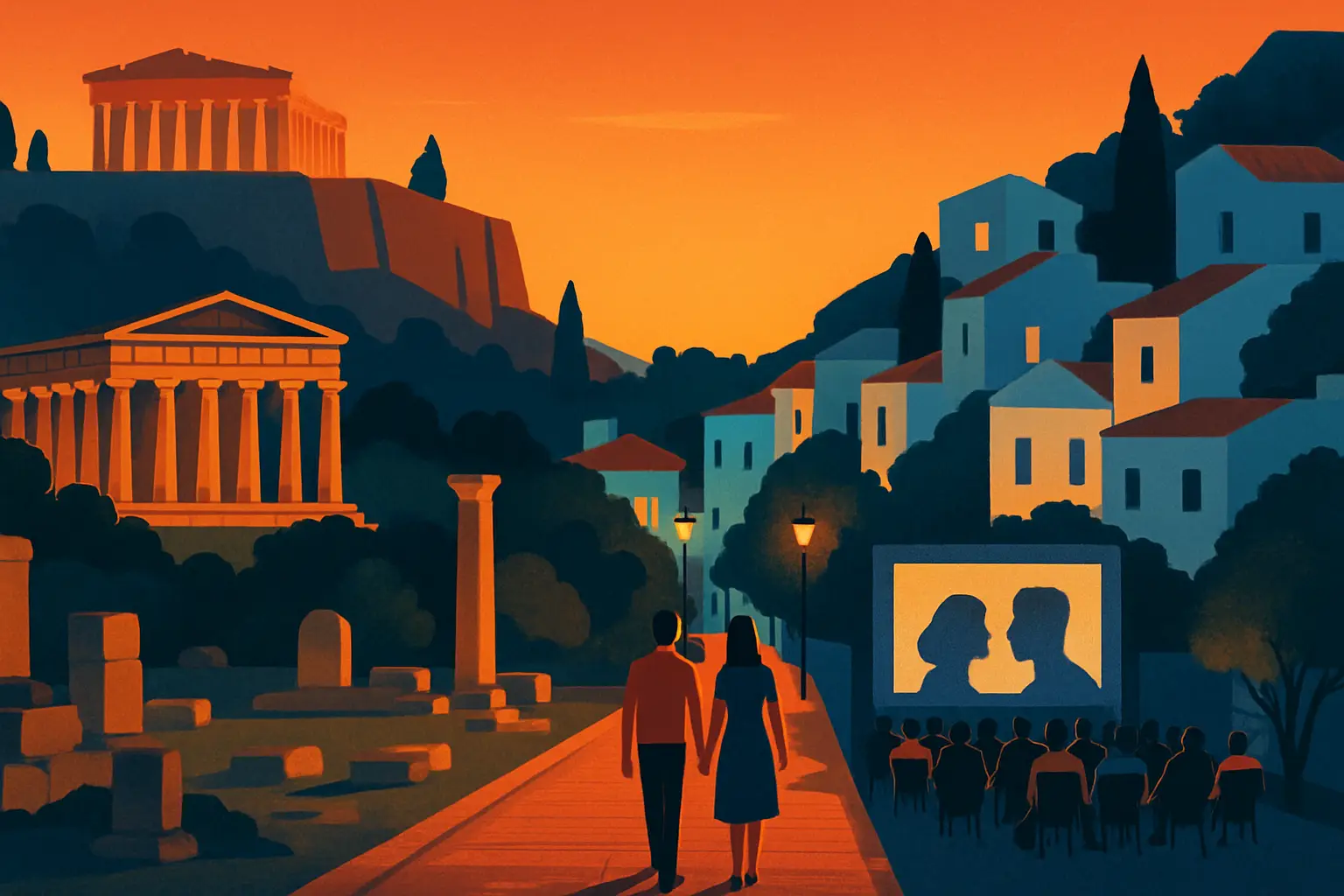
At 7 Apostolou Pavlou, set back slightly from the boulevard in a walled garden, sits Cine Thission — the oldest continuously operating open-air cinema in Athens, built in 1935 and run by the Maniakis family since 1980. It operates from late April through October, with screenings typically starting at 9 p.m. as darkness falls. The seating is a mix of chairs and benches arranged in a garden below the Acropolis cliff, which is illuminated after dark and visible above the screen throughout every film.
The programming covers a mix of contemporary releases and classics, with a bias toward art house and international cinema. Crucially, films are screened in their original language with Greek subtitles — not dubbed — which means English-language films are fully accessible to non-Greek speakers. The schedule is posted on the cinema's exterior and often fills up on weekends in June, when the combination of the right temperature (22-25°C in the evenings, often with a light breeze), the Acropolis backdrop, and outdoor seating produces the specific feeling that makes summer in Athens worth enduring the heat for.
A ticket is around €10. There is a small bar inside serving beer, wine, and soft drinks. The garden seats perhaps 200 people. Arrive at least 20 minutes early if you want a specific seat. This is not a tourist attraction manufactured for visitors — it is a neighborhood cinema that has been here longer than most of the buildings around it, and Athenians treat it accordingly.
Two blocks west of Apostolou Pavlou on Herakleidon Street sits the Herakleidon Museum — the most undervisited major museum in Thissio and one of the more surprising institutions in Athens. The museum occupies a 19th-century neoclassical building and focuses on science, mathematics, and art, but its specific draw is a fully functional reconstruction of the Antikythera mechanism.
The Antikythera mechanism is an ancient Greek analog computer, recovered from a shipwreck off the island of Antikythera in 1901, dated to approximately 100 BC. It used a system of 37 bronze gears to predict the positions of the sun and moon, track the four-year Olympiad cycle, and calculate the timing of solar and lunar eclipses — a level of mechanical sophistication that was not matched in Europe for another 1,400 years. The original fragments are at the National Archaeological Museum; the Herakleidon has the reconstruction that lets you understand how the mechanism actually worked.
The museum is small and uncrowded on most mornings, open from 10 a.m. Tuesday through Sunday, with an adult admission of €5. For anyone who found the Agora's ballot boxes and water clocks interesting, the Herakleidon is the logical next stop — both are about the specific, practical ingenuity of ancient Greek civic and scientific life.
Is it safe? Thissio is one of the calmer central Athens neighborhoods. The area around Apostolou Pavlou is busy and well-lit until late; the residential streets west toward Petralona are quiet and family-oriented. Standard urban awareness applies — bags worn forward, phones put away in crowded spots — but there is no particular hazard here.
Best time to visit? June is excellent for Thissio specifically. The outdoor cinema is running, the evening boulevard is at full life, and the Agora and Hephaisteon look their best in the long summer light. Visit the Agora before 10 a.m. to avoid the midday heat on the exposed site — the site has almost no shade. The Temple of Hephaestus from the eastern path in early morning light is a genuinely different experience from the same view at noon. For the boulevard and cinema, the hours after 7 p.m. are when Thissio works best.
Getting there: Take Line 1 (Green Line) to Thissio station — the stop is named after the neighborhood and drops you directly onto Apostolou Pavlou. From Monastiraki, it is a 10-minute walk west along Adrianou Street. From Koukaki, walk north along Apostolou Pavlou from the Acropolis Museum end — the walk takes about 20 minutes and runs directly past the Acropolis wall and below the ancient Theatre of Dionysus. The walk is not optional; it is the point.