Psyrri occupies a compact wedge of streets bounded by Ermou Street to the north, Athinas Street to the east (the road running south from the central market), Evripidou Street to the northwest, and Sarri Street to the south. On a map it appears small; on foot it is dense enough to fill an afternoon without retracing steps.
The neighborhood takes its name from a person — Psyrris — variously described as a 17th-century landowner or a church builder with connections to the island of Psara. Whatever the etymology, the district's character has been consistent for centuries: working-class, artisan, and economically marginal by central-Athens standards. In ancient times the area was the municipality of Kollytos, which hosted a rhetoric school before declining into a gathering point for craftspeople — potters, sculptors, tanners — who found cheap land near the city's commercial center.
By the 19th and early 20th centuries, Psyrri was dominated by leather tanneries, coppersmiths, hat makers, and textile workshops, most of them concentrated along Miaouli Street and the cross streets running toward Sarri. The neighborhood was rough, poor, and well-regarded by few — which is almost certainly why it survived the urban demolitions that reshaped much of central Athens after Greek independence.
The revival began in the 1990s when artists and small venue owners moved into cheap workshop spaces and converted them into bars, galleries, and performance venues. The opening of Monastiraki metro in 2003 and the catalytic effect of the 2004 Athens Olympics accelerated the transformation. By the mid-2000s, Psyrri had become the Athens nightlife district where locals with genuine preferences actually went — not a tourist simulation, but the real thing. That character has held.
The social center of Psyrri is Plateia Iroon — Heroes' Square — a mid-sized paved square reached through streets just narrow enough that you find it by turning a corner rather than walking toward it directly. The square is named for the heroes of the 1821 Greek War of Independence, the conflict that ended Ottoman rule — a naming choice that makes explicit the neighborhood's working-class and insurgent history.
During the day, Plateia Iroon is quiet: pigeons, a few cafe tables, ambient city sound. In the early evening the tables multiply as neighboring bars and kafeneions expand their outdoor footprint. By 10 p.m. on any Friday or Saturday the square and the streets feeding into it — Eschilou Street, Aisopou Street, and the western stretch of Karaiskaki Street — are dense with people moving between venues.
Beer Time on the square's edge is the neighborhood's most visible craft beer spot: a counter-service bar with a substantial draft selection of Greek and international brews, served alongside bar snacks with no particular pretension. Tables on the square itself let you drink while the neighborhood assembles around you. It functions as the natural orientation point for anyone entering Psyrri for the first time — arrive at the square, get a drink, and watch which direction the crowd moves as the evening builds.
Get short, interactive stories that make each place easier to remember while you travel.
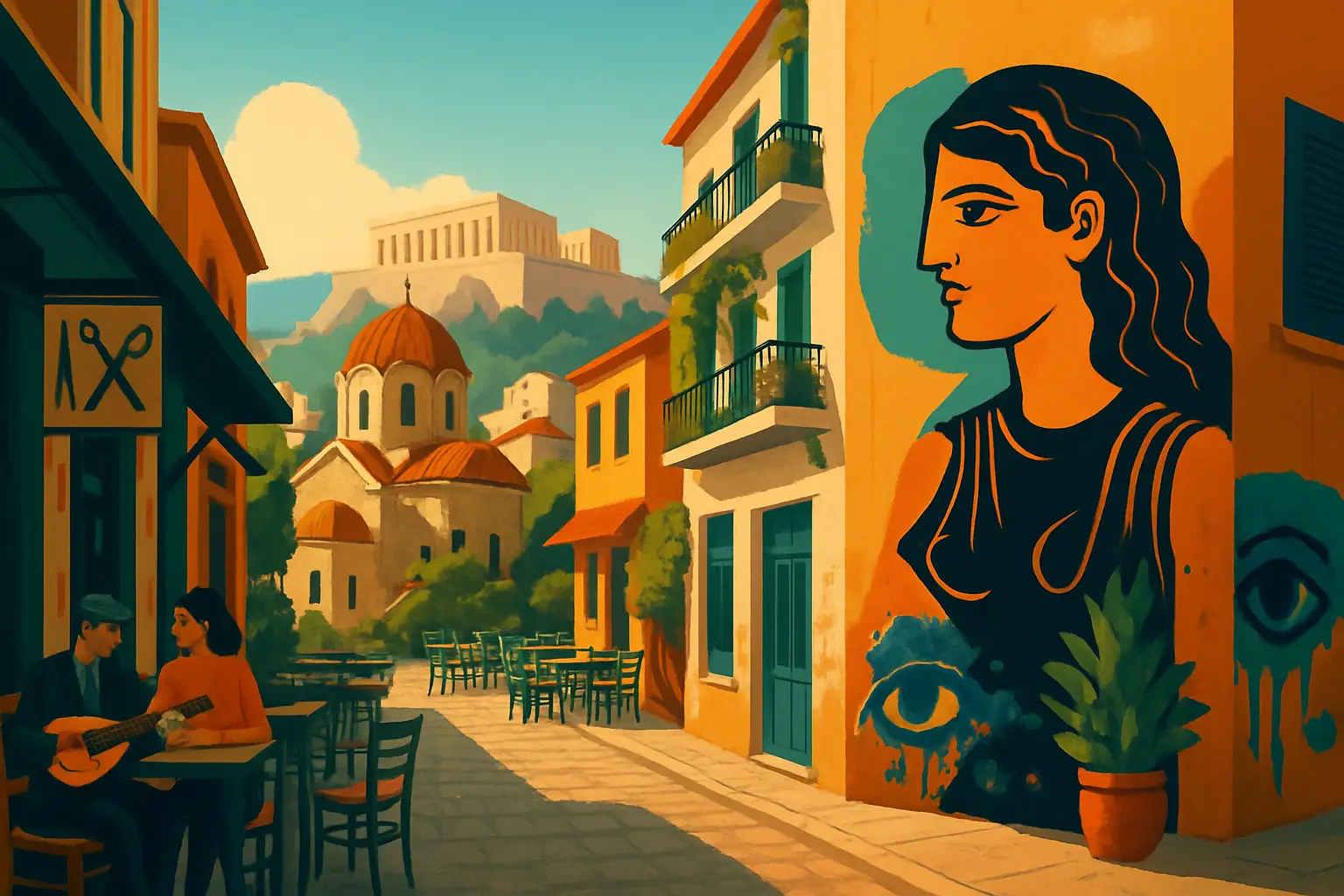
Psyrri was one of the first neighborhoods in Athens to treat its walls as exhibition space. The movement began in the late 2000s and accelerated through the austerity years of the 2010s, when the visual texture of crisis — abandoned storefronts, peeling plaster, shuttered workshops — gave muralists both surface area and subject matter with weight behind it.
Sarri Street is the primary axis. Walk its full length and you pass building-sized murals, layered poster art, stencil work, and abstract pieces that require standing back twenty meters to read properly. The landmark site is the old fire station on Sarri — its entire facade and the boards covering its doorways are covered in accumulated layers of work by multiple artists over more than a decade, each piece responding to and often partially obscuring what came before. It reads as a collective work even though dozens of individuals made it.
Two artists defined Psyrri's early street art identity: Alexandros Vasmoulakis, whose large-format works combining collage, paint, and digital media appear in and around Plateia Iroon, and Vangelis Hoursoglou, whose figurative pieces run through the side streets. Both are considered among the pioneers of the Athens urban art scene; their early Psyrri work amounts to the opening chapters of a conversation that now covers most vertical surfaces in the neighborhood.
The side streets between Sarri and Evripidou — particularly Miaouli Street — are worth walking slowly. Unlike the deliberate gallery atmosphere of some street art neighborhoods, Psyrri's mural landscape grows organically through the gaps in everyday infrastructure: painted onto loading dock doors, wrapping around abandoned kiosks, climbing blank corner walls. The still-operational coppersmith and leather workshops on Miaouli sit immediately beside murals several stories tall. The juxtaposition is not curated — it is just how the street happened.
Psyrri's food culture is organized around the mezedopoleio format: a restaurant that serves food as a sequence of small shared plates, typically alongside retsina or ouzo, over two to three hours. It is a specifically Athenian tradition — part meal, part social event — and Psyrri is one of the few central-Athens neighborhoods where it still operates on genuinely local terms rather than tourist-facing approximations.
Ta Serbetia stou Psyrri on Eschilou Street, just off Plateia Iroon, runs as a family business with the standard mezedopoleio progression: cold dishes first (taramosalata, melitzanosalata, horiatiki, olives), then fried items (calamari, zucchini chips), then grilled meats. Portions are substantial, prices honest, and on weekend evenings there is typically live music drifting through the room.
The rebetiko — Greece's urban blues, developed in the port cities of the early 20th century among Greek refugees displaced from Asia Minor — is performed live at several Psyrri venues on Thursday through Saturday nights. Strophili and Pame Psyrri are both known for traditional music alongside food; confirm the music nights before going, as schedules shift seasonally.
Before committing to dinner, walk Evripidou Street — Psyrri's northern boundary. The shops along Evripidou sell dried herbs, Greek mountain tea, preserved lemons, cheeses, cured meats, and bulk spices at prices oriented toward restaurant kitchens and Athenian households rather than visitors. The smell is completely unlike the rest of central Athens. It is a working market street, and visiting in the morning when deliveries are arriving gives you the full version of it. Kapnikarea street, which crosses this area heading south, connects you back into the neighborhood's core.
Psyrri's bar scene is more varied than the nightlife-district label suggests. Within a five-minute walk of Plateia Iroon you can find a natural wine bar, a rum-specialist cocktail bar with genuine depth of selection, craft beer on draft, and ouzo bars that have been operating since before the neighborhood's revival. The range is the point.
Cinque Wine and Deli Bar is the neighborhood's most deliberately curated offering — a wine bar and deli that carries a rotating selection of Greek and European wines by the glass, with accompanying small plates built around charcuterie and cheese. The format is more restrained than the surrounding energy, which makes it a useful anchor for beginning or ending a Psyrri evening.
Juan Rodriguez Bar occupies a specific corner of the neighborhood's personality: a cocktail bar with colonial-era decor and a rum list that runs into the dozens of bottles. The name and aesthetic are deliberately incongruous with Athens, which is part of the point — it is the kind of bar that could exist in Havana or Lisbon and happens to be on a Psyrri side street.
The rhythm of a Psyrri evening tends to run: arrive at Plateia Iroon for a beer at Beer Time while the neighborhood fills up; move to a mezedopoleio on Eschilou or Aisopou for dinner between 9:30 and 11 p.m.; continue to the wine bar or the rum bar as the evening deepens. The pace is conversation speed — not nightclub fast — which means the same table can run from dinner through the early morning hours with the right company and a continuing carafe of retsina on the table.
Is Psyrri safe? Psyrri carries a historical reputation that no longer reflects the neighborhood. For most of the 20th century it was associated with petty crime and economic marginality — the legacy of a working-class district with limited alternatives. That changed during the 2000s revival, and Psyrri today is mainstream Athenian nightlife territory. Standard urban awareness applies — bags worn forward in crowds, phones off bar tables in busy spots — but the neighborhood does not require specific vigilance beyond what you would apply to any busy European entertainment district.
The blocks immediately adjacent to the central market on Athinas Street can feel rougher in the late hours. Staying in the streets south of Evripidou — closer to Sarri and Plateia Iroon — keeps you in the neighborhood's established entertainment zone.
How does Psyrri compare to [Monastiraki](/gr/blog/things-to-do-in-monastiraki-athens)? They are three minutes apart on foot and operate on different logics. Monastiraki is daytime-first: the flea market, the square cafes, the view toward the Ancient Agora. Psyrri is evening-first: the mezedopolia, the music venues, the street bars. The natural sequence is to walk Monastiraki in the afternoon and move into Psyrri as the sun goes down — they are designed to be consecutive, not competing.
Best time to visit Psyrri? For street art and the working artisan streets on Miaouli, come on a weekday morning when the workshops are active and the streets are quiet enough to walk slowly. For the full evening — mezedopolia, rebetiko, bars — Thursday through Saturday from 9 p.m. onward is the genuine Psyrri. Sunday evenings are quieter but functional; Monday and Tuesday are mostly closed.
June is a particularly good month because the outdoor tables around Plateia Iroon and the surrounding pedestrianized stretches are in use well past midnight at comfortable temperatures — typically 22–25°C in the evenings. July and August bring intense heat that makes the narrow streets unpleasant before sundown, but the nightlife continues regardless because Athenians are constitutionally unbothered by heat.
How to get there: Monastiraki metro (Lines 1 and 2) is the correct arrival. Exit to the square and walk west along Ermou Street for one block, then turn south into the neighborhood grid — you are in Psyrri within three minutes of the exit. Alternatively, walk south from the Varvakios Agora central market on Athinas Street: the market's southern edge deposits you at Psyrri's eastern boundary.
From Plaka, the walk takes about 12 minutes northwest along Adrianou Street through Monastiraki. From Koukaki, walk north along Apostolou Pavlou — the pedestrianized boulevard below the Acropolis — for about 20 minutes to reach the Monastiraki end of the neighborhood. Psyrri has no direct metro station of its own; Thissio station (Line 1, Green Line) serves the western edge, a 10-minute walk through the pedestrianized zone.