Varvakios Agora occupies the city block bounded by Athinas, Sofokleous, Evripidou, and Aiolou Streets — five minutes north of Monastiraki Square, in the middle of Athens' oldest commercial district. Most visitors who walk down Athinas Street see the entrance to the covered hall and stop there. The market is actually three distinct zones that together cover the entire block.
On the west side of Athinas sits the covered market building — an 1886 iron-and-glass arcade sheltering the fish market in its center hall and the meat market in the flanking corridors on both sides. On the east side of Athinas is the open-air produce market: a row of stalls and old-fashioned groceries selling olives in barrels, wheels of cheese, salted cod, sun-dried vegetables, fresh herbs, and snails. Running along the market's south edge, Evripidou Street functions as Athens' dedicated spice market — a partly covered street of herb, nut, and specialty food shops.
This is not a tourist market. It is where Athens' restaurants, hotel kitchens, and home cooks have sourced their food since the 1880s. On a weekday morning the customer mix is professional chefs loading crates, neighborhood grandmothers with wheeled trolleys, and restaurateurs from across Attica negotiating prices for the week.
The center hall of the covered building is one of the most spectacular interior spaces in Athens — a long, high-ceilinged arcade, its iron columns and glass roof largely unchanged since 1886, with natural light falling across long rows of marble and stainless-steel counters.
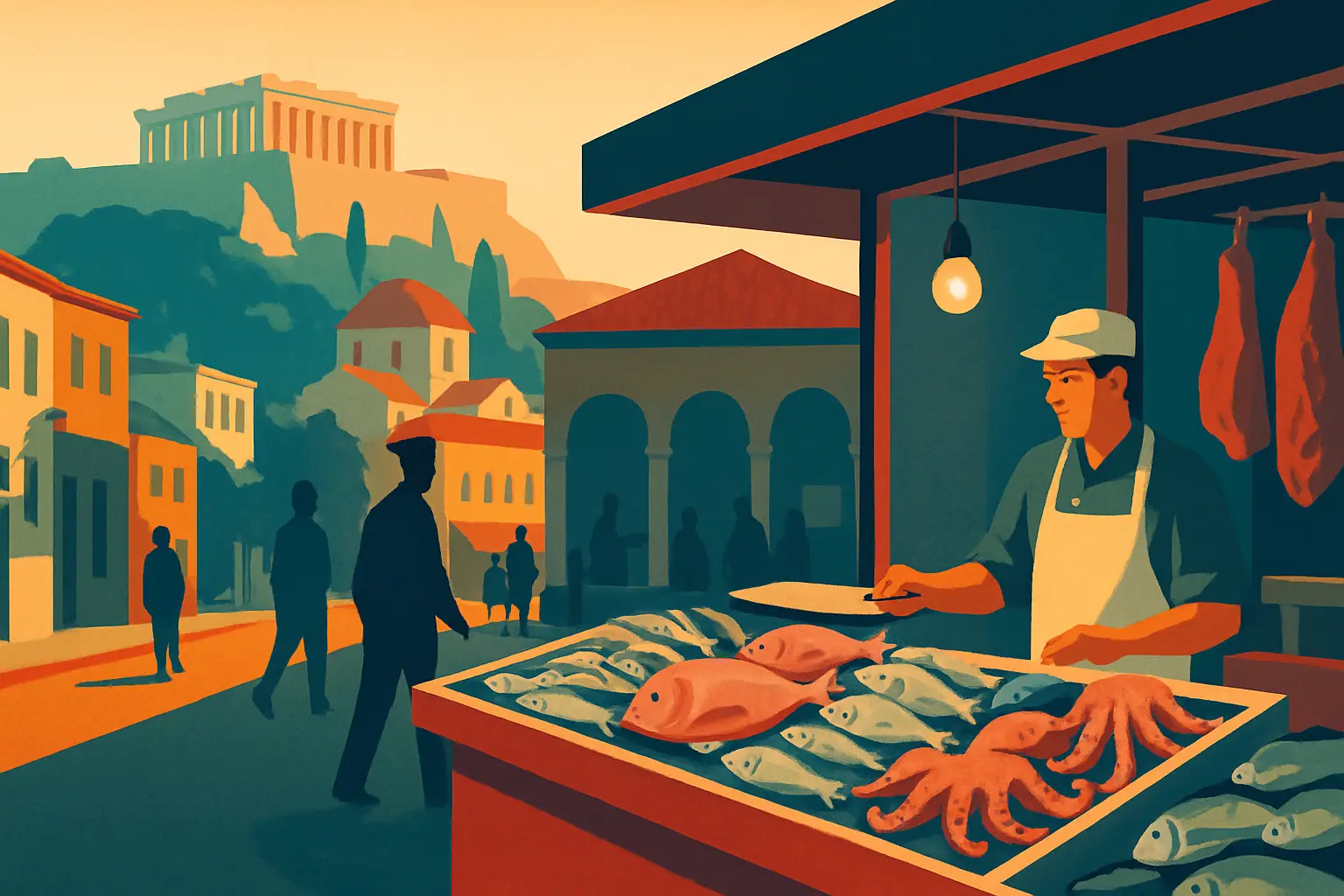
Five to ten tons of fresh fish arrive here each night, sourced from Aegean island fishing grounds: Naxos, Paros, Skyros, Kalymnos, and Symi supply most of the haul. June brings sardines, anchovies, sea bass (lavraki), gilthead bream (tsipoura), and red mullet (barbounia) — small, deep red, and priced as a delicacy. Octopus and squid appear in large quantities, fresh rather than frozen. Shrimp and crabs sit in boxes of crushed ice. Bakaliaros — salt cod — is sold by the dried slab from Norway and Portugal, as it has been since the Byzantine trade routes that introduced it to the Greek kitchen centuries ago.
The vendors call to customers and to each other continuously. The smell is strong and clean — salt and cold water — and the display is theatrical in a way that is clearly habit rather than performance. Vendors rearrange fish while talking on the phone and weigh bags without looking at the scale. By 8 a.m. the hall is at full speed. By noon the best fish are gone and the counters start to thin.
Get short, interactive stories that make each place easier to remember while you travel.
The meat corridors flank the fish hall on both sides and are the section most tourists enter, glance at, and back out of immediately. The counters display every part of the animal on marble slabs and from steel hooks — lamb heads, tripe, intestines, liver, kidneys, hooves, cheeks. Nothing is hidden or wrapped. Greeks consider these cuts genuinely valuable rather than inferior; a significant part of traditional Greek cooking — kokoretsi (spit-roasted offal wrapped in intestines), patsas, spleen with lemon — depends on them.
For less confrontational shopping, the butchers also carry standard cuts. The most recommended for quality beef is Agelis, which dry-ages its cattle sourced directly from farms in Kerkini — a wetland region in northern Greece near the Bulgarian border, known for well-marbled meat. Butchers here will cut to order, bone out a leg of lamb, or prepare a specific weight without ceremony. They are not set up for browsing, but they are not unfriendly to direct requests.
The practical approach for visitors who want to experience the corridor without buying: walk at a steady pace, treat it like a gallery, and stay to the sides of the narrow aisles where deliveries are also moving. The vendors are focused on the work.
Wedged between the butcher stalls in the meat corridors are several small tavernas that have operated in the same spots for decades. Epirus Taverna, Papandreou, and Sideris are the most established — plain rooms with marble tables, no decoration, a limited daily selection served without English menus.
The signature dish is patsas — tripe soup, made from cleaned and slow-cooked beef or pork tripe, served in a clear or milky broth with lemon and vinegar on the side. The taste is mild and deeply savory; the texture is soft. It is not a challenging dish in flavor — only in concept.
Patsas is historically a pre-dawn breakfast. The tavernas inside Varvakios traditionally opened at 4 or 5 a.m. to feed the dockworkers, market vendors, and overnight shift laborers who needed something hot before first light. The same hours made patsas the traditional Athenian hangover remedy — night owls staggering home at sunrise found the market already open. Some of this tradition has faded; the tavernas now open by 7 a.m. rather than midnight. But the dish and the context remain intact. Eating patsas at a marble table at 7:30 a.m. while butchers carry deliveries past you is one of the more specifically Athenian experiences available in the city center — and one that costs around €5.
Evripidou runs east-west along the market's south edge, connecting Athinas Street toward the commercial center. It functions as a dedicated spice and herb market — a partly covered street of shops selling dried goods at wholesale prices.
The essential stop is Bahar at Evripidou 31, open since 1940 and now stocking an estimated 2,500 individual products. Prices are roughly half to a third of supermarket rates. Worth buying:
Greek saffron (krokos Kozanis) — from the Kozani region of northern Greece, one of the few saffron varieties with EU Protected Designation of Origin status, with a stronger aroma than most imported varieties
Dried rigani (oregano) — Greek mountain oregano, harvested wild from rocky hillsides, is significantly more aromatic than the dried oregano in most supermarkets worldwide
Mastiha — dried resin from mastic trees on Chios, used in Greek desserts, spirits, and liqueur; available as crystals or ground powder
Mountain tea (tsai tou vounou) — dried Sideritis plant, sold in bundles; the herbal tea Athenians brew in winter and increasingly year-round
The open-air stalls on the east side of Athinas Street and the cheese shops on Evripidou complete the picture of what the market covers. Karatzas, at the corner of Athinas and Sofokleous, carries an extensive range of regional Greek cheeses — aged graviera from Crete and Naxos, manouri, anthotyros, seasonal varieties. The shop will vacuum-pack purchases for travel.
The produce stalls sell marinated olives by the scoop from large containers, jars of preserved vegetables, sun-dried tomatoes, and Greek honey in small jars — practical souvenirs that fit in a carry-on and represent actual Greek pantry staples rather than tourist packaging.
A few price reference points for June 2026: fresh sardines run €4–6/kg, sea bass €12–18/kg. Greek saffron at Bahar is €6–10 per packet versus €15+ in specialty shops. Aged graviera at Karatzas is €10–14/kg. Most outdoor stall vendors prefer cash; the established shops inside the covered building increasingly accept cards.
The honest answer: only if you're prepared for what it is. Varvakios is a working wholesale market, not a curated food hall. There are no English menus. The fish-counter smell is strong. The meat corridor displays whole animals. Vendors are busy and not oriented toward explanation.
For travelers who enjoy this kind of market — where the point is commerce rather than experience — Varvakios is exceptional. It is one of the few places in central Athens where you can spend an hour and understand how the city's restaurants actually source their food. The fish arriving from Kalymnos at 4 a.m. ends up that evening in a Monastiraki taverna. The knowledge sitting in the butcher's hands at Agelis is the same knowledge that's been in this building for generations.
For travelers who want an easier entry point into Athenian food culture, the loukoumades shops on Aiolou Street are one block away and far more tourist-accessible. Ktistakis on Sokratous 40 — a ten-minute walk from the market — has been frying dough balls since 1912. The neighborhood around both is worth a morning on its own.
Hours: Monday through Saturday, 7 a.m. to around 2–3 p.m. for fish and meat vendors. The spice and cheese shops on Evripidou and the open-air produce stalls stay open until 5 or 6 p.m. Closed Sundays — the main practical trap for visitors who plan to combine it with a Sunday Monastiraki flea market visit.
Best time: Saturday morning at 8 a.m. is the most atmospheric — the widest variety of fresh fish, the market at full operation, the Evripidou shops all open. Weekday mornings have the same fish quality with fewer crowds. By noon the energy is winding down and some fish counters are already cleared.
Getting there: Nearest metro is Monastiraki (Lines 1 and 3), a seven-minute walk north on Athinas Street. From Omonia (Lines 1 and 2) it is five minutes south. The address is effectively Athinas Street between Sofokleous and Evripidou — the covered market building is immediately visible from the street.
What to bring: A reusable bag if you plan to buy. Cash for outdoor stalls. One useful phrase: 'Posso kani to kilo?' — 'How much is it per kilo?' — covers most transactions.