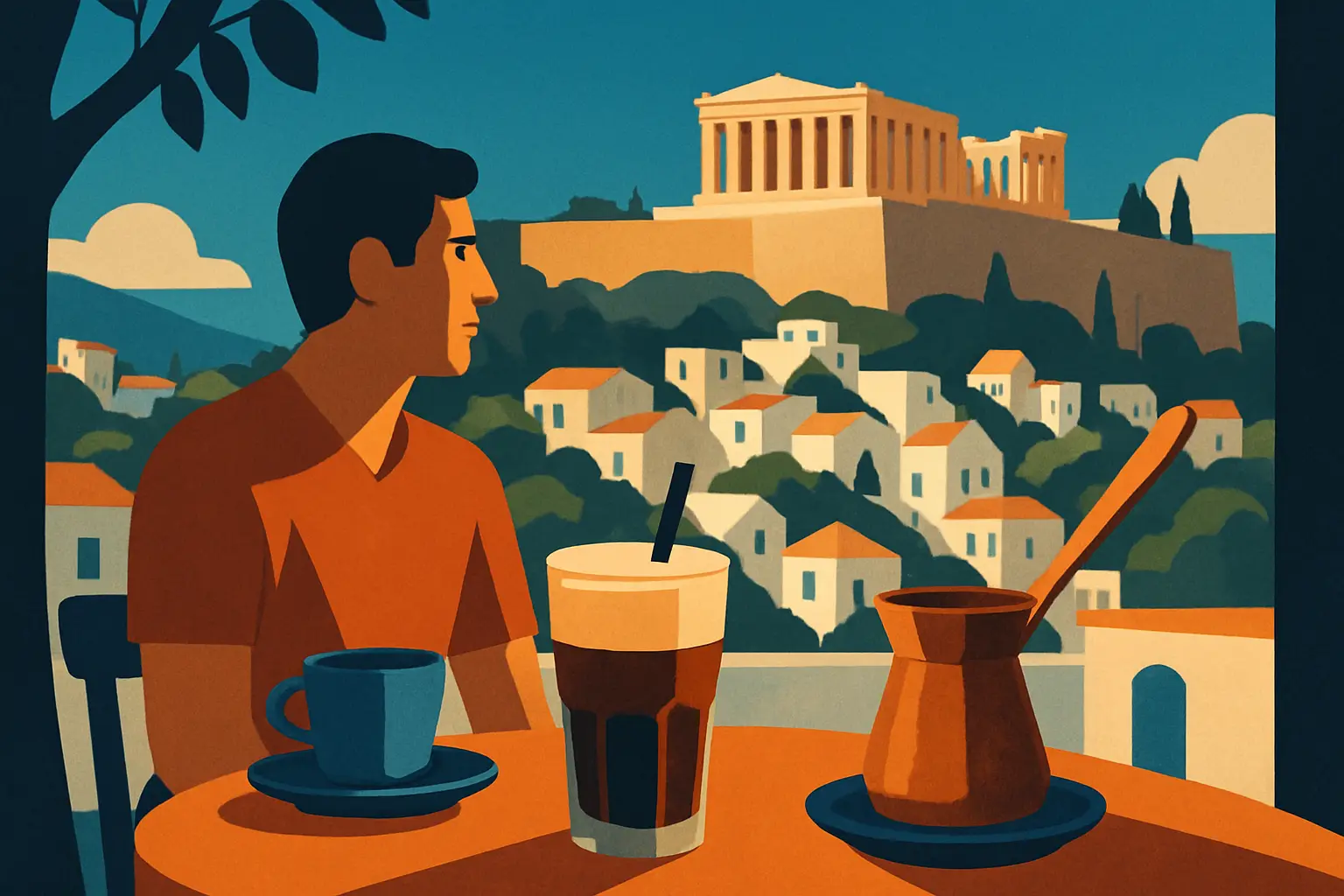
Athens is a city that sits with its coffee. Not in the Nordic twelve-minute morning ritual or the Italian three-sip espresso at a standing bar, but in a genuinely unhurried way that treats the drink as a placeholder for conversation. You order one coffee, you sit for ninety minutes. On a hot June afternoon at a table outside on Agias Eirinis Square in the Monastiraki area, the coffee is almost beside the point — the actual event is the table, the light, the people passing. Athenians will nurse a single freddo espresso for an hour without anyone suggesting they move.
This has structural consequences for how cafes operate in Athens. Nobody chases your table. No bill appears until you ask for it. A glass of cold water arrives automatically with every order and is refilled without asking. The Greek concept associated with this culture is kefi — loosely, enjoyment and high spirits, the art of living well in the moment. Coffee is one of its main vehicles.
For visitors, the implication is simple: don't order coffee between meetings and plan to leave in ten minutes. Order it when you have the afternoon. The pedestrianized streets of Monastiraki, Thissio, and Kolonaki — with their outdoor tables and slow foot traffic — are where this culture is most visible. Sit down, order a freddo, and let Athens proceed at its own pace around you.
Athens' coffee identity runs in three recognizable chapters, each displacing but never fully eliminating what came before.
Chapter one is the briki — the small copper or brass pot used to prepare unfiltered coffee since the Ottoman period. Fine grounds, cold water, and sugar are combined in the pot, brought slowly to a boil, and poured directly into a tiny cup. The grounds settle at the bottom. This is ellinikós kafés — Greek coffee — and it is the oldest continuous layer of Athenian coffee culture, running unbroken across five centuries.
Chapter two is the frappé, invented in 1957 at the Thessaloniki International Trade Fair by Dimitris Vakondios, a Nescafé representative who, having no hot water for his coffee break, shook instant coffee with cold water and ice in a cocktail shaker. The resulting cold foam was subsequently marketed across Greece by Nescafé. By the 1980s the frappé was inseparable from Greek summer — every beach kiosk, every island terrace, every office break room ran on it for thirty years.
Chapter three is the freddo espresso, invented in 1991 by Yiannis Iosifides of Kafea Terra, a Greek coffee equipment company, as a commercial solution to a specific problem: hot espresso sales collapsed every summer while frappé dominated the market. His team developed a technique for serving espresso cold — a double shot poured over ice and frothed in an electric metal cup — and named it the freddo. Within a decade it had displaced the frappé across most of urban Greece. Today, the freddo cappuccino (freddo espresso plus cold-frothed milk foam) is the single most-consumed coffee drink in the country.
Get short, interactive stories that make each place easier to remember while you travel.
In any Athens cafe, your order lands as a two- or three-part statement: coffee type + sweetness level + modification if needed. Learning the code takes thirty seconds and signals immediately to the server that you know what you're doing.
Sugar is added to Greek coffee and frappés during preparation, not afterward — which means sweetness must be specified at the moment of ordering. Once the briki is on the heat or the frappé shaker is in motion, the sugar is already inside. The three levels are sketo (no sugar), metrio (one small teaspoon, the most common default), and glyko (two teaspoons). For freddo espresso and modern cold coffees, the same modifier applies — 'metrio' means the server adds a small amount of sugar syrup before frothing. To specify milk in a frappé, add 'me gála' (with milk) or 'horis gála' (without).
'Ena ellinikós métrio, parakaló' — one medium Greek coffee, please
'Ena freddo espresso skéto' — one freddo espresso, no sugar
'Duo freddo cappuccino metrio' — two medium freddo cappuccinos
'Ena frappé glykó me gála' — one sweet frappé with milk
Traditional Greek coffee is prepared in a briki — a small metal pot with a long handle and flared rim, typically copper or stainless steel, sized for one or two cups. Cold water, one heaped teaspoon of very finely ground coffee (closer to powder than standard espresso grind), and the specified sugar are combined in the cold pot and heated slowly over low flame. The goal is the kaimáki — the thick foam that rises toward the rim as the coffee approaches boiling. The pot comes off the heat at the exact moment the foam peaks and is poured directly. No kaimáki means the coffee was heated too fast or boiled over. It is the mark of care, or the lack of it.
In Athens, ellinikós is the coffee of the kafeneion (plural: kafeneia) — the traditional Greek coffee house that predates modern cafes by centuries. A kafeneion has marble tables, small wooden chairs, backgammon boards available on request, and no music at volume. Your cup arrives on a small metal tray with a glass of cold water and sometimes a piece of loukoumi (Greek delight). You drink slowly, leave the last sip untouched because the grounds sit at the bottom, and request nothing else until you're ready to leave. The streets north of Adrianou in Plaka toward Monastiraki and the older blocks of Psyrri have the highest concentration of surviving kafeneion-style spaces in central Athens.
One ritual most travelers never encounter: tasseography — reading the future in coffee grounds. After finishing an ellinikós, you invert the cup onto its saucer and let the grounds dry into a pattern. The shapes are then read using a loose symbolic vocabulary that varies by family and region. It is not taken entirely seriously and not dismissed entirely either. It is part of the ritual — a social game played with the residue of the morning's first coffee.
The freddo espresso is not a cold espresso. A cold espresso is an espresso that has cooled down. A freddo is made by a specific technique: a double espresso poured immediately over ice into a small metal cup, then agitated in an electric frother at high speed until the coffee and ice have combined into a cold, aerated foam. The result is served in a glass with fresh ice — the original ice having done its temperature-lowering work inside the frother — and arrives as a dense, cold, slightly frothy drink that holds the espresso's full intensity while being genuinely refreshing at 35°C.
The frothing step is the distinction. It aerates the espresso so the bitterness softens slightly, creates a microfoam layer at the surface, and gives the drink a texture that doesn't water down the way iced americano does as the ice melts.
The freddo cappuccino follows the same base but adds a second step: cold milk is frothed in a clean metal cup into thick, cold foam and poured on top. No heat anywhere in the process. It arrives in a larger glass than the pure freddo and has become slightly more consumed than the espresso version in recent years.
Athens' coffee chains — Coffee Island and Mikel, with locations near every metro station and major square — standardized the technique and spread it across all of Greece. But independent cafes around Agias Eirinis Square (the outdoor-table hub at the border of Monastiraki and Psyrri) consistently produce better-quality freddos: fresher espresso shots, controlled frother temperature, cleaner ice. A freddo espresso sketo — no sugar — on a June afternoon is one of the most satisfying cold drinks the city offers.
Athens has no single coffee district. The culture is distributed and a good freddo can appear on any corner, but certain areas reward deliberate cafe-seeking.
Agias Eirinis Square (between Monastiraki and Psyrri, five minutes from Monastiraki metro) is the most concentrated strip of outdoor cafe tables in central Athens. The square is enclosed by a 19th-century neoclassical church and fills with chairs by 10 a.m. Multiple independent cafes spill onto the pavement around it. Ideal for freddo espresso and watching the neighborhood foot traffic build through the morning.
Kolonaki (northeast of Syntagma, uphill) runs serious cafe culture along Tsakalof Street and Milioni Street — design-forward interiors, €4.50–€5.50 for a freddo cappuccino, and a clientele comfortable discussing bean origin. The right neighborhood for a quiet afternoon sit-down when you want pace to drop.
Exarcheia (ten minutes northwest of Syntagma, the neighborhood with the Exarcheia character) has the highest independent coffee shop density per street in Athens. No chain presence. Cafes here tend toward minimal interiors and good sourcing. Kallidromiou Street, on the northern edge of the neighborhood near the Saturday laiki (street market), has several well-regarded spots with outdoor tables looking onto the market activity.
Plaka (directly below the Acropolis) has the best surviving kafeneion-style coffee. Walk north of Adrianou toward Monastiraki — prices drop, tourist density thins, and the coffee comes in tiny cups with cold water and a kaimáki that has not been compromised.
How much does coffee cost in Athens? A freddo espresso at a neighborhood cafe runs €2.50–€3.50. A freddo cappuccino is €3–€4. An ellinikós kafés at a traditional kafeneion is €1.50–€2.50. Kolonaki prices run 50–100% higher than the same drink in Monastiraki or Psyrri. Coffee in Athens is one of the city's genuine value propositions — you sit for two hours and spend under €4.
Is the frappé still a thing? Yes, but primarily among Athenians over 40 and in smaller towns outside the city. In central Athens, the freddo has largely displaced it among younger drinkers. For historical curiosity, order 'ena frappé metrio me gála' and specify you want it made fresh rather than from a machine.
Is Greek coffee the same as Turkish coffee? The preparation method — briki, fine grounds, unfiltered, kaimáki — is identical. The two coffees share the same geographic and historical origins. Greece and Turkey have contested the naming rights for decades. In Greek cafes, it is always ellinikós kafés. The technique is the same; the politics around the name are not.
Can I take a coffee to go? Technically yes — most cafes will put a freddo in a plastic cup with a lid. But a to-go freddo is considered slightly sad by Athenian standards. The drink was designed for sitting. If you have twenty minutes, sit down.