1. What Kypseli is: a bourgeois blueprint that time repurposed
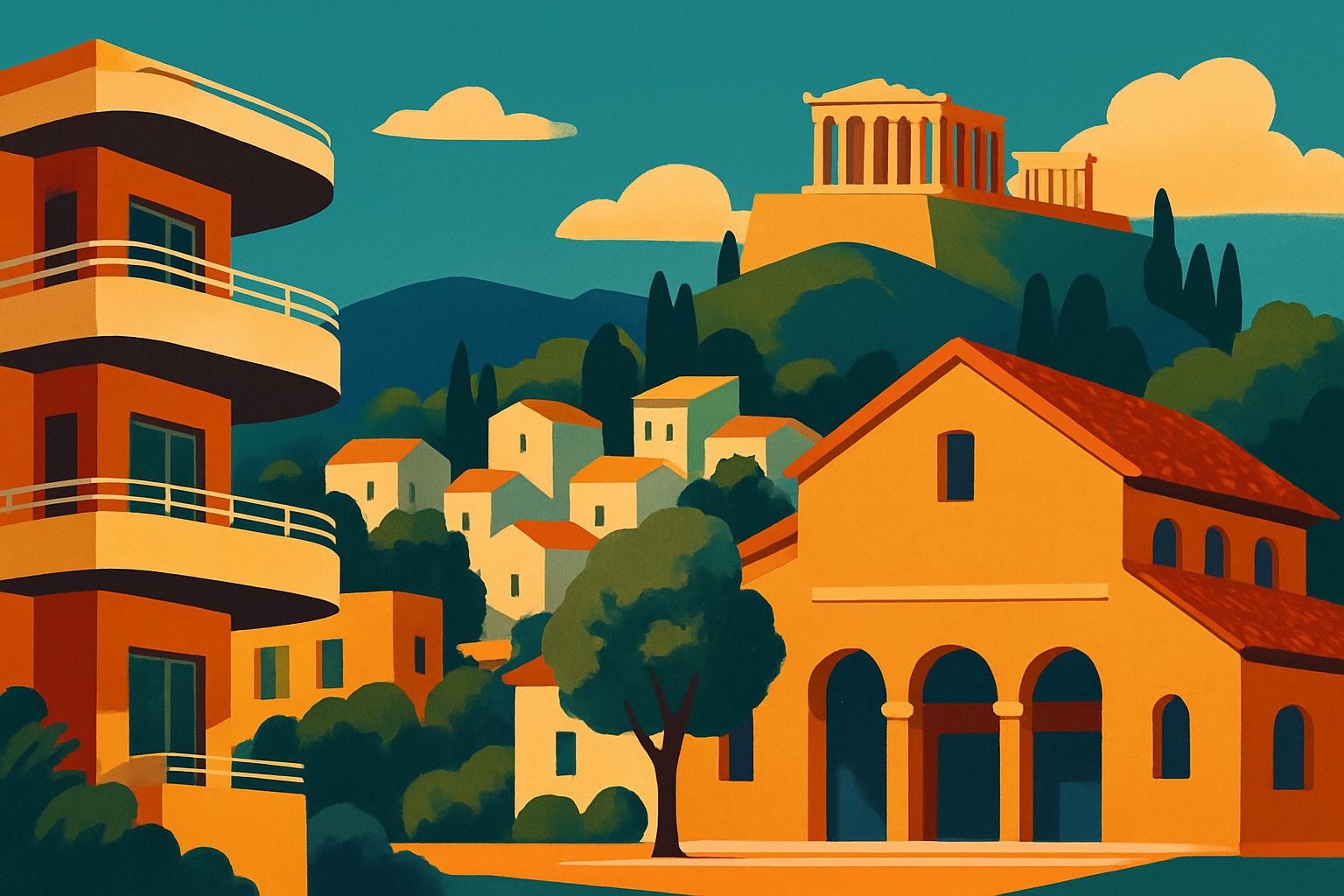
Kypseli was Athens' first deliberately planned residential expansion beyond the 19th-century city core. When Greek independence created a capital in need of urban form, the neighborhoods closest to the center filled quickly with working-class housing and commercial streets. Kypseli, laid out in the 1910s and built out primarily through the 1930s, was different: wider streets, uniform building heights, a pedestrianized central boulevard, and architecture influenced by European modernism — Bauhaus-influenced facades with horizontal balcony bands, rounded corner balconies, and decorative front doors that functioned as architectural signatures.
The professional and merchant families who settled here lived around Fokionos Negri, the pedestrianized boulevard that anchored daily life the way a village square would. By the 1960s and 70s, suburban expansion changed the calculus — the same families moved to Kifissia, Glyfada, and the northern suburbs when cars made distance manageable. The apartments they left were taken first by working-class Greek families and then, from the late 1980s onward, by successive waves of immigrants. Lebanese communities arrived earliest; West African, Pakistani, and Bangladeshi communities followed. Kypseli became one of the most ethnically diverse neighborhoods in Athens while remaining one of its most architecturally coherent — which is the central contradiction, and the central attraction, of the place.
2. Fokionos Negri: the pedestrianized boulevard that runs on its own clock
Fokionos Negri is the neighborhood's structural and social spine — a tree-lined pedestrianized boulevard running north–south through Kypseli's center, named after the Greek patriot Fokion Negri who died in 1835. The trees are old enough to form a full canopy in summer, which turns the boulevard into a corridor of shade and ambient sound during peak hours.
The seating that extends into the pedestrianized center from cafes and bars on either side functions like a village square: this is where Athenians sit for hours, not just for the duration of a coffee. The demographic is cross-generational — older residents playing backgammon at the kafeneion tables anchoring the northern stretch, younger crowds at wine bars and modern cafes opened over the last decade, families moving between them.
Fokionos Negri runs on Athenian time. Arriving after 6 p.m. on a weekday evening finds it mid-stream — tables already filling, children cycling the pedestrian center, six conversations mixing into a collective hum. Staying until 10 or 11 p.m. shows you the fuller version. It does not peak and then drop; it stays at full atmospheric intensity until the early hours.
3. Kypseli Municipal Market: a 1935 food hall with a second career
The Kypseli Municipal Market was built in 1935 as a neighborhood food market — one of several the Municipality of Athens constructed during the interwar period to give residential districts access to fresh produce, meat, and dairy without requiring a trip to the central Varvakios Agora.
The building is listed: a two-story market hall in a stripped neoclassical style, with large arched windows and a footprint built for serious daily commerce. It ran as a food market for decades before declining as supermarkets absorbed its function and the neighborhood's demographics shifted.
The second career began when the municipality restored the building as a hub for social enterprises, cooperatives, and community organizations. Today it hosts rotating events — weekend markets selling handmade goods and local produce, workshops run by NGOs and community collectives, cultural programming, food pop-ups — alongside permanent tenants including sustainability startups and organizations serving the neighborhood's immigrant population. The calendar is worth checking before visiting; the building is most alive during events, which tend to happen on weekends. On quiet weekdays the architecture alone — the original market structure with high ceilings and iron-framed windows preserved throughout — makes stepping inside worthwhile.
4. Architecture walk: what to read in Kypseli's interwar building stock
Kypseli's residential streets amount to an outdoor study of interwar Athenian architecture. The building type that dominates is the polykatoikia — the multi-family apartment block that became the dominant form of Athenian urban housing from the 1930s onward. In Kypseli these blocks were built at a moment when Bauhaus influence was reaching Greece through architects returning from European schools, giving street facades a distinctive character: horizontal balcony bands, rounded corners on key buildings, graphic tile entries, and front doors with geometric metalwork.
The streets worth walking slowly include Ithakis Street (the main east–west connector, with several intact interwar blocks in good condition), Kallidromiou Street near the Exarcheia border (more decayed, more layered, heavier street art), and the cross streets between Fokionos Negri and Plateia Agias Zonis — the neighborhood's main square, anchored by the church of the same name.
What distinguishes Kypseli's architecture from the restored facades of Kolonaki or the tourist-facing streets of Plaka is the wear. Most of its buildings carry sixty to ninety years of uninterrupted habitation visibly: crumbling plaster patches beside careful tile restorations, balcony railings repainted in individual household colors, basement-level grocery stores operating on the original 1938 tile floors.
5. Where to eat: Lebanese kitchens, Greek tavernas, and the most diverse street food in central Athens
Kypseli's food landscape is genuinely multicultural in a way that doesn't perform multiculturalism — it simply reflects who lives there. The Lebanese community that arrived in the 1980s and 1990s brought a restaurant culture woven into the neighborhood's daily food identity: Lebanese restaurants on multiple Kypseli streets serve mezze, grilled meats, and flatbreads at prices oriented toward neighborhood lunch rather than tourist dinner. The best are on the side streets east of Fokionos Negri, where the storefronts are small and the menus are often posted in Arabic alongside Greek.
The West African and South Asian communities added grocery infrastructure — African supermarkets on the side streets carry specific ingredients (fufu flour, dried fish, plantain chips, spice blends) that exist almost nowhere else in central Athens. For Greek food, the neighborhood tavernas running off Fokionos Negri operate on a clear model: printed menus, daily specials on a chalkboard, wine by the carafe, no English translation required.
Atlas, which opened in late summer 2025 on a Kypseli side street, represents a newer register: seasonal meze built around individual ingredients, a wine list organized around small Greek producers. It sits between a taverna and a wine bar without fully committing to either — and is the clearest sign that Kypseli's culinary evolution is continuing. For a broader picture of Athens food culture, what to eat in Athens covers the essential dishes by neighborhood.
6. Summer in Kypseli: the Stella open-air cinema and late evenings on the boulevard
June through September transforms Kypseli's outdoor life. Sunsets after 8:30 p.m. and temperatures holding around 24°C well into the night fill Fokionos Negri and the surrounding rooftop terraces with the kind of extended outdoor social life that is Athens at its most specifically itself.
The Stella open-air cinema is the neighborhood's summer institution. It operates from late May through September, screening films — mostly English-language with Greek subtitles — under a night sky framed by the Bauhaus facades of surrounding apartment buildings. It is owned by the City of Athens and run by a Kypseli-based film distribution company, which gives it a character more local and programmatically interesting than the open-air cinemas closer to the tourist circuit. Athens has several open-air cinemas worth knowing about — Stella is among the most genuine.
The broader Kypseli summer evening follows the boulevard's logic: dinner at a taverna or Lebanese restaurant with tables extending to the pavement, a slow walk or a settled seat on Fokionos Negri as the evening deepens. Kypseli is not a nightlife destination in the Psyrri or Gazi sense — the bars exist and the night runs late, but the pace is residential rather than performative.
7. Is Kypseli safe? How it sits next to Exarcheia
Is Kypseli safe? The question usually follows from its proximity to Exarcheia and its reputation as a densely immigrant, economically mixed area. The honest answer: Kypseli is a working residential neighborhood where standard urban awareness applies — bags worn forward in busy markets, phones off cafe tables in crowded spots — but it requires no specific vigilance beyond what you would apply in any European city neighborhood of comparable density.
The blocks closest to Victoria metro station along Patision Street are busier and rougher in feel than the residential streets farther north. Once you are in the Fokionos Negri corridor or the blocks surrounding the market, the texture is ordinary residential: families on balconies, corner kafeneions, delivery motorcycles, a cat on a wall.
How does Kypseli compare to Exarcheia? They share a border but not a personality. Exarcheia is the university and anarchist district — politically charged, confrontational street art, nightlife tied to a specific ideological identity. Kypseli is more domestically quiet. The politics exist — the neighborhood's immigrant population and housing cooperative organizations operate visibly — but they run through community organizations and mutual aid rather than street-level confrontation. Walking north from Exarcheia along Kallidromiou Street into Kypseli makes the transition legible in about two blocks: the street art shifts register, the ambient sound changes, and the kafeneions start looking like places people go every day.
8. When to visit Kypseli and how to get there
Best time to visit: Kypseli works year-round, but June through September are when Fokionos Negri and the Stella open-air cinema operate at full capacity. Spring and autumn are excellent for architecture walks — comfortable temperatures and no crowds. Winter closes the outdoor terraces but the indoor kafeneions and neighborhood tavernas remain fully operational, often quieter in a way that feels more like the actual neighborhood than a seasonal version of it.
The ideal visit runs from late afternoon through the evening: walk the architecture from 4–6 p.m. while light is good and streets are quiet, settle into Fokionos Negri from 7 p.m. for dinner, stay until the evening holds. June evenings are particularly good — sunset after 8:30 p.m. means the golden-hour window in the interwar streets runs long.
How to get there: Victoria metro station (Line 1, Green Line) is the correct arrival. Exit and walk west along Ithakis Street for two blocks, then north — you enter the Fokionos Negri corridor within ten minutes. Plateia Amerikis, one stop south on Line 1, serves the neighborhood's eastern edge at roughly equal distance.
From Exarcheia, walk north along Kallidromiou Street — under eight minutes. From Monastiraki, it is a 25-minute walk north through the commercial center or a single metro stop to Victoria. Kypseli has no tourist infrastructure — no information offices, no organized tours, no visible markers indicating you have arrived. That is the point.