The name means 'little column' — a reference to a small ancient column found in the central square during 19th-century excavations. Plateia Filikis Etaireias, still called Kolonaki Square by everyone who lives nearby, sits at the geographic and social center of the neighborhood: a compact pedestrianized plaza ringed by cafe tables, newsstands, and apartment buildings whose ground floors have been colonized by bars, boutiques, and offices for accountants and lawyers.
The neighborhood climbs the lower slopes of Lykavittos Hill — Athens' highest central point at 277 meters — with the most expensive streets near the square and quieter residential blocks extending uphill. Its southern boundary runs along Vasilissis Sophias Avenue, the grand boulevard that also fronts the National Gardens, the Byzantine and Christian Museum, and several embassy buildings. This placement gives Kolonaki access to a museum strip unlike any other street in Athens.
The luxury shopping reputation is accurate in one specific sense: Voukourestiou Street, running south from the square toward Syntagma, does carry flagships for Prada, Louis Vuitton, Cartier, and Dior, plus serious Greek jewelers. But that is one street among many. The rest of Kolonaki is working professional Athens — journalists, academics, architects — people who come here because it has excellent coffee, two world-class museums, a hill to walk in the evening, and a social texture that develops in places where people have been sitting at the same tables for decades.
The Museum of Cycladic Art at Neofitou Douka 4 holds more than 5,000 objects from the Cycladic civilization — the people who lived across the Aegean islands, primarily Naxos and Paros, between roughly 3,200 and 2,000 BC. The collection is primarily marble: small figurines, bowls, and ritual vessels carved without metal tools.
The figurines are the reason to come. They are flat, simplified, and abstract — featureless oval heads, arms folded across the torso, feet angled downward — and they bear a resemblance to 20th-century modernist sculpture that is not coincidence. Picasso studied Cycladic art. Modigliani's elongated faces trace directly to the same tradition. Seeing the originals in Athens makes the entire history of modern Western abstraction click into place in a way no textbook reproduces.
The museum building itself connects internally to the adjacent 19th-century Stathatos Mansion, which hosts temporary exhibitions and a small courtyard cafe. The permanent collection covers three floors and takes roughly 45 minutes at a focused pace. Admission is €14 (reduced €7). The Thursday-evening opening until 8 p.m. is the best time to visit — the figurine galleries are quiet, and the pieces are not obscured by visitors' phones.
Get short, interactive stories that make each place easier to remember while you travel.
The Benaki Museum at Koumbari 1 — corner of Vasilissis Sophias, directly across from the National Gardens — is the most chronologically complete collection of Greek culture anywhere in the world. Antonis Benakis, son of an Alexandrian cotton merchant, spent decades acquiring objects representing every period of Greek history. In 1930 he donated his family mansion and the entire collection to the state.
The scope is serious: Neolithic pottery, Minoan gold jewelry, ancient bronze figurines, Byzantine silver and icons, traditional regional costumes from the Ottoman period, and a 20th-century wing covering the Axis occupation, the Civil War, and the 1967 junta. A first visit will necessarily be selective — most people spend 90 minutes to two hours and leave sections for a return.
Two things worth finding specifically: the collection includes two El Greco paintings. The artist was born Domenikos Theotokopoulos in Crete in 1541, trained in Byzantine icon tradition before moving to Venice and then Toledo, Spain. Seeing his early work in Athens makes the arc of his development visible in a way that a visit to the Prado alone cannot. The Alexandrian jewelry room on the ground floor contains ancient gold objects of extraordinary precision — earrings, hairpins, necklaces — worked by Greek craftspeople in Ptolemaic Egypt. Admission is €12; the museum runs Wednesday through Monday (closed Tuesday), with extended Thursday hours until 10 p.m. The rooftop cafe does light meals and coffee in a garden setting against the neoclassical upper floors.
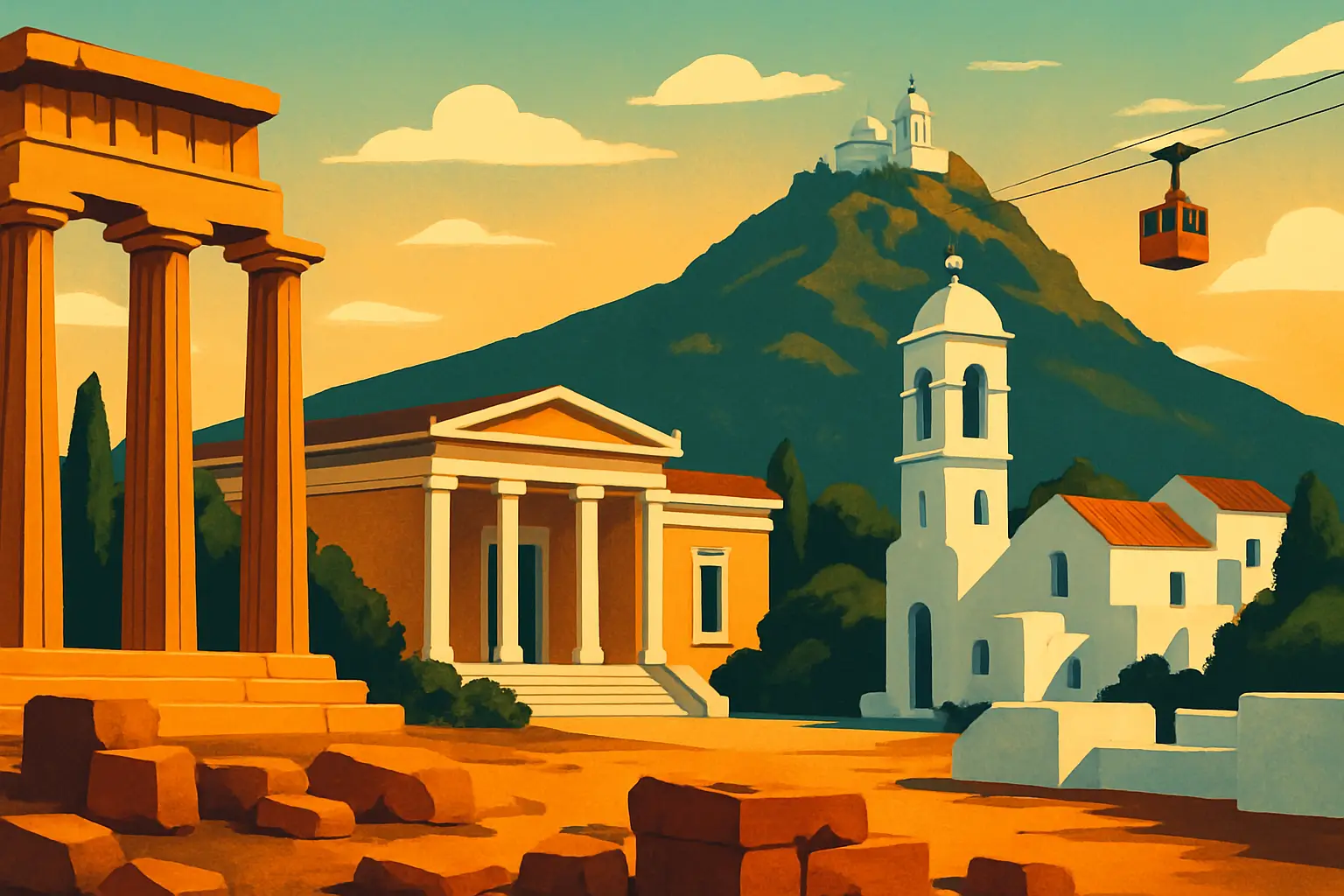
Lykavittos Hill rises to 277 meters from the upper edge of Kolonaki — Athens' highest central point. From the summit, the Acropolis is visible to the southwest at roughly eye level, not below you, which produces a completely different visual logic than standing on the Acropolis and looking out. You see the entire hill, the ancient monuments on it, and the city grid extending south toward the sea and east toward Hymettus. On a clear June day the islands of the Saronic Gulf — Aegina, Salamis — are visible on the horizon.
The funicular station is on Ploutarchou Street at the intersection with Aristippou, about a 10-minute walk uphill from Kolonaki Square. The €13 return covers a 3-minute ride entirely underground; cars run every 30 minutes (every 10 during peak hours), operating 7 a.m. to 2:30 a.m. year-round. The evening option, after dinner, is genuinely worth considering for the city lights.
The hiking alternative from Ploutarchou Street takes 30 to 45 minutes through pine-shaded trails. The lower section is easy; the final zigzagging stone steps are steep but manageable. At the summit: the whitewashed Chapel of St. George (19th century, usually open), a 360-degree viewing terrace, and Orizontes restaurant if you want dinner with what is probably the most dramatic table view in Athens.
On the hill's southeast slope, the Lycabettus Theatre — an open-air amphitheater — runs concerts from June through August as part of the Athens Epidaurus Festival program. Pine trees, warm evenings, and city light behind the stage: it is the best outdoor venue in central Athens.
Kolonaki runs on a coffee culture that has nothing to do with Instagram latte art. The neighborhood's cafe tables are working institutions — places where deals are made, columns are drafted, and the Athenian professional class moves through its day in public view.
Da Capo on Kolonaki Square has been the neighborhood's essential espresso stop since the 1980s: standing counter, quick shots, no frills. The crowd before 9 a.m. is businesspeople in motion. By 10 a.m. the outdoor tables fill with people who have time for a second coffee and a longer conversation.
Filion on Skoufa Street is the legendary alternative — older, quieter, with a green awning over wicker chairs on the pavement. The regulars who have occupied these chairs over the decades include novelists, constitutional lawyers, and journalists who covered every Greek political crisis from the 1980s onward.
LowCal on Tsakalof Street opens at 7 a.m. and runs all day, drawing a media and political-adjacent crowd given its proximity to several publishing houses and newspaper offices nearby.
The actual Greek coffee experience — ellinikos kafes, unfiltered, simmered in a small copper briki and poured thick into a demitasse — is still served at all three. Order it 'metrios' (medium sweet) for the standard, 'glykos' for sweet, 'sketos' for none. It comes with cold water and a small sweet, and it arrives slowly. That is the point.
Filipou at Xenokratous 19 is the reference for traditional Athens cooking in Kolonaki — open since 1923, cash only, handwritten daily menu. Moussaka, slow-braised lamb with orzo, spanakopita, horiatiki salad with a proper slab of barrel-aged feta. The crowd at lunch is Athenian judges, senior civil servants, and architecture professors who have been eating here for years. Full meal with wine under €20. This is the budget anchor for the neighborhood.
For seafood at a higher register, Papadakis at Fokylidou 15 runs a focused menu built around Aegean fish — sea bream, red mullet, octopus preparations — with a wine list that takes Greek producers seriously.
Jazz in Jazz at Dinokratous 4 is the bar that regularly surprises people: a tiny room, exposed brick walls, jazz vinyl playing through a system that actually sounds good, cocktails built on Greek spirits — mastiha, tsipouro, Greek gin. Standing room only by 11 p.m. on weekends. It is not a lounge. It is a small room that takes jazz and drinks seriously, and the two are compatible.
For a light afternoon break, the Benaki Museum rooftop cafe at Koumbari 1 serves coffee and light meals in a garden setting against the neoclassical building. The food is standard; the setting is not. It is the best casual pause in this part of the city.
Budget reality: a full dinner with wine at mid-range Kolonaki restaurants runs €45 to €65 per person. Filipou is the genuine exception.
Getting there: The cleanest arrival is Evangelismos station (Line 3, Blue Line) — exit puts you at the corner of Vasilissis Sophias and Rigillis, five minutes from both major museums. From Syntagma (same line, one stop west) the walk to Kolonaki Square is 12 to 15 minutes uphill via Kanari Street. Taxis from Monastiraki or Plaka take about 10 minutes off-peak.
Best time to visit: June is excellent — the city is at full population before the August island exodus, outdoor seating is packed, and the Lykavittos walk in evening light (sun sets after 8:30 p.m.) is exceptional. Both major museums are best visited on weekday mornings before crowds build. In July and August, avoid the hill hike between noon and 4 p.m.; exposed sections become punishing. October and November offer cooler weather, no queues at either museum, and a post-summer calm that regular visitors often prefer.
What to skip: The Voukourestiou luxury corridor is worth walking for its architecture, but needs no time unless you are actually shopping. The hilltop restaurant Orizontes has mixed reviews at its price point — the terrace view is free; dinner elsewhere is advisable. Focus on the two museums, the hill in the evening, and a morning on Tsakalof and Skoufa for coffee before the main tourist traffic arrives from the Acropolis corridor.