Gazi is the district immediately west of Monastiraki and Psyrri, bounded roughly by Pireos Street to the east, Konstantinoupoleos Street to the south, and Iakchou Street to the west. The metro station — Kerameikos, on Line 3 (Blue Line) — deposits you at the corner of Pireos and Keramikou Streets, directly between the two things the neighborhood is best known for.
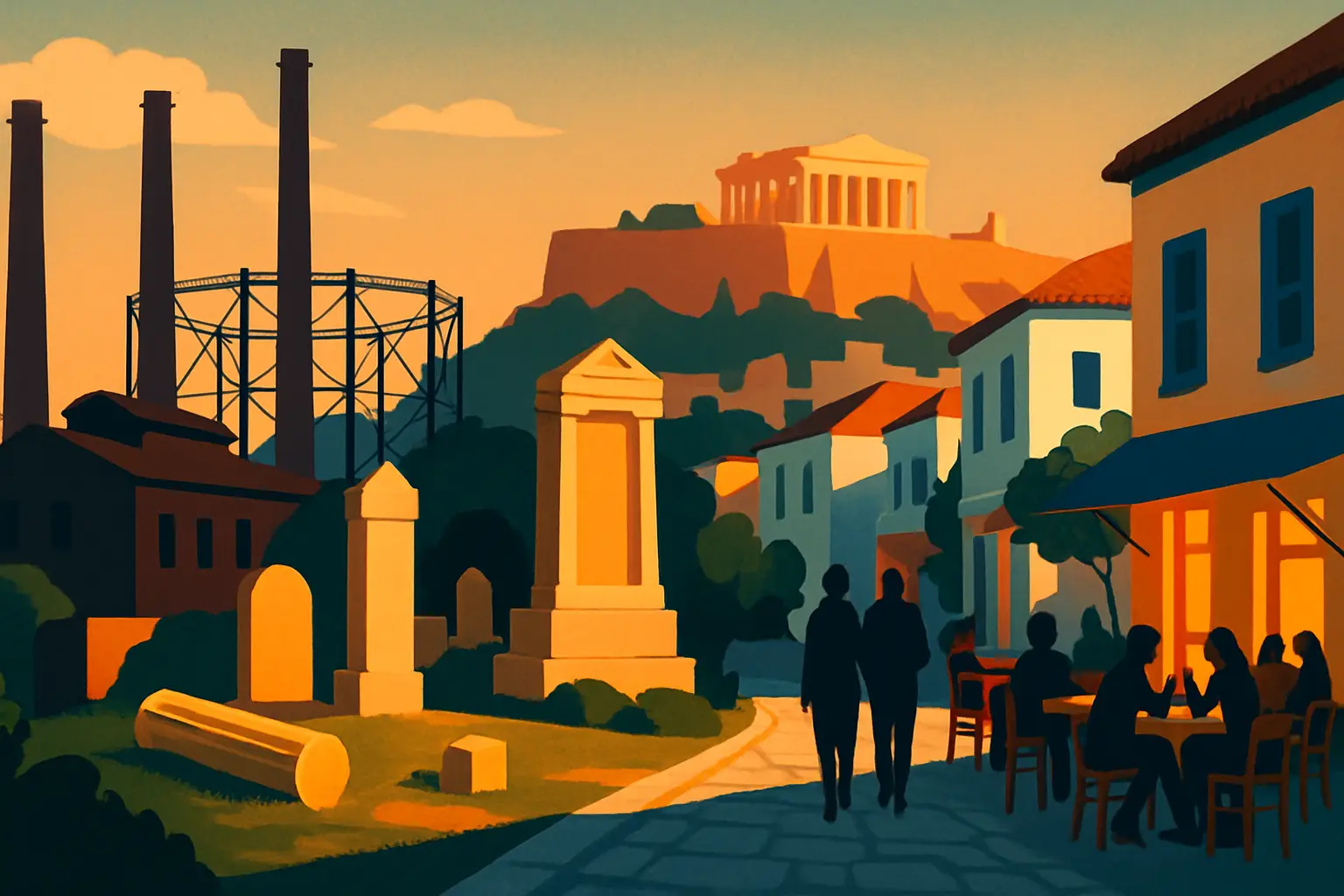
The name comes directly from the Athens Gas Factory — the Athinaiko Fotografeio, established in 1862 by the Société Anonyme Française du Gaz d'Athènes to produce coal gas for the city's street lamps. The factory operated for over a century, eventually switching to natural gas supply in the 1980s and closing the production plant fully in 1984. For fifteen years the industrial complex sat abandoned — a cluster of gasometers, boiler houses, and Victorian ironwork in the middle of an increasingly dense city.
In 1999, the City of Athens converted the 3.5-hectare site into Technopolis, a cultural center built into the original structures, preserving the chimneys, the production halls, and the ironwork while opening the spaces for concerts, galleries, and exhibitions. The name 'gazi' — gas, in Turkish — transferred from the factory to the surrounding neighborhood and stayed.
The streets that grew around the factory followed a similar arc: cheap rents, light-industrial uses, proximity to the central markets of Athinas Street, and decades of being ignored by the redevelopment projects reshaping northern and southern Athens. Technopolis in 1999 and the 2004 Athens Olympics infrastructure investment catalyzed the shift — bars opened in former warehouse spaces, restaurants replaced machine shops, and Gazi became the entertainment district it is now.
Technopolis at Pireos 100 covers nine restored industrial buildings — the gasometers, the engine hall, the boiler house, the purifier towers — spread across a courtyard that feels unlike anywhere else in Athens. The original chimneys are intact. The iron frame of the main gasometer forms the outer boundary of the open-air concert space. The Gas Museum, housed in the original production facilities, displays the machinery, pipes, and operational history of coal gas production alongside the broader story of a 19th-century city rebuilding itself as a modern European capital.
The Athens Jazz Festival uses the main courtyard each June — acts performing in the shadow of the original chimney stacks, the industrial architecture lit from below as the evening darkens. The format rotates between established international names, Greek jazz ensembles, and contemporary music crossovers. Concerts begin around 9 p.m.; the courtyard fills early on popular nights. For the current program, check the Technopolis website directly — the Jazz Festival is the busiest event of the year and well-regarded tickets sell fast.
Beyond the June festival, Technopolis runs a year-round calendar: photography exhibitions, technology fairs, food and design festivals, film screenings, and corporate events that keep the site active across every season. The Skywalk — a system of elevated catwalks and suspension bridges threading through the industrial superstructure — is available on non-event days and gives you the best vantage point for understanding the factory's original layout.
Address: Pireos 100. Kerameikos metro (Line 3) — exit and walk 200 meters south on Pireos Street.
Gas Museum hours: 9 a.m.–1 p.m. and 5–9 p.m. Tuesday through Friday; 10 a.m.–3 p.m. Saturday and Sunday.
Event nights: gates typically open 8 p.m., concerts 9 p.m. The site is primarily event-driven — check the calendar before visiting.
Get short, interactive stories that make each place easier to remember while you travel.
At the junction of Ermou Street and Pireos Street, a gap in the urban streetwall opens into the Kerameikos Archaeological Site — one of the most significant ancient sites in Athens and, because it is not the Acropolis or the Ancient Agora, almost always uncrowded. This is not a lesser site: it is simply a less-marketed one.
The name Kerameikos comes from keramos — pottery — reflecting the ancient neighborhood of potters and clay workers who settled near the Eridanos River, which still runs underground through the site. But the area's historical significance goes far beyond ceramics: Kerameikos contains the two main western entrances to ancient Athens and the departure point of one of the most important processional routes in the ancient world.
The Dipylon Gate, at 38 meters wide the largest city gate in the ancient Greek world, was the main entrance to Athens from the north and west — the point where travelers arriving from Corinth, from the Peloponnese, and from the road up from Piraeus entered the city. Just inside it stood the Pompeion — a marble colonnaded building where the Panathenaic Procession assembled every four years before marching up through the city toward the Acropolis, and where the ritual vessels used in the procession were stored between festivals.
The Sacred Gate opened directly onto the Sacred Way (Hiera Odos) — the processional road that ran 22 kilometers west to Eleusis, where the Eleusinian Mysteries were performed annually each September. The Mysteries, one of the central religious institutions of the ancient world, required initiates to walk the full Sacred Way from Athens to Eleusis on foot in a single day. The modern road running through Gazi — Iera Odos Street — follows the same alignment. You drive over the ancient route without registering it.
The Street of Tombs running alongside the Sacred Gate contains grave monuments of wealthy Athenians from the 5th and 4th centuries BCE. The most striking is the Tomb of Dexileos — a young cavalryman from the deme of Thorikos killed in the Corinthian War in 394 BCE at age 20. His grave relief, carved with extraordinary precision, shows him mounted on horseback, lunging over a fallen enemy. The original is in the on-site Kerameikos Museum; what you see outdoors is a replica. The museum — a handful of rooms, never crowded — contains original grave stelae, protogeometric and Geometric pottery from 1000–700 BCE, and architectural fragments from the Pompeion. Entry is €8, or included in the €30 multi-site pass.
Gazi became Athens' most openly LGBT-friendly neighborhood during the 2000s, when a density of bars, clubs, and cafes opened along Lepeniotou Street and the surrounding streets around Plateia Avdi. The shift coincided with the Technopolis transformation and the broader gentrification of the district, producing a neighborhood where good infrastructure, relatively affordable rents, and a genuinely welcoming atmosphere created a self-reinforcing concentration of venues. That character has held across two decades.
Plateia Avdi — the neighborhood's central square, a five-minute walk west of the Kerameikos metro exit — is ringed by cafes that function in the morning as quiet coffee spots and expand dramatically in the evening as outdoor seating fills and the ambient energy of the square builds. The bars on Lepeniotou Street run from casual cocktail bars at the northern end to club-format venues toward the south, with the transition point somewhere around 1 a.m.
The dining scene is more international and a level above Psyrri in price and register. Restaurants on Iakchou Street and Dekeleon Street lean toward modern Greek cuisine and small-plate formats — creative rather than traditional, suited to a younger Athenian dining culture. The standard Gazi rhythm: dinner between 9 and 11 p.m. on Iakchou or around Plateia Avdi, then bars from midnight as the neighborhood shifts into its later gear.
Gazi works best as part of the broader western Athens circuit rather than as a standalone visit. The natural sequence:
[Monastiraki](/gr/blog/things-to-do-in-monastiraki-athens) → Kerameikos Site → Technopolis/Gazi → [Thissio](/gr/blog/thissio-athens-guide)
From Monastiraki metro, walk west along Ermou Street for about 12 minutes to the Kerameikos site entrance at Ermou 148 — this walk takes you through the tail of Psyrri's northern edge and past the first traces of the ancient road geometry. After the archaeological site, cross Pireos Street to enter Gazi: Technopolis is 200 meters south at Pireos 100. From Technopolis, continue south along Pireos for five minutes to reach the Apostolou Pavlou pedestrianized boulevard — the marble-paved walking street running below the Acropolis through Thissio toward Koukaki.
This stretch is one of the finest urban walks in Athens: the Acropolis lit on your left, the Ancient Agora visible through the trees on your right, the Thissio streetscape quieter and greener than anything you find closer to the center. The full circuit — Monastiraki, Psyrri, Gazi, Technopolis, Kerameikos, Thissio — covers roughly 4 kilometers and fills a comfortable half-day, depending on time spent inside the two archaeological sites.
Is Gazi safe? Yes, straightforwardly. Gazi has operated as a mainstream Athenian entertainment district for over 15 years. Standard urban awareness applies — nothing specific to the neighborhood. The streets around Plateia Avdi and Lepeniotou stay active past 2 a.m. on weekends, which makes them feel actively safer than many central Athens streets that empty out after 10 p.m.
The blocks along Pireos Street immediately north of the Kerameikos site, heading toward Omonia Square, carry a rougher character — a legacy of the area's industrial and transient history. Staying west of Pireos and moving through the pedestrianized streets around Plateia Avdi keeps you in the established entertainment zone.
Best time to visit Gazi? June is genuinely the right month. The Athens Jazz Festival at Technopolis runs through June, which brings the industrial courtyard alive in a way it is not during quieter months. Evening temperatures sit at 20–24°C — warm enough for outdoor tables, far more comfortable than July and August when daytime temperatures in Gazi, with its limited tree cover, regularly reach 38°C.
How to get there? Kerameikos metro station on Line 3 (Blue Line) is the direct arrival — exit onto Pireos Street and you are between the Kerameikos Archaeological Site (right/north) and Technopolis (left/south) within one minute. From Thissio, walk north along Apostolou Pavlou and cross Ermou Street — about 10 minutes. From Psyrri, walk south along Sarri Street to Konstantinoupoleos, then west — 15 minutes on foot.