Tenochtitlán is a compound word in Nahuatl, the language of the Mexica (Aztec) people — a language still spoken by approximately 1.5 million people in Mexico today. The name breaks down as: tetl (rock or stone) + nochtli (prickly pear cactus, the nopal) + tlan (place of, a locative suffix common in Nahuatl place names). The full meaning is most often translated as 'place of the prickly pear cactus' or 'among the prickly pear cacti' — specifically, prickly pear growing on rocks or stone. Some scholars expand this slightly: tetl also carries a meaning associated with hardness and permanence, making Tenochtitlán something like 'the firm/enduring place of the nopal.' The name was given to the location when the Mexica arrived and found it — or more precisely, when they interpreted what they found there as the fulfillment of a divine prophecy that had guided their centuries-long migration.
Nahuatl breakdown: tetl (stone/rock) + nochtli (prickly pear cactus) + tlan (place of) = 'place of the prickly pear on stone'
Nahuatl is still spoken by 1.5 million people in Mexico today — the Aztec language never died
The '-tlan' suffix appears in hundreds of Mexican place names: Mazatlán, Texcoco-tlan, Tlatelolco — all Nahuatl origins
The name encodes the founding story directly. According to Aztec tradition, the god Huitzilopochtli — the sun god and patron deity of the Mexica — had given a prophecy during the long migration south from their northern homeland of Aztlán: the Mexica would found their city when they saw an eagle perched on a nopal cactus growing from a stone, devouring a serpent. This vision would mark the location the gods had chosen for the great city. In 1325, on a small swampy island in Lake Texcoco that no other group wanted, the Mexica saw the sign. They named the place Tenochtitlán — the place of the cactus on the stone — and began building. The symbol from that founding vision — eagle, cactus, serpent — became the emblem of the Aztec state and is today the central image of the Mexican flag, directly inherited 700 years later. The name of the city is inseparable from the myth that created it.
The founding prophecy: settle where you see an eagle on a nopal cactus eating a serpent — the Mexica saw this sign on the island in 1325
The eagle-cactus-serpent symbol on the Mexican flag is a direct inheritance of the Tenochtitlán founding myth
The island they chose was the worst land available — the Mexica were refugees who built an empire on what others refused
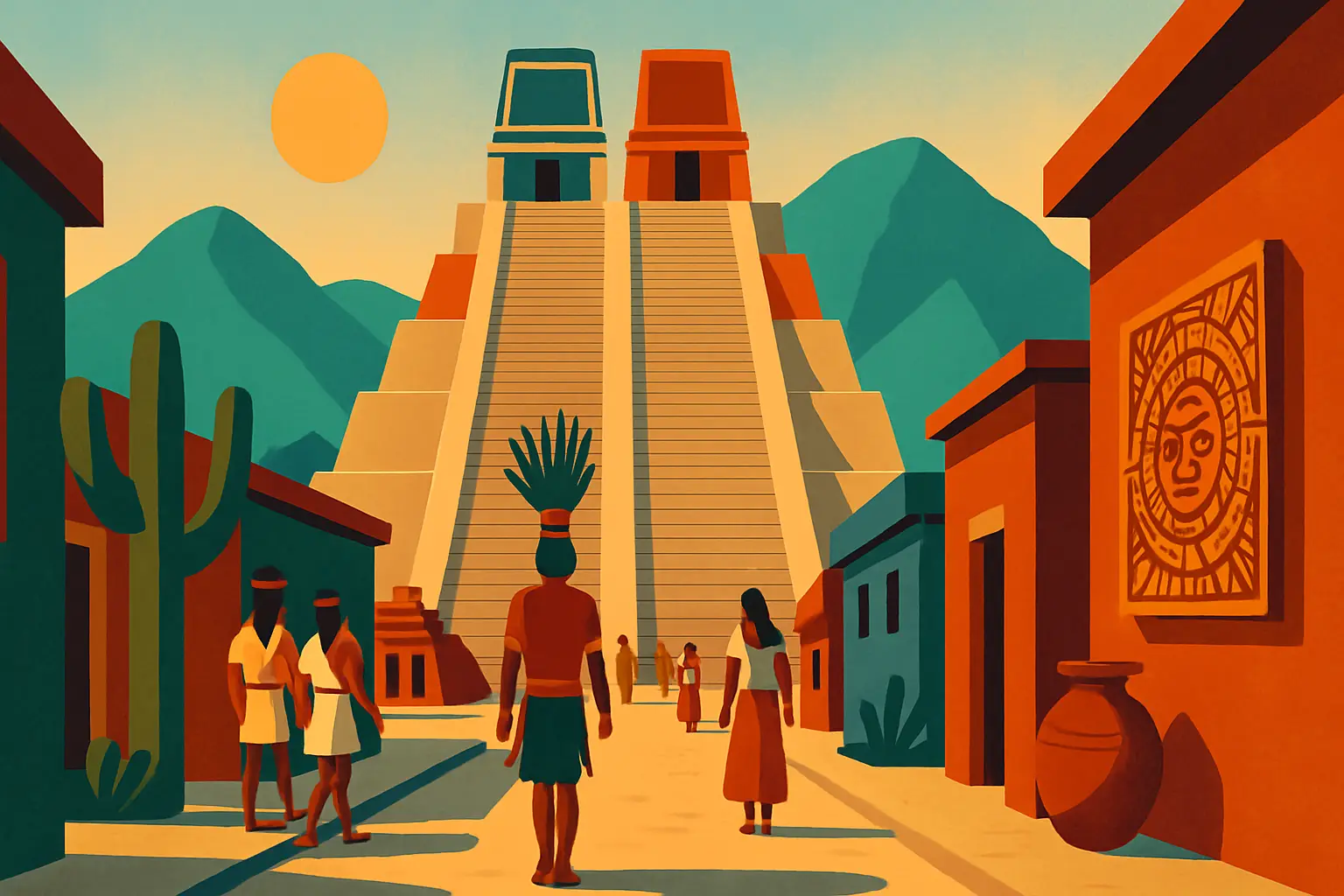
Tenochtitlán was not a ceremonial center or a government complex — it was one of the largest cities in the world. At its peak in the early 16th century, it had a population of 200,000–300,000 people, making it comparable to Constantinople and significantly larger than London, Paris, or Seville at the same period. The city was organized concentrically around a sacred precinct at its center — the temple complex that contained the Templo Mayor and over 70 other structures. From this center, four main causeways extended to the mainland in four cardinal directions, each wide enough for ten people to walk abreast. The island was expanded by chinampas (raised garden beds built from lake sediment) to create additional building land. Canals ran through the city like streets. A 16-kilometer dike regulated the water level and separated the fresh-water lake sections from the salt water of Lake Texcoco. When the first Spanish soldiers arrived in 1519, the officer Bernal Díaz del Castillo wrote that they 'could not believe that such things as we saw existed anywhere in the world.'
200,000–300,000 inhabitants at its peak — larger than any European city of the period
70+ structures in the sacred precinct alone — the ceremonial center was the scale of a modern city block
Bernal Díaz del Castillo's account of first seeing Tenochtitlán: 'We did not know what to say, or whether what appeared before us was real'
Get short, interactive stories that make each place easier to remember while you travel.
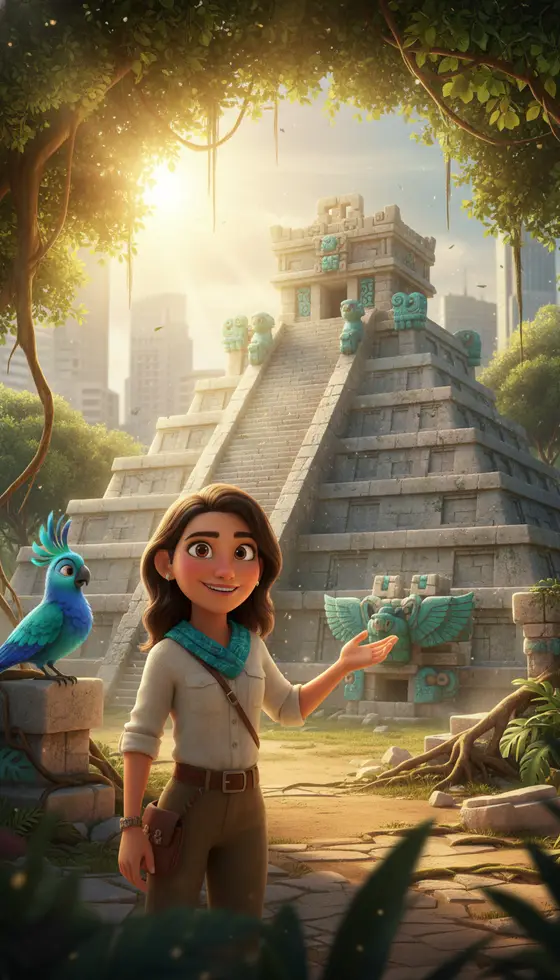
At the heart of Tenochtitlán stood the sacred precinct (Recinto Sagrado) — a walled ceremonial enclosure roughly 300 by 300 meters, containing over 70 buildings. The dominant structure was the Huey Teocalli, known today as the Templo Mayor: a twin-pyramid structure dedicated on its south side to Huitzilopochtli (war and the sun) and on its north side to Tlaloc (rain and agriculture). The pyramid was rebuilt at least seven times over the city's 200-year history, each new construction encasing the previous one — an archaeological layer cake of successive Aztec rulers' ambitions. The Aztec history civilization guide covers the religious context in detail. The ruins of the Templo Mayor were discovered in 1978 when a Mexico City electrical worker accidentally broke through a buried stone disk the size of a large table — a carved image of the goddess Coyolxauhqui. Subsequent excavations uncovered the full temple complex, now open as a ruin and museum in Centro Histórico, one block east of the Zócalo.
The Templo Mayor was rebuilt 7 times — each new pyramid encased the previous one, creating an archaeological layer cake
The 1978 discovery: an electrical worker's drill broke through the Coyolxauhqui stone disk, triggering a decade of excavation
The Zócalo (Mexico City's main plaza) sits precisely at the center of where the Tenochtitlán sacred precinct was
Tenochtitlán had a twin: Tlatelolco, a separate city-state on the northern part of the same island, connected to Tenochtitlán by a causeway. Where Tenochtitlán was the political and religious capital, Tlatelolco was the commercial capital. Its great market — Tianguis de Tlatelolco — was described by Spanish soldiers as the largest and most organized marketplace they had ever seen. Estimates suggest 60,000 visitors per day at its peak, trading everything from gold, jade, and quetzal feathers to live animals, slaves, ceramic vessels, food, cloth, and medicinal herbs. Specialist courts adjudicated commercial disputes on-site. Tlatelolco was eventually incorporated into Tenochtitlán after a military conflict in 1473. Today, the Tlatelolco archaeological site is in the Plaza de las Tres Culturas in northern Mexico City — where Aztec pyramids, a colonial Spanish church, and a 20th-century apartment complex exist on the same block, representing the three civilizations that have occupied the same ground.
Tlatelolco market: 60,000 visitors per day — described by Spanish soldiers as more organized than any market in Europe
Tlatelolco specialized courts settled commercial disputes on-site — an early form of commercial law
Plaza de las Tres Culturas: Aztec ruins, colonial church, and 1960s housing complex — three civilizations on one block
When Hernán Cortés arrived on the Gulf Coast in 1519, he found a political landscape defined by resentment of Aztec dominance. The Triple Alliance's tribute system had made enemies of dozens of subject peoples, and Cortés was able to build a coalition of indigenous allies — most importantly the Tlaxcalans, who provided the majority of the military force that ultimately defeated Tenochtitlán. That coalition was assembled largely through La Malinche, Cortés’s Nahuatl interpreter and cultural broker. A smallpox epidemic preceded the Spanish arrival in the city, killing an estimated 30–50% of the population including the ruler Cuitláhuac. The siege of Tenochtitlán lasted 75 days and ended on August 13, 1521 — the date commemorated on the plaque at Tlatelolco in the Plaza de las Tres Culturas: 'This was neither a triumph nor a defeat — it was the painful birth of the mestizo people that is Mexico today.' The city was systematically demolished; the stones of the temples were used to build the colonial city on the same site. Within decades, Mexico City would occupy the exact footprint of Tenochtitlán.
August 13, 1521: end of the 75-day siege — the Tlaxcalan coalition, not the Spanish army, provided most of the military force
Smallpox killed Cuitláhuac (the ruler who replaced Moctezuma) and an estimated 30–50% of the population before the siege ended
The colonial city was built on Tenochtitlán's ruins using the pyramid stones — not next to it, but on top of it
The relationship between Tenochtitlán and Mexico City is one of the most extraordinary facts of urban history: the capital of a destroyed civilization became, on the same physical site, the capital of the civilization that destroyed it. The Zócalo — Mexico City's central plaza, where the National Palace and the Catedral Metropolitana stand — is built precisely on the ceremonial precinct of Tenochtitlán. The National Palace occupies the site of Moctezuma's palace. The Catedral is built from the stones of the Templo Mayor. The urban grid of Centro Histórico follows the Aztec street plan. Mexico City's founding continues to sink into the lake clay that Tenochtitlán was built on — the geological reason for the sinking is a direct consequence of the decision to drain the lake that kept the Aztec city stable. Standing in the Zócalo, you are standing on Tenochtitlán.
The Zócalo: Mexico City's main plaza is built on the exact location of Tenochtitlán's sacred ceremonial precinct
The National Palace: built on the site of Moctezuma II's palace, using the same stone foundations
Centro Histórico's urban grid follows the original Aztec spatial layout — the streets are 700 years old in their orientation
Walking through Centro Histórico is walking through Tenochtitlán — not as a metaphor but as a geographic fact. The Templo Mayor ruins are open to visitors one block east of the Zócalo. The associated museum contains objects excavated from the sacred precinct including the Coyolxauhqui disk, sacrificial deposits, and Aztec-era art of exceptional quality. The Museo Nacional de Antropología houses the largest collection of Aztec artifacts in the world, including the Aztec Sun Stone (the great 'calendar stone'). The full Aztec history and civilization guide maps out the complete story. TourMe has location-specific stories for the Templo Mayor, the Zócalo, and the surrounding streets of Centro — short interactive chapters that give you the context while you're standing in the place it happened. Tenochtitlán is not history in Mexico City. It is the ground beneath your feet.
Templo Mayor museum and ruins: open Tue–Sun, located one block east of the Zócalo on Seminario street
The Coyolxauhqui disk — the discovery that triggered the Templo Mayor excavation — is on display in the Templo Mayor museum
Aztec Sun Stone (the 'calendar stone'): 24 tons, in the Museo Nacional de Antropología — the most famous Aztec artifact in existence
The word Tenochtitlán appears in the Mexican national consciousness in ways that are not purely historical. The eagle devouring a serpent on the nopal cactus — the founding vision the name encodes — is the central image of the Mexican coat of arms and appears on every Mexican passport, coin, official document, and government building. Mexico City's nickname, 'el ombligo del mundo' (the navel of the world), echoes the Aztec cosmological belief that Tenochtitlán was the center of the universe. Contemporary Mexican politics regularly invokes Tenochtitlán as a symbol of national identity — the word appears in presidential speeches, in the names of neighborhoods, in the language of indigenous rights movements, and in the graffiti on Coyoacán's walls. The complete cultural guide to Mexico gives the broader context for how pre-Hispanic identity continues to shape Mexican national consciousness. Tenochtitlán means 'place of the cactus on the stone.' But what it has come to mean is: the beginning of everything that followed.
The eagle-cactus-serpent from the founding myth appears on every Mexican coin, passport, and government seal — 700 years of continuous use
'El ombligo del mundo' (navel of the world): Mexico City's nickname reflects the Aztec belief that Tenochtitlán was the cosmic center
The name appears in contemporary politics, indigenous rights movements, and daily speech — not as nostalgia but as present identity