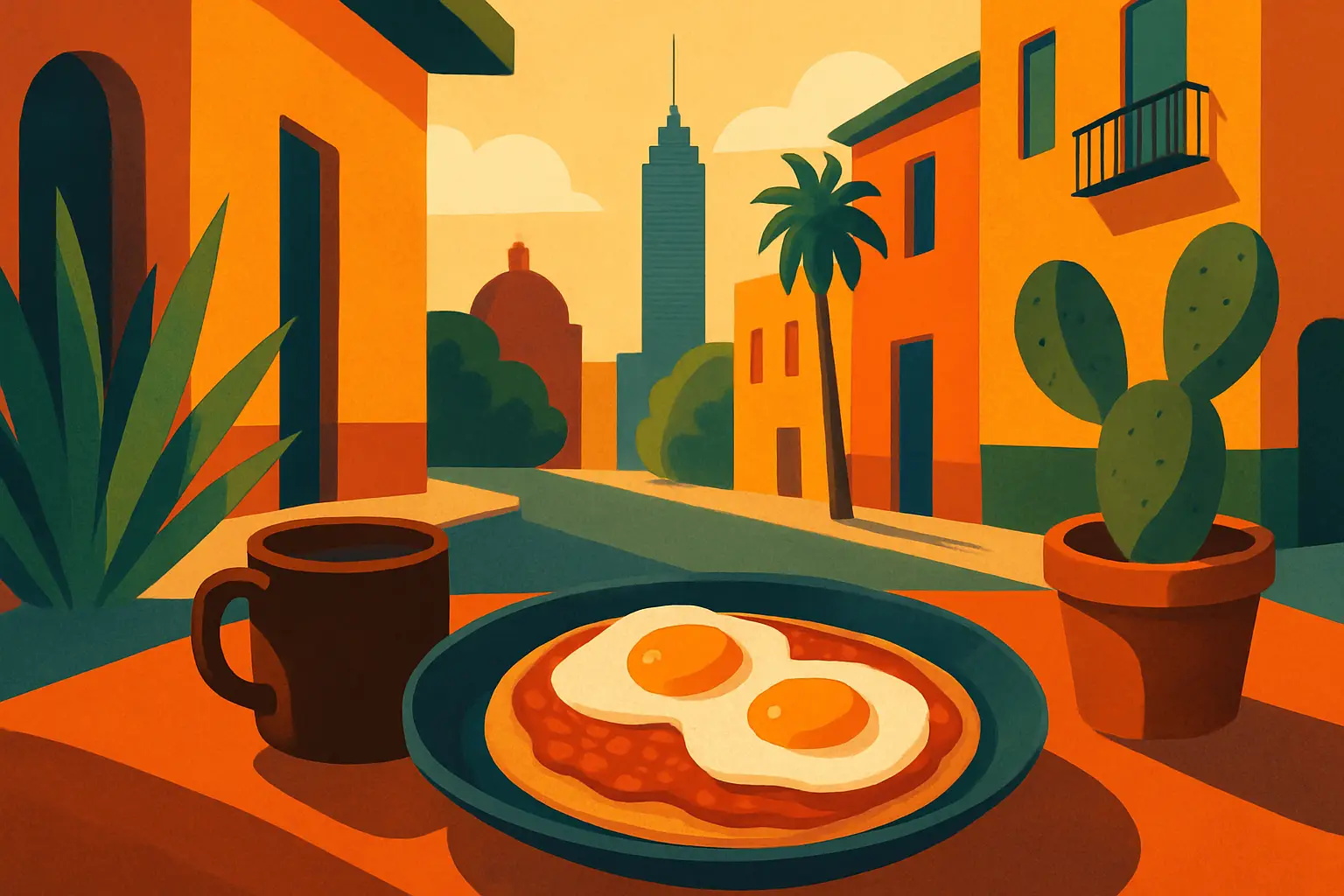
The dish is structurally simple: two fried eggs placed directly on top of corn tortillas that have been passed briefly through hot oil until warm and slightly firm, then covered in a salsa ranchera — a cooked sauce built from roasted tomatoes, dried or fresh chiles, garlic, and onion that has been simmered until the raw edges disappear and the flavors collapse into something deeper than fresh pico de gallo. Crema mexicana is drizzled on top. A side of refried black beans is nearly always included, either on the plate or in a small clay pot beside it.
The tortilla matters. In Mexico City, it is always corn — never flour. The brief oil treatment gives it enough structure to hold the egg and absorb the salsa without turning to mush: warm and pliable, somewhere between a fresh tortilla and a lightly crisped chip.
The salsa ranchera is always cooked. The tomatoes are fire-roasted or pan-charred before being blended with chiles, which adds a smokiness that raw blending cannot replicate. Most fondas make their salsa in batches early in the morning and hold it warm; at better restaurants it is made to order.
The word 'ranchero' means 'from the ranch,' and the dish traces back to the kitchens of Mexico's great haciendas and working cattle ranches, concentrated historically in Jalisco, Guanajuato, and Michoacan. Ranch hands needed a dense, hot breakfast before long days of labor — eggs from the property's hens, fresh tortillas from the comal, a quick cooked salsa from whatever tomatoes and chiles were available. The dish spread from those ranching regions into the cities over the 19th and 20th centuries, reaching Mexico City as people migrated toward the capital. By mid-century it was a standard entry on any traditional desayuno menu in the country.
It is emphatically a breakfast dish in Mexico — not something you find served at lunch or dinner except at dedicated all-day breakfast spots, which are uncommon.
The Tex-Mex version evolved separately, borrowing the name and the egg-and-salsa logic while substituting flour tortillas, using raw salsas, and scaling up portions in ways that would be unrecognizable to a cook from Jalisco. Both have their context. In Mexico City, you eat the original.
Get short, interactive stories that make each place easier to remember while you travel.
El Cardenal at Palma 23 in Centro Historico — a short walk from the Zocalo — has been the city's standard-bearer for traditional Mexican desayuno since 1969. The restaurant occupies several floors of a colonial building with tiled walls, heavy furniture, and bread baskets brought to the table immediately, filled with pan de yema, conchas, and teleras baked in the restaurant's own bakery.
Their huevos rancheros arrive on handmade corn tortillas with a dark salsa roja cooked slowly enough to lose any sharpness, alongside a clay pot of refried black beans and a tortilla basket refilled throughout the meal. The coffee — brewed in the cafe de olla style with cinnamon and piloncillo, served in clay cups — makes the argument for ordering the whole breakfast rather than eating quickly.
Plan at least 45 minutes. El Cardenal opens at 8 a.m. Tuesday through Sunday and fills quickly on weekend mornings; arriving by 9 a.m. on Saturday or Sunday usually means no wait. A second location operates in Polanco at Presidente Masaryk 360. The Templo Mayor is two blocks away — worth combining into the same morning.
For the daily, informal version — the one most chilangos eat most mornings — the answer is a market fonda.
A fonda is a small counter inside a public market with four to eight stools, a steam table of prepared dishes, and a short handwritten menu on a chalkboard. Mercado de Medellin at Campeche 101 in Roma Sur has a row of fonda counters along its back wall that start serving around 8 a.m.; huevos rancheros is almost always available. Mercado de San Juan near Centro and Mercado Jamaica in Colonia Jamaica operate similarly.
At a fonda, huevos rancheros with beans and coffee runs 70 to 90 pesos. The tortillas are usually made that morning, the salsa was on the stove before the market opened, and the beans were cooked fresh from dried. The presentation is not Instagram-worthy. The food is very good.
The main difference from the El Cardenal version: fondas often use fresh tortillas straight from the comal rather than the briefly oil-treated variety. This makes them more absorbent and softer. Both approaches are correct.
The salsa is where huevos rancheros succeeds or fails. A weak version — thin, barely cooked, tasting mostly of raw tomato — produces a dish that is just eggs with sauce. A well-made salsa ranchera produces something that is more than its parts.
The components: tomatoes (plum or roma, roasted on a dry comal or under a broiler until charred), chile (serrano for fresh heat, or dried chiles like ancho or guajillo for complexity), white onion, garlic, and sometimes a small amount of broth to loosen it for ladling. The charring is essential — it adds smokiness that raw blending cannot replicate. The mixture is blended roughly, not smooth, and simmered in a little lard or oil until it darkens and fat glistens on the surface. That shimmer is a reliable indicator that it was made properly.
At informal spots, asking 'es salsa hecha hoy?' confirms it was made that morning. At most fondas, this is a given. At tourist-facing restaurants, it sometimes is not.
Huevos rancheros in Mexico City almost never arrives alone. The standard accompaniments:
Frijoles refritos — refried black beans are the default in Mexico City (the north uses pinto beans; the capital uses black, which are earthier and denser). They arrive either on the plate alongside the eggs or in a small clay pot. Ask for them if they do not appear automatically: 'con frijoles, por favor.'
Crema mexicana — this is not sour cream, though they look similar. Crema is thinner, less acidic, and richer. It is used as a drizzle over the eggs and salsa rather than a dollop. If a place substitutes thick sour cream, the dish is not quite the same.
Tortillas de maiz — a basket of fresh corn tortillas is standard at any traditional spot. At El Cardenal, they come with every meal automatically. At fondas, ask for them separately if you want extras beyond what comes under the eggs.
Cafe de olla — the correct coffee for this meal is brewed in a clay pot with cinnamon and piloncillo. It arrives sweet and slightly spiced. The brunch guide covers cafe de olla in more detail; for now, order it alongside the eggs rather than asking for Americano first. The pairing with the salsa's heat and the eggs' richness is the morning in one sip.
Ordering huevos rancheros in Mexico City does not require more than a few phrases, but using them correctly signals that you are not reading from a tourist phrasebook.
The egg question: '¿Como quiere los huevos?' means 'How do you want the eggs?' The options relevant to huevos rancheros: estrellados means fried with the yolk intact and runny — this is the traditional version. Volteados means fried and flipped, yolk cooked but still a little soft (roughly over-easy). Bien cocidos means fully cooked through, no runny yolk.
For the full order: 'Huevos rancheros estrellados, con frijoles y cafe de olla, por favor.' That gets you the traditional version, beans, and the correct coffee.
At fondas, the person behind the counter will often ask the egg question automatically. At El Cardenal and similar restaurants, the server will specify the options. Either way, 'estrellados' is what most locals order and what the dish was designed around — the runny yolk breaks into the salsa and creates a sauce within a sauce that makes the last few forkfuls better than the first.
Tipping: at market fondas, leaving 10 pesos on a 70-peso plate is appropriate. At El Cardenal and comparable restaurants, 15% is standard. At street taco stands and market counters where you stand to eat, no tip is expected.
Desayuno in Mexico City runs from 8 a.m. to noon at fondas, and until around 12:30 p.m. at sit-down restaurants. After noon the kitchen shifts to comida and egg dishes largely disappear. Plan breakfast for 8-10 a.m. at fondas, or 9-11 a.m. for a sit-down version. Weekdays are calmer everywhere; weekend mornings at El Cardenal require arriving early or accepting a wait.
Cost: At market fondas: 60-90 pesos including beans and coffee. At El Cardenal: 150-250 pesos for the eggs alone; the full breakfast (bread, juice, cafe de olla, eggs) runs 280-380 pesos per person. At mid-range brunch spots in Roma Norte or Condesa: 130-180 pesos.
Best neighborhoods: Centro Historico for El Cardenal and nearby markets. Roma Sur for Mercado de Medellin. The markets guide covers where the city's best fondas operate if you want to explore further.