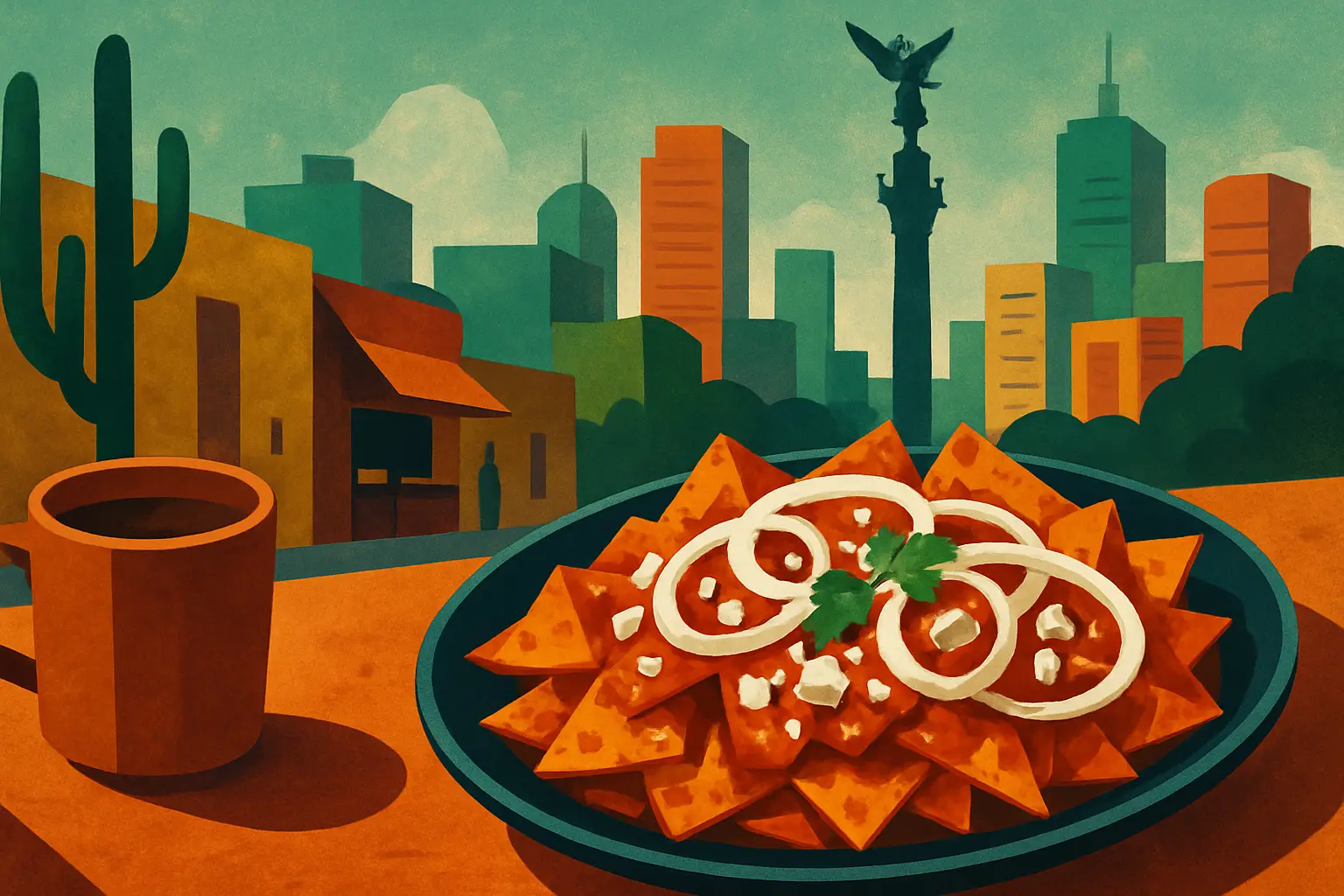
The word comes from Nahuatl: 'chīlāquilitl,' which translates loosely as 'chili-soaked things.' The dish has pre-Columbian roots — fried tortilla pieces simmered in chile broth predates the Spanish arrival, and the modern version is a direct descendant of that preparation. Totopos (fried or baked tortilla pieces) are dropped into a simmering salsa and left to absorb it. The key distinction from nachos is heat and time: chilaquiles are cooked in the sauce, not drizzled with it afterward. The totopos go soft in the middle while keeping a slight resistance at the edge, and the whole thing becomes one unified dish rather than a pile of individual chips. Standard toppings are crema (Mexican sour cream, thinner than American sour cream), queso fresco (crumbled fresh cheese), sliced white onion, and cilantro. Protein comes on the side or on top: pollo deshebrado (shredded chicken), huevo estrellado (fried egg), or huevo revuelto (scrambled egg) are the most common. In some neighborhoods you'll also find cecina (salted dried beef) or chorizo as an upgrade. The salsa is the soul of the dish — more on that next.
Totopos are simmered in hot salsa, not just topped with it — the cooking is the point
Standard toppings: crema, queso fresco, cebolla blanca, cilantro
Protein add-ons: pollo deshebrado, huevo estrellado, huevo revuelto, cecina, chorizo
Every chilaquiles order starts with the same question: rojos or verdes? Rojos use a red salsa built from dried chiles — ancho, guajillo, pasilla — giving the dish a deeper, smokier flavor with moderate heat. Verdes use fresh tomatillos, green chile, onion, and garlic, producing a brighter, more acidic sauce with a sharper finish. Neither is objectively better. Most CDMX locals will tell you that their mother's version, whichever color she made, is the correct one — which tells you everything about the personal nature of the debate. The third option is 'divorciados' — one half of the plate rojos, one half verdes, with a fried egg placed in the middle as a neutral zone. Divorciados is not a tourist invention; it is on the menu at serious fondas across the city and is the legitimate way to hedge. A fourth variation worth knowing: chilaquiles en mole negro, which appears at Oaxacan-influenced fondas in Doctores and around Centro. The mole version takes significantly longer to make and is not always available, but if you see it listed on a handwritten sign at a market fonda, order it immediately.
Rojos: dried chile salsa — smoky, deep, moderate heat
Verdes: fresh tomatillo salsa — bright, acidic, sharper finish
Divorciados: half and half on one plate, egg in the middle — a real order, not a tourist invention
Get short, interactive stories that make each place easier to remember while you travel.
El Cardenal opened in Centro Historico in 1969 under the Briz-Garizurieta family and has been the benchmark for traditional Mexican breakfast cooking in Mexico City ever since. The original location at Palma 23 — five minutes on foot from the Zocalo — occupies a colonial building with a French-Porfirian facade and stained-glass windows bearing the restaurant's namesake red cardinal bird. Before your food arrives, the kitchen sends a clay pot of hot chocolate or cafe de olla to the table with a basket of house-baked bread. This is not an appetizer you pay for; it is a signal that the kitchen takes breakfast seriously. The chilaquiles here come out with totopos that have absorbed the salsa almost completely — very soft, unified, finished with a crema that is not thin or watery. The tortillas are made in-house from corn the kitchen nixtamalizes daily. Order the verdes with pollo deshebrado on a weekday morning and arrive before 9 a.m. if you want a table without a wait — tourist traffic picks up sharply after that. The Presidente Masaryk 395 location in Polanco serves the same menu with more elbow room.
Palma 23, Centro Historico — 5 min walk from Metro Zocalo (Line 2)
Open since 1969; house-made tortillas from daily nixtamalized corn
Arrive before 9 a.m. on weekdays — tourist traffic peaks sharply after 10 a.m.
La Esquina del Chilaquil at Alfonso Reyes 139 in Hipodromo — the neighborhood immediately north of Condesa — is a street food stand, not a restaurant. A few folding tables, a counter, and a line that starts forming around 8 a.m. on weekends. The menu is deliberately short: chilaquiles, and the chilaquil torta. The torta version stuffs the entire dish — salsa-soaked totopos, crema, queso, protein — inside a bolillo roll, producing something that is structurally impractical and entirely correct. It is the most-photographed breakfast in Condesa for a reason. The salsa here is sharper and more chile-forward than El Cardenal's, which skews toward a cleaner salsa verde. La Esquina is the local-crowd version: loud, fast, standing or barely seated, over in twenty minutes. If you're staying in Roma Norte or Condesa, it is about a ten-minute walk. The line moves quickly on weekdays; on Saturday mornings it does not — arrive before 8:30 a.m. or expect to wait.
Alfonso Reyes 139, Hipodromo — 10 min walk from Roma Norte or Condesa
The chilaquil torta: the whole dish stuffed inside a bolillo roll — order it
Weekday mornings are fast; Saturday lines are long — arrive before 8:30 a.m.
The best chilaquiles in any Mexico City neighborhood are almost always at a fonda inside the local market, not at a sit-down restaurant. A fonda is a family-run lunch counter with 8–12 seats, a chalkboard menu that changes daily, and a cook who has been making the same salsa recipe for twenty years. Every market in Mexico City has at least two or three fondas serving chilaquiles from opening (usually 7 or 7:30 a.m.) until late morning. Mercado de Jamaica in Doctores has fondas where a full plate with egg costs about 60 pesos and the salsa is darker and more complex than anything you will find in a cafe. Mercado de la Merced — the largest market in Mexico City — has entire rows of breakfast fondas visible from the Anillo de Circunvalacion entrance. Mercado Medellin in Roma Sur, on Campeche between Medellin and Monterrey, has a handful of fondas with a local regulars crowd and an international market character that sets it apart. For the purest version of what most chilangos eat on a Tuesday morning, skip the famous spots and walk into your nearest market. Sit at the counter, order the chilaquiles verdes with egg, and pay 55–80 pesos.
Mercado de Jamaica (Doctores): strong salsa, full plate about 60 pesos
Mercado de la Merced: breakfast fonda rows visible from the Anillo de Circunvalacion entrance
Mercado Medellin (Roma Sur, on Campeche): local regulars crowd, good fondas
The most common mistake is arriving at 11:30 a.m. Chilaquiles are a breakfast dish that most fondas stop serving when they transition to the comida corrida around 11 or 11:30 a.m. — after that the kitchen has moved on and the answer will be 'ya no hay.' The second mistake is treating the protein as optional. A plate without added protein is technically fine, but chilaquiles with pollo deshebrado is a more complete dish and adds about 25–40 pesos to the cost. The third mistake is confusing chilaquiles with enchiladas. Enchiladas are tortillas rolled around a filling and sauced after assembly; chilaquiles are totopos cooked inside the sauce from the start, and the texture is completely different. When you sit down at a fonda, say 'buenos dias' before you order — it costs nothing and matters more than it sounds. Then: '¿Me puede dar unos chilaquiles verdes con pollo y huevo estrellado?' If you are not sure what style the cook makes, ask '¿Como los preparan?' — most cooks enjoy explaining their version, and the question signals you are paying attention.
Arrive before 11 a.m. — fondas stop serving chilaquiles when they shift to comida
Add pollo deshebrado or huevo estrellado — 25–40 pesos more, worth it
Say 'buenos dias' before ordering at a fonda — small gesture, real effect
The reputation is real and the reasoning is roughly sound. Traditional food wisdom in Mexico holds that the combination of salt (from the salsa and queso fresco), fat (crema and oil from the totopos), carbohydrates (the corn), and chile heat (which gets the metabolism moving) addresses the main symptoms of a difficult morning. Whether this is clinically precise is beside the point — the dish is genuinely restorative in a way that plain toast is not. The more interesting fact is that chilaquiles function as the universal post-anything breakfast: after a late night, after a long flight, after a hard week. In CDMX, the phrase 'nos vemos para chilaquiles' — see you for chilaquiles — is social shorthand for a morning-after gathering. It carries real weight. If a chilango invites you for chilaquiles the morning after a party, that is a relationship-deepening gesture, not just a meal suggestion. The cure reputation is not a recent brunch trend but a practice with centuries of use behind it.
Salt + fat + carbs + chile heat: the traditional morning-recovery formula
'Nos vemos para chilaquiles' is CDMX shorthand for a post-event morning gathering
The hangover association is old — it predates the brunch era by several centuries
Every neighborhood has them; the question is which style you are after. Centro Historico gives you the institution experience at El Cardenal and the densest concentration of market fondas in the city. Condesa and Hipodromo give you La Esquina del Chilaquil and the torta version, plus a handful of breakfast cafes at a slightly higher price point. Roma Sur has the best market-fonda version close to the tourist center — Mercado Medellin on Campeche is about 20 minutes on foot from Roma Norte. Coyoacan's Mercado Municipal on Abasolo has fonda breakfast counters that get busy by 8 a.m. on weekends and pair well with a morning walk to the zocalo. For the fastest route to a solid plate: take Metro Line 2 to Pino Suarez or Zocalo, walk toward Centro, find any market entrance, turn left at the fondas. You will be eating within ten minutes of leaving the Metro, for under 80 pesos, next to people who eat this same breakfast every single morning of their lives.